
154 countries
(and areas)
 - Belize
- Benin
- Bhutan
- Bolivia
- Bonaire
- Bosnia and Herzegovina
- Botswana
- Brazil
- British Virgin Islands
- Brunei
- Bulgaria
- Cambodia
- Canada
- Cape Verde
- Chile
- China
- Costa Rica
- Croatia
- Cuba
- Curacao
- Cyprus
- Czech Republic
- Denmark
- Dominica
- Dominican Republic
- Egypt
- El Salvador
- England
- Estonia
- Eswatini (Swaziland)
- Ethiopia
- Fiji
- Finland
- France
- French Guiana
- Georgia
- Germany
- Gibraltar
- Greece
- Grenada
- Guadeloupe
- Guatemala
- Honduras
- Hong Kong
- Hungary
- Iceland
- India
- Indonesia
- Iran
- Ireland
- Israel
- Italy
- Jamaica
- Japan
- Jordan
- Kazakhstan
- Kenya
- Kosovo
- Kuwait
- Kyrgyzstan
- Laos
- Latvia
- Lebanon
- Lesotho
- Liechtenstein
- Lithuania
- Luxembourg
- Macau
- Madagascar
- Malawi
- Malaysia
- Maldives
- Malta
- Martinique
- Mexico
- Moldova
- Monaco
- Mongolia
- Montenegro
- Morocco
- Mozambique
- Namibia
- Nepal
- Netherlands
- New Zealand
- Nicaragua
- North Macedonia
- Northern Ireland
- Norway
- Oman
- Pakistan
- Palestine
- Peru
- Philippines
- Poland
- Portugal
- Qatar
- Republic of Korea
- Romania
- Russia
- Saint Kitts and Nevis
- Saint Lucia
- Saint Martin
- Saint Vincent and the Grenadines
- San Marino
- São Tomé and Principe
- Saudi Arabia
- Scotland
- Senegal
- Serbia
- Singapore
- Sint Maarten
- Slovakia
- Slovenia
- South Africa
- Spain
- Sri Lanka
- Suriname
- Sweden
- Switzerland
- Tajikistan
- Tanzania
- Thailand
- The Gambia
- Tibet
- Togo
- Transnistria
- Trinidad and Tobago
- Tunisia
- Turkey
- Turkmenistan
- Uganda
- United Arab Emirates
- United States
- Uruguay
- Uzbekistan
- Vatican City
- Vietnam
- Wales
- Zambia
- Zanzibar
- Belize
- Benin
- Bhutan
- Bolivia
- Bonaire
- Bosnia and Herzegovina
- Botswana
- Brazil
- British Virgin Islands
- Brunei
- Bulgaria
- Cambodia
- Canada
- Cape Verde
- Chile
- China
- Costa Rica
- Croatia
- Cuba
- Curacao
- Cyprus
- Czech Republic
- Denmark
- Dominica
- Dominican Republic
- Egypt
- El Salvador
- England
- Estonia
- Eswatini (Swaziland)
- Ethiopia
- Fiji
- Finland
- France
- French Guiana
- Georgia
- Germany
- Gibraltar
- Greece
- Grenada
- Guadeloupe
- Guatemala
- Honduras
- Hong Kong
- Hungary
- Iceland
- India
- Indonesia
- Iran
- Ireland
- Israel
- Italy
- Jamaica
- Japan
- Jordan
- Kazakhstan
- Kenya
- Kosovo
- Kuwait
- Kyrgyzstan
- Laos
- Latvia
- Lebanon
- Lesotho
- Liechtenstein
- Lithuania
- Luxembourg
- Macau
- Madagascar
- Malawi
- Malaysia
- Maldives
- Malta
- Martinique
- Mexico
- Moldova
- Monaco
- Mongolia
- Montenegro
- Morocco
- Mozambique
- Namibia
- Nepal
- Netherlands
- New Zealand
- Nicaragua
- North Macedonia
- Northern Ireland
- Norway
- Oman
- Pakistan
- Palestine
- Peru
- Philippines
- Poland
- Portugal
- Qatar
- Republic of Korea
- Romania
- Russia
- Saint Kitts and Nevis
- Saint Lucia
- Saint Martin
- Saint Vincent and the Grenadines
- San Marino
- São Tomé and Principe
- Saudi Arabia
- Scotland
- Senegal
- Serbia
- Singapore
- Sint Maarten
- Slovakia
- Slovenia
- South Africa
- Spain
- Sri Lanka
- Suriname
- Sweden
- Switzerland
- Tajikistan
- Tanzania
- Thailand
- The Gambia
- Tibet
- Togo
- Transnistria
- Trinidad and Tobago
- Tunisia
- Turkey
- Turkmenistan
- Uganda
- United Arab Emirates
- United States
- Uruguay
- Uzbekistan
- Vatican City
- Vietnam
- Wales
- Zambia
- Zanzibar


Copyright 2004 - 2026
Veeronline.nl Travel Adventures

Home > Turkey > In the Footsteps of Marco Polo > Travelogue day 6
Travelogue In the Footsteps of Marco Polo
April 28 July 1 2012 (65 days)
Turkey > In dense fog on Nemrut Dagi mountain
Dag 6 - Thursday, May 3, 2012It rained heavily last night. Bedir, the local guide for the excursion to Nemrut Dagi, explains that due to the rainfall not all roads on the mountain are passable.

We will have to take a detour, and in particular, the statue of Hercules is probably unreachable. We leave Kahta. It is still fifty kilometers to Mount Nemrut. The sky is cloudy and threatening, but it is dry. My first stop is the Karakus Tumulus, an ancient burial mound from the time of King Antiochus and the Commagene kingdom. This kingdom existed briefly just before the turn of the era. Antiochus maintained his small kingdom by forming alliances with both the Romans to the west and the Persians to the east, giving him an ideal trade position. Ultimately, the kingdom did not last and Commagene was incorporated into the Roman Empire. Karakus Tumulus is an artificial mound of stones. Stones are stacked up to several tens of meters high. Allegedly, Antiochus’s wife, his mother, and his sisters are buried beneath the mound. Some remnants of pillars and depictions of lions surround the burial mound. A little further on, I pass the old Roman bridge from the second century. The bridge was used for traffic until recently; nowadays, a new connection spans the water.
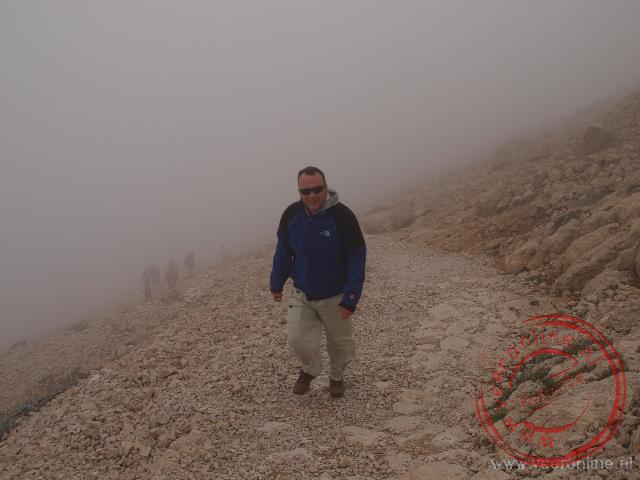
Bedir has inquired about the road conditions, and it seems that we can still reach the statue of Hercules. After the bridge, we turn left toward Arsameia, the ancient capital of the Commagene kingdom. A narrow, steep walking path leads to the old city. I steadily climb upward, and at the top of the hill, I stand in the ancient city of Arsameia. Not much has been preserved. Only the depiction of Mithridates shaking hands with the god Hercules is visible. Finally, we drive to Antiochus’s burial mound, about thirty kilometers away. Murat drives the bus along the winding mountain roads. The clouds grow increasingly close. At 2,000 meters elevation, I step out of the bus into the clouds. A strong, brisk wind blows across the parking area. I follow Bedir along the path to the top of the burial mound. It is a remarkable walk, with visibility of barely twenty meters. I shield my face from the wind. Ahead of me, I cannot see how far it still is. Behind me, my travel companions disappear as shadows in the mist. When I reach the top, I see the god statues emerge. There are about six life-sized depictions of Antiochus and various gods. Whenever the clouds thin briefly, I quickly take some photos. I am now on the east plateau. Behind the statues, I see the altars, where the statues originally stood. Presumably due to earthquakes, the statues have fallen. On the way to the west plateau, I walk over patches of snow. Bedir tells me that in winter, snow here can reach up to eight meters deep. I carefully shuffle to the other side. For a brief moment, I catch a glimpse through the clouds of the enormous mound of stones. I estimate the burial mound to be at least a hundred meters high, made of loose stones.

On the west plateau, more depictions of Antiochus stand surrounded by snow remnants. The mist on the mountain creates a striking scene. Because a harsh wind blows here as well, I quickly descend. At the small restaurant by the parking area, I order a tea. Then we drive back to Kahta for lunch. It is already three o’clock when we set off for Sanliurfa. We are considerably behind schedule. We skip the visit to the Atatürk Dam, though I do see the large reservoir to my left from the bus. Around half past five, we enter Sanliurfa. I take my luggage to my hotel room on the third floor and then follow the group into the town. Although Sanliurfa has half a million inhabitants, the old city center feels small and cozy. People greet me warmly from the stalls and kiosks, and sometimes they even ask to be photographed. When I photograph a vendor and show him the result, he insists on taking a new photo without his slippers. I capture him again with his proper shoes. In a courtyard at a restaurant, we eat. In the adjacent banquet hall, a wedding party is just beginning. All the guests gather here to eat and celebrate—fun to witness. After the meal, I take an evening walk. At the holy fish pond, the mosque’s lights reflect beautifully on the water, and I capture it in a photo. Back at the hotel, I hear music coming from behind the building. There is a performance by the Taksim Trio, a well-known Turkish ensemble. I buy a ticket and go inside. Everyone present is singing along enthusiastically.
 Turkmenistan
  The wide boulevards of Ashgabat
 Iran
Iran  The interior of the Jameh Mosque in Sanandaj
 The covered bazaar of Sanandaj
 The Sanandaj Museum is housed in an old traditional trading house
Travelogue In the Footsteps of Marco Polo
Dag 2 | Turkey > The mausoleum of Atatürk
Dag 3 | Turkey > On the way to Cappadocia
Dag 4 | Turkey > Balloon flight over the rock formations
Dag 5 | Turkey > Rain in Kahta
Dag 6 | Turkey > In dense fog on Nemrut Dagi mountain
Dag 7 | Turkey > Friday prayers in Sanliurfa
Dag 8 | Turkey > The Kurdish capital Diyarbakir
Dag 9 | Turkey > The consequences of the earthquake in Van
Dag 10 | Turkey > The island Akdamar in Lake Van
Dag 11 | Turkey > The Ishak Pasha Palace in Dogubayazit
Dag 12 | Iran > Crossing the border to Iran
Dag 13 | Iran > Visiting a cave dwelling
Dag 14 | Iran > The Throne of Solomon
Dag 15 | Iran > Kurdish food in the park
Dag 16 | Iran > An afternoon tour through Hamadan
Dag 17 | Iran > The mausoleum of Fatima in Qom
Dag 18 | Iran > On the roof of the bazaar of Kashan
Dag 19 | Iran > The red mountain village Abyaneh
Dag 20 | Iran > Wandering through Esfahan
Dag 21 | Iran > A whirlwind on the square
Dag 22 | Iran > The shrine of Sayyed Ahmad
Dag 23 | Iran > Local encounters in Shiraz
Dag 24 | Iran > The tomb of Cyrus in Pasargadae
Dag 25 | Iran > The desert city Yazd
Dag 26 | Iran > Helicopters in the desert
Dag 27 | Iran > The golden tomb of Imam Reza
Dag 28 | Iran > Back to the Holy Shrine
Dag 29 | Turkmenistan > Across the border to Turkmenistan
Dag 30 | Turkmenistan > Ashgabat: Unique and bizarre
Dag 31 | Turkmenistan > Long bus ride to Mary
Dag 32 | Turkmenistan > The UNESCO city of Merv
Dag 33 | Uzbekistan > Mosques and madrasas in Bukhara
Dag 34 | Uzbekistan > On the roof of the madrasa
Dag 35 | Uzbekistan > The old palace of Timur Lenk
Dag 36 | Uzbekistan > Registan Square in Samarkand
Dag 37 | Uzbekistan > Football match Uzbekistan - Iran
Dag 38 | Kazakhstan > Computer malfunction at the border
Dag 39 | Kazakhstan > Hiking in Aksu Djabagly Nature Park
Dag 40 | Kyrgyzstan > Ala-Too Square in Bishkek
Dag 41 | Kyrgyzstan > The waterfall in Ala Archa Nature Park
Dag 42 | Kyrgyzstan > Tamchi on Lake Issyk Kul
Dag 43 | Kyrgyzstan > The old wooden cathedral of Karakol
Dag 44 | Kyrgyzstan > Overnight in a yurt
Dag 45 | Kyrgyzstan > On horseback through the valley
Dag 46 | Kyrgyzstan > Through the mountains to Lake Sol Kul
Dag 47 | Kyrgyzstan > Rain and snow around Sol Kul
Dag 48 | Kyrgyzstan > Caravanserai of Tash Rabat
Dag 49 | China > The Torugart Pass into China
Dag 50 | China > Kashgar, the city of the Uyghurs
Dag 51 | China > Cows and goats for sale
Dag 52 | China > By train through the Taklamakan desert
Dag 53 | China > Death Valley of China
Dag 54 | China > Ruins of Jiaohe and Gaochang
Dag 55 | China > The sand dunes of Dunhuang
Dag 56 | China > The Buddhist Mogao Caves
Dag 57 | China > The fort of Jiayuguan
Dag 58 | China > Temple of the Eight Immortals
Dag 59 | China > The Terracotta Army of Xian
Dag 60 | China > Cycling on the Xian city wall
Dag 61 | China > The Forbidden City
Dag 62 | China > Rainy Temple of Heaven
Dag 63 | China > On the Great Wall of China
Dag 64 | China > Meeting the giant panda
Dag 65 | China > There is no bus