
154 countries
(and areas)
 - Belize
- Benin
- Bhutan
- Bolivia
- Bonaire
- Bosnia and Herzegovina
- Botswana
- Brazil
- British Virgin Islands
- Brunei
- Bulgaria
- Cambodia
- Canada
- Cape Verde
- Chile
- China
- Costa Rica
- Croatia
- Cuba
- Curacao
- Cyprus
- Czech Republic
- Denmark
- Dominica
- Dominican Republic
- Egypt
- El Salvador
- England
- Estonia
- Eswatini (Swaziland)
- Ethiopia
- Fiji
- Finland
- France
- French Guiana
- Georgia
- Germany
- Gibraltar
- Greece
- Grenada
- Guadeloupe
- Guatemala
- Honduras
- Hong Kong
- Hungary
- Iceland
- India
- Indonesia
- Iran
- Ireland
- Israel
- Italy
- Jamaica
- Japan
- Jordan
- Kazakhstan
- Kenya
- Kosovo
- Kuwait
- Kyrgyzstan
- Laos
- Latvia
- Lebanon
- Lesotho
- Liechtenstein
- Lithuania
- Luxembourg
- Macau
- Madagascar
- Malawi
- Malaysia
- Maldives
- Malta
- Martinique
- Mexico
- Moldova
- Monaco
- Mongolia
- Montenegro
- Morocco
- Mozambique
- Namibia
- Nepal
- Netherlands
- New Zealand
- Nicaragua
- North Macedonia
- Northern Ireland
- Norway
- Oman
- Pakistan
- Palestine
- Peru
- Philippines
- Poland
- Portugal
- Qatar
- Republic of Korea
- Romania
- Russia
- Saint Kitts and Nevis
- Saint Lucia
- Saint Martin
- Saint Vincent and the Grenadines
- San Marino
- São Tomé and Principe
- Saudi Arabia
- Scotland
- Senegal
- Serbia
- Singapore
- Sint Maarten
- Slovakia
- Slovenia
- South Africa
- Spain
- Sri Lanka
- Suriname
- Sweden
- Switzerland
- Tajikistan
- Tanzania
- Thailand
- The Gambia
- Tibet
- Togo
- Transnistria
- Trinidad and Tobago
- Tunisia
- Turkey
- Turkmenistan
- Uganda
- United Arab Emirates
- United States
- Uruguay
- Uzbekistan
- Vatican City
- Vietnam
- Wales
- Zambia
- Zanzibar
- Belize
- Benin
- Bhutan
- Bolivia
- Bonaire
- Bosnia and Herzegovina
- Botswana
- Brazil
- British Virgin Islands
- Brunei
- Bulgaria
- Cambodia
- Canada
- Cape Verde
- Chile
- China
- Costa Rica
- Croatia
- Cuba
- Curacao
- Cyprus
- Czech Republic
- Denmark
- Dominica
- Dominican Republic
- Egypt
- El Salvador
- England
- Estonia
- Eswatini (Swaziland)
- Ethiopia
- Fiji
- Finland
- France
- French Guiana
- Georgia
- Germany
- Gibraltar
- Greece
- Grenada
- Guadeloupe
- Guatemala
- Honduras
- Hong Kong
- Hungary
- Iceland
- India
- Indonesia
- Iran
- Ireland
- Israel
- Italy
- Jamaica
- Japan
- Jordan
- Kazakhstan
- Kenya
- Kosovo
- Kuwait
- Kyrgyzstan
- Laos
- Latvia
- Lebanon
- Lesotho
- Liechtenstein
- Lithuania
- Luxembourg
- Macau
- Madagascar
- Malawi
- Malaysia
- Maldives
- Malta
- Martinique
- Mexico
- Moldova
- Monaco
- Mongolia
- Montenegro
- Morocco
- Mozambique
- Namibia
- Nepal
- Netherlands
- New Zealand
- Nicaragua
- North Macedonia
- Northern Ireland
- Norway
- Oman
- Pakistan
- Palestine
- Peru
- Philippines
- Poland
- Portugal
- Qatar
- Republic of Korea
- Romania
- Russia
- Saint Kitts and Nevis
- Saint Lucia
- Saint Martin
- Saint Vincent and the Grenadines
- San Marino
- São Tomé and Principe
- Saudi Arabia
- Scotland
- Senegal
- Serbia
- Singapore
- Sint Maarten
- Slovakia
- Slovenia
- South Africa
- Spain
- Sri Lanka
- Suriname
- Sweden
- Switzerland
- Tajikistan
- Tanzania
- Thailand
- The Gambia
- Tibet
- Togo
- Transnistria
- Trinidad and Tobago
- Tunisia
- Turkey
- Turkmenistan
- Uganda
- United Arab Emirates
- United States
- Uruguay
- Uzbekistan
- Vatican City
- Vietnam
- Wales
- Zambia
- Zanzibar


Copyright 2004 - 2026
Veeronline.nl Travel Adventures
Home > China > In the Footsteps of Marco Polo > Travelogue day 61
Travelogue In the Footsteps of Marco Polo
April 28 July 1 2012 (65 days)
China > The Forbidden City
Dag 61 - Wednesday, June 27, 2012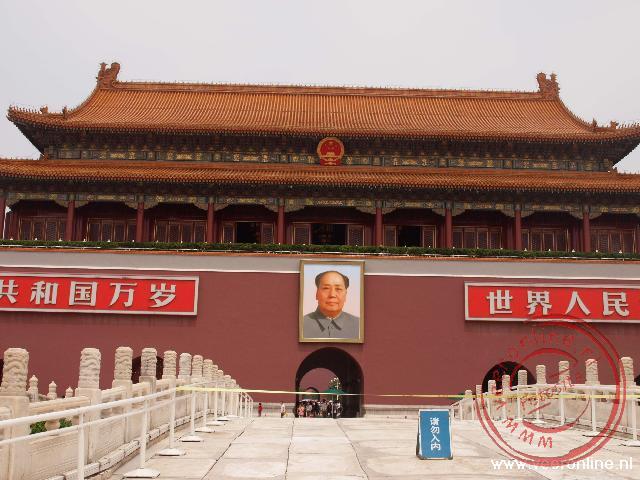
Tea is brought to the compartment. It’s half past six. The train is already running through the suburbs of Beijing. That’s not surprising, considering that the city of 20 million inhabitants is about the size of a quarter of the Netherlands. I get off at Beijing West Station. A bus takes me to the hotel. With the travel group, I take a walk through the city to get my bearings. Through the hutongs, the old working-class neighborhoods, I walk toward the vast Tiananmen Square. I’m struck by these narrow, old streets. They feel more like a village atmosphere than the center of a megacity. In the background, I see tall tower blocks and office buildings. I fear that these hutongs will soon have to make way for progress. The closer I get to Tiananmen Square, the more commercial the shops and restaurants become. As I exit the hutong, I see the Front Gate of Tiananmen Square, or the Square of Heavenly Peace, ahead. The gate provides access to the largest square in the world. Everything around the square seems tightly controlled. Pedestrians must use an underground tunnel to enter the square so traffic can flow uninterrupted. Fences line the sidewalks to prevent people from crossing the road. In the tunnel, there’s a thorough baggage check. I send my backpack through the scanner and walk onto the square. Facing me is Mao’s mausoleum, which prevents me from seeing the entire square. I join the line of people waiting to enter. Security here is also strict—bags and cameras are not allowed. The line moves past the glass coffin.

I see Mao lying inside. His body reminds me more of a wax figure than a human corpse. The pace is brisk; anyone who slows down is immediately urged forward. Before long, I am back outside on the square. Looking across, I see a large flagpole and Mao’s portrait on the wall of the Forbidden City—the iconic image. I cross the square diagonally toward the Forbidden City and enter the complex beneath Mao’s portrait. The Forbidden City was once home to the Ming dynasty emperors. Ordinary Chinese citizens were not allowed inside, which explains the name. Today the complex is open to all, and tourists in particular make eager use of this opportunity. I see the imperial throne in the Hall of Supreme Harmony, from which the emperor once addressed his court. I visit several ceremonial halls. Walking among the splendid buildings is an extraordinary experience. In the innermost part of the Forbidden City lived the emperor and his family.

I wander through various palaces and halls. After a few hours, I’ve had enough, though I haven’t seen all the structures—the place is simply too vast to take in. I exit through the rear gate. Behind the complex, I enter a park and climb the hill to the pavilion. From its terrace, I enjoy a beautiful view over the Forbidden City and retrace the path I took through it. I descend on the side path and cross the street into Beihai Park, one of the largest classical Chinese gardens. A large portion of the park is occupied by the northern lake. I watch young couples pedal-boating across the water. I climb up to the White Pagoda, the 40-meter-tall Bai Ta pagoda at the highest point of the park. Near the pagoda, I see signs pointing to the “ancient caves” and follow them. Inside the grotto, a network of stairs winds through chambers adorned with statues. The signage is in Chinese, and I’m not always sure which way to go. A Chinese couple laughs when they see my puzzled expression and points me in the right direction. Together, we find the exit. I walk back toward Tiananmen Square alongside the Forbidden City.

By now, the Forbidden City is closed, so I can’t pass through the gate with Mao’s portrait. The shortest way is straight through the park, but that requires a ticket. Not wanting to take a long detour, I buy a ticket for two yuan (about 25 cents). On the square, crowds are already waiting for the flag-lowering ceremony, still three-quarters of an hour away. I decide not to wait and instead return to the hotel through the hutongs. In one hutong, I spot a cozy restaurant. I sit on the outdoor terrace for dinner. I attract a lot of attention from passing Chinese tourists. More than once, people—sometimes openly, sometimes discreetly—take my picture.
 Turkmenistan
  The golden statue of Turkmenbashi in Ashgabat
 Iran
Iran  Men prepare for midday prayer in the Friday mosque
 Turkey
 The mudbrick construction of the bazaar in Kashan
Travelogue In the Footsteps of Marco Polo
Dag 2 | Turkey > The mausoleum of Atatürk
Dag 3 | Turkey > On the way to Cappadocia
Dag 4 | Turkey > Balloon flight over the rock formations
Dag 5 | Turkey > Rain in Kahta
Dag 6 | Turkey > In dense fog on Nemrut Dagi mountain
Dag 7 | Turkey > Friday prayers in Sanliurfa
Dag 8 | Turkey > The Kurdish capital Diyarbakir
Dag 9 | Turkey > The consequences of the earthquake in Van
Dag 10 | Turkey > The island Akdamar in Lake Van
Dag 11 | Turkey > The Ishak Pasha Palace in Dogubayazit
Dag 12 | Iran > Crossing the border to Iran
Dag 13 | Iran > Visiting a cave dwelling
Dag 14 | Iran > The Throne of Solomon
Dag 15 | Iran > Kurdish food in the park
Dag 16 | Iran > An afternoon tour through Hamadan
Dag 17 | Iran > The mausoleum of Fatima in Qom
Dag 18 | Iran > On the roof of the bazaar of Kashan
Dag 19 | Iran > The red mountain village Abyaneh
Dag 20 | Iran > Wandering through Esfahan
Dag 21 | Iran > A whirlwind on the square
Dag 22 | Iran > The shrine of Sayyed Ahmad
Dag 23 | Iran > Local encounters in Shiraz
Dag 24 | Iran > The tomb of Cyrus in Pasargadae
Dag 25 | Iran > The desert city Yazd
Dag 26 | Iran > Helicopters in the desert
Dag 27 | Iran > The golden tomb of Imam Reza
Dag 28 | Iran > Back to the Holy Shrine
Dag 29 | Turkmenistan > Across the border to Turkmenistan
Dag 30 | Turkmenistan > Ashgabat: Unique and bizarre
Dag 31 | Turkmenistan > Long bus ride to Mary
Dag 32 | Turkmenistan > The UNESCO city of Merv
Dag 33 | Uzbekistan > Mosques and madrasas in Bukhara
Dag 34 | Uzbekistan > On the roof of the madrasa
Dag 35 | Uzbekistan > The old palace of Timur Lenk
Dag 36 | Uzbekistan > Registan Square in Samarkand
Dag 37 | Uzbekistan > Football match Uzbekistan - Iran
Dag 38 | Kazakhstan > Computer malfunction at the border
Dag 39 | Kazakhstan > Hiking in Aksu Djabagly Nature Park
Dag 40 | Kyrgyzstan > Ala-Too Square in Bishkek
Dag 41 | Kyrgyzstan > The waterfall in Ala Archa Nature Park
Dag 42 | Kyrgyzstan > Tamchi on Lake Issyk Kul
Dag 43 | Kyrgyzstan > The old wooden cathedral of Karakol
Dag 44 | Kyrgyzstan > Overnight in a yurt
Dag 45 | Kyrgyzstan > On horseback through the valley
Dag 46 | Kyrgyzstan > Through the mountains to Lake Sol Kul
Dag 47 | Kyrgyzstan > Rain and snow around Sol Kul
Dag 48 | Kyrgyzstan > Caravanserai of Tash Rabat
Dag 49 | China > The Torugart Pass into China
Dag 50 | China > Kashgar, the city of the Uyghurs
Dag 51 | China > Cows and goats for sale
Dag 52 | China > By train through the Taklamakan desert
Dag 53 | China > Death Valley of China
Dag 54 | China > Ruins of Jiaohe and Gaochang
Dag 55 | China > The sand dunes of Dunhuang
Dag 56 | China > The Buddhist Mogao Caves
Dag 57 | China > The fort of Jiayuguan
Dag 58 | China > Temple of the Eight Immortals
Dag 59 | China > The Terracotta Army of Xian
Dag 60 | China > Cycling on the Xian city wall
Dag 61 | China > The Forbidden City
Dag 62 | China > Rainy Temple of Heaven
Dag 63 | China > On the Great Wall of China
Dag 64 | China > Meeting the giant panda
Dag 65 | China > There is no bus