
154 countries
(and areas)
 - Belize
- Benin
- Bhutan
- Bolivia
- Bonaire
- Bosnia and Herzegovina
- Botswana
- Brazil
- British Virgin Islands
- Brunei
- Bulgaria
- Cambodia
- Canada
- Cape Verde
- Chile
- China
- Costa Rica
- Croatia
- Cuba
- Curacao
- Cyprus
- Czech Republic
- Denmark
- Dominica
- Dominican Republic
- Egypt
- El Salvador
- England
- Estonia
- Eswatini (Swaziland)
- Ethiopia
- Fiji
- Finland
- France
- French Guiana
- Georgia
- Germany
- Gibraltar
- Greece
- Grenada
- Guadeloupe
- Guatemala
- Honduras
- Hong Kong
- Hungary
- Iceland
- India
- Indonesia
- Iran
- Ireland
- Israel
- Italy
- Jamaica
- Japan
- Jordan
- Kazakhstan
- Kenya
- Kosovo
- Kuwait
- Kyrgyzstan
- Laos
- Latvia
- Lebanon
- Lesotho
- Liechtenstein
- Lithuania
- Luxembourg
- Macau
- Madagascar
- Malawi
- Malaysia
- Maldives
- Malta
- Martinique
- Mexico
- Moldova
- Monaco
- Mongolia
- Montenegro
- Morocco
- Mozambique
- Namibia
- Nepal
- Netherlands
- New Zealand
- Nicaragua
- North Macedonia
- Northern Ireland
- Norway
- Oman
- Pakistan
- Palestine
- Peru
- Philippines
- Poland
- Portugal
- Qatar
- Republic of Korea
- Romania
- Russia
- Saint Kitts and Nevis
- Saint Lucia
- Saint Martin
- Saint Vincent and the Grenadines
- San Marino
- São Tomé and Principe
- Saudi Arabia
- Scotland
- Senegal
- Serbia
- Singapore
- Sint Maarten
- Slovakia
- Slovenia
- South Africa
- Spain
- Sri Lanka
- Suriname
- Sweden
- Switzerland
- Tajikistan
- Tanzania
- Thailand
- The Gambia
- Tibet
- Togo
- Transnistria
- Trinidad and Tobago
- Tunisia
- Turkey
- Turkmenistan
- Uganda
- United Arab Emirates
- United States
- Uruguay
- Uzbekistan
- Vatican City
- Vietnam
- Wales
- Zambia
- Zanzibar
- Belize
- Benin
- Bhutan
- Bolivia
- Bonaire
- Bosnia and Herzegovina
- Botswana
- Brazil
- British Virgin Islands
- Brunei
- Bulgaria
- Cambodia
- Canada
- Cape Verde
- Chile
- China
- Costa Rica
- Croatia
- Cuba
- Curacao
- Cyprus
- Czech Republic
- Denmark
- Dominica
- Dominican Republic
- Egypt
- El Salvador
- England
- Estonia
- Eswatini (Swaziland)
- Ethiopia
- Fiji
- Finland
- France
- French Guiana
- Georgia
- Germany
- Gibraltar
- Greece
- Grenada
- Guadeloupe
- Guatemala
- Honduras
- Hong Kong
- Hungary
- Iceland
- India
- Indonesia
- Iran
- Ireland
- Israel
- Italy
- Jamaica
- Japan
- Jordan
- Kazakhstan
- Kenya
- Kosovo
- Kuwait
- Kyrgyzstan
- Laos
- Latvia
- Lebanon
- Lesotho
- Liechtenstein
- Lithuania
- Luxembourg
- Macau
- Madagascar
- Malawi
- Malaysia
- Maldives
- Malta
- Martinique
- Mexico
- Moldova
- Monaco
- Mongolia
- Montenegro
- Morocco
- Mozambique
- Namibia
- Nepal
- Netherlands
- New Zealand
- Nicaragua
- North Macedonia
- Northern Ireland
- Norway
- Oman
- Pakistan
- Palestine
- Peru
- Philippines
- Poland
- Portugal
- Qatar
- Republic of Korea
- Romania
- Russia
- Saint Kitts and Nevis
- Saint Lucia
- Saint Martin
- Saint Vincent and the Grenadines
- San Marino
- São Tomé and Principe
- Saudi Arabia
- Scotland
- Senegal
- Serbia
- Singapore
- Sint Maarten
- Slovakia
- Slovenia
- South Africa
- Spain
- Sri Lanka
- Suriname
- Sweden
- Switzerland
- Tajikistan
- Tanzania
- Thailand
- The Gambia
- Tibet
- Togo
- Transnistria
- Trinidad and Tobago
- Tunisia
- Turkey
- Turkmenistan
- Uganda
- United Arab Emirates
- United States
- Uruguay
- Uzbekistan
- Vatican City
- Vietnam
- Wales
- Zambia
- Zanzibar


Copyright 2004 - 2026
Veeronline.nl Travel Adventures

Home > Iran > In the Footsteps of Marco Polo > Travelogue day 20
Travelogue In the Footsteps of Marco Polo
April 28 July 1 2012 (65 days)
Iran > Wandering through Esfahan
Dag 20 - Thursday, May 17, 2012Esfahan is a wonderful city to wander through. The palaces, the mosques, the bustling bazaar, and of course the friendly Esfahanis. I walk towards the central Imam Square. It is still early and there is little activity. The grand Imam Mosque is just opening its doors. As one of the first visitors of the day, I walk under the imposing gateway. I enter the large courtyard and head towards the southern iwan with its minarets.

Under the dome, there is a perfect echo. I stand directly beneath the beautifully decorated dome and clap my hands loudly. I hear the echo several times. Diagonal to the mosque stands the Ali Qapu Palace. This 16th-century building holds a dominant position on Imam Square. I go inside and climb the stairs to the terrace on the third floor. From there I have a panoramic view over the entire square and the Imam Mosque. The old wooden ceiling and pillars on the terrace are under restoration, so unfortunately, the music hall at the very top is closed. The throne room is accessible, however, and I admire the frescoes in this beautiful hall. I continue to the Chehel Sotoun Palace, the Palace of Forty Columns. It takes me several tries to find the garden entrance. The main gate is closed, and the side entrance is hidden behind a promotional fair for volunteers. From the garden, I photograph the palace reflected in the water. Thanks to this reflection, the palace got its name: the twenty columns doubled in the water, making it the Forty Columns Palace.

Today happens to be museum day in Esfahan, so admission is free everywhere—but also very crowded. Inside, the palace is lavishly decorated with frescoes from the era of Shah Abbas I, depicting battles with Turkmens and Uzbeks. After visiting the palace, I continue towards the covered bazaar. From there I turn towards the Hakim Mosque, the oldest mosque in the city, with its remarkable brick entrance gate. I carry a leaflet showing a rooftop view. I ask a group of men where I can take this photo. “No, no, closed,” they reply. Another man sees possibilities, and after a small discussion (and a small tip), the caretaker reluctantly agrees to take me up. We slip through a small door and climb a narrow staircase. Soon I am standing on the mosque’s roof, overlooking Esfahan. Back in the bazaar, its long, shaded corridors provide coolness in the summer heat. I peek into a madrasa, where a mullah is teaching students. At a small stall, an old man gestures me to follow him. He makes me sit in a freight elevator, warns me about the greasy chain, and pushes a button. Upstairs, a weaving machine produces silk. It amazes me that such a machine fits behind a tiny stall. Proudly, the man shows me his apparatus, and I photograph him beside it. Later, I enter a teahouse: a plain room with fluorescent lighting and tiled walls. Despite the stark setting, it is full of men, most smoking water pipes.

Before I can order a non-alcoholic beer, I am asked to photograph the boy in the kitchen. While drinking, everyone stares at me, but I return their gazes with a friendly nod. I doubt many foreigners come here. I continue through the bazaar until I reach the Jameh Mosque, the Friday Mosque, the largest and most important in Esfahan. Since I will visit it tomorrow with a guide, I only take a quick look at the courtyard, where carpets for noon prayers are already spread out. I exit and walk parallel to the bazaar back toward the square. After visiting two more mosques, I find a small restaurant. I point at a dish on the neighboring table and am soon served abgusht. A young man explains how to break bread into the soup and wrap the meat-and-vegetable stew in pieces of bread. It tastes surprisingly good and satisfies my appetite after so much walking. Back at Imam Square, the crowds have grown. Local tourists ride in horse-drawn carriages around the square. I cross over to the Sheikh Lotfollah Mosque, a small mosque without a courtyard, yet with a magnificent decorated dome.

Dazzled, I leave again and head towards the luxurious Abbasi Hotel. In its lush courtyard, I sink into a chair and order tea with local sweets. I fear a high price, but it is reasonable. At dusk, I follow the Iranians to the historic bridges across the Zayandeh River. On the way, I am approached by Sahi, a young technical teacher. We chat as we stroll across the Si-o-Se Bridge, dating from 1602 with its 33 arches. Together we walk through the riverside park, where families picnic on the grass. Sahi is surprised that everyone greets me, but I have grown used to it. Further downstream, at the Khaju Bridge, the lights just switch on. Groups of men sing under the arches, while youths perch above the water. I take evening photos before sharing a taxi back with Sahi. He gets out halfway, and I promise to send him the pictures. Back at the square, I dine at a traditional restaurant, ordering fesenjan: a delicious mix of pomegranate, walnut, meat, and rice.
 Kyrgyzstan
  The sharp hairpin bends of the mountain pass
 The yurt camp at Song Kul Lake
 The boy of the family lights the wood stove in the tent
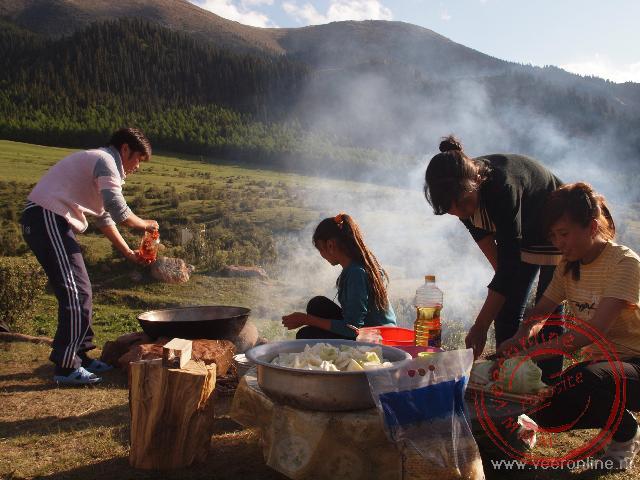 Cooking over a wood fire next to the yurt
Travelogue In the Footsteps of Marco Polo
Dag 2 | Turkey > The mausoleum of Atatürk
Dag 3 | Turkey > On the way to Cappadocia
Dag 4 | Turkey > Balloon flight over the rock formations
Dag 5 | Turkey > Rain in Kahta
Dag 6 | Turkey > In dense fog on Nemrut Dagi mountain
Dag 7 | Turkey > Friday prayers in Sanliurfa
Dag 8 | Turkey > The Kurdish capital Diyarbakir
Dag 9 | Turkey > The consequences of the earthquake in Van
Dag 10 | Turkey > The island Akdamar in Lake Van
Dag 11 | Turkey > The Ishak Pasha Palace in Dogubayazit
Dag 12 | Iran > Crossing the border to Iran
Dag 13 | Iran > Visiting a cave dwelling
Dag 14 | Iran > The Throne of Solomon
Dag 15 | Iran > Kurdish food in the park
Dag 16 | Iran > An afternoon tour through Hamadan
Dag 17 | Iran > The mausoleum of Fatima in Qom
Dag 18 | Iran > On the roof of the bazaar of Kashan
Dag 19 | Iran > The red mountain village Abyaneh
Dag 20 | Iran > Wandering through Esfahan
Dag 21 | Iran > A whirlwind on the square
Dag 22 | Iran > The shrine of Sayyed Ahmad
Dag 23 | Iran > Local encounters in Shiraz
Dag 24 | Iran > The tomb of Cyrus in Pasargadae
Dag 25 | Iran > The desert city Yazd
Dag 26 | Iran > Helicopters in the desert
Dag 27 | Iran > The golden tomb of Imam Reza
Dag 28 | Iran > Back to the Holy Shrine
Dag 29 | Turkmenistan > Across the border to Turkmenistan
Dag 30 | Turkmenistan > Ashgabat: Unique and bizarre
Dag 31 | Turkmenistan > Long bus ride to Mary
Dag 32 | Turkmenistan > The UNESCO city of Merv
Dag 33 | Uzbekistan > Mosques and madrasas in Bukhara
Dag 34 | Uzbekistan > On the roof of the madrasa
Dag 35 | Uzbekistan > The old palace of Timur Lenk
Dag 36 | Uzbekistan > Registan Square in Samarkand
Dag 37 | Uzbekistan > Football match Uzbekistan - Iran
Dag 38 | Kazakhstan > Computer malfunction at the border
Dag 39 | Kazakhstan > Hiking in Aksu Djabagly Nature Park
Dag 40 | Kyrgyzstan > Ala-Too Square in Bishkek
Dag 41 | Kyrgyzstan > The waterfall in Ala Archa Nature Park
Dag 42 | Kyrgyzstan > Tamchi on Lake Issyk Kul
Dag 43 | Kyrgyzstan > The old wooden cathedral of Karakol
Dag 44 | Kyrgyzstan > Overnight in a yurt
Dag 45 | Kyrgyzstan > On horseback through the valley
Dag 46 | Kyrgyzstan > Through the mountains to Lake Sol Kul
Dag 47 | Kyrgyzstan > Rain and snow around Sol Kul
Dag 48 | Kyrgyzstan > Caravanserai of Tash Rabat
Dag 49 | China > The Torugart Pass into China
Dag 50 | China > Kashgar, the city of the Uyghurs
Dag 51 | China > Cows and goats for sale
Dag 52 | China > By train through the Taklamakan desert
Dag 53 | China > Death Valley of China
Dag 54 | China > Ruins of Jiaohe and Gaochang
Dag 55 | China > The sand dunes of Dunhuang
Dag 56 | China > The Buddhist Mogao Caves
Dag 57 | China > The fort of Jiayuguan
Dag 58 | China > Temple of the Eight Immortals
Dag 59 | China > The Terracotta Army of Xian
Dag 60 | China > Cycling on the Xian city wall
Dag 61 | China > The Forbidden City
Dag 62 | China > Rainy Temple of Heaven
Dag 63 | China > On the Great Wall of China
Dag 64 | China > Meeting the giant panda
Dag 65 | China > There is no bus