
153 countries
(and areas)
 - Andorra
- Antigua and Barbuda
- Argentina
- Armenia
- Aruba
- Australia
- Austria
- Azerbaijan
- Bahrain
- Barbados
- Belgium
- Belize
- Benin
- Bhutan
- Bolivia
- Bonaire
- Bosnia and Herzegovina
- Botswana
- Brazil
- British Virgin Islands
- Brunei
- Bulgaria
- Cambodia
- Canada
- Cape Verde
- Chile
- China
- Costa Rica
- Croatia
- Cuba
- Curacao
- Cyprus
- Czech Republic
- Denmark
- Dominica
- Dominican Republic
- Egypt
- El Salvador
- England
- Estonia
- Eswatini (Swaziland)
- Ethiopia
- Fiji
- Finland
- France
- French Guiana
- Georgia
- Germany
- Gibraltar
- Greece
- Grenada
- Guadeloupe
- Guatemala
- Honduras
- Hong Kong
- Hungary
- Iceland
- India
- Indonesia
- Iran
- Ireland
- Israel
- Italy
- Jamaica
- Japan
- Jordan
- Kazakhstan
- Kenya
- Kosovo
- Kuwait
- Kyrgyzstan
- Laos
- Latvia
- Lebanon
- Lesotho
- Liechtenstein
- Lithuania
- Luxembourg
- Macau
- Madagascar
- Malawi
- Malaysia
- Maldives
- Malta
- Martinique
- Mexico
- Moldova
- Monaco
- Mongolia
- Montenegro
- Morocco
- Mozambique
- Namibia
- Nepal
- Netherlands
- New Zealand
- Nicaragua
- North Macedonia
- Northern Ireland
- Norway
- Oman
- Pakistan
- Palestine
- Peru
- Philippines
- Poland
- Portugal
- Qatar
- Republic of Korea
- Romania
- Russia
- Saint Kitts and Nevis
- Saint Lucia
- Saint Martin
- Saint Vincent and the Grenadines
- San Marino
- Saudi Arabia
- Scotland
- Senegal
- Serbia
- Singapore
- Sint Maarten
- Slovakia
- Slovenia
- South Africa
- Spain
- Sri Lanka
- Suriname
- Sweden
- Switzerland
- Tajikistan
- Tanzania
- Thailand
- The Gambia
- Tibet
- Togo
- Transnistria
- Trinidad and Tobago
- Tunisia
- Turkey
- Turkmenistan
- Uganda
- United Arab Emirates
- United States
- Uruguay
- Uzbekistan
- Vatican City
- Vietnam
- Wales
- Zambia
- Zanzibar
- Andorra
- Antigua and Barbuda
- Argentina
- Armenia
- Aruba
- Australia
- Austria
- Azerbaijan
- Bahrain
- Barbados
- Belgium
- Belize
- Benin
- Bhutan
- Bolivia
- Bonaire
- Bosnia and Herzegovina
- Botswana
- Brazil
- British Virgin Islands
- Brunei
- Bulgaria
- Cambodia
- Canada
- Cape Verde
- Chile
- China
- Costa Rica
- Croatia
- Cuba
- Curacao
- Cyprus
- Czech Republic
- Denmark
- Dominica
- Dominican Republic
- Egypt
- El Salvador
- England
- Estonia
- Eswatini (Swaziland)
- Ethiopia
- Fiji
- Finland
- France
- French Guiana
- Georgia
- Germany
- Gibraltar
- Greece
- Grenada
- Guadeloupe
- Guatemala
- Honduras
- Hong Kong
- Hungary
- Iceland
- India
- Indonesia
- Iran
- Ireland
- Israel
- Italy
- Jamaica
- Japan
- Jordan
- Kazakhstan
- Kenya
- Kosovo
- Kuwait
- Kyrgyzstan
- Laos
- Latvia
- Lebanon
- Lesotho
- Liechtenstein
- Lithuania
- Luxembourg
- Macau
- Madagascar
- Malawi
- Malaysia
- Maldives
- Malta
- Martinique
- Mexico
- Moldova
- Monaco
- Mongolia
- Montenegro
- Morocco
- Mozambique
- Namibia
- Nepal
- Netherlands
- New Zealand
- Nicaragua
- North Macedonia
- Northern Ireland
- Norway
- Oman
- Pakistan
- Palestine
- Peru
- Philippines
- Poland
- Portugal
- Qatar
- Republic of Korea
- Romania
- Russia
- Saint Kitts and Nevis
- Saint Lucia
- Saint Martin
- Saint Vincent and the Grenadines
- San Marino
- Saudi Arabia
- Scotland
- Senegal
- Serbia
- Singapore
- Sint Maarten
- Slovakia
- Slovenia
- South Africa
- Spain
- Sri Lanka
- Suriname
- Sweden
- Switzerland
- Tajikistan
- Tanzania
- Thailand
- The Gambia
- Tibet
- Togo
- Transnistria
- Trinidad and Tobago
- Tunisia
- Turkey
- Turkmenistan
- Uganda
- United Arab Emirates
- United States
- Uruguay
- Uzbekistan
- Vatican City
- Vietnam
- Wales
- Zambia
- Zanzibar


Copyright 2004 - 2026
Veeronline.nl Travel Adventures
Home > Turkmenistan > In the Footsteps of Marco Polo > Travelogue day 32
Travelogue In the Footsteps of Marco Polo
April 28 July 1 2012 (65 days)
Turkmenistan > The UNESCO city of Merv
Dag 32 - Tuesday, May 29, 2012It’s barely six o’clock in the morning when I’m already on the bus. Bachtiar is our guide today, taking over for Maksat. He is a cheerful man, but unfortunately he speaks German, which isn’t my preferred language. Today, I’m heading to Uzbekistan. I’ve brought a small breakfast package to eat later. Before going to Uzbekistan, I first visit the archaeological site of Merv. The remnants of this ancient trading city are especially beautiful in the morning light.
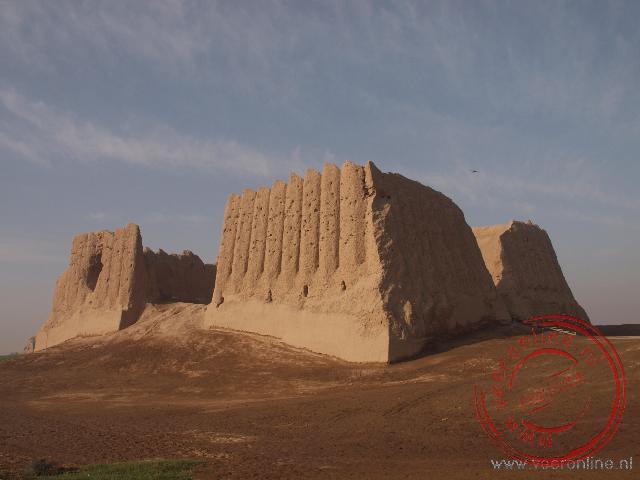
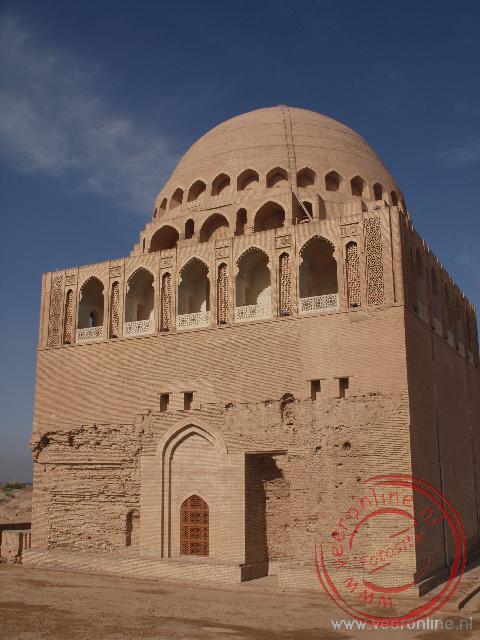
The city once flourished centuries ago until it was completely destroyed by the Mongols in the 12th century, with hundreds of thousands of people losing their lives. At the ruins of the women’s fortress, the ingenious construction is still visible. The tall mud walls stand proudly to this day. The Islamic mausoleum of Askhabs al-Hakam and Buraydah al-Husayn demonstrates that multiple religions could coexist in Merv. Jews, Christians, Buddhists, and Muslims all lived within the city walls. From the oldest hill of Merv, I have a view of the entire complex. I see the old city walls, the oldest parts of which date back to the sixth century. I conclude my visit to Merv with a trip to the Seljuk mausoleum. The square building with a round dome rises prominently above the surroundings. It is the only structure that has been fully restored, giving it a strange presence in an otherwise barren landscape. I continue my journey to Turkmenabat, the second-largest city in Turkmenistan. It’s several hours of driving through the desert. High sand dunes line the road on both sides. The wind slowly moves the dunes, some of which have come quite close to the road. I notice a greenish hue on the dunes from sparse vegetation. Bachtiar tells me that all of this will be dried up within two weeks—the vegetation has no chance in the summer heat. The road on this route is much better than yesterday’s, though still not entirely free of potholes. Around one o’clock, we enter Turkmenabat.
Before we can have lunch, there is an administrative matter to take care of. Every visitor to Turkmenistan must register within three days. Normally, the hotel handles this, but in Ashgabat, this didn’t happen—or they weren’t interested. Without registration, you cannot leave the country. At a luxury hotel, there is a registration office. In exchange for my two passport photos, I receive a registration stamp in my passport. After lunch, I leave Turkmenabat and drive toward the border with Uzbekistan. It’s well past three o’clock when I arrive. Without too much trouble and without a baggage check, I pass the Turkmenistan border post. Outside, a small van is ready to take me across no-man’s land for one dollar. When I’m dropped off several hundred meters later at a gate, I realize that I must still walk from this gate to the Uzbek border post. I estimate the distance at about one kilometer. There’s no choice but to walk with my luggage under the blazing sun. I am relieved to finally enter the shade of the Uzbek customs office. Immediately, a device is pressed to my forehead. Laughing, the officer says I’m healthy, showing a reading of 35 degrees Celsius. I doubt whether the device measures correctly but continue. I’m given a Russian form to fill out. Where do I start? A customs officer helps me with the translation, and together we manage. Soon, I have my stamp quickly placed in my passport. But I’m not done yet.

In the last building, about a hundred meters further, the stamp in my passport is checked, and my baggage is scanned. Only now am I officially in Uzbekistan. Jonas is already waiting for us with his bus. He looks a bit concerned about the bus’s luggage space when he sees all the travel bags—thirteen in total. Eventually, with four bags in the back row, we drive the last hundred kilometers to Bukhara. By the time I enter the city at seven in the evening, I am quite exhausted. I’ve been active since six o’clock this morning. My hotel is nicely located near Lyabi Hauz Square. I immediately notice how touristy Bukhara is. In Eastern Turkey and Iran, I’ve hardly seen other tourists so far. There are plenty of terraces and shops. A boy shows me his euro collection; he already has the smaller coins and wants to complete it. A creative way to make money. I thank him. I also need to exchange money myself, which results in three hundred bills of 1,000 som each. The 1,000-som note is the largest denomination, but it’s only worth about 40 euro cents. Large amounts are handled in bundles of 100 notes. In the evening, I eat near the hotel on the terrace at Lyabi Hauz Square by the pond. The atmosphere is cozy and relaxed. I think I’m going to enjoy my time in Bukhara.
 China
China  The Buddha statue in the Lama Temple in Beijing
 The large hall of the Terracotta Army in Xian
 Just outside the centre of Kashgar the livestock market is held
Travelogue In the Footsteps of Marco Polo
Dag 2 | Turkey > The mausoleum of Atatürk
Dag 3 | Turkey > On the way to Cappadocia
Dag 4 | Turkey > Balloon flight over the rock formations
Dag 5 | Turkey > Rain in Kahta
Dag 6 | Turkey > In dense fog on Nemrut Dagi mountain
Dag 7 | Turkey > Friday prayers in Sanliurfa
Dag 8 | Turkey > The Kurdish capital Diyarbakir
Dag 9 | Turkey > The consequences of the earthquake in Van
Dag 10 | Turkey > The island Akdamar in Lake Van
Dag 11 | Turkey > The Ishak Pasha Palace in Dogubayazit
Dag 12 | Iran > Crossing the border to Iran
Dag 13 | Iran > Visiting a cave dwelling
Dag 14 | Iran > The Throne of Solomon
Dag 15 | Iran > Kurdish food in the park
Dag 16 | Iran > An afternoon tour through Hamadan
Dag 17 | Iran > The mausoleum of Fatima in Qom
Dag 18 | Iran > On the roof of the bazaar of Kashan
Dag 19 | Iran > The red mountain village Abyaneh
Dag 20 | Iran > Wandering through Esfahan
Dag 21 | Iran > A whirlwind on the square
Dag 22 | Iran > The shrine of Sayyed Ahmad
Dag 23 | Iran > Local encounters in Shiraz
Dag 24 | Iran > The tomb of Cyrus in Pasargadae
Dag 25 | Iran > The desert city Yazd
Dag 26 | Iran > Helicopters in the desert
Dag 27 | Iran > The golden tomb of Imam Reza
Dag 28 | Iran > Back to the Holy Shrine
Dag 29 | Turkmenistan > Across the border to Turkmenistan
Dag 30 | Turkmenistan > Ashgabat: Unique and bizarre
Dag 31 | Turkmenistan > Long bus ride to Mary
Dag 32 | Turkmenistan > The UNESCO city of Merv
Dag 33 | Uzbekistan > Mosques and madrasas in Bukhara
Dag 34 | Uzbekistan > On the roof of the madrasa
Dag 35 | Uzbekistan > The old palace of Timur Lenk
Dag 36 | Uzbekistan > Registan Square in Samarkand
Dag 37 | Uzbekistan > Football match Uzbekistan - Iran
Dag 38 | Kazakhstan > Computer malfunction at the border
Dag 39 | Kazakhstan > Hiking in Aksu Djabagly Nature Park
Dag 40 | Kyrgyzstan > Ala-Too Square in Bishkek
Dag 41 | Kyrgyzstan > The waterfall in Ala Archa Nature Park
Dag 42 | Kyrgyzstan > Tamchi on Lake Issyk Kul
Dag 43 | Kyrgyzstan > The old wooden cathedral of Karakol
Dag 44 | Kyrgyzstan > Overnight in a yurt
Dag 45 | Kyrgyzstan > On horseback through the valley
Dag 46 | Kyrgyzstan > Through the mountains to Lake Sol Kul
Dag 47 | Kyrgyzstan > Rain and snow around Sol Kul
Dag 48 | Kyrgyzstan > Caravanserai of Tash Rabat
Dag 49 | China > The Torugart Pass into China
Dag 50 | China > Kashgar, the city of the Uyghurs
Dag 51 | China > Cows and goats for sale
Dag 52 | China > By train through the Taklamakan desert
Dag 53 | China > Death Valley of China
Dag 54 | China > Ruins of Jiaohe and Gaochang
Dag 55 | China > The sand dunes of Dunhuang
Dag 56 | China > The Buddhist Mogao Caves
Dag 57 | China > The fort of Jiayuguan
Dag 58 | China > Temple of the Eight Immortals
Dag 59 | China > The Terracotta Army of Xian
Dag 60 | China > Cycling on the Xian city wall
Dag 61 | China > The Forbidden City
Dag 62 | China > Rainy Temple of Heaven
Dag 63 | China > On the Great Wall of China
Dag 64 | China > Meeting the giant panda
Dag 65 | China > There is no bus