
153 countries
(and areas)
 - Andorra
- Antigua and Barbuda
- Argentina
- Armenia
- Aruba
- Australia
- Austria
- Azerbaijan
- Bahrain
- Barbados
- Belgium
- Belize
- Benin
- Bhutan
- Bolivia
- Bonaire
- Bosnia and Herzegovina
- Botswana
- Brazil
- British Virgin Islands
- Brunei
- Bulgaria
- Cambodia
- Canada
- Cape Verde
- Chile
- China
- Costa Rica
- Croatia
- Cuba
- Curacao
- Cyprus
- Czech Republic
- Denmark
- Dominica
- Dominican Republic
- Egypt
- El Salvador
- England
- Estonia
- Eswatini (Swaziland)
- Ethiopia
- Fiji
- Finland
- France
- French Guiana
- Georgia
- Germany
- Gibraltar
- Greece
- Grenada
- Guadeloupe
- Guatemala
- Honduras
- Hong Kong
- Hungary
- Iceland
- India
- Indonesia
- Iran
- Ireland
- Israel
- Italy
- Jamaica
- Japan
- Jordan
- Kazakhstan
- Kenya
- Kosovo
- Kuwait
- Kyrgyzstan
- Laos
- Latvia
- Lebanon
- Lesotho
- Liechtenstein
- Lithuania
- Luxembourg
- Macau
- Madagascar
- Malawi
- Malaysia
- Maldives
- Malta
- Martinique
- Mexico
- Moldova
- Monaco
- Mongolia
- Montenegro
- Morocco
- Mozambique
- Namibia
- Nepal
- Netherlands
- New Zealand
- Nicaragua
- North Macedonia
- Northern Ireland
- Norway
- Oman
- Pakistan
- Palestine
- Peru
- Philippines
- Poland
- Portugal
- Qatar
- Republic of Korea
- Romania
- Russia
- Saint Kitts and Nevis
- Saint Lucia
- Saint Martin
- Saint Vincent and the Grenadines
- San Marino
- Saudi Arabia
- Scotland
- Senegal
- Serbia
- Singapore
- Sint Maarten
- Slovakia
- Slovenia
- South Africa
- Spain
- Sri Lanka
- Suriname
- Sweden
- Switzerland
- Tajikistan
- Tanzania
- Thailand
- The Gambia
- Tibet
- Togo
- Transnistria
- Trinidad and Tobago
- Tunisia
- Turkey
- Turkmenistan
- Uganda
- United Arab Emirates
- United States
- Uruguay
- Uzbekistan
- Vatican City
- Vietnam
- Wales
- Zambia
- Zanzibar
- Andorra
- Antigua and Barbuda
- Argentina
- Armenia
- Aruba
- Australia
- Austria
- Azerbaijan
- Bahrain
- Barbados
- Belgium
- Belize
- Benin
- Bhutan
- Bolivia
- Bonaire
- Bosnia and Herzegovina
- Botswana
- Brazil
- British Virgin Islands
- Brunei
- Bulgaria
- Cambodia
- Canada
- Cape Verde
- Chile
- China
- Costa Rica
- Croatia
- Cuba
- Curacao
- Cyprus
- Czech Republic
- Denmark
- Dominica
- Dominican Republic
- Egypt
- El Salvador
- England
- Estonia
- Eswatini (Swaziland)
- Ethiopia
- Fiji
- Finland
- France
- French Guiana
- Georgia
- Germany
- Gibraltar
- Greece
- Grenada
- Guadeloupe
- Guatemala
- Honduras
- Hong Kong
- Hungary
- Iceland
- India
- Indonesia
- Iran
- Ireland
- Israel
- Italy
- Jamaica
- Japan
- Jordan
- Kazakhstan
- Kenya
- Kosovo
- Kuwait
- Kyrgyzstan
- Laos
- Latvia
- Lebanon
- Lesotho
- Liechtenstein
- Lithuania
- Luxembourg
- Macau
- Madagascar
- Malawi
- Malaysia
- Maldives
- Malta
- Martinique
- Mexico
- Moldova
- Monaco
- Mongolia
- Montenegro
- Morocco
- Mozambique
- Namibia
- Nepal
- Netherlands
- New Zealand
- Nicaragua
- North Macedonia
- Northern Ireland
- Norway
- Oman
- Pakistan
- Palestine
- Peru
- Philippines
- Poland
- Portugal
- Qatar
- Republic of Korea
- Romania
- Russia
- Saint Kitts and Nevis
- Saint Lucia
- Saint Martin
- Saint Vincent and the Grenadines
- San Marino
- Saudi Arabia
- Scotland
- Senegal
- Serbia
- Singapore
- Sint Maarten
- Slovakia
- Slovenia
- South Africa
- Spain
- Sri Lanka
- Suriname
- Sweden
- Switzerland
- Tajikistan
- Tanzania
- Thailand
- The Gambia
- Tibet
- Togo
- Transnistria
- Trinidad and Tobago
- Tunisia
- Turkey
- Turkmenistan
- Uganda
- United Arab Emirates
- United States
- Uruguay
- Uzbekistan
- Vatican City
- Vietnam
- Wales
- Zambia
- Zanzibar


Copyright 2004 - 2026
Veeronline.nl Travel Adventures
Home > China > In the Footsteps of Marco Polo > Travelogue day 49
Travelogue In the Footsteps of Marco Polo
April 28 July 1 2012 (65 days)
China > The Torugart Pass into China
Dag 49 - Friday, June 15, 2012I didn’t sleep well last night. I was just cold! When the alarm goes off, I’m ready for a nice warm shower and clean clothes. But I have to make do with a small trickle of water and a bit of soap. Five days in a yurt might have been just a little too much for me—especially with some bad weather. I have all the admiration for the local people. For them, this is the way of life. Today I leave Kyrgyzstan and head toward China—my last border crossing of this trip. Around seven in the morning, I drive out of the Tash Rabat valley. Unlike yesterday, the weather is beautiful. Several marmots bask in the sun. When the bus approaches, they quickly scatter. Back on the main road, I head toward the border. This promises to be quite a challenge. The high mountain range in the distance, with snow-capped peaks, forms the natural border between China and Kyrgyzstan.

The first checkpoint is far ahead. About sixty kilometers from the actual border, my passport is already checked. After this checkpoint, no photos are allowed in the military area between China and Kyrgyzstan. An exception is made at the highest mountain pass, 3,574 meters above sea level. From this pass, I have a view of the snow-covered peaks. The road to the border is very rough. There’s no asphalt, and there are many potholes. Dimitri carefully drives around the holes. For kilometers, I drive along the border, with a barbed-wire fence on my right-hand side for hours. Finally, we reach the Torugart Pass. At the top of this pass lies the actual border between Kyrgyzstan and China. I enter a gloomy, cold customs building on the Kyrgyz side. I explain to the customs officer why my visa form says “Dutch” after my name. My explanation doesn’t seem to help much. Behind me, other travelers are asked the same question. Atop the Torugart Pass, I say goodbye to Olga and both drivers. I walk across the border with my travel bag. On the other side, the Chinese bus is already waiting. If the bus hadn’t arrived, I wouldn’t have been allowed to cross. Another tour group is still waiting. My new driver is Sadic. He drives a short distance ahead for the baggage inspection on the Chinese side. I have bad luck. There is just a Chinese double-decker bus in front of me. All baggage must be scanned. I watch numerous packages and boxes coming out of that bus. From my bus, I see how excruciatingly slowly the process goes. After an hour and a half, when all the baggage is loaded back onto my bus, it’s finally our turn. My baggage also goes through the scanner. This goes much faster because everyone has only one travel bag. Even before the double-decker bus, we continue driving. Hopefully, we can reach the official border for registration before them. But this border is still more than a hundred kilometers away. We leave the valley. The driver lets the bus roll kilometers down the mountain in neutral gear.

Soon, the real reason becomes clear—there is a problem with the coolant. The bus starts to smell, and the engine is overheating. The driver stops at a small roadside house to get water. Carefully, he pours it into the cooling system. While we are stopped, the double-decker bus passes us again. We continue driving slowly. Around seven o’clock—two hours later in China—I arrive at the border. There is no choice but to join the waiting line at the back. The large bus is in front of us. When all its baggage has to be unloaded, my bus is fortunately allowed to unload at the same time. I receive a Chinese stamp in my passport, and the baggage is checked randomly. My bag is opened. The officer looks through all my travel guides. It is eight o’clock in the evening when I officially enter China. This means it took me seven hours to pass the border entirely. I’ve never spent so long at a border crossing. Of course, this included more than 160 kilometers of road. It’s now just one more hour to the hotel in Kashgar. I’m staying in the hotel of the former Russian embassy—a large stately building. In the courtyard is John’s Café, a restaurant aimed at tourists, where I have my meal. Although it’s quite late, I don’t need to hurry. China uses a single time zone—the time of Beijing—but the people of Kashgar follow their own local time. This means daily life is shifted by about two hours. Tomorrow morning, everything will start two hours later as well.
 China
China  The Buddha statue in the Lama Temple in Beijing
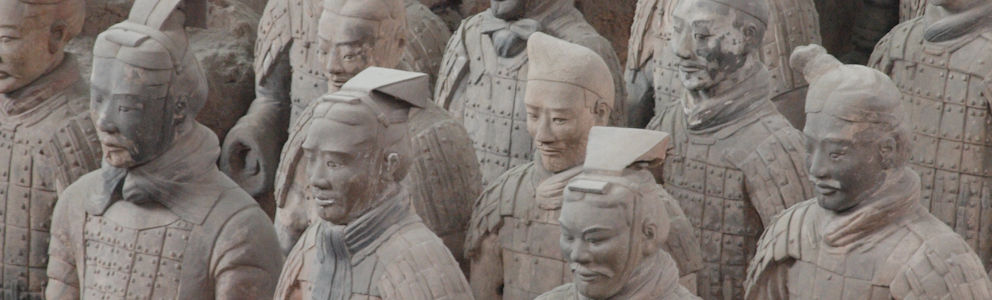
 The large hall of the Terracotta Army in Xian
 Just outside the centre of Kashgar the livestock market is held
Travelogue In the Footsteps of Marco Polo
Dag 2 | Turkey > The mausoleum of Atatürk
Dag 3 | Turkey > On the way to Cappadocia
Dag 4 | Turkey > Balloon flight over the rock formations
Dag 5 | Turkey > Rain in Kahta
Dag 6 | Turkey > In dense fog on Nemrut Dagi mountain
Dag 7 | Turkey > Friday prayers in Sanliurfa
Dag 8 | Turkey > The Kurdish capital Diyarbakir
Dag 9 | Turkey > The consequences of the earthquake in Van
Dag 10 | Turkey > The island Akdamar in Lake Van
Dag 11 | Turkey > The Ishak Pasha Palace in Dogubayazit
Dag 12 | Iran > Crossing the border to Iran
Dag 13 | Iran > Visiting a cave dwelling
Dag 14 | Iran > The Throne of Solomon
Dag 15 | Iran > Kurdish food in the park
Dag 16 | Iran > An afternoon tour through Hamadan
Dag 17 | Iran > The mausoleum of Fatima in Qom
Dag 18 | Iran > On the roof of the bazaar of Kashan
Dag 19 | Iran > The red mountain village Abyaneh
Dag 20 | Iran > Wandering through Esfahan
Dag 21 | Iran > A whirlwind on the square
Dag 22 | Iran > The shrine of Sayyed Ahmad
Dag 23 | Iran > Local encounters in Shiraz
Dag 24 | Iran > The tomb of Cyrus in Pasargadae
Dag 25 | Iran > The desert city Yazd
Dag 26 | Iran > Helicopters in the desert
Dag 27 | Iran > The golden tomb of Imam Reza
Dag 28 | Iran > Back to the Holy Shrine
Dag 29 | Turkmenistan > Across the border to Turkmenistan
Dag 30 | Turkmenistan > Ashgabat: Unique and bizarre
Dag 31 | Turkmenistan > Long bus ride to Mary
Dag 32 | Turkmenistan > The UNESCO city of Merv
Dag 33 | Uzbekistan > Mosques and madrasas in Bukhara
Dag 34 | Uzbekistan > On the roof of the madrasa
Dag 35 | Uzbekistan > The old palace of Timur Lenk
Dag 36 | Uzbekistan > Registan Square in Samarkand
Dag 37 | Uzbekistan > Football match Uzbekistan - Iran
Dag 38 | Kazakhstan > Computer malfunction at the border
Dag 39 | Kazakhstan > Hiking in Aksu Djabagly Nature Park
Dag 40 | Kyrgyzstan > Ala-Too Square in Bishkek
Dag 41 | Kyrgyzstan > The waterfall in Ala Archa Nature Park
Dag 42 | Kyrgyzstan > Tamchi on Lake Issyk Kul
Dag 43 | Kyrgyzstan > The old wooden cathedral of Karakol
Dag 44 | Kyrgyzstan > Overnight in a yurt
Dag 45 | Kyrgyzstan > On horseback through the valley
Dag 46 | Kyrgyzstan > Through the mountains to Lake Sol Kul
Dag 47 | Kyrgyzstan > Rain and snow around Sol Kul
Dag 48 | Kyrgyzstan > Caravanserai of Tash Rabat
Dag 49 | China > The Torugart Pass into China
Dag 50 | China > Kashgar, the city of the Uyghurs
Dag 51 | China > Cows and goats for sale
Dag 52 | China > By train through the Taklamakan desert
Dag 53 | China > Death Valley of China
Dag 54 | China > Ruins of Jiaohe and Gaochang
Dag 55 | China > The sand dunes of Dunhuang
Dag 56 | China > The Buddhist Mogao Caves
Dag 57 | China > The fort of Jiayuguan
Dag 58 | China > Temple of the Eight Immortals
Dag 59 | China > The Terracotta Army of Xian
Dag 60 | China > Cycling on the Xian city wall
Dag 61 | China > The Forbidden City
Dag 62 | China > Rainy Temple of Heaven
Dag 63 | China > On the Great Wall of China
Dag 64 | China > Meeting the giant panda
Dag 65 | China > There is no bus