
154 countries
(and areas)
 - Belize
- Benin
- Bhutan
- Bolivia
- Bonaire
- Bosnia and Herzegovina
- Botswana
- Brazil
- British Virgin Islands
- Brunei
- Bulgaria
- Cambodia
- Canada
- Cape Verde
- Chile
- China
- Costa Rica
- Croatia
- Cuba
- Curacao
- Cyprus
- Czech Republic
- Denmark
- Dominica
- Dominican Republic
- Egypt
- El Salvador
- England
- Estonia
- Eswatini (Swaziland)
- Ethiopia
- Fiji
- Finland
- France
- French Guiana
- Georgia
- Germany
- Gibraltar
- Greece
- Grenada
- Guadeloupe
- Guatemala
- Honduras
- Hong Kong
- Hungary
- Iceland
- India
- Indonesia
- Iran
- Ireland
- Israel
- Italy
- Jamaica
- Japan
- Jordan
- Kazakhstan
- Kenya
- Kosovo
- Kuwait
- Kyrgyzstan
- Laos
- Latvia
- Lebanon
- Lesotho
- Liechtenstein
- Lithuania
- Luxembourg
- Macau
- Madagascar
- Malawi
- Malaysia
- Maldives
- Malta
- Martinique
- Mexico
- Moldova
- Monaco
- Mongolia
- Montenegro
- Morocco
- Mozambique
- Namibia
- Nepal
- Netherlands
- New Zealand
- Nicaragua
- North Macedonia
- Northern Ireland
- Norway
- Oman
- Pakistan
- Palestine
- Peru
- Philippines
- Poland
- Portugal
- Qatar
- Republic of Korea
- Romania
- Russia
- Saint Kitts and Nevis
- Saint Lucia
- Saint Martin
- Saint Vincent and the Grenadines
- San Marino
- São Tomé and Principe
- Saudi Arabia
- Scotland
- Senegal
- Serbia
- Singapore
- Sint Maarten
- Slovakia
- Slovenia
- South Africa
- Spain
- Sri Lanka
- Suriname
- Sweden
- Switzerland
- Tajikistan
- Tanzania
- Thailand
- The Gambia
- Tibet
- Togo
- Transnistria
- Trinidad and Tobago
- Tunisia
- Turkey
- Turkmenistan
- Uganda
- United Arab Emirates
- United States
- Uruguay
- Uzbekistan
- Vatican City
- Vietnam
- Wales
- Zambia
- Zanzibar
- Belize
- Benin
- Bhutan
- Bolivia
- Bonaire
- Bosnia and Herzegovina
- Botswana
- Brazil
- British Virgin Islands
- Brunei
- Bulgaria
- Cambodia
- Canada
- Cape Verde
- Chile
- China
- Costa Rica
- Croatia
- Cuba
- Curacao
- Cyprus
- Czech Republic
- Denmark
- Dominica
- Dominican Republic
- Egypt
- El Salvador
- England
- Estonia
- Eswatini (Swaziland)
- Ethiopia
- Fiji
- Finland
- France
- French Guiana
- Georgia
- Germany
- Gibraltar
- Greece
- Grenada
- Guadeloupe
- Guatemala
- Honduras
- Hong Kong
- Hungary
- Iceland
- India
- Indonesia
- Iran
- Ireland
- Israel
- Italy
- Jamaica
- Japan
- Jordan
- Kazakhstan
- Kenya
- Kosovo
- Kuwait
- Kyrgyzstan
- Laos
- Latvia
- Lebanon
- Lesotho
- Liechtenstein
- Lithuania
- Luxembourg
- Macau
- Madagascar
- Malawi
- Malaysia
- Maldives
- Malta
- Martinique
- Mexico
- Moldova
- Monaco
- Mongolia
- Montenegro
- Morocco
- Mozambique
- Namibia
- Nepal
- Netherlands
- New Zealand
- Nicaragua
- North Macedonia
- Northern Ireland
- Norway
- Oman
- Pakistan
- Palestine
- Peru
- Philippines
- Poland
- Portugal
- Qatar
- Republic of Korea
- Romania
- Russia
- Saint Kitts and Nevis
- Saint Lucia
- Saint Martin
- Saint Vincent and the Grenadines
- San Marino
- São Tomé and Principe
- Saudi Arabia
- Scotland
- Senegal
- Serbia
- Singapore
- Sint Maarten
- Slovakia
- Slovenia
- South Africa
- Spain
- Sri Lanka
- Suriname
- Sweden
- Switzerland
- Tajikistan
- Tanzania
- Thailand
- The Gambia
- Tibet
- Togo
- Transnistria
- Trinidad and Tobago
- Tunisia
- Turkey
- Turkmenistan
- Uganda
- United Arab Emirates
- United States
- Uruguay
- Uzbekistan
- Vatican City
- Vietnam
- Wales
- Zambia
- Zanzibar


Copyright 2004 - 2026
Veeronline.nl Travel Adventures

Home > Iran > In the Footsteps of Marco Polo > Travelogue day 21
Travelogue In the Footsteps of Marco Polo
April 28 July 1 2012 (65 days)
Iran > A whirlwind on the square
Dag 21 - Friday, May 18, 2012The Friday Mosque of Esfahan is the largest and oldest in the city. The mosque is well worth an extensive visit. I follow the guide, Irah, inside. At the scale model, Irah explains that the mosque actually consists of seven interconnected mosques. The oldest dates back to the 12th century, the youngest to the 16th century. Especially the dome of the old mosque is remarkable. First, four walls were built, then eight arches around them, followed by sixteen smaller arches, and finally the round dome. As I cross the central courtyard, I realize how vast the mosque really is. Through a small door, I enter the prayer hall. Just enough light filters through the ceiling to allow for prayer.

When Irah switches off the light, I get a good sense of how it must have been in the past. From the mosque, we drive to the old hammam outside the city center. The bathhouse is no longer in use. Irah explains the former purpose of the different rooms. I explore both the men’s and women’s bathing areas. In the outskirts of Esfahan, I visit the “shaking minarets,” a more touristy attraction. When someone shakes one of the minarets, both start to sway. This spectacle is demonstrated every hour. When I arrive, I’m surprised by the relatively small size of the mosque and minarets; I had expected very tall towers. On the square, about two hundred people—mainly Iranians—are waiting. Exactly at noon, a man climbs into the right minaret. As he begins to shake, I see the tower sway, and a bell in the other minaret starts ringing. Amusing. The last stop with Irah is the Tower of Silence. On this mountain, the Zoroastrians once laid out their dead, to be consumed by vultures. This practice is now forbidden. We only view the hill from a nearby park. It’s Friday, and many Iranians have the day off. Families are picnicking on the grass. As I walk by, I’m offered tea and a dolma (a kind of date). The family also wants to take a photo with me. I quickly say goodbye and take the bus back to the city center, getting off at the Zayandeh River. I stroll across the Si-o-Se Bridge, under whose arches a teahouse is located. I order tea and gaze across the river. A student asks where I come from. “From Holland,” she translates to her friends. On the bridge, a young teacher approaches me—he wants to practice his English. Unfortunately, his phone rings, and apparently, that is more important.

He keeps walking near me, talking on the phone. When he finally finishes, we chat briefly. The park is lively, filled with families picnicking in the shade and couples sitting by the water. It’s a cheerful atmosphere, enjoyable to be part of. In the late afternoon, I return to central Iman Square. As the sun sets, more and more people gather on the lawns. Families are dining, children are playing by the fountain, and horse-drawn carriages shuttle local tourists. When the lights around the square are switched on, it creates a picturesque scene. I wait for the right evening light to photograph the Jameh Mosque. Suddenly, I hear shouting from the far side of the square. Something is happening. The sound grows louder, and the wind suddenly picks up. Before I know it, rugs and trash are flying through the air. A billboard topples next to me. A small whirlwind sweeps across the square. As quickly as it appeared, it vanishes again. Life resumes as if nothing happened. A man gestures to me that I can safely sit back down on the wall.
 Iran
Iran  The Chehel Sotoun the palace of the forty pillars
 Turkey
  The Rizvaniye Mosque in Sanliurfa beautifully reflects in the holy fish pond
 Uzbekistan
 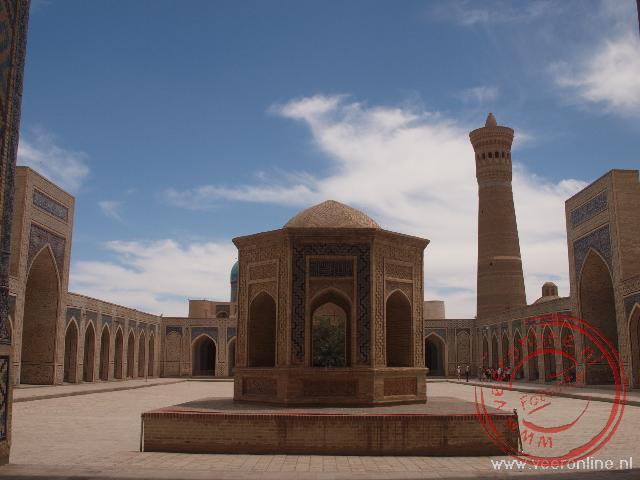 The central square of Bukhara
 The dome of the madrassa at Lyabi Hauz Square
Travelogue In the Footsteps of Marco Polo
Dag 2 | Turkey > The mausoleum of Atatürk
Dag 3 | Turkey > On the way to Cappadocia
Dag 4 | Turkey > Balloon flight over the rock formations
Dag 5 | Turkey > Rain in Kahta
Dag 6 | Turkey > In dense fog on Nemrut Dagi mountain
Dag 7 | Turkey > Friday prayers in Sanliurfa
Dag 8 | Turkey > The Kurdish capital Diyarbakir
Dag 9 | Turkey > The consequences of the earthquake in Van
Dag 10 | Turkey > The island Akdamar in Lake Van
Dag 11 | Turkey > The Ishak Pasha Palace in Dogubayazit
Dag 12 | Iran > Crossing the border to Iran
Dag 13 | Iran > Visiting a cave dwelling
Dag 14 | Iran > The Throne of Solomon
Dag 15 | Iran > Kurdish food in the park
Dag 16 | Iran > An afternoon tour through Hamadan
Dag 17 | Iran > The mausoleum of Fatima in Qom
Dag 18 | Iran > On the roof of the bazaar of Kashan
Dag 19 | Iran > The red mountain village Abyaneh
Dag 20 | Iran > Wandering through Esfahan
Dag 21 | Iran > A whirlwind on the square
Dag 22 | Iran > The shrine of Sayyed Ahmad
Dag 23 | Iran > Local encounters in Shiraz
Dag 24 | Iran > The tomb of Cyrus in Pasargadae
Dag 25 | Iran > The desert city Yazd
Dag 26 | Iran > Helicopters in the desert
Dag 27 | Iran > The golden tomb of Imam Reza
Dag 28 | Iran > Back to the Holy Shrine
Dag 29 | Turkmenistan > Across the border to Turkmenistan
Dag 30 | Turkmenistan > Ashgabat: Unique and bizarre
Dag 31 | Turkmenistan > Long bus ride to Mary
Dag 32 | Turkmenistan > The UNESCO city of Merv
Dag 33 | Uzbekistan > Mosques and madrasas in Bukhara
Dag 34 | Uzbekistan > On the roof of the madrasa
Dag 35 | Uzbekistan > The old palace of Timur Lenk
Dag 36 | Uzbekistan > Registan Square in Samarkand
Dag 37 | Uzbekistan > Football match Uzbekistan - Iran
Dag 38 | Kazakhstan > Computer malfunction at the border
Dag 39 | Kazakhstan > Hiking in Aksu Djabagly Nature Park
Dag 40 | Kyrgyzstan > Ala-Too Square in Bishkek
Dag 41 | Kyrgyzstan > The waterfall in Ala Archa Nature Park
Dag 42 | Kyrgyzstan > Tamchi on Lake Issyk Kul
Dag 43 | Kyrgyzstan > The old wooden cathedral of Karakol
Dag 44 | Kyrgyzstan > Overnight in a yurt
Dag 45 | Kyrgyzstan > On horseback through the valley
Dag 46 | Kyrgyzstan > Through the mountains to Lake Sol Kul
Dag 47 | Kyrgyzstan > Rain and snow around Sol Kul
Dag 48 | Kyrgyzstan > Caravanserai of Tash Rabat
Dag 49 | China > The Torugart Pass into China
Dag 50 | China > Kashgar, the city of the Uyghurs
Dag 51 | China > Cows and goats for sale
Dag 52 | China > By train through the Taklamakan desert
Dag 53 | China > Death Valley of China
Dag 54 | China > Ruins of Jiaohe and Gaochang
Dag 55 | China > The sand dunes of Dunhuang
Dag 56 | China > The Buddhist Mogao Caves
Dag 57 | China > The fort of Jiayuguan
Dag 58 | China > Temple of the Eight Immortals
Dag 59 | China > The Terracotta Army of Xian
Dag 60 | China > Cycling on the Xian city wall
Dag 61 | China > The Forbidden City
Dag 62 | China > Rainy Temple of Heaven
Dag 63 | China > On the Great Wall of China
Dag 64 | China > Meeting the giant panda
Dag 65 | China > There is no bus