
154 countries
(and areas)
 - Belize
- Benin
- Bhutan
- Bolivia
- Bonaire
- Bosnia and Herzegovina
- Botswana
- Brazil
- British Virgin Islands
- Brunei
- Bulgaria
- Cambodia
- Canada
- Cape Verde
- Chile
- China
- Costa Rica
- Croatia
- Cuba
- Curacao
- Cyprus
- Czech Republic
- Denmark
- Dominica
- Dominican Republic
- Egypt
- El Salvador
- England
- Estonia
- Eswatini (Swaziland)
- Ethiopia
- Fiji
- Finland
- France
- French Guiana
- Georgia
- Germany
- Gibraltar
- Greece
- Grenada
- Guadeloupe
- Guatemala
- Honduras
- Hong Kong
- Hungary
- Iceland
- India
- Indonesia
- Iran
- Ireland
- Israel
- Italy
- Jamaica
- Japan
- Jordan
- Kazakhstan
- Kenya
- Kosovo
- Kuwait
- Kyrgyzstan
- Laos
- Latvia
- Lebanon
- Lesotho
- Liechtenstein
- Lithuania
- Luxembourg
- Macau
- Madagascar
- Malawi
- Malaysia
- Maldives
- Malta
- Martinique
- Mexico
- Moldova
- Monaco
- Mongolia
- Montenegro
- Morocco
- Mozambique
- Namibia
- Nepal
- Netherlands
- New Zealand
- Nicaragua
- North Macedonia
- Northern Ireland
- Norway
- Oman
- Pakistan
- Palestine
- Peru
- Philippines
- Poland
- Portugal
- Qatar
- Republic of Korea
- Romania
- Russia
- Saint Kitts and Nevis
- Saint Lucia
- Saint Martin
- Saint Vincent and the Grenadines
- San Marino
- São Tomé and Principe
- Saudi Arabia
- Scotland
- Senegal
- Serbia
- Singapore
- Sint Maarten
- Slovakia
- Slovenia
- South Africa
- Spain
- Sri Lanka
- Suriname
- Sweden
- Switzerland
- Tajikistan
- Tanzania
- Thailand
- The Gambia
- Tibet
- Togo
- Transnistria
- Trinidad and Tobago
- Tunisia
- Turkey
- Turkmenistan
- Uganda
- United Arab Emirates
- United States
- Uruguay
- Uzbekistan
- Vatican City
- Vietnam
- Wales
- Zambia
- Zanzibar
- Belize
- Benin
- Bhutan
- Bolivia
- Bonaire
- Bosnia and Herzegovina
- Botswana
- Brazil
- British Virgin Islands
- Brunei
- Bulgaria
- Cambodia
- Canada
- Cape Verde
- Chile
- China
- Costa Rica
- Croatia
- Cuba
- Curacao
- Cyprus
- Czech Republic
- Denmark
- Dominica
- Dominican Republic
- Egypt
- El Salvador
- England
- Estonia
- Eswatini (Swaziland)
- Ethiopia
- Fiji
- Finland
- France
- French Guiana
- Georgia
- Germany
- Gibraltar
- Greece
- Grenada
- Guadeloupe
- Guatemala
- Honduras
- Hong Kong
- Hungary
- Iceland
- India
- Indonesia
- Iran
- Ireland
- Israel
- Italy
- Jamaica
- Japan
- Jordan
- Kazakhstan
- Kenya
- Kosovo
- Kuwait
- Kyrgyzstan
- Laos
- Latvia
- Lebanon
- Lesotho
- Liechtenstein
- Lithuania
- Luxembourg
- Macau
- Madagascar
- Malawi
- Malaysia
- Maldives
- Malta
- Martinique
- Mexico
- Moldova
- Monaco
- Mongolia
- Montenegro
- Morocco
- Mozambique
- Namibia
- Nepal
- Netherlands
- New Zealand
- Nicaragua
- North Macedonia
- Northern Ireland
- Norway
- Oman
- Pakistan
- Palestine
- Peru
- Philippines
- Poland
- Portugal
- Qatar
- Republic of Korea
- Romania
- Russia
- Saint Kitts and Nevis
- Saint Lucia
- Saint Martin
- Saint Vincent and the Grenadines
- San Marino
- São Tomé and Principe
- Saudi Arabia
- Scotland
- Senegal
- Serbia
- Singapore
- Sint Maarten
- Slovakia
- Slovenia
- South Africa
- Spain
- Sri Lanka
- Suriname
- Sweden
- Switzerland
- Tajikistan
- Tanzania
- Thailand
- The Gambia
- Tibet
- Togo
- Transnistria
- Trinidad and Tobago
- Tunisia
- Turkey
- Turkmenistan
- Uganda
- United Arab Emirates
- United States
- Uruguay
- Uzbekistan
- Vatican City
- Vietnam
- Wales
- Zambia
- Zanzibar


Copyright 2004 - 2026
Veeronline.nl Travel Adventures
Home > Turkmenistan > In the Footsteps of Marco Polo > Travelogue day 29
Travelogue In the Footsteps of Marco Polo
April 28 July 1 2012 (65 days)
Turkmenistan > Across the border to Turkmenistan
Dag 29 - Saturday, May 26, 2012As I leave the city by bus during the morning rush, I see a learner driver on the road. I immediately feel sorry for the student. Traffic in Iran is some of the most extreme I have ever experienced. Everyone asserts their right of way, and whoever brakes last goes first. As a prospective driver, you quickly need to know the exact dimensions of your car—especially because at a three-lane traffic light, people line up with at least four cars side by side.

My bus driver also weaves through traffic. He has two types of horns: a normal one and a very loud one to warn other drivers. Pedestrians don’t matter. Even when the pedestrian light is green, turning vehicles still roar past. The only solution is to jump aside in time. Outside the city, it quickly becomes quieter. It’s a several-hour drive to the border post. The landscape becomes increasingly green, and the road winds into the mountains. The higher I go, the less dry it is. The mountain ridge forms the border with Turkmenistan. Around one o’clock, we approach the border town. Long lines of trucks are waiting to cross. I estimate that the trucks at the back will be waiting for days rather than hours. We pass a line stretching for kilometers. The customs procedure at the Iranian border goes quickly. I walk with my travel bag toward Turkmenistan. The border procedures there take a little longer. I have to get a visa at the border. The application form goes from counter to counter. After more than an hour and a half, the visa is in my passport. Then my luggage has to be checked. This is extremely slow.

All suitcases must be opened. In front of me are Turkmen travelers. Large quantities of cigarettes are confiscated and destroyed, and they have to cut each cigarette in half themselves. My suitcase is opened as well, but without much trouble I pass the check. I am officially in Turkmenistan. Outside the customs building, I meet Maksat, the guide for the next few days, as well as Murat, my driver. Murat drives the bus to Ashgabat in about an hour. As I approach Ashgabat, I can already see the white marble buildings from the hills. My hotel, like most tourist hotels, is fairly far from the city center. To get downtown, I take the local bus 19. I pay 0.20 manat (0.05 euros) for the ride. I try to follow the bus route on my map but quickly lose track. After a while, the driver tells me to transfer to line 22 for the Russian Market. I get off at the indicated stop. Bus 22 is already waiting. With line 22, I head into the center. The Russian Market is a hub for fruit, vegetables, and other goods. When I take photos, someone comes up to tell me it’s not allowed. I don’t understand the reason. Outside the market hall, I order a large beer—wonderful, a beer again after three weeks in Iran.

At checkout, everything goes wrong. The bill is incorrect. I pay for what I had and walk away, much to the waitress’s annoyance. I stroll through the wide streets and notice that there are hardly any people around. The streets are deserted. Lush greenery lines the roads, watered daily because otherwise it would be far too dry. I search for the famous Turkmenbashi statue. According to the Lonely Planet, I should be nearby. From a few young people, I finally learn that the statue has been moved to the edge of the city, and I will need a taxi to get there—something I’ll do tomorrow. I arrive at the beautifully illuminated Turkmenbashi Palace. When I ask a soldier if I may take a photo, he gestures firmly that I may not, and warns that I would be arrested if I do. He presses his wrists together as a warning. Taking photos at other buildings is also difficult. Practically every corner has a policeman or soldier. Perhaps this is why the streets are almost empty. Turkmenistan remains a police state. I look for a taxi. Passersby tell me that five manat should be enough for the ride back. When I speak to someone, she points to a few waiting cars and asks if I want sex. How direct can you get? I politely decline. I then approach a young man in a Lada. He nods when I show him a five-manat note, though he still has to call someone to ask exactly where the Ahal Hotel is located.
 Iran
Iran  The Chehel Sotoun the palace of the forty pillars
 Turkey
  The Rizvaniye Mosque in Sanliurfa beautifully reflects in the holy fish pond
 Uzbekistan
 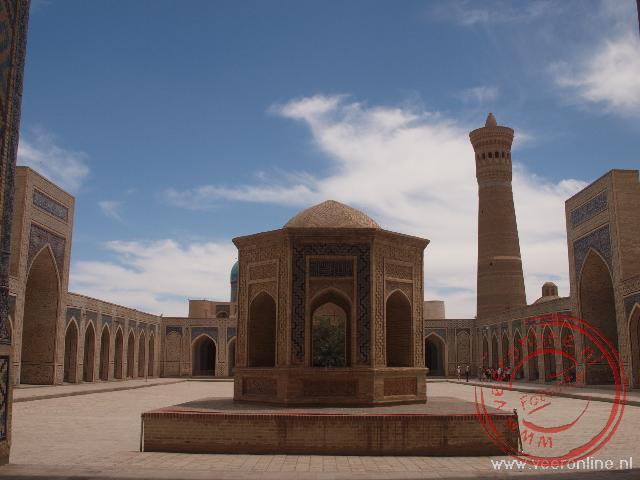 The central square of Bukhara
 The dome of the madrassa at Lyabi Hauz Square
Travelogue In the Footsteps of Marco Polo
Dag 2 | Turkey > The mausoleum of Atatürk
Dag 3 | Turkey > On the way to Cappadocia
Dag 4 | Turkey > Balloon flight over the rock formations
Dag 5 | Turkey > Rain in Kahta
Dag 6 | Turkey > In dense fog on Nemrut Dagi mountain
Dag 7 | Turkey > Friday prayers in Sanliurfa
Dag 8 | Turkey > The Kurdish capital Diyarbakir
Dag 9 | Turkey > The consequences of the earthquake in Van
Dag 10 | Turkey > The island Akdamar in Lake Van
Dag 11 | Turkey > The Ishak Pasha Palace in Dogubayazit
Dag 12 | Iran > Crossing the border to Iran
Dag 13 | Iran > Visiting a cave dwelling
Dag 14 | Iran > The Throne of Solomon
Dag 15 | Iran > Kurdish food in the park
Dag 16 | Iran > An afternoon tour through Hamadan
Dag 17 | Iran > The mausoleum of Fatima in Qom
Dag 18 | Iran > On the roof of the bazaar of Kashan
Dag 19 | Iran > The red mountain village Abyaneh
Dag 20 | Iran > Wandering through Esfahan
Dag 21 | Iran > A whirlwind on the square
Dag 22 | Iran > The shrine of Sayyed Ahmad
Dag 23 | Iran > Local encounters in Shiraz
Dag 24 | Iran > The tomb of Cyrus in Pasargadae
Dag 25 | Iran > The desert city Yazd
Dag 26 | Iran > Helicopters in the desert
Dag 27 | Iran > The golden tomb of Imam Reza
Dag 28 | Iran > Back to the Holy Shrine
Dag 29 | Turkmenistan > Across the border to Turkmenistan
Dag 30 | Turkmenistan > Ashgabat: Unique and bizarre
Dag 31 | Turkmenistan > Long bus ride to Mary
Dag 32 | Turkmenistan > The UNESCO city of Merv
Dag 33 | Uzbekistan > Mosques and madrasas in Bukhara
Dag 34 | Uzbekistan > On the roof of the madrasa
Dag 35 | Uzbekistan > The old palace of Timur Lenk
Dag 36 | Uzbekistan > Registan Square in Samarkand
Dag 37 | Uzbekistan > Football match Uzbekistan - Iran
Dag 38 | Kazakhstan > Computer malfunction at the border
Dag 39 | Kazakhstan > Hiking in Aksu Djabagly Nature Park
Dag 40 | Kyrgyzstan > Ala-Too Square in Bishkek
Dag 41 | Kyrgyzstan > The waterfall in Ala Archa Nature Park
Dag 42 | Kyrgyzstan > Tamchi on Lake Issyk Kul
Dag 43 | Kyrgyzstan > The old wooden cathedral of Karakol
Dag 44 | Kyrgyzstan > Overnight in a yurt
Dag 45 | Kyrgyzstan > On horseback through the valley
Dag 46 | Kyrgyzstan > Through the mountains to Lake Sol Kul
Dag 47 | Kyrgyzstan > Rain and snow around Sol Kul
Dag 48 | Kyrgyzstan > Caravanserai of Tash Rabat
Dag 49 | China > The Torugart Pass into China
Dag 50 | China > Kashgar, the city of the Uyghurs
Dag 51 | China > Cows and goats for sale
Dag 52 | China > By train through the Taklamakan desert
Dag 53 | China > Death Valley of China
Dag 54 | China > Ruins of Jiaohe and Gaochang
Dag 55 | China > The sand dunes of Dunhuang
Dag 56 | China > The Buddhist Mogao Caves
Dag 57 | China > The fort of Jiayuguan
Dag 58 | China > Temple of the Eight Immortals
Dag 59 | China > The Terracotta Army of Xian
Dag 60 | China > Cycling on the Xian city wall
Dag 61 | China > The Forbidden City
Dag 62 | China > Rainy Temple of Heaven
Dag 63 | China > On the Great Wall of China
Dag 64 | China > Meeting the giant panda
Dag 65 | China > There is no bus