
154 countries
(and areas)
 - Belize
- Benin
- Bhutan
- Bolivia
- Bonaire
- Bosnia and Herzegovina
- Botswana
- Brazil
- British Virgin Islands
- Brunei
- Bulgaria
- Cambodia
- Canada
- Cape Verde
- Chile
- China
- Costa Rica
- Croatia
- Cuba
- Curacao
- Cyprus
- Czech Republic
- Denmark
- Dominica
- Dominican Republic
- Egypt
- El Salvador
- England
- Estonia
- Eswatini (Swaziland)
- Ethiopia
- Fiji
- Finland
- France
- French Guiana
- Georgia
- Germany
- Gibraltar
- Greece
- Grenada
- Guadeloupe
- Guatemala
- Honduras
- Hong Kong
- Hungary
- Iceland
- India
- Indonesia
- Iran
- Ireland
- Israel
- Italy
- Jamaica
- Japan
- Jordan
- Kazakhstan
- Kenya
- Kosovo
- Kuwait
- Kyrgyzstan
- Laos
- Latvia
- Lebanon
- Lesotho
- Liechtenstein
- Lithuania
- Luxembourg
- Macau
- Madagascar
- Malawi
- Malaysia
- Maldives
- Malta
- Martinique
- Mexico
- Moldova
- Monaco
- Mongolia
- Montenegro
- Morocco
- Mozambique
- Namibia
- Nepal
- Netherlands
- New Zealand
- Nicaragua
- North Macedonia
- Northern Ireland
- Norway
- Oman
- Pakistan
- Palestine
- Peru
- Philippines
- Poland
- Portugal
- Qatar
- Republic of Korea
- Romania
- Russia
- Saint Kitts and Nevis
- Saint Lucia
- Saint Martin
- Saint Vincent and the Grenadines
- San Marino
- São Tomé and Principe
- Saudi Arabia
- Scotland
- Senegal
- Serbia
- Singapore
- Sint Maarten
- Slovakia
- Slovenia
- South Africa
- Spain
- Sri Lanka
- Suriname
- Sweden
- Switzerland
- Tajikistan
- Tanzania
- Thailand
- The Gambia
- Tibet
- Togo
- Transnistria
- Trinidad and Tobago
- Tunisia
- Turkey
- Turkmenistan
- Uganda
- United Arab Emirates
- United States
- Uruguay
- Uzbekistan
- Vatican City
- Vietnam
- Wales
- Zambia
- Zanzibar
- Belize
- Benin
- Bhutan
- Bolivia
- Bonaire
- Bosnia and Herzegovina
- Botswana
- Brazil
- British Virgin Islands
- Brunei
- Bulgaria
- Cambodia
- Canada
- Cape Verde
- Chile
- China
- Costa Rica
- Croatia
- Cuba
- Curacao
- Cyprus
- Czech Republic
- Denmark
- Dominica
- Dominican Republic
- Egypt
- El Salvador
- England
- Estonia
- Eswatini (Swaziland)
- Ethiopia
- Fiji
- Finland
- France
- French Guiana
- Georgia
- Germany
- Gibraltar
- Greece
- Grenada
- Guadeloupe
- Guatemala
- Honduras
- Hong Kong
- Hungary
- Iceland
- India
- Indonesia
- Iran
- Ireland
- Israel
- Italy
- Jamaica
- Japan
- Jordan
- Kazakhstan
- Kenya
- Kosovo
- Kuwait
- Kyrgyzstan
- Laos
- Latvia
- Lebanon
- Lesotho
- Liechtenstein
- Lithuania
- Luxembourg
- Macau
- Madagascar
- Malawi
- Malaysia
- Maldives
- Malta
- Martinique
- Mexico
- Moldova
- Monaco
- Mongolia
- Montenegro
- Morocco
- Mozambique
- Namibia
- Nepal
- Netherlands
- New Zealand
- Nicaragua
- North Macedonia
- Northern Ireland
- Norway
- Oman
- Pakistan
- Palestine
- Peru
- Philippines
- Poland
- Portugal
- Qatar
- Republic of Korea
- Romania
- Russia
- Saint Kitts and Nevis
- Saint Lucia
- Saint Martin
- Saint Vincent and the Grenadines
- San Marino
- São Tomé and Principe
- Saudi Arabia
- Scotland
- Senegal
- Serbia
- Singapore
- Sint Maarten
- Slovakia
- Slovenia
- South Africa
- Spain
- Sri Lanka
- Suriname
- Sweden
- Switzerland
- Tajikistan
- Tanzania
- Thailand
- The Gambia
- Tibet
- Togo
- Transnistria
- Trinidad and Tobago
- Tunisia
- Turkey
- Turkmenistan
- Uganda
- United Arab Emirates
- United States
- Uruguay
- Uzbekistan
- Vatican City
- Vietnam
- Wales
- Zambia
- Zanzibar


Copyright 2004 - 2026
Veeronline.nl Travel Adventures
Home > China > In the Footsteps of Marco Polo > Travelogue day 63
Travelogue In the Footsteps of Marco Polo
April 28 July 1 2012 (65 days)
China > On the Great Wall of China
Dag 63 - Friday, June 29, 2012It’s raining again when I look out of the window in the morning. The weather forecast doesn’t help much. For the past two days, sunshine has been predicted for the coming day, only to be changed to rain again by morning. A pity, because today I am going to the Great Wall of China. Something I have long been looking forward to, and one of the highlights of this trip.

The Great Wall is something you simply have to see once in your life. To avoid the large tourist groups, I’m not going to Badaling but to the town of Mutianyu. Badaling is the closest to Beijing and therefore attracts many tourists. I also set out before seven o’clock. Even at this early hour, the streets of Beijing are busy. I can imagine that within an hour traffic will come to a complete standstill in the morning rush. I try to get a bit more sleep, but in vain. At half past eight I arrive in Mutianyu at the Great Wall. Luckily, it’s dry. The souvenir vendors are just opening their stalls. To visit the famous Great Wall, I first need to make a twenty-minute climb. I could take the cable car, but that doesn’t really feel appropriate in this setting. I soon regret this decision. The climb is much tougher than expected. It’s warm and humid. Halfway up, I decide to slow down and continue at a much calmer pace. When I turn the final corner, I see the outlines of the wall. Impressive! Passing through the gate, I am actually standing on the world-famous Great Wall.

Wow! At this early hour, I’m practically alone on the wall. I decide to walk a section. I turn left. It’s misty. The view is limited to at most fifty meters. Occasionally, the clouds part and I can see a bit further. Then the wall reveals itself, winding through the landscape. The Great Wall follows the hills, which means I have to climb and descend steeply to follow the route. At times, the stones are treacherously slippery. I walk from watchtower to watchtower, spending more than an hour on the wall. At watchtower number six I buy a ticket for the toboggan run. Though it doesn’t really fit with the historical surroundings, I still step into the sled. The controls are simple: push the lever forward to accelerate, release to brake. With a few gestures, the attendant explains that I need to lean into the curves. I set off, pushing the lever as far forward as possible and leaning into the bends. After a few curves I catch up with the people in front of me. The American couple ahead of me descends painfully slowly. I have to brake hard to avoid bumping into them. Against the rules, I stop my sled to give them a head start.

The track attendant allows it, keeping an eye out to ensure no one else is coming. But it doesn’t help much—within two bends I’ve caught up with the couple again. I repeat this process until I reach the bottom. I never manage to build up real speed. On the way back to Beijing I stop at the Olympic Park. I stand beside the “Bird’s Nest” stadium of the 2008 Olympic Games. From close up, the special design of the stadium is clearly visible. I also see the Olympic swimming pool with its blue “bubbles.” At night, the bubbles are lit up. The Summer Palace is today’s last stop. The old palace was destroyed by Westerners—“Western barbarians,” as they explain it here. The new palace was built next to it. I stroll past the palace buildings and along the wooden corridor by the lake. I strike up a conversation with an American tourist. She tells me the climb to the pagoda at the top of the hill is very strenuous. She insists that I should buy water first, and she points out the entrance gate.

We part ways there. I start climbing the stairs to the temple. Although it is quite a climb, I find her warning a bit exaggerated. From the temple complex I have a view over the lake. I can already see the island in the middle of the lake—my next goal. I descend via the Bronze Temple. It’s striking that everyone takes the main staircase. In the Bronze Temple, right next to the complex, I encounter hardly any visitors. I wander down slowly through the temples and emerge at the harbor. Here lies the emperor’s marble boat. I buy a ticket for the crossing to the island. As I board, I get into conversation with a girl who is the private guide of an elderly Chinese couple. The couple would like to have their photo taken with me—would I mind? Of course not. They also want to know all sorts of things about me. The guide translates their questions. What is my job? What do I think of China? Before I realize it, the boat has reached the island. I say goodbye and quickly take another photo of the lake. Then I walk back to the mainland via the Seventeen-Arch Bridge.
 Iran
Iran  The Chehel Sotoun the palace of the forty pillars
 Turkey
  The Rizvaniye Mosque in Sanliurfa beautifully reflects in the holy fish pond
 Uzbekistan
 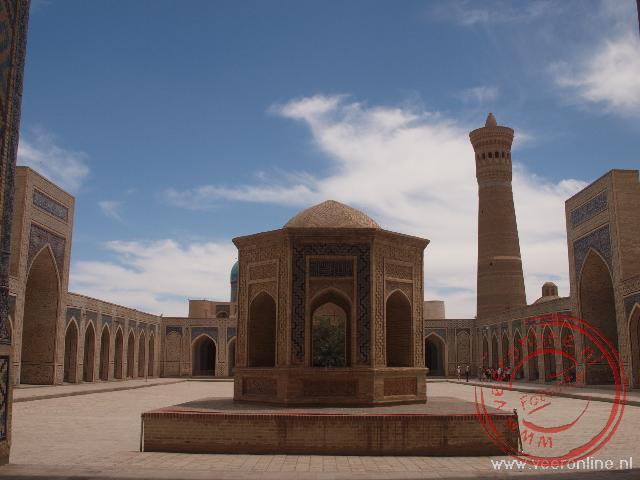 The central square of Bukhara
 The dome of the madrassa at Lyabi Hauz Square
Travelogue In the Footsteps of Marco Polo
Dag 2 | Turkey > The mausoleum of Atatürk
Dag 3 | Turkey > On the way to Cappadocia
Dag 4 | Turkey > Balloon flight over the rock formations
Dag 5 | Turkey > Rain in Kahta
Dag 6 | Turkey > In dense fog on Nemrut Dagi mountain
Dag 7 | Turkey > Friday prayers in Sanliurfa
Dag 8 | Turkey > The Kurdish capital Diyarbakir
Dag 9 | Turkey > The consequences of the earthquake in Van
Dag 10 | Turkey > The island Akdamar in Lake Van
Dag 11 | Turkey > The Ishak Pasha Palace in Dogubayazit
Dag 12 | Iran > Crossing the border to Iran
Dag 13 | Iran > Visiting a cave dwelling
Dag 14 | Iran > The Throne of Solomon
Dag 15 | Iran > Kurdish food in the park
Dag 16 | Iran > An afternoon tour through Hamadan
Dag 17 | Iran > The mausoleum of Fatima in Qom
Dag 18 | Iran > On the roof of the bazaar of Kashan
Dag 19 | Iran > The red mountain village Abyaneh
Dag 20 | Iran > Wandering through Esfahan
Dag 21 | Iran > A whirlwind on the square
Dag 22 | Iran > The shrine of Sayyed Ahmad
Dag 23 | Iran > Local encounters in Shiraz
Dag 24 | Iran > The tomb of Cyrus in Pasargadae
Dag 25 | Iran > The desert city Yazd
Dag 26 | Iran > Helicopters in the desert
Dag 27 | Iran > The golden tomb of Imam Reza
Dag 28 | Iran > Back to the Holy Shrine
Dag 29 | Turkmenistan > Across the border to Turkmenistan
Dag 30 | Turkmenistan > Ashgabat: Unique and bizarre
Dag 31 | Turkmenistan > Long bus ride to Mary
Dag 32 | Turkmenistan > The UNESCO city of Merv
Dag 33 | Uzbekistan > Mosques and madrasas in Bukhara
Dag 34 | Uzbekistan > On the roof of the madrasa
Dag 35 | Uzbekistan > The old palace of Timur Lenk
Dag 36 | Uzbekistan > Registan Square in Samarkand
Dag 37 | Uzbekistan > Football match Uzbekistan - Iran
Dag 38 | Kazakhstan > Computer malfunction at the border
Dag 39 | Kazakhstan > Hiking in Aksu Djabagly Nature Park
Dag 40 | Kyrgyzstan > Ala-Too Square in Bishkek
Dag 41 | Kyrgyzstan > The waterfall in Ala Archa Nature Park
Dag 42 | Kyrgyzstan > Tamchi on Lake Issyk Kul
Dag 43 | Kyrgyzstan > The old wooden cathedral of Karakol
Dag 44 | Kyrgyzstan > Overnight in a yurt
Dag 45 | Kyrgyzstan > On horseback through the valley
Dag 46 | Kyrgyzstan > Through the mountains to Lake Sol Kul
Dag 47 | Kyrgyzstan > Rain and snow around Sol Kul
Dag 48 | Kyrgyzstan > Caravanserai of Tash Rabat
Dag 49 | China > The Torugart Pass into China
Dag 50 | China > Kashgar, the city of the Uyghurs
Dag 51 | China > Cows and goats for sale
Dag 52 | China > By train through the Taklamakan desert
Dag 53 | China > Death Valley of China
Dag 54 | China > Ruins of Jiaohe and Gaochang
Dag 55 | China > The sand dunes of Dunhuang
Dag 56 | China > The Buddhist Mogao Caves
Dag 57 | China > The fort of Jiayuguan
Dag 58 | China > Temple of the Eight Immortals
Dag 59 | China > The Terracotta Army of Xian
Dag 60 | China > Cycling on the Xian city wall
Dag 61 | China > The Forbidden City
Dag 62 | China > Rainy Temple of Heaven
Dag 63 | China > On the Great Wall of China
Dag 64 | China > Meeting the giant panda
Dag 65 | China > There is no bus