
154 countries
(and areas)
 - Belize
- Benin
- Bhutan
- Bolivia
- Bonaire
- Bosnia and Herzegovina
- Botswana
- Brazil
- British Virgin Islands
- Brunei
- Bulgaria
- Cambodia
- Canada
- Cape Verde
- Chile
- China
- Costa Rica
- Croatia
- Cuba
- Curacao
- Cyprus
- Czech Republic
- Denmark
- Dominica
- Dominican Republic
- Egypt
- El Salvador
- England
- Estonia
- Eswatini (Swaziland)
- Ethiopia
- Fiji
- Finland
- France
- French Guiana
- Georgia
- Germany
- Gibraltar
- Greece
- Grenada
- Guadeloupe
- Guatemala
- Honduras
- Hong Kong
- Hungary
- Iceland
- India
- Indonesia
- Iran
- Ireland
- Israel
- Italy
- Jamaica
- Japan
- Jordan
- Kazakhstan
- Kenya
- Kosovo
- Kuwait
- Kyrgyzstan
- Laos
- Latvia
- Lebanon
- Lesotho
- Liechtenstein
- Lithuania
- Luxembourg
- Macau
- Madagascar
- Malawi
- Malaysia
- Maldives
- Malta
- Martinique
- Mexico
- Moldova
- Monaco
- Mongolia
- Montenegro
- Morocco
- Mozambique
- Namibia
- Nepal
- Netherlands
- New Zealand
- Nicaragua
- North Macedonia
- Northern Ireland
- Norway
- Oman
- Pakistan
- Palestine
- Peru
- Philippines
- Poland
- Portugal
- Qatar
- Republic of Korea
- Romania
- Russia
- Saint Kitts and Nevis
- Saint Lucia
- Saint Martin
- Saint Vincent and the Grenadines
- San Marino
- São Tomé and Principe
- Saudi Arabia
- Scotland
- Senegal
- Serbia
- Singapore
- Sint Maarten
- Slovakia
- Slovenia
- South Africa
- Spain
- Sri Lanka
- Suriname
- Sweden
- Switzerland
- Tajikistan
- Tanzania
- Thailand
- The Gambia
- Tibet
- Togo
- Transnistria
- Trinidad and Tobago
- Tunisia
- Turkey
- Turkmenistan
- Uganda
- United Arab Emirates
- United States
- Uruguay
- Uzbekistan
- Vatican City
- Vietnam
- Wales
- Zambia
- Zanzibar
- Belize
- Benin
- Bhutan
- Bolivia
- Bonaire
- Bosnia and Herzegovina
- Botswana
- Brazil
- British Virgin Islands
- Brunei
- Bulgaria
- Cambodia
- Canada
- Cape Verde
- Chile
- China
- Costa Rica
- Croatia
- Cuba
- Curacao
- Cyprus
- Czech Republic
- Denmark
- Dominica
- Dominican Republic
- Egypt
- El Salvador
- England
- Estonia
- Eswatini (Swaziland)
- Ethiopia
- Fiji
- Finland
- France
- French Guiana
- Georgia
- Germany
- Gibraltar
- Greece
- Grenada
- Guadeloupe
- Guatemala
- Honduras
- Hong Kong
- Hungary
- Iceland
- India
- Indonesia
- Iran
- Ireland
- Israel
- Italy
- Jamaica
- Japan
- Jordan
- Kazakhstan
- Kenya
- Kosovo
- Kuwait
- Kyrgyzstan
- Laos
- Latvia
- Lebanon
- Lesotho
- Liechtenstein
- Lithuania
- Luxembourg
- Macau
- Madagascar
- Malawi
- Malaysia
- Maldives
- Malta
- Martinique
- Mexico
- Moldova
- Monaco
- Mongolia
- Montenegro
- Morocco
- Mozambique
- Namibia
- Nepal
- Netherlands
- New Zealand
- Nicaragua
- North Macedonia
- Northern Ireland
- Norway
- Oman
- Pakistan
- Palestine
- Peru
- Philippines
- Poland
- Portugal
- Qatar
- Republic of Korea
- Romania
- Russia
- Saint Kitts and Nevis
- Saint Lucia
- Saint Martin
- Saint Vincent and the Grenadines
- San Marino
- São Tomé and Principe
- Saudi Arabia
- Scotland
- Senegal
- Serbia
- Singapore
- Sint Maarten
- Slovakia
- Slovenia
- South Africa
- Spain
- Sri Lanka
- Suriname
- Sweden
- Switzerland
- Tajikistan
- Tanzania
- Thailand
- The Gambia
- Tibet
- Togo
- Transnistria
- Trinidad and Tobago
- Tunisia
- Turkey
- Turkmenistan
- Uganda
- United Arab Emirates
- United States
- Uruguay
- Uzbekistan
- Vatican City
- Vietnam
- Wales
- Zambia
- Zanzibar


Copyright 2004 - 2026
Veeronline.nl Travel Adventures
Home > Madagascar > Madagascar the Island of Lemurs > Travelogue day 5
Travelogue Madagascar the Island of Lemurs
October 14 November 7 2014 (25 days)
Madagascar > In the Pousse-pousse
Dag 5 - Saturday, October 18, 2014At eight o’clock I get on the bus to go to Lac du Tritriva, a crater lake about thirty kilometers past Antsirabe. The last ten kilometers are over a sandy, bumpy road. Heavy trucks also travel along this dusty route, kicking up thick clouds of dust over the road and nearby houses. The road gradually climbs upward. Faly drives the bus carefully toward the crater lake. After about an hour and a half, I round the final bend and see a large group of vendors ready with their goods, hoping to make a sale. When they realize the bus isn’t stopping at the entrance gate, they quickly run up the hill to the parking area. I estimate there are more than fifty sellers. I cannot imagine they sell much here. As expected, I am immediately surrounded when I step off the bus. Zony, my local guide, keeps them at a distance. “Later, later,” they shout, knowing I have to get back on the bus. I walk to the rim of the crater.

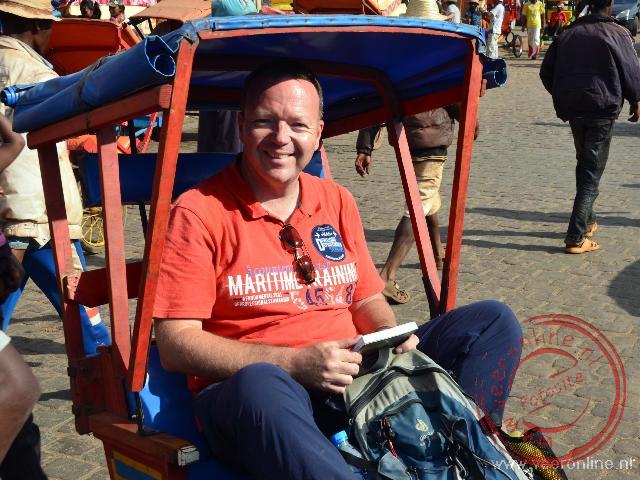
From here, I have a stunning view of Tritriva crater lake. I see the steep rocks on the opposite side reflecting in the turquoise water. Zony explains that the lake was formed by a volcanic eruption and is about 160 meters deep. The volcano is no longer active. The rocks on the far side rise up to thirty meters above the water. I carefully descend along the walking path. With the loose stones, I have to watch my step to avoid slipping. I make my way around the other side of the lake and return to the bus. On the way back to Antsirabe, I walk along a stretch of the road. It’s enjoyable to see the landscape and daily life along the route up close. Later, the bus picks me up again to continue to Antsirabe. After lunch, I explore Antsirabe itself. I first visit the cathedral. Inside, the church is being cleaned—it turns out they do this every Saturday in preparation for Sunday mass. Further along the main road, I enter the Antsenakely market (Petit marché). At the various stalls, people are eating. Meat hangs ready, and fruit is neatly stacked. However, it looks somewhat messy and unkempt, and a strong, unpleasant smell lingers in the air. I leave the market. At a second church, I see the gate open and walk toward the doorway. When I enter from the side, a mass is in progress. I quickly turn around. Judging by a funeral cart outside, I realize I may have just walked into a funeral ceremony. I feel a bit awkward about this. I continue to the Asabotsy market, a large open-air market resembling an Arab souq. Numerous pousse-pousse drivers (hand-pulled taxis) try to get me into their carts, but I decline. The market entrance is easy to spot—I follow the crowd inside. The market is a colorful mix of stalls selling all sorts of goods. I step back a little from the pungent smell around the dried fish. One would have to spend the whole day here to really experience it. I greet everyone politely with “Bonjour” and “Salama.” Once I leave the market, I am immediately approached by pousse-pousse drivers. I decide to let one of them take me back to the center. Using the numbers in the Lonely Planet, I manage to negotiate a fare.

I sit in the cart as a slender man pulls it. Only now do I notice that he is running down the slope barefoot with the cart. When the road climbs again, he clearly struggles with the heavy load. I feel a bit uneasy. I am relieved when we arrive at the post office, our agreed-upon destination. I decide to give him a little extra, hoping it will help him save for shoes. At the luxurious Hotel des Thermes, I meet my fellow travelers again.
Together, we drive back to our accommodation at Madalief. Feeling dusty, I quickly take a shower. In the evening, there is another traditional Malagasy soup-based meal. Rémy, the founder of the Madalief Foundation, explains the meal and also provides information about the foundation. Over the past twelve years, she has cared for orphaned children and strives to create work opportunities for older children through the foundation. She also supports local schools and pays school fees for poor children. With income from, among other things, overnight stays here, the foundation is able to fulfill these objectives.
 Madagascar
 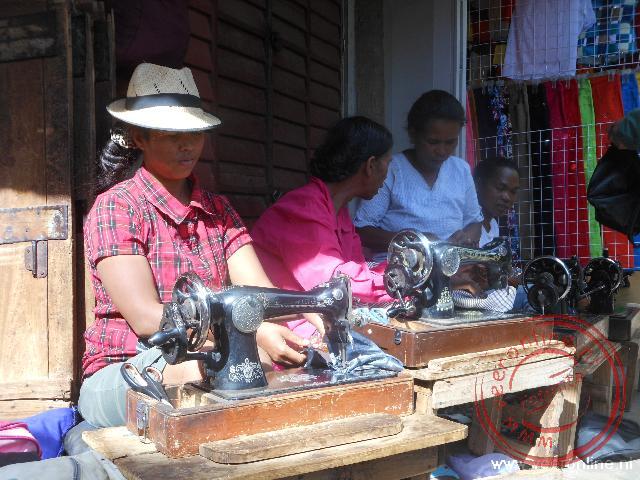 Seamstresses repair clothes at the local market
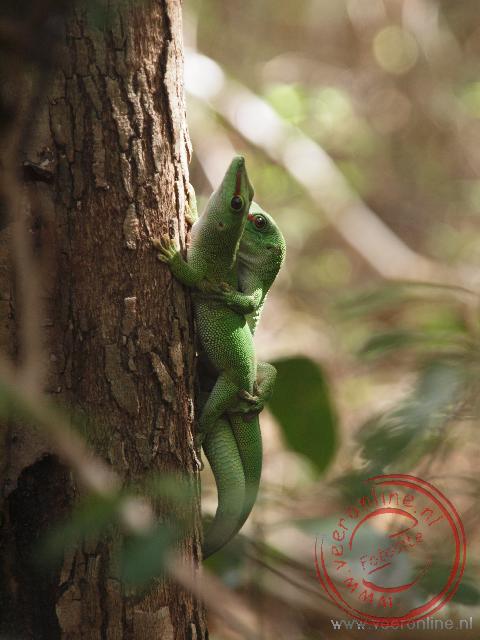 Two lizards on a tree trunk
 The asphalt is laid but no longer maintained
 Walking through Ankarana National Park
Travelogue Madagascar the Island of Lemurs
Dag 2 | Madagascar > Chameleons in all shapes and sizes
Dag 3 | Madagascar > The haunting call of the indri-indri
Dag 4 | Madagascar > Playing football with local youth
Dag 5 | Madagascar > In the Pousse-pousse
Dag 6 | Madagascar > Travel day to Ranomafana
Dag 7 | Madagascar > Lemurs in the National Park
Dag 8 | Madagascar > To Ambalavao
Dag 9 | Madagascar > Ring-tailed lemurs everywhere
Dag 10 | Madagascar > Climbing the Chameleon
Dag 11 | Madagascar > Resting by the pool
Dag 12 | Madagascar > Isalo National Park
Dag 13 | Madagascar > To Tulear and Ifaty
Dag 14 | Madagascar > Fishing boats on the beach
Dag 15 | Madagascar > Flight to Antananarivo
Dag 16 | Madagascar > Tsingy Rouge rock formations
Dag 17 | Madagascar > Les Trois Baies
Dag 18 | Madagascar > The Tsingy Tsingy rocks
Dag 19 | Madagascar > Ankarana National Park
Dag 20 | Madagascar > By boat to Nosy Be
Dag 21 | Madagascar > Swimming with turtles
Dag 22 | Madagascar > Canoeing to the black lemur
Dag 23 | Madagascar > Farewell to Nosy Be
Dag 24 | Madagascar > Wandering through Antananarivo
Dag 25 | Madagascar > On the way to Paris