
154 countries
(and areas)
 - Belize
- Benin
- Bhutan
- Bolivia
- Bonaire
- Bosnia and Herzegovina
- Botswana
- Brazil
- British Virgin Islands
- Brunei
- Bulgaria
- Cambodia
- Canada
- Cape Verde
- Chile
- China
- Costa Rica
- Croatia
- Cuba
- Curacao
- Cyprus
- Czech Republic
- Denmark
- Dominica
- Dominican Republic
- Egypt
- El Salvador
- England
- Estonia
- Eswatini (Swaziland)
- Ethiopia
- Fiji
- Finland
- France
- French Guiana
- Georgia
- Germany
- Gibraltar
- Greece
- Grenada
- Guadeloupe
- Guatemala
- Honduras
- Hong Kong
- Hungary
- Iceland
- India
- Indonesia
- Iran
- Ireland
- Israel
- Italy
- Jamaica
- Japan
- Jordan
- Kazakhstan
- Kenya
- Kosovo
- Kuwait
- Kyrgyzstan
- Laos
- Latvia
- Lebanon
- Lesotho
- Liechtenstein
- Lithuania
- Luxembourg
- Macau
- Madagascar
- Malawi
- Malaysia
- Maldives
- Malta
- Martinique
- Mexico
- Moldova
- Monaco
- Mongolia
- Montenegro
- Morocco
- Mozambique
- Namibia
- Nepal
- Netherlands
- New Zealand
- Nicaragua
- North Macedonia
- Northern Ireland
- Norway
- Oman
- Pakistan
- Palestine
- Peru
- Philippines
- Poland
- Portugal
- Qatar
- Republic of Korea
- Romania
- Russia
- Saint Kitts and Nevis
- Saint Lucia
- Saint Martin
- Saint Vincent and the Grenadines
- San Marino
- São Tomé and Principe
- Saudi Arabia
- Scotland
- Senegal
- Serbia
- Singapore
- Sint Maarten
- Slovakia
- Slovenia
- South Africa
- Spain
- Sri Lanka
- Suriname
- Sweden
- Switzerland
- Tajikistan
- Tanzania
- Thailand
- The Gambia
- Tibet
- Togo
- Transnistria
- Trinidad and Tobago
- Tunisia
- Turkey
- Turkmenistan
- Uganda
- United Arab Emirates
- United States
- Uruguay
- Uzbekistan
- Vatican City
- Vietnam
- Wales
- Zambia
- Zanzibar
- Belize
- Benin
- Bhutan
- Bolivia
- Bonaire
- Bosnia and Herzegovina
- Botswana
- Brazil
- British Virgin Islands
- Brunei
- Bulgaria
- Cambodia
- Canada
- Cape Verde
- Chile
- China
- Costa Rica
- Croatia
- Cuba
- Curacao
- Cyprus
- Czech Republic
- Denmark
- Dominica
- Dominican Republic
- Egypt
- El Salvador
- England
- Estonia
- Eswatini (Swaziland)
- Ethiopia
- Fiji
- Finland
- France
- French Guiana
- Georgia
- Germany
- Gibraltar
- Greece
- Grenada
- Guadeloupe
- Guatemala
- Honduras
- Hong Kong
- Hungary
- Iceland
- India
- Indonesia
- Iran
- Ireland
- Israel
- Italy
- Jamaica
- Japan
- Jordan
- Kazakhstan
- Kenya
- Kosovo
- Kuwait
- Kyrgyzstan
- Laos
- Latvia
- Lebanon
- Lesotho
- Liechtenstein
- Lithuania
- Luxembourg
- Macau
- Madagascar
- Malawi
- Malaysia
- Maldives
- Malta
- Martinique
- Mexico
- Moldova
- Monaco
- Mongolia
- Montenegro
- Morocco
- Mozambique
- Namibia
- Nepal
- Netherlands
- New Zealand
- Nicaragua
- North Macedonia
- Northern Ireland
- Norway
- Oman
- Pakistan
- Palestine
- Peru
- Philippines
- Poland
- Portugal
- Qatar
- Republic of Korea
- Romania
- Russia
- Saint Kitts and Nevis
- Saint Lucia
- Saint Martin
- Saint Vincent and the Grenadines
- San Marino
- São Tomé and Principe
- Saudi Arabia
- Scotland
- Senegal
- Serbia
- Singapore
- Sint Maarten
- Slovakia
- Slovenia
- South Africa
- Spain
- Sri Lanka
- Suriname
- Sweden
- Switzerland
- Tajikistan
- Tanzania
- Thailand
- The Gambia
- Tibet
- Togo
- Transnistria
- Trinidad and Tobago
- Tunisia
- Turkey
- Turkmenistan
- Uganda
- United Arab Emirates
- United States
- Uruguay
- Uzbekistan
- Vatican City
- Vietnam
- Wales
- Zambia
- Zanzibar


Copyright 2004 - 2026
Veeronline.nl Travel Adventures
Home > Madagascar > Madagascar the Island of Lemurs > Travelogue day 22
Travelogue Madagascar the Island of Lemurs
October 14 November 7 2014 (25 days)
Madagascar > Canoeing to the black lemur
Dag 22 - Tuesday, November 4, 2014When I step outside, I see that it rained during the night. During breakfast, I immediately feel the humid warmth of the evaporating water. These rain showers are a sign of the approaching rainy season. In Madagascar, the rainy season runs from mid-November to early April. During these months, it can also be quite windy, and in the past, several cyclones have caused significant damage. Exactly at eight o’clock, Donald arrives. Today he will take me to the Lokobe Rainforest. To get there, I first need to cross to the other side of the island, and then travel by traditional canoe, a pirogue, to the park. In the harbor town of Hell-Ville, Donald stops to buy supplies for lunch. I have time to wander through the market and the streets. I think I will never get used to the smell of dried fish. What a stench! As we continue toward Lokobe, Donald suddenly stops. He has spotted a bright green chameleon in the trees—a magnificent specimen. I am impressed that he saw the animal from a moving car, while I already struggle to spot it when standing right in front of the tree. Donald beams and explains that he is a senior guide, having worked as a guide for over twenty years.

At the village of Ambatoxavavy, I get out. Donald explains that it is low tide, so I have to walk a short distance through the dry riverbed. He assures me that we can paddle back to the village this afternoon. I see the pirogues already ready. Carefully, I step into the narrow wooden canoe. The extra float on the right side keeps the canoe stable on the water. When I ask why the float is always on the right side of a pirogue, he gives a long, unclear answer. I gather that the float is usually on the sea side to break the waves, while boats from India have the float on the left. In my opinion, since a fisherman always goes out and returns, any advantage is neutralized. I decide not to ask further. I paddle into the water, relieved that there is another crew member at the back of the canoe paddling with full force. In total, we cover about three kilometers by canoe. Donald points out the beach of Lokobe in the distance. Although I am thrilled to row such a traditional canoe, the beach slowly approaches. I’m happy when the pirogue finally runs onto the sand at the national park. I follow Donald into the park. Immediately, he points out various fruits and trees. He also spots another chameleon—the female of the species I saw this morning.

But my main reason for visiting the park is the black lemur—a species in which the male is completely black and the female brown with a white collar around her head. It takes some effort to find the lemurs. I have less trouble with the mosquitoes and cicadas. The mosquitoes mainly target my ankles, and the cicadas produce a continuous loud whistling sound. In a tree, a sporty lemur is sleeping, clearly unfazed by the cicadas. Looking around, I see several more sleeping in the trees. These nocturnal animals sleep during the day with their eyes open. Fortunately, Donald spots a black lemur further along among the branches. He, too, seems relieved. The little animal jumps from branch to branch. As I venture further into the park, I see several groups of black lemurs, including young ones among them.

After about two hours, I return to the village and the beach. By now, a large lunch has been prepared. I find that I don’t have much appetite, which is a shame, because the fish, crab, and shrimp look delicious. As usual, there’s far more food than needed—likely entire families will eat it once I leave. A strong wind has picked up over the sea. Donald looks a bit concerned. We should wait until the wind calms down. In my experience, the wind usually increases every afternoon. However, Donald is right. Around three o’clock, the sea is calmer. I step into the canoe and paddle back to Ambatoxavavy. It is now high tide. The difference between low and high tide is as much as five meters. We paddle close to the shore. Dark clouds appear overhead—could it rain? Fortunately, the dark cloud passes without a drop, and after an hour of paddling, we reach Ambatoxavavy. By van, I return to the hotel. In the evening, I have no appetite for food and decide to go to bed early. I am simply tired. Just as I lie down, the power goes out, taking the air conditioning with it.

I turn over under my mosquito net and fall asleep. I wake to some rustling at the door. The door opens and a flashlight shines in. I am startled, but the hotel staff are even more surprised when I ask who it is—they hadn’t expected anyone to be inside. She hurries away. It turns out that only my bungalow and the one above me are without power. The fuse box is next to my bed. A little later, Zoe knocks to check if the staff can access the box. After that, I quickly fall asleep again.
 Madagascar
 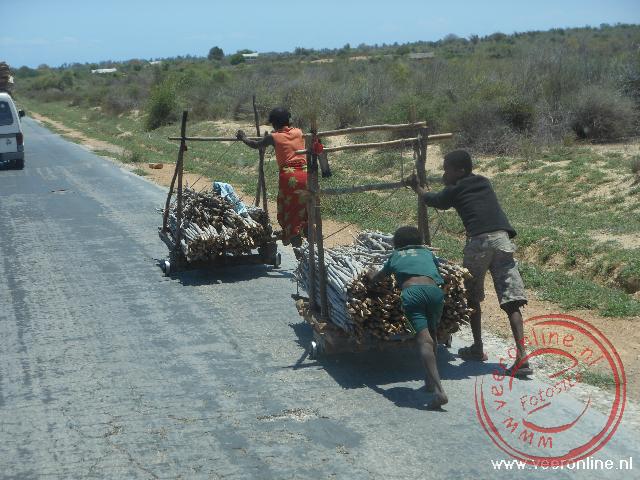 Children use carts to transport their wood
 Children along the roadside
 A chameleon can look in two different directions at once
 A bamboo lemur in Andasibe
Travelogue Madagascar the Island of Lemurs
Dag 2 | Madagascar > Chameleons in all shapes and sizes
Dag 3 | Madagascar > The haunting call of the indri-indri
Dag 4 | Madagascar > Playing football with local youth
Dag 5 | Madagascar > In the Pousse-pousse
Dag 6 | Madagascar > Travel day to Ranomafana
Dag 7 | Madagascar > Lemurs in the National Park
Dag 8 | Madagascar > To Ambalavao
Dag 9 | Madagascar > Ring-tailed lemurs everywhere
Dag 10 | Madagascar > Climbing the Chameleon
Dag 11 | Madagascar > Resting by the pool
Dag 12 | Madagascar > Isalo National Park
Dag 13 | Madagascar > To Tulear and Ifaty
Dag 14 | Madagascar > Fishing boats on the beach
Dag 15 | Madagascar > Flight to Antananarivo
Dag 16 | Madagascar > Tsingy Rouge rock formations
Dag 17 | Madagascar > Les Trois Baies
Dag 18 | Madagascar > The Tsingy Tsingy rocks
Dag 19 | Madagascar > Ankarana National Park
Dag 20 | Madagascar > By boat to Nosy Be
Dag 21 | Madagascar > Swimming with turtles
Dag 22 | Madagascar > Canoeing to the black lemur
Dag 23 | Madagascar > Farewell to Nosy Be
Dag 24 | Madagascar > Wandering through Antananarivo
Dag 25 | Madagascar > On the way to Paris