
153 countries
(and areas)
 - Azerbaijan
- Bahrain
- Barbados
- Belgium
- Belize
- Benin
- Bhutan
- Bolivia
- Bonaire
- Bosnia and Herzegovina
- Botswana
- Brazil
- British Virgin Islands
- Brunei
- Bulgaria
- Cambodia
- Canada
- Cape Verde
- Chile
- China
- Costa Rica
- Croatia
- Cuba
- Curacao
- Cyprus
- Czech Republic
- Denmark
- Dominica
- Dominican Republic
- Egypt
- El Salvador
- England
- Estonia
- Eswatini (Swaziland)
- Ethiopia
- Fiji
- Finland
- France
- French Guiana
- Georgia
- Germany
- Gibraltar
- Greece
- Grenada
- Guadeloupe
- Guatemala
- Honduras
- Hong Kong
- Hungary
- Iceland
- India
- Indonesia
- Iran
- Ireland
- Israel
- Italy
- Jamaica
- Japan
- Jordan
- Kazakhstan
- Kenya
- Kosovo
- Kuwait
- Kyrgyzstan
- Laos
- Latvia
- Lebanon
- Lesotho
- Liechtenstein
- Lithuania
- Luxembourg
- Macau
- Madagascar
- Malawi
- Malaysia
- Maldives
- Malta
- Martinique
- Mexico
- Moldova
- Monaco
- Mongolia
- Montenegro
- Morocco
- Mozambique
- Namibia
- Nepal
- Netherlands
- New Zealand
- Nicaragua
- North Macedonia
- Northern Ireland
- Norway
- Oman
- Pakistan
- Palestine
- Peru
- Philippines
- Poland
- Portugal
- Qatar
- Republic of Korea
- Romania
- Russia
- Saint Kitts and Nevis
- Saint Lucia
- Saint Martin
- Saint Vincent and the Grenadines
- San Marino
- Saudi Arabia
- Scotland
- Senegal
- Serbia
- Singapore
- Sint Maarten
- Slovakia
- Slovenia
- South Africa
- Spain
- Sri Lanka
- Suriname
- Sweden
- Switzerland
- Tajikistan
- Tanzania
- Thailand
- The Gambia
- Tibet
- Togo
- Transnistria
- Trinidad and Tobago
- Tunisia
- Turkey
- Turkmenistan
- Uganda
- United Arab Emirates
- United States
- Uruguay
- Uzbekistan
- Vatican City
- Vietnam
- Wales
- Zambia
- Zanzibar
- Azerbaijan
- Bahrain
- Barbados
- Belgium
- Belize
- Benin
- Bhutan
- Bolivia
- Bonaire
- Bosnia and Herzegovina
- Botswana
- Brazil
- British Virgin Islands
- Brunei
- Bulgaria
- Cambodia
- Canada
- Cape Verde
- Chile
- China
- Costa Rica
- Croatia
- Cuba
- Curacao
- Cyprus
- Czech Republic
- Denmark
- Dominica
- Dominican Republic
- Egypt
- El Salvador
- England
- Estonia
- Eswatini (Swaziland)
- Ethiopia
- Fiji
- Finland
- France
- French Guiana
- Georgia
- Germany
- Gibraltar
- Greece
- Grenada
- Guadeloupe
- Guatemala
- Honduras
- Hong Kong
- Hungary
- Iceland
- India
- Indonesia
- Iran
- Ireland
- Israel
- Italy
- Jamaica
- Japan
- Jordan
- Kazakhstan
- Kenya
- Kosovo
- Kuwait
- Kyrgyzstan
- Laos
- Latvia
- Lebanon
- Lesotho
- Liechtenstein
- Lithuania
- Luxembourg
- Macau
- Madagascar
- Malawi
- Malaysia
- Maldives
- Malta
- Martinique
- Mexico
- Moldova
- Monaco
- Mongolia
- Montenegro
- Morocco
- Mozambique
- Namibia
- Nepal
- Netherlands
- New Zealand
- Nicaragua
- North Macedonia
- Northern Ireland
- Norway
- Oman
- Pakistan
- Palestine
- Peru
- Philippines
- Poland
- Portugal
- Qatar
- Republic of Korea
- Romania
- Russia
- Saint Kitts and Nevis
- Saint Lucia
- Saint Martin
- Saint Vincent and the Grenadines
- San Marino
- Saudi Arabia
- Scotland
- Senegal
- Serbia
- Singapore
- Sint Maarten
- Slovakia
- Slovenia
- South Africa
- Spain
- Sri Lanka
- Suriname
- Sweden
- Switzerland
- Tajikistan
- Tanzania
- Thailand
- The Gambia
- Tibet
- Togo
- Transnistria
- Trinidad and Tobago
- Tunisia
- Turkey
- Turkmenistan
- Uganda
- United Arab Emirates
- United States
- Uruguay
- Uzbekistan
- Vatican City
- Vietnam
- Wales
- Zambia
- Zanzibar


Copyright 2004 - 2026
Veeronline.nl Travel Adventures
Home > Argentina > Uruguay Argentina and Brazil > Travelogue day 7
Travelogue Uruguay Argentina and Brazil
September 26 October 20 2019 (25 days)
Argentina > Cycling Tour through Buenos Aires
Dag 7 - Wednesday 2 October 2019Today I’m going on a bike ride through the northern districts of Buenos Aires: Retiro, Recoleta, and Palermo. Everyone in the group is joining today. Nice! To get to the starting point, we have to take the metro for a short distance. From the hotel, we walk to Avenue 9 de Julio. Here, I descend into the metro. The first train is packed—no one can squeeze in anymore. We spread out along the platform to increase our chances. The next train is also overcrowded. At the door where I’m standing, a few people get off, just enough for me to step inside. On the train, I don’t need to hold onto anything—falling over is impossible. Still, I’m extra alert with my valuables, though a potential pickpocket can hardly move either. Two stops later, at Avenue de Mayo, most passengers leave the train, giving us more space. I get off at Parque San Martín. It turns out that three group members didn’t manage to board the train and will arrive with the next one. At Parque San Martín, twenty bicycles are waiting. I also meet Alex again. Together with Paulus, he will guide me through the city by bike today. He talks with as much enthusiasm as yesterday about the statue of General San Martín, the founder of Chile, Peru, and Argentina; the war memorial for the fallen in the Falklands War; and the Torre Monumental (the British Tower). We then cycle west along Avenue Del Libertador. I pass the Floralis Genérica, a large mechanical flower made of steel and aluminum, an artwork in a park. I also pass the planetarium and the rose garden—unfortunately, the roses are not in bloom at this time of year. The neighborhoods I ride through are strikingly green, with large parks, grassy fields, and broad tree-lined roads. Along the way, there are impressive statues on the roundabouts and in the parks.

Alex explains that many countries donated statues to commemorate Argentina’s centenary of independence in 1810. He is notably less enthusiastic about the French contribution. I mostly cycle along bike lanes next to the avenue, often going up and down curbs. The lanes are narrow, and sometimes we get angry reactions from oncoming cyclists when we ride too wide as a group. Since we follow the avenue, we don’t have to cross any tricky intersections. Every crossing has traffic lights. After a lunch break, we arrive at the somewhat remote statue of Evita Perón. Alex explains that Argentines either adore or despise her. Together with her husband, President Juan Perón, she championed the cause of poor Argentines. Due to her popularity, Juan often had her address the people from the balcony at Plaza de Mayo. Their aid to the poor was funded through expropriations—land was seized, and anyone who owned two houses had to give up one. Argentina’s elite hated the Peróns, believing they were buying votes with these programs. Evita died in 1952 at the age of 38 from cancer. Not everyone in Argentina mourned her death. After a military coup, the authorities feared her enduring popularity, even posthumously. Her body was buried anonymously outside Argentina. Fourteen years later, it emerged that she had been buried in Milan. Her remains were returned to Argentina and, in 1976, placed in the family tomb in Recoleta Cemetery. This cemetery is also the final stop of our bike ride. It is the resting place of Buenos Aires’ wealthy elite. The graves are true showpieces. I walk among the tall mausoleums—it feels like a city of the dead, where families want to be remembered even after death.

I visit Evita Perón’s grave. Her body rests in the Duarte family tomb, in a modest mausoleum tucked away in a narrow alley of the cemetery—perhaps not the place she truly deserved? Next to the cemetery stands La Iglesia de Nuestra Señora del Pilar, completed in 1732 as part of a Franciscan monastery. From here, I ride back to the starting point, which requires a short stretch along the wide traffic artery Avenida 9 de Julio. Carefully, I ride with the group in the right lane as cars pass on the left. We arrive safely back at the bike rental shop. It’s now four o’clock. In the city center, I go with a few group members to find a place for a beer. We pass the stately shopping center Galerías Pacífico. I step inside briefly. Luxurious stores sell lavish products, but it’s the building itself that captures my attention. The shops are framed by old facades beneath a modern glass roof—beautiful! A little further along the street, I order a beer. It’s happy hour in the café. The Centro Cultural Kirchner is open today—after finding its doors closed twice before. The old central post office has been converted into an exhibition and theater space. From the outside, the building retains its early 20th-century style. A century later, it has been completely renovated. Inside, I see the original wooden revolving doors, counters, and stained glass ceiling. The large central hall has been rebuilt in a modern style, with a theater seemingly suspended in the middle. It’s wonderful that this characteristic building has been preserved for the city in this way. On the way back to the hotel, I pass the cathedral on Plaza de Mayo one last time. With this, I end my sightseeing in Buenos Aires. I think I’ve made the most of the past few days to see as much of this world city as possible.
 Brazil
  The water level during the wet season is visible even on the trees
 The walk in the Pantanal ends at dusk
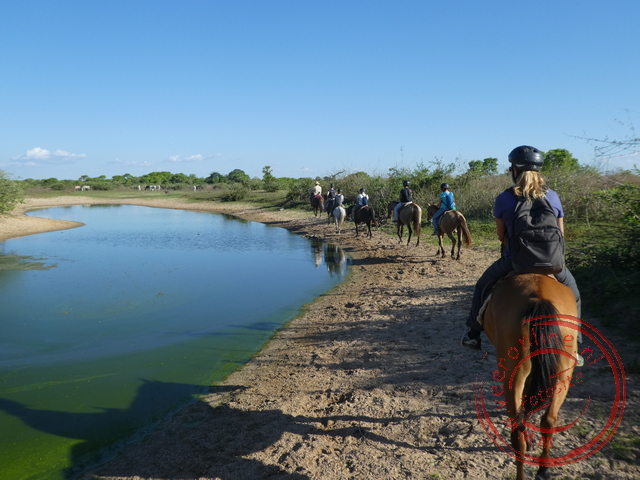 Exploring the beautiful Pantanal area on horseback
 On horseback searching for animals
Travelogue Uruguay Argentina and Brazil
Dag 2 | Uruguay > Wandering through Colonia
Dag 3 | Uruguay > By Bus to Montevideo
Dag 4 | Uruguay > To the Theatre in Montevideo
Dag 5 | Argentina > Back to Buenos Aires
Dag 6 | Argentina > Walking to La Boca
Dag 7 | Argentina > Cycling Tour through Buenos Aires
Dag 8 | Brazil > To the Iguazú Falls
Dag 9 | Brazil > Under the Iguazú Falls
Dag 10 | Brazil > Spotting Toucans and Macaws
Dag 11 | Brazil > The Blue Grotto
Dag 12 | Brazil > Snorkeling among the Fish
Dag 13 | Brazil > Safari in the Pantanal
Dag 14 | Brazil > By Canoe through the Pantanal
Dag 15 | Brazil > Fishing for Piranhas
Dag 16 | Brazil > Via São Paulo to Paraty
Dag 17 | Brazil > Hiking Along the Beaches
Dag 18 | Brazil > The Saco Bravo Waterfall
Dag 19 | Brazil > Ilha Grande
Dag 20 | Brazil > To Praia de Lopes Mendes
Dag 21 | Brazil > Dois Rios by Mountain Bike
Dag 22 | Brazil > Rio de Janeiro
Dag 23 | Brazil > Rio de Janeiro
Dag 24 | Brazil > Delta Flight or Not?
Dag 25 | Brazil > Back via Voorhout