
153 countries
(and areas)
 - Azerbaijan
- Bahrain
- Barbados
- Belgium
- Belize
- Benin
- Bhutan
- Bolivia
- Bonaire
- Bosnia and Herzegovina
- Botswana
- Brazil
- British Virgin Islands
- Brunei
- Bulgaria
- Cambodia
- Canada
- Cape Verde
- Chile
- China
- Costa Rica
- Croatia
- Cuba
- Curacao
- Cyprus
- Czech Republic
- Denmark
- Dominica
- Dominican Republic
- Egypt
- El Salvador
- England
- Estonia
- Eswatini (Swaziland)
- Ethiopia
- Fiji
- Finland
- France
- French Guiana
- Georgia
- Germany
- Gibraltar
- Greece
- Grenada
- Guadeloupe
- Guatemala
- Honduras
- Hong Kong
- Hungary
- Iceland
- India
- Indonesia
- Iran
- Ireland
- Israel
- Italy
- Jamaica
- Japan
- Jordan
- Kazakhstan
- Kenya
- Kosovo
- Kuwait
- Kyrgyzstan
- Laos
- Latvia
- Lebanon
- Lesotho
- Liechtenstein
- Lithuania
- Luxembourg
- Macau
- Madagascar
- Malawi
- Malaysia
- Maldives
- Malta
- Martinique
- Mexico
- Moldova
- Monaco
- Mongolia
- Montenegro
- Morocco
- Mozambique
- Namibia
- Nepal
- Netherlands
- New Zealand
- Nicaragua
- North Macedonia
- Northern Ireland
- Norway
- Oman
- Pakistan
- Palestine
- Peru
- Philippines
- Poland
- Portugal
- Qatar
- Republic of Korea
- Romania
- Russia
- Saint Kitts and Nevis
- Saint Lucia
- Saint Martin
- Saint Vincent and the Grenadines
- San Marino
- Saudi Arabia
- Scotland
- Senegal
- Serbia
- Singapore
- Sint Maarten
- Slovakia
- Slovenia
- South Africa
- Spain
- Sri Lanka
- Suriname
- Sweden
- Switzerland
- Tajikistan
- Tanzania
- Thailand
- The Gambia
- Tibet
- Togo
- Transnistria
- Trinidad and Tobago
- Tunisia
- Turkey
- Turkmenistan
- Uganda
- United Arab Emirates
- United States
- Uruguay
- Uzbekistan
- Vatican City
- Vietnam
- Wales
- Zambia
- Zanzibar
- Azerbaijan
- Bahrain
- Barbados
- Belgium
- Belize
- Benin
- Bhutan
- Bolivia
- Bonaire
- Bosnia and Herzegovina
- Botswana
- Brazil
- British Virgin Islands
- Brunei
- Bulgaria
- Cambodia
- Canada
- Cape Verde
- Chile
- China
- Costa Rica
- Croatia
- Cuba
- Curacao
- Cyprus
- Czech Republic
- Denmark
- Dominica
- Dominican Republic
- Egypt
- El Salvador
- England
- Estonia
- Eswatini (Swaziland)
- Ethiopia
- Fiji
- Finland
- France
- French Guiana
- Georgia
- Germany
- Gibraltar
- Greece
- Grenada
- Guadeloupe
- Guatemala
- Honduras
- Hong Kong
- Hungary
- Iceland
- India
- Indonesia
- Iran
- Ireland
- Israel
- Italy
- Jamaica
- Japan
- Jordan
- Kazakhstan
- Kenya
- Kosovo
- Kuwait
- Kyrgyzstan
- Laos
- Latvia
- Lebanon
- Lesotho
- Liechtenstein
- Lithuania
- Luxembourg
- Macau
- Madagascar
- Malawi
- Malaysia
- Maldives
- Malta
- Martinique
- Mexico
- Moldova
- Monaco
- Mongolia
- Montenegro
- Morocco
- Mozambique
- Namibia
- Nepal
- Netherlands
- New Zealand
- Nicaragua
- North Macedonia
- Northern Ireland
- Norway
- Oman
- Pakistan
- Palestine
- Peru
- Philippines
- Poland
- Portugal
- Qatar
- Republic of Korea
- Romania
- Russia
- Saint Kitts and Nevis
- Saint Lucia
- Saint Martin
- Saint Vincent and the Grenadines
- San Marino
- Saudi Arabia
- Scotland
- Senegal
- Serbia
- Singapore
- Sint Maarten
- Slovakia
- Slovenia
- South Africa
- Spain
- Sri Lanka
- Suriname
- Sweden
- Switzerland
- Tajikistan
- Tanzania
- Thailand
- The Gambia
- Tibet
- Togo
- Transnistria
- Trinidad and Tobago
- Tunisia
- Turkey
- Turkmenistan
- Uganda
- United Arab Emirates
- United States
- Uruguay
- Uzbekistan
- Vatican City
- Vietnam
- Wales
- Zambia
- Zanzibar


Copyright 2004 - 2026
Veeronline.nl Travel Adventures

Home > Brazil > Uruguay Argentina and Brazil > Travelogue day 15
Travelogue Uruguay Argentina and Brazil
September 26 October 20 2019 (25 days)
Brazil > Fishing for Piranhas
Dag 15 - Thursday 10 October 2019I wake up early. Before sunrise, I can already hear the birds making noise in the trees. The wildlife is slowly coming back to life. During breakfast, Gino walks in. An anaconda snake has been spotted behind the farm. Would I like to see it? Outside, I find Fabio proudly holding the young anaconda in his hands. The anaconda is the largest species of snake in the world—not in length, but in weight. A fully grown anaconda can reach up to eight meters long and weigh over 200 kilos. Fabio asks if I want to hold it. He carefully holds the head, I hold the middle and the tail. I feel the muscles moving, and with its tail, the animal tries to wrap around my arm. A bite from an anaconda is not poisonous, but its sharp teeth hold the prey tightly. The prey is strangled by the body.
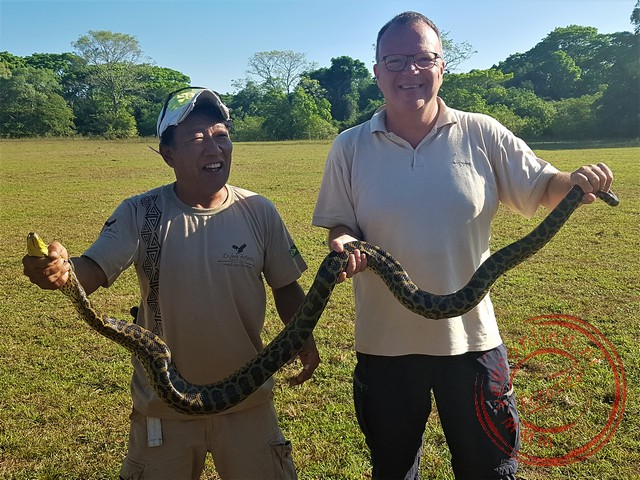
The snake can easily eat animals much larger than itself. Its jaw can open 180 degrees. The snake does smell bad. I quickly wash my hands with soap. Today is the last day in the Pantanal. Each group does the activity they haven’t done yet. I have not yet fished for piranhas. These predatory fish swim in the river behind the farm. I follow Fabio to the water. He has a stack of bamboo fishing rods. At the water’s edge, he attaches a piece of meat to my hook. I cast the bait into the river. Across the water, a few caimans watch me with their eyes just above the surface. Maybe they are hoping for any fish that might get caught. I don’t have to wait long. I feel the line being pulled. The bait is eaten from the hook. Some fish are too clever. Fabio puts on a new piece. Several times, the meat is nibbled. Suddenly, I feel a stronger pull. I reel in the rod and a small fish hangs from the hook. I’ve got a bite! I quickly take a photo with the catch. “A Piau fish,” says Fabio. A fish often served in restaurants. One of my travel companions hooks a piranha. Carefully, Fabio removes the hook from between its sharp teeth. The fun thing about fishing here is you don’t have to wait long. Almost immediately the bait is nibbled. I catch a second fish—a predatory fish. By now, the group has three fish on the shore. “We will feed the caimans with these after we’re done,” Fabio explains. Every next fish is released again.
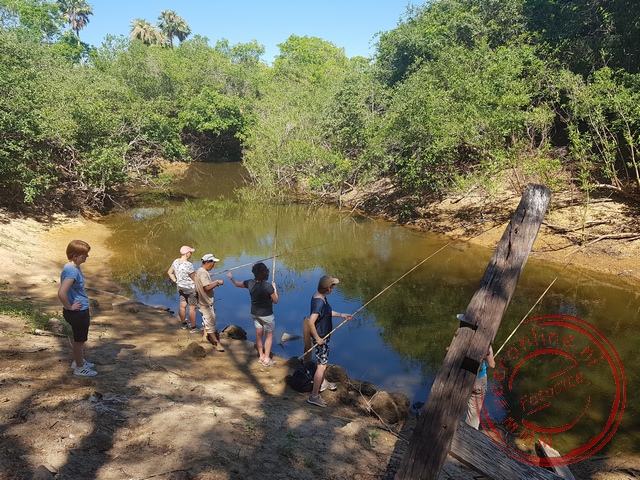
The water moves quite a bit. Someone has a bite. It turns out to be a caiman whose leg got caught in the line. With a lot of struggling, it tries to swim away. The rope breaks. After an hour and a half, we have caught several fish. Fabio ties one of the saved fish to a rope. With the dead fish, he slaps the water. The caimans hardly react. A few swim over but don’t bite. “They’re not hungry,” Fabio apologizes. Just as he throws the fish into the water, the caimans arrive. With a second fish on the line, the caiman bites. It follows the fish onto land. With its jaws, it smashes the fish. A beautiful sight. Back at the lodge, Mattheus is ready with mate tea. According to him, this is the best and most flavorful mate tea in Brazil. I try a few sips. The taste lingers somewhere between like and dislike. I don’t think this will be my favorite drink. I order a cola and walk past the lunch buffet for the last time. Before I get in the truck for the return journey, the farm staff say goodbye. Mattheus hugs me and Gino gives me a firm handshake. What hospitality. On the way back, I sit in the other car. Unlike the way there, this car doesn’t have foam rubber benches. I sit directly on the wood. The bench is wider, though, and placed perpendicular to the car. I’m surprised how rarely I get thrown off the bench by the bumps. The steel roof, however, makes a lot of noise. I wonder if the structure will survive the potholes in the road. At the main road, our driver is waiting again with the bus. He has been in Bonito for the past two days, he says in Portuguese. He drives me further to Campo Grande, a large city in the region about a five-hour drive away. From there, I fly to São Paulo tomorrow. Outside, the Pantanal landscape gradually turns into a dry landscape. Near Campo Grande, spectacular rock formations rise. Behind them, dark clouds hang. A rain shower passes. When I enter Campo Grande, it is dark and dry. It hasn’t rained here. The dark streets look deserted. The hotel is near the airport—not the liveliest part of the city. Nearby is a fish restaurant.

All dishes are served for two people. If you want to order a dish alone, you pay an extra fee. Funny. On the corner near the hotel is a typical Brazilian street restaurant. You can get something to eat here, but most people come for a drink. The bright yellow plastic chairs and tables fit this atmosphere. With a few travel companions, I take a seat and order beer. A fun way to end the day. The waiter signals me to point out the beer I want myself from the fridge. A boy with a guitar sings Brazilian songs. People sing along from the terrace.
 Argentina
 Uruguay


Travelogue Uruguay Argentina and Brazil
Dag 2 | Uruguay > Wandering through Colonia
Dag 3 | Uruguay > By Bus to Montevideo
Dag 4 | Uruguay > To the Theatre in Montevideo
Dag 5 | Argentina > Back to Buenos Aires
Dag 6 | Argentina > Walking to La Boca
Dag 7 | Argentina > Cycling Tour through Buenos Aires
Dag 8 | Brazil > To the Iguazú Falls
Dag 9 | Brazil > Under the Iguazú Falls
Dag 10 | Brazil > Spotting Toucans and Macaws
Dag 11 | Brazil > The Blue Grotto
Dag 12 | Brazil > Snorkeling among the Fish
Dag 13 | Brazil > Safari in the Pantanal
Dag 14 | Brazil > By Canoe through the Pantanal
Dag 15 | Brazil > Fishing for Piranhas
Dag 16 | Brazil > Via São Paulo to Paraty
Dag 17 | Brazil > Hiking Along the Beaches
Dag 18 | Brazil > The Saco Bravo Waterfall
Dag 19 | Brazil > Ilha Grande
Dag 20 | Brazil > To Praia de Lopes Mendes
Dag 21 | Brazil > Dois Rios by Mountain Bike
Dag 22 | Brazil > Rio de Janeiro
Dag 23 | Brazil > Rio de Janeiro
Dag 24 | Brazil > Delta Flight or Not?
Dag 25 | Brazil > Back via Voorhout