
154 countries
(and areas)
 - Belize
- Benin
- Bhutan
- Bolivia
- Bonaire
- Bosnia and Herzegovina
- Botswana
- Brazil
- British Virgin Islands
- Brunei
- Bulgaria
- Cambodia
- Canada
- Cape Verde
- Chile
- China
- Costa Rica
- Croatia
- Cuba
- Curacao
- Cyprus
- Czech Republic
- Denmark
- Dominica
- Dominican Republic
- Egypt
- El Salvador
- England
- Estonia
- Eswatini (Swaziland)
- Ethiopia
- Fiji
- Finland
- France
- French Guiana
- Georgia
- Germany
- Gibraltar
- Greece
- Grenada
- Guadeloupe
- Guatemala
- Honduras
- Hong Kong
- Hungary
- Iceland
- India
- Indonesia
- Iran
- Ireland
- Israel
- Italy
- Jamaica
- Japan
- Jordan
- Kazakhstan
- Kenya
- Kosovo
- Kuwait
- Kyrgyzstan
- Laos
- Latvia
- Lebanon
- Lesotho
- Liechtenstein
- Lithuania
- Luxembourg
- Macau
- Madagascar
- Malawi
- Malaysia
- Maldives
- Malta
- Martinique
- Mexico
- Moldova
- Monaco
- Mongolia
- Montenegro
- Morocco
- Mozambique
- Namibia
- Nepal
- Netherlands
- New Zealand
- Nicaragua
- North Macedonia
- Northern Ireland
- Norway
- Oman
- Pakistan
- Palestine
- Peru
- Philippines
- Poland
- Portugal
- Qatar
- Republic of Korea
- Romania
- Russia
- Saint Kitts and Nevis
- Saint Lucia
- Saint Martin
- Saint Vincent and the Grenadines
- San Marino
- São Tomé and Principe
- Saudi Arabia
- Scotland
- Senegal
- Serbia
- Singapore
- Sint Maarten
- Slovakia
- Slovenia
- South Africa
- Spain
- Sri Lanka
- Suriname
- Sweden
- Switzerland
- Tajikistan
- Tanzania
- Thailand
- The Gambia
- Tibet
- Togo
- Transnistria
- Trinidad and Tobago
- Tunisia
- Turkey
- Turkmenistan
- Uganda
- United Arab Emirates
- United States
- Uruguay
- Uzbekistan
- Vatican City
- Vietnam
- Wales
- Zambia
- Zanzibar
- Belize
- Benin
- Bhutan
- Bolivia
- Bonaire
- Bosnia and Herzegovina
- Botswana
- Brazil
- British Virgin Islands
- Brunei
- Bulgaria
- Cambodia
- Canada
- Cape Verde
- Chile
- China
- Costa Rica
- Croatia
- Cuba
- Curacao
- Cyprus
- Czech Republic
- Denmark
- Dominica
- Dominican Republic
- Egypt
- El Salvador
- England
- Estonia
- Eswatini (Swaziland)
- Ethiopia
- Fiji
- Finland
- France
- French Guiana
- Georgia
- Germany
- Gibraltar
- Greece
- Grenada
- Guadeloupe
- Guatemala
- Honduras
- Hong Kong
- Hungary
- Iceland
- India
- Indonesia
- Iran
- Ireland
- Israel
- Italy
- Jamaica
- Japan
- Jordan
- Kazakhstan
- Kenya
- Kosovo
- Kuwait
- Kyrgyzstan
- Laos
- Latvia
- Lebanon
- Lesotho
- Liechtenstein
- Lithuania
- Luxembourg
- Macau
- Madagascar
- Malawi
- Malaysia
- Maldives
- Malta
- Martinique
- Mexico
- Moldova
- Monaco
- Mongolia
- Montenegro
- Morocco
- Mozambique
- Namibia
- Nepal
- Netherlands
- New Zealand
- Nicaragua
- North Macedonia
- Northern Ireland
- Norway
- Oman
- Pakistan
- Palestine
- Peru
- Philippines
- Poland
- Portugal
- Qatar
- Republic of Korea
- Romania
- Russia
- Saint Kitts and Nevis
- Saint Lucia
- Saint Martin
- Saint Vincent and the Grenadines
- San Marino
- São Tomé and Principe
- Saudi Arabia
- Scotland
- Senegal
- Serbia
- Singapore
- Sint Maarten
- Slovakia
- Slovenia
- South Africa
- Spain
- Sri Lanka
- Suriname
- Sweden
- Switzerland
- Tajikistan
- Tanzania
- Thailand
- The Gambia
- Tibet
- Togo
- Transnistria
- Trinidad and Tobago
- Tunisia
- Turkey
- Turkmenistan
- Uganda
- United Arab Emirates
- United States
- Uruguay
- Uzbekistan
- Vatican City
- Vietnam
- Wales
- Zambia
- Zanzibar


Copyright 2004 - 2026
Veeronline.nl Travel Adventures

Home > Uruguay > Uruguay Argentina and Brazil > Travelogue day 2
Travelogue Uruguay Argentina and Brazil
September 26 October 20 2019 (25 days)
Uruguay > Wandering through Colonia
Dag 2 - Friday 27 September 2019I barely get any sleep during the night. Whenever I doze off, one of my neighbors moves, or someone needs to go to the toilet. Especially when someone in the row behind me needs to use the restroom and grabs hold of my seatback, I feel almost launched out of my seat. I notice how little legroom there is. I can’t even reach down to pick up a dropped water bottle. Slowly, agonizingly, the destination draws closer. I give up on sleeping and watch a new movie in the middle of the night. Meanwhile, I keep shifting positions to relieve pressure on my tailbone. I try putting a pillow underneath, sitting the seat upright, or twisting slightly — nothing helps for more than a few minutes. If only I were already at my destination. At six o’clock local time, my prayers are answered. The plane lands at the international airport. It feels wonderful to stretch my legs. Gabriëlla has stayed behind specifically to remind me again about the TiendaLeon taxi service. She says it’s right after the sliding doors. I shake her hand and thank her for all the information. I promise to watch my belongings carefully in Buenos Aires. Ideally, she would have dropped me off at the terminal herself to ensure I arrived safely, but she only has four nights with her own family. On Tuesday, she will travel back. At the bank, I exchange money and then follow Gabriëlla’s instructions. I order a taxi to the city centre. The friendly driver leads me to the parking lot. An old Citroën pulls up. Its suspension has clearly seen better days. I don’t mind — as long as I get into the city. The driver speaks about as much English as I do Spanish, which isn’t much. Traffic flows fairly well. Through some broken words, I understand that the Friday morning rush hasn’t yet started further ahead. This soon proves correct. Five lanes must merge into two. No one yields space, and a big traffic jam results. I don’t worry about it — I am well on time. I plan to take the twelve o’clock ferry across the Río de la Plata to Uruguay. Customs and boarding begin two hours in advance. Shortly before eight, the driver drops me off at the ferry terminal. I want to travel as light as possible to Uruguay, so I leave my main luggage at the depot. After asking several times where the depot is, I finally find it in the parking garage.
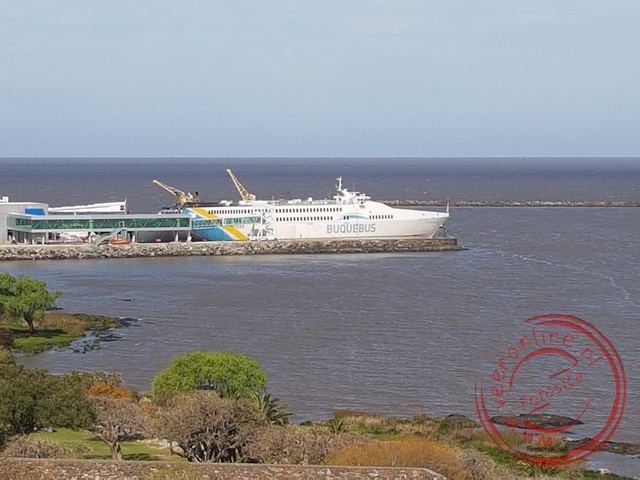
From the Spanish signs, I gather I am at the right door, but no one is around. What now? Just as I’m about to walk back to ask, an older man comes laughing, holding a large bunch of keys. He apologizes in Spanish. From his gestures, I understand that I must keep the receipt he gives me carefully. He locks the door again carefully. Inside the ferry terminal, I order coffee and a sandwich. I still have an hour and a half to wait. I step outside and cross the busy street, arriving at the inner harbour, Puerto Madero. Old warehouses have been converted into residences. A few cranes remain, reminders of earlier times. On the other side, modern sailing yachts are moored. I walk back along this side of Puerto Madero. The harbour, warehouses, and the high-rise buildings behind give Buenos Aires an elegant appearance. At ten o’clock, I check in at the counter. I get the Argentina exit stamp alongside the recently obtained Argentina entry stamp. The official gestures for me to follow. I must stand in a separate line for Uruguayan immigration. Likely, Argentine and Uruguayan citizens don’t need to do this. After the formalities, I enter the departure hall — a huge hall. Even though it’s still an hour and a half before departure, people are already queuing. I take a seat on one of the benches. The hall gradually fills with more and more people. The line also steadily grows to the back of the hall. I wonder how many people can fit on board. When the ferry arrives, the queue has become so long that the returning line loops back to the starting point. Everyone must board, and I assume there are enough seats for all passengers. On the bench, I practice a few Portuguese phrases with a Brazilian couple next to me. I quickly realize Portuguese is harder than Spanish, especially the pronunciation. On board, I ask if I can join a table. A Brazilian woman has her laptop open and is travelling to Uruguay for business. She becomes interested in my travel route through Brazil. Meanwhile, the ferry departs more than half an hour late, heading for Colonia del Sacramento. Disembarking in Uruguay goes more smoothly.

It takes a while for everyone to get off, but no lines form at customs. I walk into the town of Colonia. At the bus station, I immediately buy a bus ticket for tomorrow afternoon. Although the clerk doesn’t speak a word of English, I manage to get the correct ticket by pointing and using a bit of Spanish. I had just gotten used to the Argentine peso, and now I must adjust to Uruguayan pesos. I check in at my hotel, exchange money, and walk into the old town. Everything is within walking distance. Colonia del Sacramento was founded by the Portuguese in 1680 and later conquered by the Spanish. These influences are still visible in the streetscape. I enter the Basilica del Santísimo Sacramento, the oldest church in Uruguay. The interior is simple. At Plaza Mayor 25 de Mayo stands the striking “Faro” lighthouse. The tower is square at the base and round at the top. I climb the 34-metre tower. “Would you like me to take a photo?” asks an Argentine girl. Of course, if she takes one of me as well. A third boy from Brazil joins the line. “Can you take a photo of me too?” he asks. As we walk down, I strike up a conversation with him. His name is Flavio, and he is returning to Buenos Aires tonight, and from there back to Brazil. His vacation is over. He helps me with the pronunciation of a few Portuguese words — though I fear I’ll need more practice. At the bottom, we shake hands firmly and say goodbye.

I continue to Calle de los Suspiros, a narrow, authentic street lined with small colorful houses. Behind it stands the city wall and the entrance gate at Bastión de San Miguel. Colonia is such a charming, cozy, and above all beautiful town. I can’t stop looking around. On the other side of the historic centre lies the former port. From the pier, I look at the pleasure yachts. I spot Flavio again. He warns me not to go to the acuario, the aquarium — a complete tourist trap, in his experience. There are only a few fish. Instead, we decide to have a drink together at a terrace. Over a beer, we exchange travel experiences, talk about Brazilian politics, and he gives me tips about the country. Flavio gives me his email. If anything happens in Brazil or I have questions about the country, I can always write to him. We take one final photo together and say goodbye. Flavio has to catch his boat back to Buenos Aires. As evening falls, I hunt for “Chivito,” a traditional Uruguayan dish. I don’t have to search long — practically every restaurant has it listed: a sandwich with a hamburger, cheese, tomato, lettuce, egg, and fries. I choose a cosy-looking restaurant on Avenue Gral Flores. A good choice. Probably, by local standards, I’m eating far too early — it’s only half past six. For today, I don’t mind, and I head to bed early. After the overnight flight, I slowly drift off to sleep.
 Uruguay

 Brazil
 Argentina
Travelogue Uruguay Argentina and Brazil
Dag 2 | Uruguay > Wandering through Colonia
Dag 3 | Uruguay > By Bus to Montevideo
Dag 4 | Uruguay > To the Theatre in Montevideo
Dag 5 | Argentina > Back to Buenos Aires
Dag 6 | Argentina > Walking to La Boca
Dag 7 | Argentina > Cycling Tour through Buenos Aires
Dag 8 | Brazil > To the Iguazú Falls
Dag 9 | Brazil > Under the Iguazú Falls
Dag 10 | Brazil > Spotting Toucans and Macaws
Dag 11 | Brazil > The Blue Grotto
Dag 12 | Brazil > Snorkeling among the Fish
Dag 13 | Brazil > Safari in the Pantanal
Dag 14 | Brazil > By Canoe through the Pantanal
Dag 15 | Brazil > Fishing for Piranhas
Dag 16 | Brazil > Via São Paulo to Paraty
Dag 17 | Brazil > Hiking Along the Beaches
Dag 18 | Brazil > The Saco Bravo Waterfall
Dag 19 | Brazil > Ilha Grande
Dag 20 | Brazil > To Praia de Lopes Mendes
Dag 21 | Brazil > Dois Rios by Mountain Bike
Dag 22 | Brazil > Rio de Janeiro
Dag 23 | Brazil > Rio de Janeiro
Dag 24 | Brazil > Delta Flight or Not?
Dag 25 | Brazil > Back via Voorhout