
154 countries
(and areas)
 - Belize
- Benin
- Bhutan
- Bolivia
- Bonaire
- Bosnia and Herzegovina
- Botswana
- Brazil
- British Virgin Islands
- Brunei
- Bulgaria
- Cambodia
- Canada
- Cape Verde
- Chile
- China
- Costa Rica
- Croatia
- Cuba
- Curacao
- Cyprus
- Czech Republic
- Denmark
- Dominica
- Dominican Republic
- Egypt
- El Salvador
- England
- Estonia
- Eswatini (Swaziland)
- Ethiopia
- Fiji
- Finland
- France
- French Guiana
- Georgia
- Germany
- Gibraltar
- Greece
- Grenada
- Guadeloupe
- Guatemala
- Honduras
- Hong Kong
- Hungary
- Iceland
- India
- Indonesia
- Iran
- Ireland
- Israel
- Italy
- Jamaica
- Japan
- Jordan
- Kazakhstan
- Kenya
- Kosovo
- Kuwait
- Kyrgyzstan
- Laos
- Latvia
- Lebanon
- Lesotho
- Liechtenstein
- Lithuania
- Luxembourg
- Macau
- Madagascar
- Malawi
- Malaysia
- Maldives
- Malta
- Martinique
- Mexico
- Moldova
- Monaco
- Mongolia
- Montenegro
- Morocco
- Mozambique
- Namibia
- Nepal
- Netherlands
- New Zealand
- Nicaragua
- North Macedonia
- Northern Ireland
- Norway
- Oman
- Pakistan
- Palestine
- Peru
- Philippines
- Poland
- Portugal
- Qatar
- Republic of Korea
- Romania
- Russia
- Saint Kitts and Nevis
- Saint Lucia
- Saint Martin
- Saint Vincent and the Grenadines
- San Marino
- São Tomé and Principe
- Saudi Arabia
- Scotland
- Senegal
- Serbia
- Singapore
- Sint Maarten
- Slovakia
- Slovenia
- South Africa
- Spain
- Sri Lanka
- Suriname
- Sweden
- Switzerland
- Tajikistan
- Tanzania
- Thailand
- The Gambia
- Tibet
- Togo
- Transnistria
- Trinidad and Tobago
- Tunisia
- Turkey
- Turkmenistan
- Uganda
- United Arab Emirates
- United States
- Uruguay
- Uzbekistan
- Vatican City
- Vietnam
- Wales
- Zambia
- Zanzibar
- Belize
- Benin
- Bhutan
- Bolivia
- Bonaire
- Bosnia and Herzegovina
- Botswana
- Brazil
- British Virgin Islands
- Brunei
- Bulgaria
- Cambodia
- Canada
- Cape Verde
- Chile
- China
- Costa Rica
- Croatia
- Cuba
- Curacao
- Cyprus
- Czech Republic
- Denmark
- Dominica
- Dominican Republic
- Egypt
- El Salvador
- England
- Estonia
- Eswatini (Swaziland)
- Ethiopia
- Fiji
- Finland
- France
- French Guiana
- Georgia
- Germany
- Gibraltar
- Greece
- Grenada
- Guadeloupe
- Guatemala
- Honduras
- Hong Kong
- Hungary
- Iceland
- India
- Indonesia
- Iran
- Ireland
- Israel
- Italy
- Jamaica
- Japan
- Jordan
- Kazakhstan
- Kenya
- Kosovo
- Kuwait
- Kyrgyzstan
- Laos
- Latvia
- Lebanon
- Lesotho
- Liechtenstein
- Lithuania
- Luxembourg
- Macau
- Madagascar
- Malawi
- Malaysia
- Maldives
- Malta
- Martinique
- Mexico
- Moldova
- Monaco
- Mongolia
- Montenegro
- Morocco
- Mozambique
- Namibia
- Nepal
- Netherlands
- New Zealand
- Nicaragua
- North Macedonia
- Northern Ireland
- Norway
- Oman
- Pakistan
- Palestine
- Peru
- Philippines
- Poland
- Portugal
- Qatar
- Republic of Korea
- Romania
- Russia
- Saint Kitts and Nevis
- Saint Lucia
- Saint Martin
- Saint Vincent and the Grenadines
- San Marino
- São Tomé and Principe
- Saudi Arabia
- Scotland
- Senegal
- Serbia
- Singapore
- Sint Maarten
- Slovakia
- Slovenia
- South Africa
- Spain
- Sri Lanka
- Suriname
- Sweden
- Switzerland
- Tajikistan
- Tanzania
- Thailand
- The Gambia
- Tibet
- Togo
- Transnistria
- Trinidad and Tobago
- Tunisia
- Turkey
- Turkmenistan
- Uganda
- United Arab Emirates
- United States
- Uruguay
- Uzbekistan
- Vatican City
- Vietnam
- Wales
- Zambia
- Zanzibar


Copyright 2004 - 2026
Veeronline.nl Travel Adventures

Home > Brazil > Uruguay Argentina and Brazil > Travelogue day 23
Travelogue Uruguay Argentina and Brazil
September 26 October 20 2019 (25 days)
Brazil > Rio de Janeiro
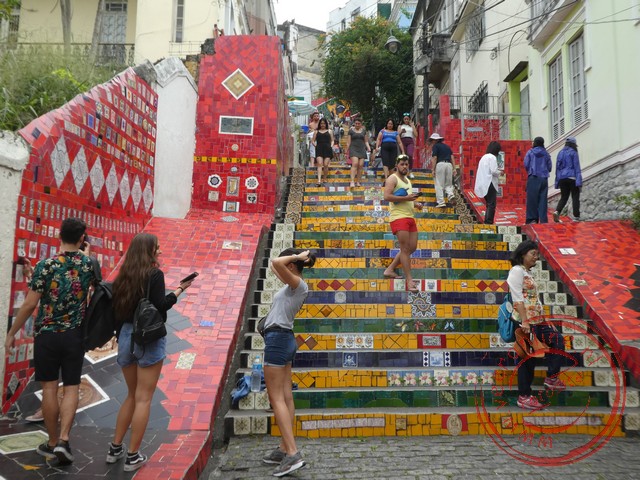
Dag 23 - Friday 17 October 2019A few blocks from the hotel is Rio by Bike, run by some Dutch people who organize bike tours through the city. We ride through the city in two groups. Marco takes me along. He met a Brazilian woman and has now lived in Rio for seven years. Right at the start something goes wrong—my rear tire is flat. Marco quickly swaps the bike. Now we can set off. During the 2016 Olympic Games, bike lanes were installed all over the city. A separate lane sometimes alongside the road, sometimes on the sidewalk. The paths are nice, Marco sighs, but they forgot to install traffic lights for cyclists. When the car traffic stops, we can go. After two tunnels under the Morro São João hill, we arrive at the Cemitério São João Baptista cemetery. From the cemetery, the surrounding favelas are clearly visible—the slums built against the steep hillsides. Marco explains that although these poor neighborhoods have a nice view over the city, there are hardly any facilities. There is no sewage system. He also says that drug gangs rule the neighborhoods. The police crack down hard in these areas. They do not hesitate to shoot immediately if they suspect armed gang members. Recently, the police have even opened fire from helicopters above the neighborhoods. This is why, Marco continues, they have stopped doing tours in the favelas. Safety cannot be guaranteed one hundred percent. In the cemetery lie wealthy and important residents. Family graves are richly decorated. At the edges are graves for poorer residents, which are cleared after three years. Via the bay of Passrela, we ride toward the historic center. The beaches here are less popular, Marco explains. The water in the bay is polluted due to industry and discharges. During the Olympics, the water was rejected as a venue for competitions. In the park between the water and the buildings, it’s busier. A music stage is being set up, people exercise or enjoy the sun. In the old center is Cinelândia square. There used to be several cinemas here, which is how the square got its unofficial name. A market is being set up in front of the town hall, somewhat blocking the view of the colorful Theatro Municipal from 1909. When demonstrations occur in Rio, they always happen in this square. The streets around the square look busy and messy. Not for nothing does Marco warn to come here only when it is busy. At night and on weekends, it is not safe. At the colored stairs (Escadaria Selarón), I get off. I lean my bike against the wall. “Do I need to lock the bike?” I ask. “No, this is not Amsterdam,” Marco says laughing. Artist Jorge Selarón started tiling the stairs in front of his house in 1990 with leftover materials.

It took him ten years to cover the hundreds of steps with tiles. A colorful spectacle. Many tourists want to take a photo exactly where Snoop Dogg and Pharrell Williams shot their "Beautiful" music video. There’s even a queue for photos. I decide to take a photo a little higher up. Via the boulevard and bay, we ride back to Copacabana. Marco shows a photo of Copacabana beach as it looked a hundred years ago. There were no buildings yet. The second image shows the Copacabana Palace, a luxury hotel built in 1923 to celebrate the hundredth anniversary of independent Brazil. This hotel led to more development along the coast. Later, Dutch companies reclaimed land, creating space for a wide beach and boulevard — the current Copacabana beach. The bike tour has run a bit long. I quickly buy a sandwich.
Trash bins are being emptied outside the door. Garbage men throw the bags into the truck. Three homeless people pull the bags back out. They tear them open searching for food. Among them is an elderly woman, neatly dressed with a little hat. She pulls a whole bag out of the truck and puts it in her cart. The garbage men don’t even blink. I stand rooted to the spot, shocked by the scene unfolding before my eyes. How dehumanizing…? Hesitantly, I start eating my sandwich. At three o’clock, I go to the statue of Christ the Redeemer. I buy a combined ticket for transportation and entrance to Trilha Parque. The Friday evening rush hour is already starting. Traffic is jammed in several places but moves very slowly. When leaving the main road, the driver heads into the mountains. With every bend, I get higher. Eventually, I’m dropped off at the parking lot near the information center. But I’m not yet at the statue. I have to transfer to another shuttle. This shuttle drives me to the top of Morro de Corcovado, the 710-meter-high mountain. The road there is steep and full of hairpin turns. When I get off, I stand at the foot of the 38-meter-high Christ the Redeemer statue. The statue was built in the early twentieth century. By 1923, the funds were complete. The construction took ten years and is one of the city’s most iconic landmarks. The Christ statue has even been named one of the seven new wonders of the world. It’s funny to see how everyone twists and turns around the statue to take a photo. To get a good picture, the photographer has to lie on the ground. It is already dark when I return to the hotel. Tonight is the last evening that the entire travel group is together. Tomorrow evening I fly back to the Netherlands. We decide to eat at a beach bar with live music. Most people were not keen on the alternative to take taxis to the nightlife district of Lapa. It is already late. A table for twenty is quickly set up in the beach bar. The location by the beach is fantastic; the food quality is not. After dinner, we thank Marion for her good care during the trip. It’s rightly noted that a tour leader is good if you don’t notice anything going wrong during the trip. I end the evening with a beer with some fellow travelers. Only after midnight do I return to the hotel.

 Argentina
 Brazil

Travelogue Uruguay Argentina and Brazil
Dag 2 | Uruguay > Wandering through Colonia
Dag 3 | Uruguay > By Bus to Montevideo
Dag 4 | Uruguay > To the Theatre in Montevideo
Dag 5 | Argentina > Back to Buenos Aires
Dag 6 | Argentina > Walking to La Boca
Dag 7 | Argentina > Cycling Tour through Buenos Aires
Dag 8 | Brazil > To the Iguazú Falls
Dag 9 | Brazil > Under the Iguazú Falls
Dag 10 | Brazil > Spotting Toucans and Macaws
Dag 11 | Brazil > The Blue Grotto
Dag 12 | Brazil > Snorkeling among the Fish
Dag 13 | Brazil > Safari in the Pantanal
Dag 14 | Brazil > By Canoe through the Pantanal
Dag 15 | Brazil > Fishing for Piranhas
Dag 16 | Brazil > Via São Paulo to Paraty
Dag 17 | Brazil > Hiking Along the Beaches
Dag 18 | Brazil > The Saco Bravo Waterfall
Dag 19 | Brazil > Ilha Grande
Dag 20 | Brazil > To Praia de Lopes Mendes
Dag 21 | Brazil > Dois Rios by Mountain Bike
Dag 22 | Brazil > Rio de Janeiro
Dag 23 | Brazil > Rio de Janeiro
Dag 24 | Brazil > Delta Flight or Not?
Dag 25 | Brazil > Back via Voorhout