
153 countries
(and areas)
 - Azerbaijan
- Bahrain
- Barbados
- Belgium
- Belize
- Benin
- Bhutan
- Bolivia
- Bonaire
- Bosnia and Herzegovina
- Botswana
- Brazil
- British Virgin Islands
- Brunei
- Bulgaria
- Cambodia
- Canada
- Cape Verde
- Chile
- China
- Costa Rica
- Croatia
- Cuba
- Curacao
- Cyprus
- Czech Republic
- Denmark
- Dominica
- Dominican Republic
- Egypt
- El Salvador
- England
- Estonia
- Eswatini (Swaziland)
- Ethiopia
- Fiji
- Finland
- France
- French Guiana
- Georgia
- Germany
- Gibraltar
- Greece
- Grenada
- Guadeloupe
- Guatemala
- Honduras
- Hong Kong
- Hungary
- Iceland
- India
- Indonesia
- Iran
- Ireland
- Israel
- Italy
- Jamaica
- Japan
- Jordan
- Kazakhstan
- Kenya
- Kosovo
- Kuwait
- Kyrgyzstan
- Laos
- Latvia
- Lebanon
- Lesotho
- Liechtenstein
- Lithuania
- Luxembourg
- Macau
- Madagascar
- Malawi
- Malaysia
- Maldives
- Malta
- Martinique
- Mexico
- Moldova
- Monaco
- Mongolia
- Montenegro
- Morocco
- Mozambique
- Namibia
- Nepal
- Netherlands
- New Zealand
- Nicaragua
- North Macedonia
- Northern Ireland
- Norway
- Oman
- Pakistan
- Palestine
- Peru
- Philippines
- Poland
- Portugal
- Qatar
- Republic of Korea
- Romania
- Russia
- Saint Kitts and Nevis
- Saint Lucia
- Saint Martin
- Saint Vincent and the Grenadines
- San Marino
- Saudi Arabia
- Scotland
- Senegal
- Serbia
- Singapore
- Sint Maarten
- Slovakia
- Slovenia
- South Africa
- Spain
- Sri Lanka
- Suriname
- Sweden
- Switzerland
- Tajikistan
- Tanzania
- Thailand
- The Gambia
- Tibet
- Togo
- Transnistria
- Trinidad and Tobago
- Tunisia
- Turkey
- Turkmenistan
- Uganda
- United Arab Emirates
- United States
- Uruguay
- Uzbekistan
- Vatican City
- Vietnam
- Wales
- Zambia
- Zanzibar
- Azerbaijan
- Bahrain
- Barbados
- Belgium
- Belize
- Benin
- Bhutan
- Bolivia
- Bonaire
- Bosnia and Herzegovina
- Botswana
- Brazil
- British Virgin Islands
- Brunei
- Bulgaria
- Cambodia
- Canada
- Cape Verde
- Chile
- China
- Costa Rica
- Croatia
- Cuba
- Curacao
- Cyprus
- Czech Republic
- Denmark
- Dominica
- Dominican Republic
- Egypt
- El Salvador
- England
- Estonia
- Eswatini (Swaziland)
- Ethiopia
- Fiji
- Finland
- France
- French Guiana
- Georgia
- Germany
- Gibraltar
- Greece
- Grenada
- Guadeloupe
- Guatemala
- Honduras
- Hong Kong
- Hungary
- Iceland
- India
- Indonesia
- Iran
- Ireland
- Israel
- Italy
- Jamaica
- Japan
- Jordan
- Kazakhstan
- Kenya
- Kosovo
- Kuwait
- Kyrgyzstan
- Laos
- Latvia
- Lebanon
- Lesotho
- Liechtenstein
- Lithuania
- Luxembourg
- Macau
- Madagascar
- Malawi
- Malaysia
- Maldives
- Malta
- Martinique
- Mexico
- Moldova
- Monaco
- Mongolia
- Montenegro
- Morocco
- Mozambique
- Namibia
- Nepal
- Netherlands
- New Zealand
- Nicaragua
- North Macedonia
- Northern Ireland
- Norway
- Oman
- Pakistan
- Palestine
- Peru
- Philippines
- Poland
- Portugal
- Qatar
- Republic of Korea
- Romania
- Russia
- Saint Kitts and Nevis
- Saint Lucia
- Saint Martin
- Saint Vincent and the Grenadines
- San Marino
- Saudi Arabia
- Scotland
- Senegal
- Serbia
- Singapore
- Sint Maarten
- Slovakia
- Slovenia
- South Africa
- Spain
- Sri Lanka
- Suriname
- Sweden
- Switzerland
- Tajikistan
- Tanzania
- Thailand
- The Gambia
- Tibet
- Togo
- Transnistria
- Trinidad and Tobago
- Tunisia
- Turkey
- Turkmenistan
- Uganda
- United Arab Emirates
- United States
- Uruguay
- Uzbekistan
- Vatican City
- Vietnam
- Wales
- Zambia
- Zanzibar


Copyright 2004 - 2026
Veeronline.nl Travel Adventures

Home > Greece > Ancient Greece > Travelogue day 4
Travelogue Ancient Greece
June 721 2019 (15 days)
Greece > The Monasteries of Meteora
Dag 4 - Monday 10 June 2019In the fourteenth century, hermits carved cave dwellings into the rugged rocks high above Kalambaka. Later, monks built dozens of magnificent monasteries atop the rocks. The rocks were shaped by wind and erosion. The rock pillars could only be reached by climbing the steep cliffs. On the rocks, they could find peace and feel closer to God. It sometimes took the monks decades to transport the materials needed for the monasteries to the top. Over the centuries, various monasteries were plundered and destroyed. During World War II, the monasteries also suffered heavy damage. About six monasteries have been fully restored. Today, little remains of the peace that once prevailed. The Meteora monasteries are, after the Acropolis in Athens, the most visited tourist attraction in Greece. When I arrive at the Great Meteoron Monastery, the largest monastery complex in the area, dozens of buses are already parked. The monastery is about to open. Hundreds of people wait on the steps at the entrance. I first have to descend a little to join the steps leading up to the monastery. By the time I reach the entrance, the lines have just disappeared. In the Great Meteoron Monastery, the chapel is undoubtedly the highlight. I enter the small space. I estimate the church’s vestibule to be about eight by eight meters.

All the vaults are fully covered with frescoes and murals. Through a doorway, I enter the actual chapel. This space is even more beautiful. The walls are entirely covered with paintings, a massive chandelier hangs from the ceiling, and the gilded iconostasis displays impressive icons. This magnificent atmosphere is somewhat diminished by the many tourists, mostly from Asia, in the small space. Everyone squeezes past each other to catch a glimpse of the beauty. Jessy comes running up enthusiastically. “The manuscript room is open today,” she says. This is a rare opportunity. She hasn’t been able to visit this room before. I follow her to see the impressively old books and the monks’ earliest writings. Remarkable. I accept that the hall with the old frescoes is closed today. At the Rousanou Monastery, a few hundred meters away, I have a wide view over the valley. From here, I can see five of the six monasteries perched on the mountaintops. Only the Stefanou Monastery is hidden behind the mountains. Rousanou Monastery is reached via a descending staircase. Many tourists use the steps to reach the monastery.

I walk down with a Flemish tour group. They are concluding their trip in Meteora and will return home tomorrow. This monastery is also busy. It is much smaller than the Great Meteoron Monastery. Tour groups jostle to enter the small church together. I weave between the groups to view the church. The church has the same beauty as the first monastery—stunning. Outside, I follow the descending steps. Mantos is waiting with the bus at the bottom. We drive back to Kalambaka. Along the way, I pass the beautiful monasteries of Varlaam, Agia Triada, and Stefanou, each uniquely situated. Back in town, we stop at an icon workshop. As is often the case, the shop is much larger than the workshop, and apart from the demonstration, no one is working. I’m not particularly interested in these kinds of handicraft visits. After lunch, we continue to the mountain village of Metsovo. Metsovo is located in the Pindos Mountains. The name literally means “The Village of Bears,” because many bears live in the surrounding area.

I recognize the road from my trip three years ago, albeit in the opposite direction. I feel a strong sense of familiarity as I enter the picturesque village. The village square, the church, and the hotel where I stayed (including the steep street to reach it) are all recognizable. It’s nice to be back. In the afternoon, I walk through Metsovo with Cecile. She is Dutch and married a Greek man from Metsovo thirty years ago. She takes us on a tour of the mountain village. Along the way, she shares her experiences of Greek life and culture. She tells anecdotes about strict social control in the village, conversations in the village square, the conservative attitude between men and women, and the important role of family. She explains that in Metsovo, you are expected to make your purchases through family members—for groceries, drinks, and even renovations, even if they aren’t specialists in that field. “Think of this,” she concludes, “if something in a hotel isn’t perfectly straight.” The walking tour ends at her house with a glass of wine—a lovely introduction to Greek life.
 Greece
  The sixkilometerlong Corinth canal
 The boulevard of Thessaloniki
 A Byzantine church in Athens
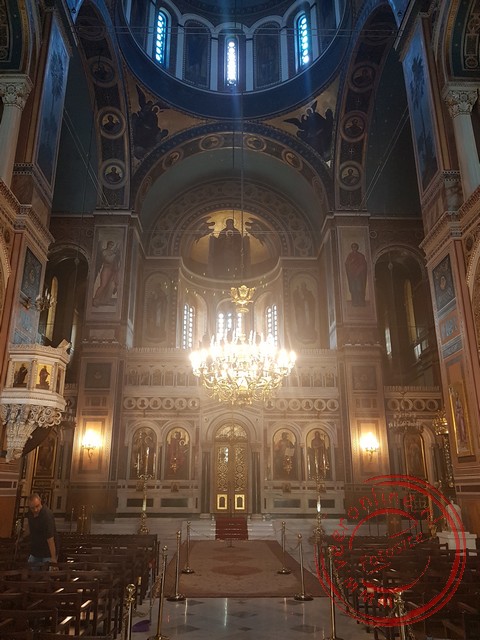 The Mitropoleos Cathedral in Athens
Travelogue Ancient Greece
Dag 2 | Greece > Thessaloniki Deserves a Second Chance
Dag 3 | Greece > The Tomb of Philip II
Dag 4 | Greece > The Monasteries of Meteora
Dag 5 | Greece > In the Footsteps of Ali Pasha
Dag 6 | Greece > Sailing on the Ionian Sea
Dag 7 | Greece > Via Nafpaktos to Delphi
Dag 8 | Greece > The Oracle of Delphi
Dag 9 | Greece > The Mountain Village of Kalavryta
Dag 10 | Greece > The Games of Olympia
Dag 11 | Greece > The Monasteries of Mystras
Dag 12 | Greece > Through the Mountains to Nafplio
Dag 13 | Greece > Mycenae and Epidaurus
Dag 14 | Greece > The Acropolis in Athens
Dag 15 | Greece > Farewell to Athens