
153 countries
(and areas)
 - Azerbaijan
- Bahrain
- Barbados
- Belgium
- Belize
- Benin
- Bhutan
- Bolivia
- Bonaire
- Bosnia and Herzegovina
- Botswana
- Brazil
- British Virgin Islands
- Brunei
- Bulgaria
- Cambodia
- Canada
- Cape Verde
- Chile
- China
- Costa Rica
- Croatia
- Cuba
- Curacao
- Cyprus
- Czech Republic
- Denmark
- Dominica
- Dominican Republic
- Egypt
- El Salvador
- England
- Estonia
- Eswatini (Swaziland)
- Ethiopia
- Fiji
- Finland
- France
- French Guiana
- Georgia
- Germany
- Gibraltar
- Greece
- Grenada
- Guadeloupe
- Guatemala
- Honduras
- Hong Kong
- Hungary
- Iceland
- India
- Indonesia
- Iran
- Ireland
- Israel
- Italy
- Jamaica
- Japan
- Jordan
- Kazakhstan
- Kenya
- Kosovo
- Kuwait
- Kyrgyzstan
- Laos
- Latvia
- Lebanon
- Lesotho
- Liechtenstein
- Lithuania
- Luxembourg
- Macau
- Madagascar
- Malawi
- Malaysia
- Maldives
- Malta
- Martinique
- Mexico
- Moldova
- Monaco
- Mongolia
- Montenegro
- Morocco
- Mozambique
- Namibia
- Nepal
- Netherlands
- New Zealand
- Nicaragua
- North Macedonia
- Northern Ireland
- Norway
- Oman
- Pakistan
- Palestine
- Peru
- Philippines
- Poland
- Portugal
- Qatar
- Republic of Korea
- Romania
- Russia
- Saint Kitts and Nevis
- Saint Lucia
- Saint Martin
- Saint Vincent and the Grenadines
- San Marino
- Saudi Arabia
- Scotland
- Senegal
- Serbia
- Singapore
- Sint Maarten
- Slovakia
- Slovenia
- South Africa
- Spain
- Sri Lanka
- Suriname
- Sweden
- Switzerland
- Tajikistan
- Tanzania
- Thailand
- The Gambia
- Tibet
- Togo
- Transnistria
- Trinidad and Tobago
- Tunisia
- Turkey
- Turkmenistan
- Uganda
- United Arab Emirates
- United States
- Uruguay
- Uzbekistan
- Vatican City
- Vietnam
- Wales
- Zambia
- Zanzibar
- Azerbaijan
- Bahrain
- Barbados
- Belgium
- Belize
- Benin
- Bhutan
- Bolivia
- Bonaire
- Bosnia and Herzegovina
- Botswana
- Brazil
- British Virgin Islands
- Brunei
- Bulgaria
- Cambodia
- Canada
- Cape Verde
- Chile
- China
- Costa Rica
- Croatia
- Cuba
- Curacao
- Cyprus
- Czech Republic
- Denmark
- Dominica
- Dominican Republic
- Egypt
- El Salvador
- England
- Estonia
- Eswatini (Swaziland)
- Ethiopia
- Fiji
- Finland
- France
- French Guiana
- Georgia
- Germany
- Gibraltar
- Greece
- Grenada
- Guadeloupe
- Guatemala
- Honduras
- Hong Kong
- Hungary
- Iceland
- India
- Indonesia
- Iran
- Ireland
- Israel
- Italy
- Jamaica
- Japan
- Jordan
- Kazakhstan
- Kenya
- Kosovo
- Kuwait
- Kyrgyzstan
- Laos
- Latvia
- Lebanon
- Lesotho
- Liechtenstein
- Lithuania
- Luxembourg
- Macau
- Madagascar
- Malawi
- Malaysia
- Maldives
- Malta
- Martinique
- Mexico
- Moldova
- Monaco
- Mongolia
- Montenegro
- Morocco
- Mozambique
- Namibia
- Nepal
- Netherlands
- New Zealand
- Nicaragua
- North Macedonia
- Northern Ireland
- Norway
- Oman
- Pakistan
- Palestine
- Peru
- Philippines
- Poland
- Portugal
- Qatar
- Republic of Korea
- Romania
- Russia
- Saint Kitts and Nevis
- Saint Lucia
- Saint Martin
- Saint Vincent and the Grenadines
- San Marino
- Saudi Arabia
- Scotland
- Senegal
- Serbia
- Singapore
- Sint Maarten
- Slovakia
- Slovenia
- South Africa
- Spain
- Sri Lanka
- Suriname
- Sweden
- Switzerland
- Tajikistan
- Tanzania
- Thailand
- The Gambia
- Tibet
- Togo
- Transnistria
- Trinidad and Tobago
- Tunisia
- Turkey
- Turkmenistan
- Uganda
- United Arab Emirates
- United States
- Uruguay
- Uzbekistan
- Vatican City
- Vietnam
- Wales
- Zambia
- Zanzibar


Copyright 2004 - 2026
Veeronline.nl Travel Adventures

Home > Greece > Ancient Greece > Travelogue day 2
Travelogue Ancient Greece
June 721 2019 (15 days)
Greece > Thessaloniki Deserves a Second Chance
Dag 2 - Saturday 8 June 2019Last night, the sliding door to the balcony was wide open. Letting the cool night air into the room is always preferable to the air conditioning—or whatever the ventilation system is supposed to be. At four o’clock, one of the stray dogs under my balcony starts barking. His barking sets off a chain reaction among the other dogs in the area. A cacophony of barking dogs keeps me awake. I close the door—it makes a big difference in the noise. I turn over and try to sleep again. At breakfast, I meet up with the rest of the group. Although I’m reasonably on time for my standards, I am practically the last to arrive. I put together a breakfast from the buffet. Because others arrived earlier, they leave earlier as well. I’m left alone with the driver. He introduces himself as Mateous—or maybe Mateo or Mantos. It doesn’t really matter to him what I call him. He explains that his name is difficult to write in Roman letters. On his taxi card, it says Mateous, so we decide to stick with Mantos. He tells me he lives in Athens. When he left home, he had said goodbye to his 12-year-old son for a month. He is now traveling for two weeks, and by the time he returns, his son will have left for the island of Mykonos.

School holidays start today in Greece. Proudly, he shows me a video of both his sons. He also gives me a geography lesson about the Greek islands, including Mykonos. I go back to my room briefly to make sure I’m ready for departure. Today, we are heading to Thessaloniki. Entering Greece’s second-largest city, I realize I have been here before. It was 1992, and I was traveling by train with friends from Athens to Istanbul. We had a six-hour layover in Thessaloniki. I walked along the boulevard and visited the White Tower. The city didn’t impress me much; I didn’t even bother to go inside the tower. In the tower’s shadow, we rested in the park. I was glad to get back on the train. Today feels different. Old mansions from the late 19th century stand among mostly modern apartment buildings. Some are dilapidated, others recently renovated. In the center, we stop at the Byzantine Museum. Helen guides our group inside, enthusiastically explaining the various periods of Byzantine history. I try to stay alert, but it’s just too much.

After a few rooms full of frescoes, artifacts, and church decorations, I fall behind. I wander through the remaining rooms, admiring the beautiful collection. From the museum, we drive along the old city walls. From the northern and highest wall, I can see all of Thessaloniki. It’s easy to gauge the city’s size. Large cargo ships wait in the bay to enter the harbor. Agios Dimitrios is the largest church in Greece, dedicated to the city’s patron saint, Saint Dimitrios. He was supposedly killed and buried in the crypt beneath the church. Today, his remains lie in a shrine in one of the side aisles. In the afternoon, I walk through the city on my own. My first stop is the White Tower. Just as I buy a ticket, a lady apologizes that all the descriptions are only in Greek. I can use an audio guide for free. For each room, I have to press a number on a small device. The wide staircase wraps around the circular outer wall. The steps are too large to climb in one stride, and they slope upward, so fewer steps are needed. On each floor, exhibitions are displayed in the center.

I dutifully press the number corresponding to each room. Unintentionally, I think about how many people have already pressed this device to their ear on such a hot day—but I don’t dwell on it. The exhibitions are not particularly impressive. However, each floor has a guide, and I amuse myself by greeting them politely in Greek, practicing a little of the language. They all laugh. Slowly, I climb higher in the tower. My goal is the view from the top. I see the boulevard, the sea, and the city. It’s a beautiful view and definitely worth the climb. From the tower, I can see the street leading to the Rotonda—my next destination. I follow the promenade, passing small shops on either side. In one, I order a sandwich. The man greets me with “kalimera”—good morning. I ask him until what time it’s proper to use “kalimera.” As if I had asked a very silly question, he replies until noon. But it’s half past one. Another customer, noticing my confusion, explains that officially it’s until twelve, but in practice everyone uses it until two, especially on weekends when people wake up later, so the “morning feeling” lasts longer.

The Rotonda was built in 306 AD as a mausoleum for Emperor Galerius. The circular building has walls several meters thick and a dome with a diameter of 24 meters—unique for its time. At the end of the 3rd century, it became a Christian church, and just over a century later, in 1571, a mosque. Today it serves as a museum. Nearby stands the Galerius Arch of Triumph. I walk through the shopping streets to the broad Aristotelous Street. Some streets are lively; others are deserted and run-down. I stick mostly to the streets where people are walking—it’s more pleasant. On Aristotelous Square stands the Byzantine Church of Saint Mary, which is closed. I wander into the narrow streets behind the square and quickly enter the lively market. Meat, fish, fruit—you can find everything here. A butcher chops meat on a wooden block while smoking a cigarette. The meat hangs unchilled in the display, yet there are plenty of buyers. The old district of Ladadika is a mix of narrow streets, cafés, and restaurants. I find an empty table on a terrace. It’s still almost thirty-five degrees, and I feel I deserve a beer. Watching the people pass by, I conclude that Thessaloniki is a much nicer city than I remembered from thirty years ago.
 Greece
  The sixkilometerlong Corinth canal
 The boulevard of Thessaloniki
 A Byzantine church in Athens
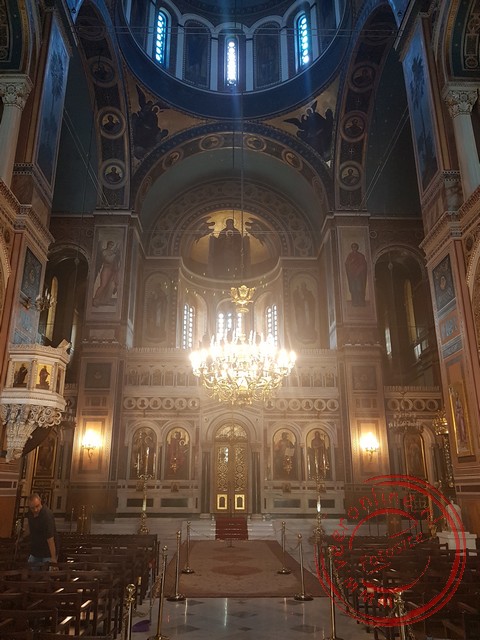 The Mitropoleos Cathedral in Athens
Travelogue Ancient Greece
Dag 2 | Greece > Thessaloniki Deserves a Second Chance
Dag 3 | Greece > The Tomb of Philip II
Dag 4 | Greece > The Monasteries of Meteora
Dag 5 | Greece > In the Footsteps of Ali Pasha
Dag 6 | Greece > Sailing on the Ionian Sea
Dag 7 | Greece > Via Nafpaktos to Delphi
Dag 8 | Greece > The Oracle of Delphi
Dag 9 | Greece > The Mountain Village of Kalavryta
Dag 10 | Greece > The Games of Olympia
Dag 11 | Greece > The Monasteries of Mystras
Dag 12 | Greece > Through the Mountains to Nafplio
Dag 13 | Greece > Mycenae and Epidaurus
Dag 14 | Greece > The Acropolis in Athens
Dag 15 | Greece > Farewell to Athens