
153 countries
(and areas)
 - Azerbaijan
- Bahrain
- Barbados
- Belgium
- Belize
- Benin
- Bhutan
- Bolivia
- Bonaire
- Bosnia and Herzegovina
- Botswana
- Brazil
- British Virgin Islands
- Brunei
- Bulgaria
- Cambodia
- Canada
- Cape Verde
- Chile
- China
- Costa Rica
- Croatia
- Cuba
- Curacao
- Cyprus
- Czech Republic
- Denmark
- Dominica
- Dominican Republic
- Egypt
- El Salvador
- England
- Estonia
- Eswatini (Swaziland)
- Ethiopia
- Fiji
- Finland
- France
- French Guiana
- Georgia
- Germany
- Gibraltar
- Greece
- Grenada
- Guadeloupe
- Guatemala
- Honduras
- Hong Kong
- Hungary
- Iceland
- India
- Indonesia
- Iran
- Ireland
- Israel
- Italy
- Jamaica
- Japan
- Jordan
- Kazakhstan
- Kenya
- Kosovo
- Kuwait
- Kyrgyzstan
- Laos
- Latvia
- Lebanon
- Lesotho
- Liechtenstein
- Lithuania
- Luxembourg
- Macau
- Madagascar
- Malawi
- Malaysia
- Maldives
- Malta
- Martinique
- Mexico
- Moldova
- Monaco
- Mongolia
- Montenegro
- Morocco
- Mozambique
- Namibia
- Nepal
- Netherlands
- New Zealand
- Nicaragua
- North Macedonia
- Northern Ireland
- Norway
- Oman
- Pakistan
- Palestine
- Peru
- Philippines
- Poland
- Portugal
- Qatar
- Republic of Korea
- Romania
- Russia
- Saint Kitts and Nevis
- Saint Lucia
- Saint Martin
- Saint Vincent and the Grenadines
- San Marino
- Saudi Arabia
- Scotland
- Senegal
- Serbia
- Singapore
- Sint Maarten
- Slovakia
- Slovenia
- South Africa
- Spain
- Sri Lanka
- Suriname
- Sweden
- Switzerland
- Tajikistan
- Tanzania
- Thailand
- The Gambia
- Tibet
- Togo
- Transnistria
- Trinidad and Tobago
- Tunisia
- Turkey
- Turkmenistan
- Uganda
- United Arab Emirates
- United States
- Uruguay
- Uzbekistan
- Vatican City
- Vietnam
- Wales
- Zambia
- Zanzibar
- Azerbaijan
- Bahrain
- Barbados
- Belgium
- Belize
- Benin
- Bhutan
- Bolivia
- Bonaire
- Bosnia and Herzegovina
- Botswana
- Brazil
- British Virgin Islands
- Brunei
- Bulgaria
- Cambodia
- Canada
- Cape Verde
- Chile
- China
- Costa Rica
- Croatia
- Cuba
- Curacao
- Cyprus
- Czech Republic
- Denmark
- Dominica
- Dominican Republic
- Egypt
- El Salvador
- England
- Estonia
- Eswatini (Swaziland)
- Ethiopia
- Fiji
- Finland
- France
- French Guiana
- Georgia
- Germany
- Gibraltar
- Greece
- Grenada
- Guadeloupe
- Guatemala
- Honduras
- Hong Kong
- Hungary
- Iceland
- India
- Indonesia
- Iran
- Ireland
- Israel
- Italy
- Jamaica
- Japan
- Jordan
- Kazakhstan
- Kenya
- Kosovo
- Kuwait
- Kyrgyzstan
- Laos
- Latvia
- Lebanon
- Lesotho
- Liechtenstein
- Lithuania
- Luxembourg
- Macau
- Madagascar
- Malawi
- Malaysia
- Maldives
- Malta
- Martinique
- Mexico
- Moldova
- Monaco
- Mongolia
- Montenegro
- Morocco
- Mozambique
- Namibia
- Nepal
- Netherlands
- New Zealand
- Nicaragua
- North Macedonia
- Northern Ireland
- Norway
- Oman
- Pakistan
- Palestine
- Peru
- Philippines
- Poland
- Portugal
- Qatar
- Republic of Korea
- Romania
- Russia
- Saint Kitts and Nevis
- Saint Lucia
- Saint Martin
- Saint Vincent and the Grenadines
- San Marino
- Saudi Arabia
- Scotland
- Senegal
- Serbia
- Singapore
- Sint Maarten
- Slovakia
- Slovenia
- South Africa
- Spain
- Sri Lanka
- Suriname
- Sweden
- Switzerland
- Tajikistan
- Tanzania
- Thailand
- The Gambia
- Tibet
- Togo
- Transnistria
- Trinidad and Tobago
- Tunisia
- Turkey
- Turkmenistan
- Uganda
- United Arab Emirates
- United States
- Uruguay
- Uzbekistan
- Vatican City
- Vietnam
- Wales
- Zambia
- Zanzibar


Copyright 2004 - 2026
Veeronline.nl Travel Adventures

Home > Greece > Ancient Greece > Travelogue day 13
Travelogue Ancient Greece
June 721 2019 (15 days)
Greece > Mycenae and Epidaurus
Dag 13 - Wednesday 19 June 2019A busy day ahead. Today I visit several sights near Tolo. First, our travel group heads to Nafplion—not on foot this time, but by bus. Due to the important role Nafplion played in the formation of modern Greece, this city cannot be missed on this trip. Since I already explored the center yesterday, I walk around the peninsula. From the quay, I again have a view of the Bourdzi fortress on the island just off the coast. The sun shines beautifully on the defensive structure. On the west side, the walking path appears to be closed due to possible falling rocks. It is forbidden to walk there. How can this be? Yesterday I saw countless people walking on this path while descending from the castle. A woman, who feeds some stray cats, tells me to just continue. I follow her advice. The path winds around the rocky point. Above it lies the Akronafplia fortress—the Acropolis of the old city. On the other side of the peninsula, space for the path is limited. A tunnel through the rocks provides a solution. When I finish the walk, I turn toward the Acropolis. I follow the rising road. The fortress is integrated into the town; some houses stand within the fortress walls, and the main road also runs through it. From the clock tower, I look out over the lower houses and the bay. On the way down, I pass a Catholic church. The gate is invitingly open. Having visited so many Orthodox churches, I decide to also visit a Catholic one.

In the courtyard, I am immediately welcomed by the priest, who interrupts his phone call for me. He is pleased that I am from the Netherlands and that I am visiting his church. He invites me for a tour of the small church and gestures to someone to open the crypt. A steel plate is lifted, revealing a stone staircase leading down. Inside the church, the priest explains that it was originally built as a mosque in the early 1700s during the Turkish occupation. After the independence struggle, the building became a Catholic church in 1840. The priest shows me the names of the fighters who died in the struggle, emphasizing how many foreigners helped the Greeks against the Turks. After the tour, I descend into the small crypt. Using the flashlight on my phone, I inspect the relatively empty space. In one corner stands a mosaic of Christ. I thank the priest and walk back to the bus. I arrive exactly on time. The next stop today is Mycenae, an important city in ancient times, founded in 2100 BCE. At the Tholos tomb of Atreus, just outside Mycenae, I meet Patty, today’s guide. She explains the burial mound. Due to earlier looting, it is uncertain who was buried here.

The thirteen-meter-high beehive-shaped tomb has withstood all earthquakes. The construction looks very solid, with heavy stones. The ancient city of Mycenae lies ten minutes further on. First, Patty takes us to the museum. Using a scale model, she explains how the city was originally laid out. Then she guides us through the artifacts from the Mycenaean period. The royal fortress of Mycenae is enclosed by a 900-meter-long, six-meter-thick wall. I enter the fortress through the Lion Gate, decorated with a stone engraving of two lions. Unlike the rest of the city, this gate has been well preserved. Of the houses, churches, and palaces inside the city walls, little remains. At most, wall fragments stand up to half a meter. This makes it difficult to imagine how the ancient city originally looked. From the highest point, where the palace once stood, I can see the extent of the city. Lunch is at a nearby restaurant. In the large, somewhat uninviting hall, several tour groups are already eating. This restaurant is clearly prepared for large groups. The food is not great; everything seems pre-prepared and reheated.

The fries are limp. This is the least impressive restaurant so far—unfortunate. In the afternoon, we drive to a second archaeological site. Suddenly it starts raining, raindrops rattling on the windshield. This is the first rain during the trip. I didn’t bring any rain gear. Yesterday I was better prepared. Hopefully, the rain stops quickly. When we arrive at Epidaurus, it is dry. Patty also takes us to the museum here. Inside, a few excavated statues are displayed, and parts of the Asklepieion temple have been reconstructed. The most famous attraction at Epidaurus is not the sanctuary of Asklepios, but the theater of Epidaurus—the best-preserved theater from ancient Greece. The enormous amphitheater accommodates over 12,000 spectators. The lowest thirty rows were built in the 4th century BCE, with twenty more rows added during Roman times. The acoustics are perfect in the center; singing from the central spot can be heard throughout the theater—a remarkable engineering feat. As I climb to the top row, it begins raining again. At the upper side of the theater, I take shelter under the trees. The rain only seems to pour harder, soaking the leaves and dripping through. I get wet. When the rain eases slightly, I descend carefully; the stones are slippery. Eventually, I am thoroughly soaked. I leave the excavations of the Asklepieion sanctuary behind and get on the bus to return to the hotel.
 Greece
  The sixkilometerlong Corinth canal
 The boulevard of Thessaloniki
 A Byzantine church in Athens
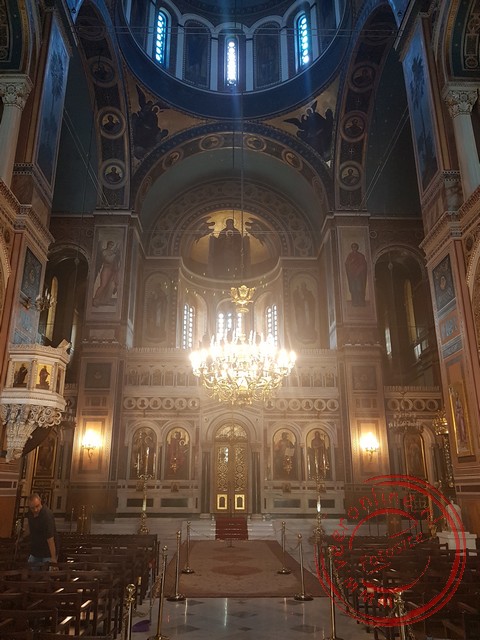 The Mitropoleos Cathedral in Athens
Travelogue Ancient Greece
Dag 2 | Greece > Thessaloniki Deserves a Second Chance
Dag 3 | Greece > The Tomb of Philip II
Dag 4 | Greece > The Monasteries of Meteora
Dag 5 | Greece > In the Footsteps of Ali Pasha
Dag 6 | Greece > Sailing on the Ionian Sea
Dag 7 | Greece > Via Nafpaktos to Delphi
Dag 8 | Greece > The Oracle of Delphi
Dag 9 | Greece > The Mountain Village of Kalavryta
Dag 10 | Greece > The Games of Olympia
Dag 11 | Greece > The Monasteries of Mystras
Dag 12 | Greece > Through the Mountains to Nafplio
Dag 13 | Greece > Mycenae and Epidaurus
Dag 14 | Greece > The Acropolis in Athens
Dag 15 | Greece > Farewell to Athens