
153 countries
(and areas)
 - Azerbaijan
- Bahrain
- Barbados
- Belgium
- Belize
- Benin
- Bhutan
- Bolivia
- Bonaire
- Bosnia and Herzegovina
- Botswana
- Brazil
- British Virgin Islands
- Brunei
- Bulgaria
- Cambodia
- Canada
- Cape Verde
- Chile
- China
- Costa Rica
- Croatia
- Cuba
- Curacao
- Cyprus
- Czech Republic
- Denmark
- Dominica
- Dominican Republic
- Egypt
- El Salvador
- England
- Estonia
- Eswatini (Swaziland)
- Ethiopia
- Fiji
- Finland
- France
- French Guiana
- Georgia
- Germany
- Gibraltar
- Greece
- Grenada
- Guadeloupe
- Guatemala
- Honduras
- Hong Kong
- Hungary
- Iceland
- India
- Indonesia
- Iran
- Ireland
- Israel
- Italy
- Jamaica
- Japan
- Jordan
- Kazakhstan
- Kenya
- Kosovo
- Kuwait
- Kyrgyzstan
- Laos
- Latvia
- Lebanon
- Lesotho
- Liechtenstein
- Lithuania
- Luxembourg
- Macau
- Madagascar
- Malawi
- Malaysia
- Maldives
- Malta
- Martinique
- Mexico
- Moldova
- Monaco
- Mongolia
- Montenegro
- Morocco
- Mozambique
- Namibia
- Nepal
- Netherlands
- New Zealand
- Nicaragua
- North Macedonia
- Northern Ireland
- Norway
- Oman
- Pakistan
- Palestine
- Peru
- Philippines
- Poland
- Portugal
- Qatar
- Republic of Korea
- Romania
- Russia
- Saint Kitts and Nevis
- Saint Lucia
- Saint Martin
- Saint Vincent and the Grenadines
- San Marino
- Saudi Arabia
- Scotland
- Senegal
- Serbia
- Singapore
- Sint Maarten
- Slovakia
- Slovenia
- South Africa
- Spain
- Sri Lanka
- Suriname
- Sweden
- Switzerland
- Tajikistan
- Tanzania
- Thailand
- The Gambia
- Tibet
- Togo
- Transnistria
- Trinidad and Tobago
- Tunisia
- Turkey
- Turkmenistan
- Uganda
- United Arab Emirates
- United States
- Uruguay
- Uzbekistan
- Vatican City
- Vietnam
- Wales
- Zambia
- Zanzibar
- Azerbaijan
- Bahrain
- Barbados
- Belgium
- Belize
- Benin
- Bhutan
- Bolivia
- Bonaire
- Bosnia and Herzegovina
- Botswana
- Brazil
- British Virgin Islands
- Brunei
- Bulgaria
- Cambodia
- Canada
- Cape Verde
- Chile
- China
- Costa Rica
- Croatia
- Cuba
- Curacao
- Cyprus
- Czech Republic
- Denmark
- Dominica
- Dominican Republic
- Egypt
- El Salvador
- England
- Estonia
- Eswatini (Swaziland)
- Ethiopia
- Fiji
- Finland
- France
- French Guiana
- Georgia
- Germany
- Gibraltar
- Greece
- Grenada
- Guadeloupe
- Guatemala
- Honduras
- Hong Kong
- Hungary
- Iceland
- India
- Indonesia
- Iran
- Ireland
- Israel
- Italy
- Jamaica
- Japan
- Jordan
- Kazakhstan
- Kenya
- Kosovo
- Kuwait
- Kyrgyzstan
- Laos
- Latvia
- Lebanon
- Lesotho
- Liechtenstein
- Lithuania
- Luxembourg
- Macau
- Madagascar
- Malawi
- Malaysia
- Maldives
- Malta
- Martinique
- Mexico
- Moldova
- Monaco
- Mongolia
- Montenegro
- Morocco
- Mozambique
- Namibia
- Nepal
- Netherlands
- New Zealand
- Nicaragua
- North Macedonia
- Northern Ireland
- Norway
- Oman
- Pakistan
- Palestine
- Peru
- Philippines
- Poland
- Portugal
- Qatar
- Republic of Korea
- Romania
- Russia
- Saint Kitts and Nevis
- Saint Lucia
- Saint Martin
- Saint Vincent and the Grenadines
- San Marino
- Saudi Arabia
- Scotland
- Senegal
- Serbia
- Singapore
- Sint Maarten
- Slovakia
- Slovenia
- South Africa
- Spain
- Sri Lanka
- Suriname
- Sweden
- Switzerland
- Tajikistan
- Tanzania
- Thailand
- The Gambia
- Tibet
- Togo
- Transnistria
- Trinidad and Tobago
- Tunisia
- Turkey
- Turkmenistan
- Uganda
- United Arab Emirates
- United States
- Uruguay
- Uzbekistan
- Vatican City
- Vietnam
- Wales
- Zambia
- Zanzibar


Copyright 2004 - 2026
Veeronline.nl Travel Adventures

Home > Greece > Ancient Greece > Travelogue day 14
Travelogue Ancient Greece
June 721 2019 (15 days)
Greece > The Acropolis in Athens
Dag 14 - Thursday 20 June 2019The last day of the holiday has arrived. Tomorrow I fly back to the Netherlands. I leave from Tolo for the final part of the journey to Athens. After about an hour, I pass the Corinth Canal. This canal connects the Ionian Sea with the Aegean Sea. The idea of creating a passage already existed in the time of the Byzantines. This small strip of land connects the Peloponnese peninsula with the Greek mainland. Ships no longer had to sail around the dangerous, stormy Cape Malea. However, it was not possible to create a full passage. As an alternative, ships were lifted out of the water and relaunched ten kilometers further on. In 1880, the current canal was dug by thousands of workers. The canal is 6.3 kilometers long, 21 meters wide, and 8 meters deep. Because of the relatively narrow passage and strong currents, modern ships nowadays often avoid the canal. Today, mainly smaller boats and tourist vessels use it. From the bridge, I look down into the straight canal. About seventy meters below me, a boat is passing. There is no other traffic. There is very little room to pass.

From the bridge, it is easy to see how the steep rocky walls were cut out. Corinth is not far from the capital, Athens. Soon, I see the buildings around this large city appear. As the bus drives further into the city center, there are more traffic lights and congestion. By the end of the morning, I arrive at the Acropolis Museum. Today marks exactly ten years since the museum opened at its new location. Because of this anniversary, admission is free—a nice bonus. However, this also means the museum is very busy. On the top floor, the Parthenon is reproduced at full scale. The original statues and fragments found around the temple are placed in their original locations. Thus, the remnants of the Birth of Athena on the east side and the Trojan War on the north side can be seen. At the same time, through the glass wall, you can look out at the real Acropolis with the Parthenon temple. A film about the Parthenon shows its history—from its construction in the 5th century BCE to the destruction and looting. The building suffered the most damage when the Venetians attacked it while it was under Turkish control and hit the munitions storage, causing an explosion. The lively Plaka district is located next to the museum. It is a neighborhood with narrow streets filled with restaurants and tourist shops. I wander through the streets until I reach the Mitropoleos Cathedral. Although the cathedral dates from the 19th century and is relatively new by Greek standards, it is entirely decorated with beautiful frescoes and murals—something I did not expect. In the shadow of the cathedral stands the small Byzantine Eleftherios Church (or Little Metropolitan). The caretaker welcomes me. Surprised, he says “yes, of course” when I ask if I may take photos inside. I continue the walking route from the guidebook through the Plaka neighborhood. I pass Adrianou Street in the pedestrian area. I notice that quite a few shops are empty, with some houses in disrepair. Could this be due to the financial crisis? Graffiti is also visible in many places, giving the streets, especially the side streets, a somewhat impoverished look. At the St. Nicholas Rangavas Church, I follow the path around the church. A narrow alley with steps and overhanging greenery—it makes for a beautiful scene. I notice a small chapel with its door open. Inside, the caretaker explains that the church dates from the 11th century. The frescoes were added a century later. During the Turkish occupation, the church was closed for 400 years, and many murals were lost due to dampness. He is pleased that I am familiar with Greek history, the Turkish occupation, and the struggle for independence. I have gained a good impression of the Plaka neighborhood. I still have some time before we meet at the bus. At one of the cozy terraces on a narrow street, I order a beer and enjoy watching the people pass by. At two o’clock, I meet Jessica at the bus. She guides our group on a city tour, showing us the Olympic Stadium, the Parliament building, and the Temple of Zeus. After about an hour, we return to the Acropolis.

While Jessica explains the history of the Acropolis, we climb the 150-meter-high hill. The Parthenon, the main and most famous temple on the Acropolis, was built in the 5th century BCE. Originally, the temple was 20 meters high and housed a 12-meter-tall golden statue of the goddess Athena. Jessica explains that the columns taper slightly and lean inward. With the naked eye, this is hardly noticeable, but from the scaffolding erected for restoration, you can see the curvature. At the Pandroseion Temple, the gods Zeus and Athena competed for the favor of the people. Zeus offered water, Athena offered an olive tree. Because the water source on the Acropolis contained slightly salty water, the people chose Athena. The city thus owes its name to her. With the visit to the Acropolis, I conclude my journey through ancient Greece. From the hotel rooftop terrace, I enjoy the view of the Acropolis and Athens. In the evening, our group thanks Jessy during dinner for her guidance. Thanks to her enthusiasm and explanations, the trip has been an amazing experience. Tomorrow I head home.
 Greece
  The sixkilometerlong Corinth canal
 The boulevard of Thessaloniki
 A Byzantine church in Athens
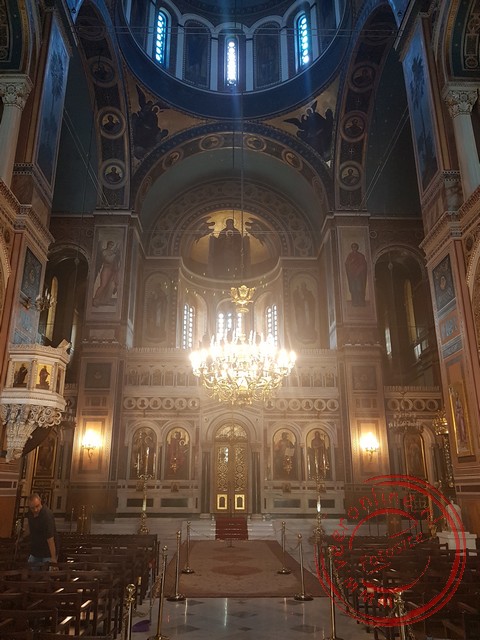 The Mitropoleos Cathedral in Athens
Travelogue Ancient Greece
Dag 2 | Greece > Thessaloniki Deserves a Second Chance
Dag 3 | Greece > The Tomb of Philip II
Dag 4 | Greece > The Monasteries of Meteora
Dag 5 | Greece > In the Footsteps of Ali Pasha
Dag 6 | Greece > Sailing on the Ionian Sea
Dag 7 | Greece > Via Nafpaktos to Delphi
Dag 8 | Greece > The Oracle of Delphi
Dag 9 | Greece > The Mountain Village of Kalavryta
Dag 10 | Greece > The Games of Olympia
Dag 11 | Greece > The Monasteries of Mystras
Dag 12 | Greece > Through the Mountains to Nafplio
Dag 13 | Greece > Mycenae and Epidaurus
Dag 14 | Greece > The Acropolis in Athens
Dag 15 | Greece > Farewell to Athens