
153 countries
(and areas)
 - Azerbaijan
- Bahrain
- Barbados
- Belgium
- Belize
- Benin
- Bhutan
- Bolivia
- Bonaire
- Bosnia and Herzegovina
- Botswana
- Brazil
- British Virgin Islands
- Brunei
- Bulgaria
- Cambodia
- Canada
- Cape Verde
- Chile
- China
- Costa Rica
- Croatia
- Cuba
- Curacao
- Cyprus
- Czech Republic
- Denmark
- Dominica
- Dominican Republic
- Egypt
- El Salvador
- England
- Estonia
- Eswatini (Swaziland)
- Ethiopia
- Fiji
- Finland
- France
- French Guiana
- Georgia
- Germany
- Gibraltar
- Greece
- Grenada
- Guadeloupe
- Guatemala
- Honduras
- Hong Kong
- Hungary
- Iceland
- India
- Indonesia
- Iran
- Ireland
- Israel
- Italy
- Jamaica
- Japan
- Jordan
- Kazakhstan
- Kenya
- Kosovo
- Kuwait
- Kyrgyzstan
- Laos
- Latvia
- Lebanon
- Lesotho
- Liechtenstein
- Lithuania
- Luxembourg
- Macau
- Madagascar
- Malawi
- Malaysia
- Maldives
- Malta
- Martinique
- Mexico
- Moldova
- Monaco
- Mongolia
- Montenegro
- Morocco
- Mozambique
- Namibia
- Nepal
- Netherlands
- New Zealand
- Nicaragua
- North Macedonia
- Northern Ireland
- Norway
- Oman
- Pakistan
- Palestine
- Peru
- Philippines
- Poland
- Portugal
- Qatar
- Republic of Korea
- Romania
- Russia
- Saint Kitts and Nevis
- Saint Lucia
- Saint Martin
- Saint Vincent and the Grenadines
- San Marino
- Saudi Arabia
- Scotland
- Senegal
- Serbia
- Singapore
- Sint Maarten
- Slovakia
- Slovenia
- South Africa
- Spain
- Sri Lanka
- Suriname
- Sweden
- Switzerland
- Tajikistan
- Tanzania
- Thailand
- The Gambia
- Tibet
- Togo
- Transnistria
- Trinidad and Tobago
- Tunisia
- Turkey
- Turkmenistan
- Uganda
- United Arab Emirates
- United States
- Uruguay
- Uzbekistan
- Vatican City
- Vietnam
- Wales
- Zambia
- Zanzibar
- Azerbaijan
- Bahrain
- Barbados
- Belgium
- Belize
- Benin
- Bhutan
- Bolivia
- Bonaire
- Bosnia and Herzegovina
- Botswana
- Brazil
- British Virgin Islands
- Brunei
- Bulgaria
- Cambodia
- Canada
- Cape Verde
- Chile
- China
- Costa Rica
- Croatia
- Cuba
- Curacao
- Cyprus
- Czech Republic
- Denmark
- Dominica
- Dominican Republic
- Egypt
- El Salvador
- England
- Estonia
- Eswatini (Swaziland)
- Ethiopia
- Fiji
- Finland
- France
- French Guiana
- Georgia
- Germany
- Gibraltar
- Greece
- Grenada
- Guadeloupe
- Guatemala
- Honduras
- Hong Kong
- Hungary
- Iceland
- India
- Indonesia
- Iran
- Ireland
- Israel
- Italy
- Jamaica
- Japan
- Jordan
- Kazakhstan
- Kenya
- Kosovo
- Kuwait
- Kyrgyzstan
- Laos
- Latvia
- Lebanon
- Lesotho
- Liechtenstein
- Lithuania
- Luxembourg
- Macau
- Madagascar
- Malawi
- Malaysia
- Maldives
- Malta
- Martinique
- Mexico
- Moldova
- Monaco
- Mongolia
- Montenegro
- Morocco
- Mozambique
- Namibia
- Nepal
- Netherlands
- New Zealand
- Nicaragua
- North Macedonia
- Northern Ireland
- Norway
- Oman
- Pakistan
- Palestine
- Peru
- Philippines
- Poland
- Portugal
- Qatar
- Republic of Korea
- Romania
- Russia
- Saint Kitts and Nevis
- Saint Lucia
- Saint Martin
- Saint Vincent and the Grenadines
- San Marino
- Saudi Arabia
- Scotland
- Senegal
- Serbia
- Singapore
- Sint Maarten
- Slovakia
- Slovenia
- South Africa
- Spain
- Sri Lanka
- Suriname
- Sweden
- Switzerland
- Tajikistan
- Tanzania
- Thailand
- The Gambia
- Tibet
- Togo
- Transnistria
- Trinidad and Tobago
- Tunisia
- Turkey
- Turkmenistan
- Uganda
- United Arab Emirates
- United States
- Uruguay
- Uzbekistan
- Vatican City
- Vietnam
- Wales
- Zambia
- Zanzibar


Copyright 2004 - 2026
Veeronline.nl Travel Adventures

Home > Greece > Ancient Greece > Travelogue day 3
Travelogue Ancient Greece
June 721 2019 (15 days)
Greece > The Tomb of Philip II
Dag 3 - Sunday 9 June 2019I carefully step into the small elevator with my luggage. Two days ago, I had my first experience with this lift. With two people and luggage, we stepped into the elevator opening. It fit just barely. Inside, two more doors needed to be closed. We shuffled our luggage slightly toward the back to be able to close the doors. The elevator started moving. At the top, we had to get out on the other side—at least, that’s what we thought. We shuffled in the small space to open the doors on the other side. The elevator hung about fifteen centimeters below the floor. Strange. Just as we were about to “climb” out, someone opened the doors on the other side. “We are on the staff side,” the man gestured. We had to exit on his side. Only then did I see the sign: max 150 kg. Including our luggage, we were well over that limit. I decided to avoid the elevator as much as possible. Now, standing here with my luggage, I make one exception. I safely reach the ground floor. At the bus, Jessy welcomes me. She will be leading the trip from now on. Yesterday, Helen guided the group because the original tour leader had fallen ill. Jessy finished her trip yesterday and flew quickly to Thessaloniki. She studied modern history and, on the way to the royal tombs of Vergina, enthusiastically tells us about the history of Philip II of Macedonia, the father of Alexander the Great, Alexander himself, and his son. Philip II was assassinated in 336 BC at the wedding of his daughter Cleopatra. Alexander suddenly became the ruler of the Macedonian Empire. At the archaeological site of Vergina, Angelika takes over the explanations.

In Greek museums, only official guides are allowed to give tours. In Vergina lies the tomb of Philip and his grandson Alexander IV, the son of Alexander the Great. In total, there are four tombs. Two had been looted; the other two were only discovered and opened in 1979. They revealed magnificent treasures, including the larnax—a golden casket containing Philip’s remains. On the lid is a sun with twelve rays, the symbol of Greek Macedonia. For lunch, I walk into the small town of Vergina. Outside the tourist restaurants, there isn’t much to see. I pass an older man on the street. The greeting “kalimera” is starting to come naturally. I am, however, unprepared for the full Greek sentence that follows. I look at the man in confusion and say “Hollanda,” not knowing what he asked. We both burst out laughing. The man speaks a few words of German. I understand that he lives in Vergina, and I explain that I’ll be staying in Kalambaka tonight. A little later, he drives past honking and waving. What hospitable people. Kalambaka lies about 150 kilometers west at the foot of the Meteora rocks. On the tops of the rock pillars, hermits lived in caves and monks built monasteries. Tomorrow, we will visit the monasteries. From a terrace in central Kalambaka, I can see several monasteries perched about four hundred meters above the town on the rock pillars. A beautiful sight. On the way back to the hotel, a man is walking his dog. “Where are you from?” he asks. When I answer the Netherlands, he explains that the Greeks call it “Ollandía.” “Why the difference?” he asks me. After I explain the distinction between Holland and the Netherlands, he insists I come with him to pick some fruit from his trees. I take a bite. I think I’m a little early in the season.

I shake his hand and continue to the hotel. Mantos, the driver, suggests watching the sunset from the rocks—a nice idea. First, he takes us to a viewpoint over the town. From here, I can see Kalambaka in the evening sun, with the enormous Meteora rock pillars behind it. Mantos also shows us two lesser-known monasteries. For these, I have to walk a short path. Around the bend, I see two monasteries clinging to the slopes. The lower monastery is still in use; the one high in the rocks is now abandoned. The sun is quickly sinking toward the horizon. We have to hurry to reach the top in time. We climb into the mountains via the winding road. I can already see the first monasteries perched atop the rock points. What a magnificent sight. The rock for viewing the sunset cannot be missed. About a hundred other tourists are already waiting for the sun to disappear behind the hills. I quickly get out and walk up the rock. I look out over the deep valley. Far below, more than four hundred meters down, I see the town of Kalambaka. Jagged rock pillars jut hundreds of meters into the sky. Some of these rocks have monasteries built upon them. I enjoy the view as the sun sets behind the mountains. That I don’t return for dinner until nine o’clock, I accept without complaint.

 Greece
  The sixkilometerlong Corinth canal
 The boulevard of Thessaloniki
 A Byzantine church in Athens
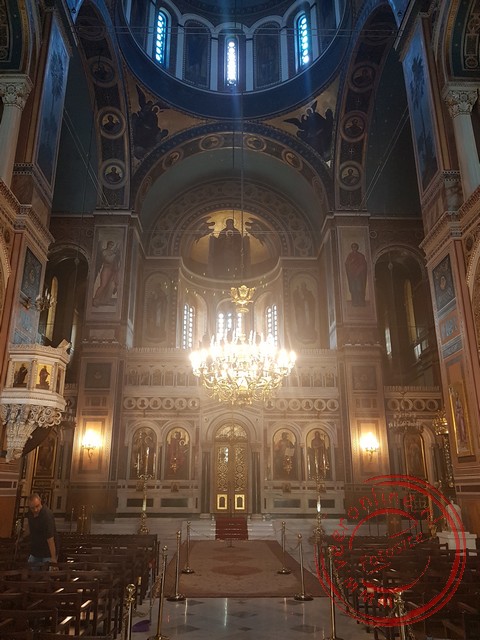 The Mitropoleos Cathedral in Athens
Travelogue Ancient Greece
Dag 2 | Greece > Thessaloniki Deserves a Second Chance
Dag 3 | Greece > The Tomb of Philip II
Dag 4 | Greece > The Monasteries of Meteora
Dag 5 | Greece > In the Footsteps of Ali Pasha
Dag 6 | Greece > Sailing on the Ionian Sea
Dag 7 | Greece > Via Nafpaktos to Delphi
Dag 8 | Greece > The Oracle of Delphi
Dag 9 | Greece > The Mountain Village of Kalavryta
Dag 10 | Greece > The Games of Olympia
Dag 11 | Greece > The Monasteries of Mystras
Dag 12 | Greece > Through the Mountains to Nafplio
Dag 13 | Greece > Mycenae and Epidaurus
Dag 14 | Greece > The Acropolis in Athens
Dag 15 | Greece > Farewell to Athens