
154 countries
(and areas)
 - Belize
- Benin
- Bhutan
- Bolivia
- Bonaire
- Bosnia and Herzegovina
- Botswana
- Brazil
- British Virgin Islands
- Brunei
- Bulgaria
- Cambodia
- Canada
- Cape Verde
- Chile
- China
- Costa Rica
- Croatia
- Cuba
- Curacao
- Cyprus
- Czech Republic
- Denmark
- Dominica
- Dominican Republic
- Egypt
- El Salvador
- England
- Estonia
- Eswatini (Swaziland)
- Ethiopia
- Fiji
- Finland
- France
- French Guiana
- Georgia
- Germany
- Gibraltar
- Greece
- Grenada
- Guadeloupe
- Guatemala
- Honduras
- Hong Kong
- Hungary
- Iceland
- India
- Indonesia
- Iran
- Ireland
- Israel
- Italy
- Jamaica
- Japan
- Jordan
- Kazakhstan
- Kenya
- Kosovo
- Kuwait
- Kyrgyzstan
- Laos
- Latvia
- Lebanon
- Lesotho
- Liechtenstein
- Lithuania
- Luxembourg
- Macau
- Madagascar
- Malawi
- Malaysia
- Maldives
- Malta
- Martinique
- Mexico
- Moldova
- Monaco
- Mongolia
- Montenegro
- Morocco
- Mozambique
- Namibia
- Nepal
- Netherlands
- New Zealand
- Nicaragua
- North Macedonia
- Northern Ireland
- Norway
- Oman
- Pakistan
- Palestine
- Peru
- Philippines
- Poland
- Portugal
- Qatar
- Republic of Korea
- Romania
- Russia
- Saint Kitts and Nevis
- Saint Lucia
- Saint Martin
- Saint Vincent and the Grenadines
- San Marino
- São Tomé and Principe
- Saudi Arabia
- Scotland
- Senegal
- Serbia
- Singapore
- Sint Maarten
- Slovakia
- Slovenia
- South Africa
- Spain
- Sri Lanka
- Suriname
- Sweden
- Switzerland
- Tajikistan
- Tanzania
- Thailand
- The Gambia
- Tibet
- Togo
- Transnistria
- Trinidad and Tobago
- Tunisia
- Turkey
- Turkmenistan
- Uganda
- United Arab Emirates
- United States
- Uruguay
- Uzbekistan
- Vatican City
- Vietnam
- Wales
- Zambia
- Zanzibar
- Belize
- Benin
- Bhutan
- Bolivia
- Bonaire
- Bosnia and Herzegovina
- Botswana
- Brazil
- British Virgin Islands
- Brunei
- Bulgaria
- Cambodia
- Canada
- Cape Verde
- Chile
- China
- Costa Rica
- Croatia
- Cuba
- Curacao
- Cyprus
- Czech Republic
- Denmark
- Dominica
- Dominican Republic
- Egypt
- El Salvador
- England
- Estonia
- Eswatini (Swaziland)
- Ethiopia
- Fiji
- Finland
- France
- French Guiana
- Georgia
- Germany
- Gibraltar
- Greece
- Grenada
- Guadeloupe
- Guatemala
- Honduras
- Hong Kong
- Hungary
- Iceland
- India
- Indonesia
- Iran
- Ireland
- Israel
- Italy
- Jamaica
- Japan
- Jordan
- Kazakhstan
- Kenya
- Kosovo
- Kuwait
- Kyrgyzstan
- Laos
- Latvia
- Lebanon
- Lesotho
- Liechtenstein
- Lithuania
- Luxembourg
- Macau
- Madagascar
- Malawi
- Malaysia
- Maldives
- Malta
- Martinique
- Mexico
- Moldova
- Monaco
- Mongolia
- Montenegro
- Morocco
- Mozambique
- Namibia
- Nepal
- Netherlands
- New Zealand
- Nicaragua
- North Macedonia
- Northern Ireland
- Norway
- Oman
- Pakistan
- Palestine
- Peru
- Philippines
- Poland
- Portugal
- Qatar
- Republic of Korea
- Romania
- Russia
- Saint Kitts and Nevis
- Saint Lucia
- Saint Martin
- Saint Vincent and the Grenadines
- San Marino
- São Tomé and Principe
- Saudi Arabia
- Scotland
- Senegal
- Serbia
- Singapore
- Sint Maarten
- Slovakia
- Slovenia
- South Africa
- Spain
- Sri Lanka
- Suriname
- Sweden
- Switzerland
- Tajikistan
- Tanzania
- Thailand
- The Gambia
- Tibet
- Togo
- Transnistria
- Trinidad and Tobago
- Tunisia
- Turkey
- Turkmenistan
- Uganda
- United Arab Emirates
- United States
- Uruguay
- Uzbekistan
- Vatican City
- Vietnam
- Wales
- Zambia
- Zanzibar


Copyright 2004 - 2026
Veeronline.nl Travel Adventures
Home > China > From Beijing to Hong Kong > Travelogue day 15
Travelogue From Beijing to Hong Kong
April 9 May 10 2025 (32 days)
China > Pandas, Pandas, and More Pandas
Dag 15 - Wednesday 23 April 2025Breakfast is included at this guesthouse. However, when I arrive just before seven o’clock, the door is still closed. The receptionist dogmatically says breakfast starts at seven sharp. At exactly seven, the door opens. A buffet with Chinese food is ready. I take some rice, vegetables, and an egg. Half an hour later, we board the bus for an excursion to the Panda Research Base just outside Chengdu, and to the Giant Buddha at Leshan. A small bus arrives. It is big enough for our group, but not everyone can sit on their own seat. The streets of Chengdu are already quite busy. Children are being taken to school and people are heading to work. Everywhere in the city you see images of pandas. The Giant Panda Breeding Research Base is a research center aimed at protecting and preserving the giant panda from extinction. The center was founded in 1987 with six pandas. In Chengdu, they have successfully found a method to breed pandas. There have now been 124 successful panda births in the park, bringing the current number of pandas to 83. A panda lives on average twenty years in captivity, somewhat less in the wild.

When we arrive at the entrance gate, it’s not very busy yet. It was good to come early. We can walk in immediately. We are driven around the park by a golf cart to the first stop. The park is three square kilometers large, too big to explore entirely on foot. At the Star Giant Panda Nursery House, I get off. I follow people into the park. Soon I see a large group gathered, cameras ready. In the outdoor enclosure, I see a giant panda. The animal is searching for food in its enclosure. The caretakers have scattered bamboo over the area, so the panda has to work to find it. At each piece of bamboo, it calmly sits down and chews the treat. In the adjacent enclosure, there is a mother with a small panda. The little one wrestles with the mother to get food. The mother eats first and playfully pushes the little one away. It is a lovely sight to see both animals playing together like this.

Eventually, the little panda gets its own piece of bamboo. In every enclosure, the pandas are eating. Sometimes multiple pandas eat together or a panda has finished and is hanging in a tree. I take the golf cart to the second stop: the lookout tower. This tower can only be climbed by stairs. I estimate it is at least ten floors high. I decide not to climb it. I want to spend my time with the pandas. I return to the golf cart stop. The next stop is the Giant Panda Villa. Here pandas lie in their enclosures. This seems to be an older part of the park. I also want to see the red pandas. There is no stop for the golf carts here, so I walk a bit along the road. I pass a second Panda Villa enclosure. Opposite is the Red Panda Nursery. The red panda is much smaller than the giant panda. They are therefore harder to spot. Through the leaves, I see some pandas in the trees. It is not easy to take a photo of them. When a red panda walks on the ground, I have better chances. By half past eleven, I have seen enough pandas and leave the park via the south side.

Frank and the bus driver are already waiting for us here. In the afternoon, we drive to Leshan, about 150 kilometers south of Chengdu. To save time, we stop at a roadside restaurant. I buy a fried waffle and a sausage. Carefully, I wrap the sausage in spicy herbs. I remember my experience in Xi’an. This time the herbs are less spicy. Luckily. The remaining part of the route to the Giant Buddha takes longer than I expected. We only arrive at the park around three o’clock. From the parking lot, it is still a fifteen-minute walk to the entrance. I follow a group of Chinese Buddhist pilgrims up the stairs to the top of the Buddha. The 71-meter-high seated Buddha was carved out of the rocks between 713 and 803. It is the largest seated Buddha in the world. For Chinese Buddhists, this is a pilgrimage site. From the plateau, I see the three rivers that meet at Leshan. The Giant Buddha overlooks these rivers. I see hundreds of people gathered. The upper half of the enormous Buddha head rises above them. From the edge near the head, the seated Buddha is hard to see. The descent to the feet is closed due to renovation work on the legs.

Several temples surround the Buddha. Pilgrims pray in each temple. It is unclear whether photography is allowed. Nobody is taking photos. When I ask, a dismissive gesture is made. I carefully take a photo through the doorway. I visit the temples around the complex, enter the cave, and climb to the foot of the pagoda. After about two hours, I am back down. Late in the afternoon, we take the bus back to Chengdu. Traffic is heavier during the evening rush hour. When we arrive at the hotel at eight, I am a bit tired of the bus. We decide to eat nearby. At the restaurant, several waitresses come immediately. The idea is that you tick what you want to order on a laminated menu. This is only in Chinese. All waitresses use their translation app, and we quickly lose track of what was ordered or not. A copy of the bill, to clarify, is also in Chinese and doesn’t help. We take drinks ourselves from the fridge and let whatever was ordered come. This turns out to be a good solution. The five dishes are enough for seven people. When we pay and split the bill, there is a mistake. Not everything is on the bill. We have to pay an additional 65 yuan (about 7.50 euros). Back at the hotel, I take the laundry off the drying line and fold it. Time to go to sleep.
 China
China  A dance performance about the Tang dynasty
 People dressed in traditional clothing pose on the wall of Xian
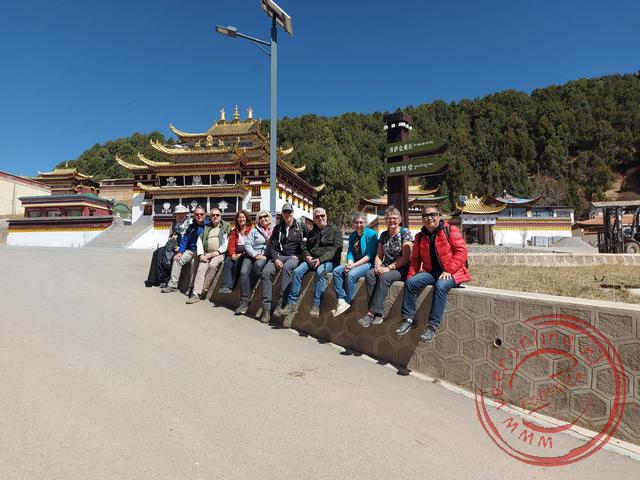 A break during the monastery tour
 The Namo Gorge just outside the village of Langmusi
Travelogue From Beijing to Hong Kong
Dag 2 | China > Tiananmen Square
Dag 3 | China > The Forbidden City
Dag 4 | China > Storm in Beijing
Dag 5 | China > To the Great Wall
Dag 6 | China > Sunrise on the Wall
Dag 7 | China > The Terracotta Army
Dag 8 | China > Cycling on the Xi'an Wall
Dag 9 | China > By Train to Xiahe
Dag 10 | China > The Labrang Monastery in Xiahe
Dag 11 | China > By Bus to Langmusi
Dag 12 | China > The Serti and Kirti Monastery of Langmusi
Dag 13 | China > The Huanglong Travertine Pools
Dag 14 | China > The Mask-Changing Dance in Chengdu
Dag 15 | China > Pandas, Pandas, and More Pandas
Dag 16 | China > A Long Walk Through Chengdu
Dag 17 | China > Potatso National Park
Dag 18 | China > The Wu Fu Palace in Lijiang
Dag 19 | China > Cycling to Baisha and Shuhe
Dag 20 | China > Wandering through Shaxi
Dag 21 | China > Climbing in the Shibaoshan Mountains
Dag 22 | China > Cycling Towards Dali
Dag 23 | China > Rainy Xizhou
Dag 24 | China > The Old Center of Weishan
Dag 25 | China > Hiking in the Weibao Mountains
Dag 26 | China > Travel Day to Yangshuo
Dag 27 | China > The Colorful Caves of Yangshuo
Dag 28 | China > Bamboo Rafting on the Yulong River
Dag 29 | Hong Kong > By Train to Hong Kong
Dag 30 | Hong Kong > Victoria Peak
Dag 31 | Hong Kong > The Ten Thousand Buddhas Temple
Dag 32 | Hong Kong > Heading Home