
153 countries
(and areas)
 - Azerbaijan
- Bahrain
- Barbados
- Belgium
- Belize
- Benin
- Bhutan
- Bolivia
- Bonaire
- Bosnia and Herzegovina
- Botswana
- Brazil
- British Virgin Islands
- Brunei
- Bulgaria
- Cambodia
- Canada
- Cape Verde
- Chile
- China
- Costa Rica
- Croatia
- Cuba
- Curacao
- Cyprus
- Czech Republic
- Denmark
- Dominica
- Dominican Republic
- Egypt
- El Salvador
- England
- Estonia
- Eswatini (Swaziland)
- Ethiopia
- Fiji
- Finland
- France
- French Guiana
- Georgia
- Germany
- Gibraltar
- Greece
- Grenada
- Guadeloupe
- Guatemala
- Honduras
- Hong Kong
- Hungary
- Iceland
- India
- Indonesia
- Iran
- Ireland
- Israel
- Italy
- Jamaica
- Japan
- Jordan
- Kazakhstan
- Kenya
- Kosovo
- Kuwait
- Kyrgyzstan
- Laos
- Latvia
- Lebanon
- Lesotho
- Liechtenstein
- Lithuania
- Luxembourg
- Macau
- Madagascar
- Malawi
- Malaysia
- Maldives
- Malta
- Martinique
- Mexico
- Moldova
- Monaco
- Mongolia
- Montenegro
- Morocco
- Mozambique
- Namibia
- Nepal
- Netherlands
- New Zealand
- Nicaragua
- North Macedonia
- Northern Ireland
- Norway
- Oman
- Pakistan
- Palestine
- Peru
- Philippines
- Poland
- Portugal
- Qatar
- Republic of Korea
- Romania
- Russia
- Saint Kitts and Nevis
- Saint Lucia
- Saint Martin
- Saint Vincent and the Grenadines
- San Marino
- Saudi Arabia
- Scotland
- Senegal
- Serbia
- Singapore
- Sint Maarten
- Slovakia
- Slovenia
- South Africa
- Spain
- Sri Lanka
- Suriname
- Sweden
- Switzerland
- Tajikistan
- Tanzania
- Thailand
- The Gambia
- Tibet
- Togo
- Transnistria
- Trinidad and Tobago
- Tunisia
- Turkey
- Turkmenistan
- Uganda
- United Arab Emirates
- United States
- Uruguay
- Uzbekistan
- Vatican City
- Vietnam
- Wales
- Zambia
- Zanzibar
- Azerbaijan
- Bahrain
- Barbados
- Belgium
- Belize
- Benin
- Bhutan
- Bolivia
- Bonaire
- Bosnia and Herzegovina
- Botswana
- Brazil
- British Virgin Islands
- Brunei
- Bulgaria
- Cambodia
- Canada
- Cape Verde
- Chile
- China
- Costa Rica
- Croatia
- Cuba
- Curacao
- Cyprus
- Czech Republic
- Denmark
- Dominica
- Dominican Republic
- Egypt
- El Salvador
- England
- Estonia
- Eswatini (Swaziland)
- Ethiopia
- Fiji
- Finland
- France
- French Guiana
- Georgia
- Germany
- Gibraltar
- Greece
- Grenada
- Guadeloupe
- Guatemala
- Honduras
- Hong Kong
- Hungary
- Iceland
- India
- Indonesia
- Iran
- Ireland
- Israel
- Italy
- Jamaica
- Japan
- Jordan
- Kazakhstan
- Kenya
- Kosovo
- Kuwait
- Kyrgyzstan
- Laos
- Latvia
- Lebanon
- Lesotho
- Liechtenstein
- Lithuania
- Luxembourg
- Macau
- Madagascar
- Malawi
- Malaysia
- Maldives
- Malta
- Martinique
- Mexico
- Moldova
- Monaco
- Mongolia
- Montenegro
- Morocco
- Mozambique
- Namibia
- Nepal
- Netherlands
- New Zealand
- Nicaragua
- North Macedonia
- Northern Ireland
- Norway
- Oman
- Pakistan
- Palestine
- Peru
- Philippines
- Poland
- Portugal
- Qatar
- Republic of Korea
- Romania
- Russia
- Saint Kitts and Nevis
- Saint Lucia
- Saint Martin
- Saint Vincent and the Grenadines
- San Marino
- Saudi Arabia
- Scotland
- Senegal
- Serbia
- Singapore
- Sint Maarten
- Slovakia
- Slovenia
- South Africa
- Spain
- Sri Lanka
- Suriname
- Sweden
- Switzerland
- Tajikistan
- Tanzania
- Thailand
- The Gambia
- Tibet
- Togo
- Transnistria
- Trinidad and Tobago
- Tunisia
- Turkey
- Turkmenistan
- Uganda
- United Arab Emirates
- United States
- Uruguay
- Uzbekistan
- Vatican City
- Vietnam
- Wales
- Zambia
- Zanzibar


Copyright 2004 - 2026
Veeronline.nl Travel Adventures
Home > China > From Beijing to Hong Kong > Travelogue day 12
Travelogue From Beijing to Hong Kong
April 9 May 10 2025 (32 days)
China > The Serti and Kirti Monastery of Langmusi
Dag 12 - Sunday 20 April 2025I wasn’t cold last night. Only when I had to go to the toilet for a moment, my feet felt a bit chilly. I quickly crawled back into bed. The hotel doesn’t serve breakfast. I bought some yogurt at the supermarket yesterday. Using the kettle, I prepare hot water for coffee. There’s just no coffee mug. Carefully, I pour the boiling water into a glass. The glass seems to handle it fine. At half past eight, everyone is ready for an excursion to one of the monasteries in Langmusi. Two fellow travelers opt for a mountain hike instead. That sounds like a beautiful trip as well, but also quite tough at 3,350 meters altitude. At the hotel, we meet Sunna, our guide for today’s monastery visit. He is a local Tibetan. When we arrive at the first monastery, the Serti Monastery, the ticket office is still closed. We continue on without entrance tickets. In front of the stupa, we turn toward the largest temple of the complex. Meanwhile, Sunna explains that the monastery was destroyed by the Chinese during the Cultural Revolution, which followed the occupation of Tibet. Only in the 1970s, when Tibetan Buddhism was once again allowed, were the temples rebuilt. In front of the large temple, numerous monk boots lie scattered on the ground. The temple door is closed. It seems the monks are either praying or holding a ceremony inside. The side door is also shut. We take the stairs to visit the other temples. There are plenty within the complex. Looking around, I notice that all the temple roofs are gilded with gold. They gleam in the sunlight. We enter the temple that houses the stupa of the monastery's founder.

In 1748, he established a simple temple on this site. Later Lamas—reincarnations of the founder—expanded the complex with additional Tibetan temples. In the second temple we visit, there is a large Buddha statue. A reincarnation of one of the Lamas, Sunna explains. Even though it's technically not allowed, I secretly take a quick photo. I want to remember this statue. As we walk further through the complex, we pass the residence of the current Lama. Just behind it lies his summer residence. The view of Langmusi from the monastery is stunning. Sunna takes us to the path that leads to the sky burial site. He doesn’t accompany us—Tibetans typically do not visit this location. A sky burial is the place where Tibetans lay their deceased, allowing vultures to “clean” the body. They believe this helps the soul reach the afterlife more swiftly. We follow the path uphill. It's clear that we’re at an altitude of around 3.5 kilometers. The final stretch is a gravel road. From a distance, I already see numerous Tibetan prayer flags. Fortunately, the sky burial site hasn’t been used recently. That means no vultures circling or feasting on remains. Apart from a few bones, there are no other remains visible—which might be for the best. There are several axes and knives lying around, used to dismember the body so that the vultures can access it more easily.

After this rather gruesome experience, we walk back to Langmusi. I’m craving coffee. We find a restaurant where we can order some. “Would you like apple pie with that?” Why not. We’ve long since finished the coffee by the time the freshly baked pie arrives. It’s a large slice. I can skip lunch today. At half past one, I meet Sunna again at the hotel. This time we head in the opposite direction to visit the Kirti Monastery. Founded in 1413, this monastery is smaller than the Serti Monastery. There is an entrance check here. I buy a ticket for thirty yuan (about €3.75). This covers both the monastery complex and the Namo Gorge behind it. I follow Sunna to the main temple, which turns out to be closed. We can’t view the monastery's main temple. “Let’s go to the gorge then,” Sunna says, slightly disappointed. Behind the monastery are a few more temples near the monks’ school. Inside one of the temples it’s dark. Sunna uses his phone flashlight to show us where to walk, but the beauty of the temple is hard to perceive in the dark. After visiting one temple, I point out a sign to another. From Sunna’s reaction, it seems he doesn’t know this temple. A passing monk gestures that we should go through the gate to reach it. Once inside, the caretaker of the temple—also a monk—appears. He says something to Sunna, who then tells us we’d better leave. I get the impression that tourists aren’t supposed to be here. But then, why put up a sign? Sunna seems rattled. He has already left the monastery grounds and waits for us outside. Here, the Namo Gorge begins.

We follow a small stream that forms the source of the Bailong River. Some caves along the gorge are used by monks for prayer. I have to crouch to enter one. Inside is a larger space for meditation. Back outside, I cross the bridge and follow the stream. The gorge narrows. I walk over stones in the water. Suddenly, the water stops—this is where the Bailong River springs from the White Dragon source. The gorge continues. Along a beautiful path, I walk between steep rock walls. After about thirty minutes, I reach a grassy plain. This is where the trail ends. Coincidentally, two fellow travelers arrive from the mountains, having set off early this morning. We walk back to Langmusi together. Near the monastery, many young monks are heading toward the stream. Some sit with their feet in the water. They greet us kindly. Via the temple with the silver roof, we return to town. Time for a beer. At six, Frank gathers the group. There’s some confusion about tomorrow’s plan. We’re traveling to Songpan. From there, you can visit Huanglong National Park. This park, with its waterfalls and travertine terraces, is on the UNESCO World Heritage List. However, it would be more convenient to visit the park on the way to Songpan. For that, everyone needs to agree—including on the extra costs. Since the driver can’t return immediately to Songpan, we’ll need to rent the bus for an extra day. Although the entrance fees are still somewhat unclear, everyone agrees. That means we’ll depart tomorrow morning at 7:30. In the evening, we return to the same restaurant where we had coffee this morning. I order a yak burger and fries. Both are larger than expected. I don’t even manage to eat half.

 China
China  The little fish eat old and dead skin cells
 The high-speed train to Guilin
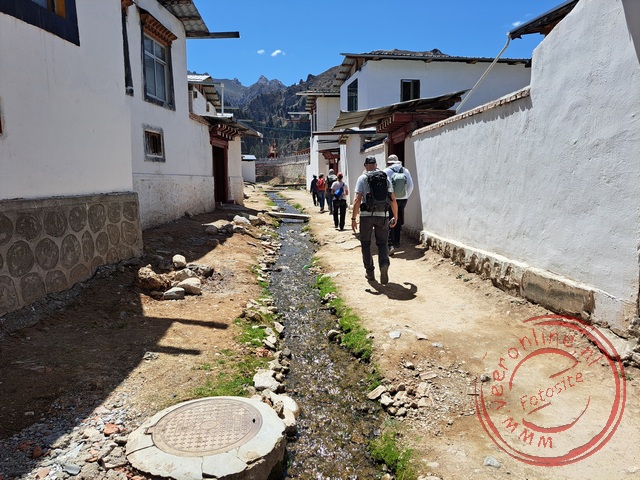 Walking through the village of Langmusi
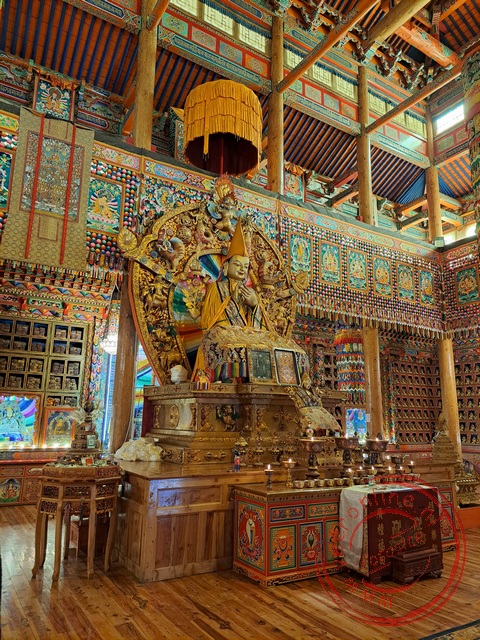 The Buddha in one of the temples
Travelogue From Beijing to Hong Kong
Dag 2 | China > Tiananmen Square
Dag 3 | China > The Forbidden City
Dag 4 | China > Storm in Beijing
Dag 5 | China > To the Great Wall
Dag 6 | China > Sunrise on the Wall
Dag 7 | China > The Terracotta Army
Dag 8 | China > Cycling on the Xi'an Wall
Dag 9 | China > By Train to Xiahe
Dag 10 | China > The Labrang Monastery in Xiahe
Dag 11 | China > By Bus to Langmusi
Dag 12 | China > The Serti and Kirti Monastery of Langmusi
Dag 13 | China > The Huanglong Travertine Pools
Dag 14 | China > The Mask-Changing Dance in Chengdu
Dag 15 | China > Pandas, Pandas, and More Pandas
Dag 16 | China > A Long Walk Through Chengdu
Dag 17 | China > Potatso National Park
Dag 18 | China > The Wu Fu Palace in Lijiang
Dag 19 | China > Cycling to Baisha and Shuhe
Dag 20 | China > Wandering through Shaxi
Dag 21 | China > Climbing in the Shibaoshan Mountains
Dag 22 | China > Cycling Towards Dali
Dag 23 | China > Rainy Xizhou
Dag 24 | China > The Old Center of Weishan
Dag 25 | China > Hiking in the Weibao Mountains
Dag 26 | China > Travel Day to Yangshuo
Dag 27 | China > The Colorful Caves of Yangshuo
Dag 28 | China > Bamboo Rafting on the Yulong River
Dag 29 | Hong Kong > By Train to Hong Kong
Dag 30 | Hong Kong > Victoria Peak
Dag 31 | Hong Kong > The Ten Thousand Buddhas Temple
Dag 32 | Hong Kong > Heading Home