
154 countries
(and areas)
 - Belize
- Benin
- Bhutan
- Bolivia
- Bonaire
- Bosnia and Herzegovina
- Botswana
- Brazil
- British Virgin Islands
- Brunei
- Bulgaria
- Cambodia
- Canada
- Cape Verde
- Chile
- China
- Costa Rica
- Croatia
- Cuba
- Curacao
- Cyprus
- Czech Republic
- Denmark
- Dominica
- Dominican Republic
- Egypt
- El Salvador
- England
- Estonia
- Eswatini (Swaziland)
- Ethiopia
- Fiji
- Finland
- France
- French Guiana
- Georgia
- Germany
- Gibraltar
- Greece
- Grenada
- Guadeloupe
- Guatemala
- Honduras
- Hong Kong
- Hungary
- Iceland
- India
- Indonesia
- Iran
- Ireland
- Israel
- Italy
- Jamaica
- Japan
- Jordan
- Kazakhstan
- Kenya
- Kosovo
- Kuwait
- Kyrgyzstan
- Laos
- Latvia
- Lebanon
- Lesotho
- Liechtenstein
- Lithuania
- Luxembourg
- Macau
- Madagascar
- Malawi
- Malaysia
- Maldives
- Malta
- Martinique
- Mexico
- Moldova
- Monaco
- Mongolia
- Montenegro
- Morocco
- Mozambique
- Namibia
- Nepal
- Netherlands
- New Zealand
- Nicaragua
- North Macedonia
- Northern Ireland
- Norway
- Oman
- Pakistan
- Palestine
- Peru
- Philippines
- Poland
- Portugal
- Qatar
- Republic of Korea
- Romania
- Russia
- Saint Kitts and Nevis
- Saint Lucia
- Saint Martin
- Saint Vincent and the Grenadines
- San Marino
- São Tomé and Principe
- Saudi Arabia
- Scotland
- Senegal
- Serbia
- Singapore
- Sint Maarten
- Slovakia
- Slovenia
- South Africa
- Spain
- Sri Lanka
- Suriname
- Sweden
- Switzerland
- Tajikistan
- Tanzania
- Thailand
- The Gambia
- Tibet
- Togo
- Transnistria
- Trinidad and Tobago
- Tunisia
- Turkey
- Turkmenistan
- Uganda
- United Arab Emirates
- United States
- Uruguay
- Uzbekistan
- Vatican City
- Vietnam
- Wales
- Zambia
- Zanzibar
- Belize
- Benin
- Bhutan
- Bolivia
- Bonaire
- Bosnia and Herzegovina
- Botswana
- Brazil
- British Virgin Islands
- Brunei
- Bulgaria
- Cambodia
- Canada
- Cape Verde
- Chile
- China
- Costa Rica
- Croatia
- Cuba
- Curacao
- Cyprus
- Czech Republic
- Denmark
- Dominica
- Dominican Republic
- Egypt
- El Salvador
- England
- Estonia
- Eswatini (Swaziland)
- Ethiopia
- Fiji
- Finland
- France
- French Guiana
- Georgia
- Germany
- Gibraltar
- Greece
- Grenada
- Guadeloupe
- Guatemala
- Honduras
- Hong Kong
- Hungary
- Iceland
- India
- Indonesia
- Iran
- Ireland
- Israel
- Italy
- Jamaica
- Japan
- Jordan
- Kazakhstan
- Kenya
- Kosovo
- Kuwait
- Kyrgyzstan
- Laos
- Latvia
- Lebanon
- Lesotho
- Liechtenstein
- Lithuania
- Luxembourg
- Macau
- Madagascar
- Malawi
- Malaysia
- Maldives
- Malta
- Martinique
- Mexico
- Moldova
- Monaco
- Mongolia
- Montenegro
- Morocco
- Mozambique
- Namibia
- Nepal
- Netherlands
- New Zealand
- Nicaragua
- North Macedonia
- Northern Ireland
- Norway
- Oman
- Pakistan
- Palestine
- Peru
- Philippines
- Poland
- Portugal
- Qatar
- Republic of Korea
- Romania
- Russia
- Saint Kitts and Nevis
- Saint Lucia
- Saint Martin
- Saint Vincent and the Grenadines
- San Marino
- São Tomé and Principe
- Saudi Arabia
- Scotland
- Senegal
- Serbia
- Singapore
- Sint Maarten
- Slovakia
- Slovenia
- South Africa
- Spain
- Sri Lanka
- Suriname
- Sweden
- Switzerland
- Tajikistan
- Tanzania
- Thailand
- The Gambia
- Tibet
- Togo
- Transnistria
- Trinidad and Tobago
- Tunisia
- Turkey
- Turkmenistan
- Uganda
- United Arab Emirates
- United States
- Uruguay
- Uzbekistan
- Vatican City
- Vietnam
- Wales
- Zambia
- Zanzibar


Copyright 2004 - 2026
Veeronline.nl Travel Adventures
Home > China > From Beijing to Hong Kong > Travelogue day 14
Travelogue From Beijing to Hong Kong
April 9 May 10 2025 (32 days)
China > The Mask-Changing Dance in Chengdu
Dag 14 - Tuesday 22 April 2025I opt for a continental breakfast, which includes yogurt, muesli and fruit, and toast with a boiled egg. I can choose between orange juice or coffee. I pick the orange juice and order a cappuccino on the side. Around noon, we take the train to Chengdu, which means I still have time this morning to visit the old town of Songpan. I soon reach the north gate. The original city walls, built during the Ming dynasty, are still largely intact. The walls are 12 meters high and about 6 meters wide. Within the walls lies the old town, with classic wooden houses and stone streets. The architecture shows influences from Han Chinese, Tibetan, and Qiang cultures. It reminds me of a small ski resort. In the middle of the old town is a covered wooden bridge. Shops are everywhere, and merchandise is displayed along the street.

By around half past ten, I'm back at the guesthouse. With five taxis, we're taken to the station. Emma is coming with us too. The Songpan station is located outside the city. The rail connection with Chengdu was only opened last year. Upon entry, all luggage must be scanned. Water bottles are checked separately. At around noon, we join the queue of passengers at the gates. The train hasn’t arrived yet, which makes it tricky to figure out exactly where carriage five will stop. When I try to ask, a whistle signals me to stay behind the yellow line. After that, someone kindly explains that carriage five will stop just a bit further down the platform. Moments later, the high-speed train arrives. I take seat 1A. It soon becomes clear that sitting by the window doesn’t offer much of an advantage—most of the journey through the mountains is spent in tunnels.
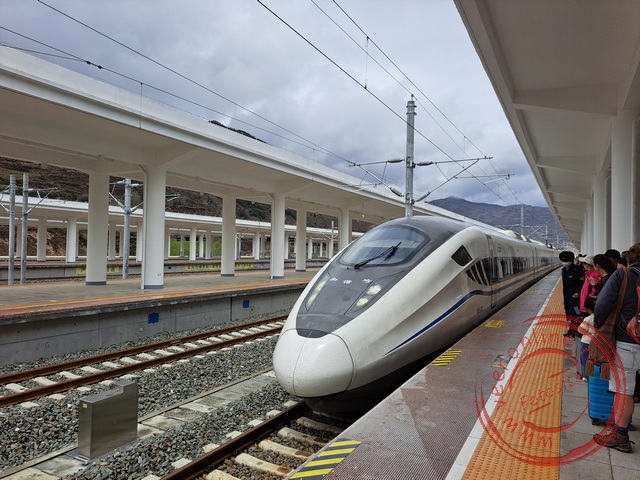
Along the way, I eat a few buns I bought earlier this morning. Outside, the landscape becomes increasingly green. We descend from 2,900 meters to 500 meters in Chengdu. Chengdu is the train’s final destination, which makes disembarking easier when we arrive at 14:21. The station here is perhaps even larger than the previous ones. With 22 million inhabitants, Chengdu is also a massive city. A staff member from the guesthouse meets us in the arrival hall and leads us to the bus. Buses are not allowed to park long here, so our luggage is quickly loaded. The guesthouse is located in Chengdu’s Tibetan district. The narrow street is lined with restaurants and souvenir shops. Unsurprisingly, pandas are a popular item here. Near Chengdu is the largest giant panda sanctuary. In the late afternoon, we take public transport to People’s Park. We ride four stops on bus 57. The park is crowded with Chinese visitors who come to drink tea, dance, or play a game of Chinese chess. Couples are rowing around the pond in small boats. The life jackets they wear seem a bit excessive. In one corner of the park is the “blind date” area. Boys and girls looking for a partner are advertised on placards. There are no names or photos. This is a common way people find relationships here—sometimes with help from their parents. Interested parties can call the parents directly. With a small group, I walk on to the Shufeng Yayun Theater. Tonight, there’s a special Chinese cultural show. The performance isn’t in a traditional theater, but in a covered courtyard. Our entrance ticket includes a gift. We can choose between a massage, Chinese ear cleaning, a dessert, or a panda bag. I initially go for the massage, but the queue is too long, and I won’t make it before the show starts. I swap it for a bag instead. Meanwhile, tea is being served. I order a small bowl of popcorn. The performance begins with singing and dancing. The performers wear extravagant costumes. The Chinese singing is high-pitched and, to our ears, sometimes off-key. Suddenly, my bowl of popcorn is gone. The Chinese tourists behind me thought it was part of the show and started passing it around. I offer them some of my popcorn on a small plate. A moment later, I feel a tap on my shoulder—someone is offering me their dessert.
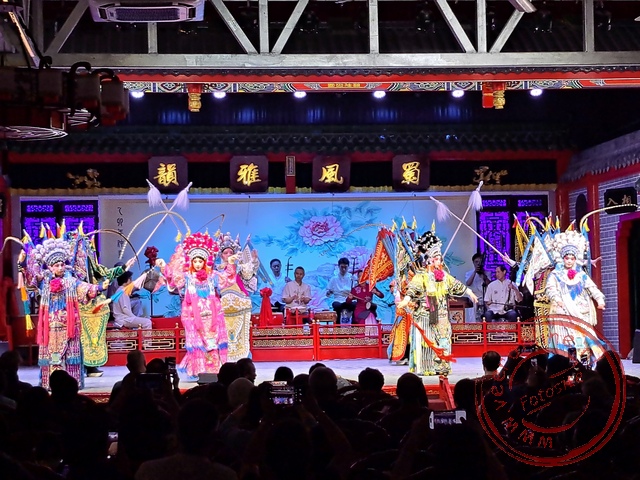
I politely take a small bite. The show continues with a man playing a string instrument, acrobats doing flips on stage, and a shadow performance displayed on a screen. It’s impressive how many animals can be portrayed using just two hands. The show ends with a Bian Lian mask dance. The masks are changed at lightning speed. It’s incredible how quickly the transitions happen. After an hour and a half, we’re back outside. In the park, entire groups are dancing—professionals in the middle, and others joining in on the sides. We walk to the metro station and take the subway back to the hotel. In a street near the hotel, we order a simple meal. The popcorn was already quite filling. With hand gestures, pictures, and the translation app, we manage to order dumplings and steamed buns. Back at the hotel, the washing machine is finally available. We quickly grab our laundry. When someone helps with the detergent, it turns out we’ve overloaded the machine. We have to split the load, which means waiting twice for 43 minutes. We hang the laundry to dry on the top-floor clothesline. After that, I go to bed.
 China
China 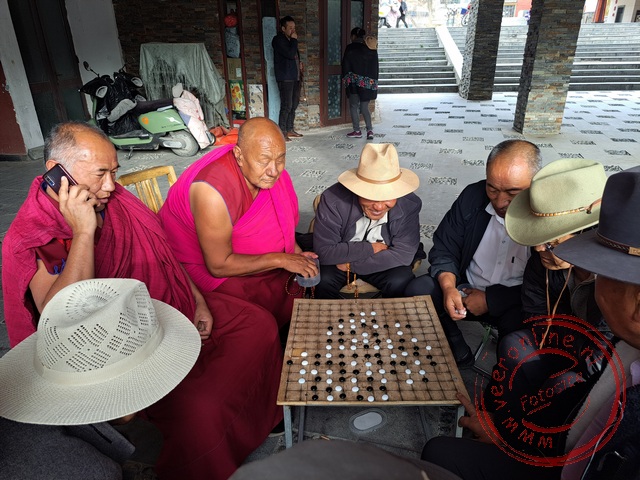 Men playing the game Go in Xiahe
 Some young monks rest by the river after a day of school
 The bridge in the old city of Songpan
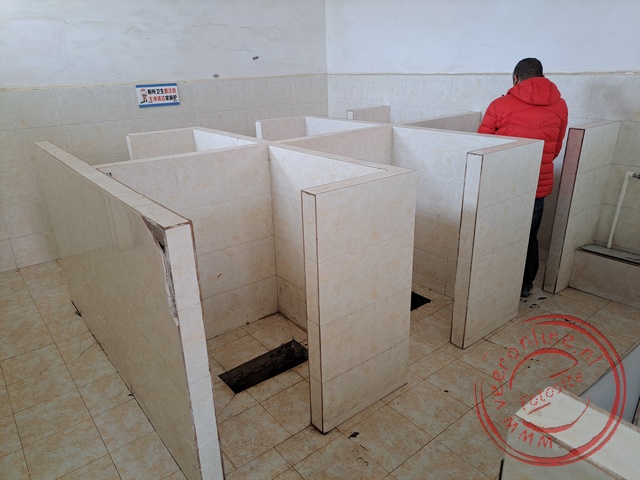 The simple toilets along the way
Travelogue From Beijing to Hong Kong
Dag 2 | China > Tiananmen Square
Dag 3 | China > The Forbidden City
Dag 4 | China > Storm in Beijing
Dag 5 | China > To the Great Wall
Dag 6 | China > Sunrise on the Wall
Dag 7 | China > The Terracotta Army
Dag 8 | China > Cycling on the Xi'an Wall
Dag 9 | China > By Train to Xiahe
Dag 10 | China > The Labrang Monastery in Xiahe
Dag 11 | China > By Bus to Langmusi
Dag 12 | China > The Serti and Kirti Monastery of Langmusi
Dag 13 | China > The Huanglong Travertine Pools
Dag 14 | China > The Mask-Changing Dance in Chengdu
Dag 15 | China > Pandas, Pandas, and More Pandas
Dag 16 | China > A Long Walk Through Chengdu
Dag 17 | China > Potatso National Park
Dag 18 | China > The Wu Fu Palace in Lijiang
Dag 19 | China > Cycling to Baisha and Shuhe
Dag 20 | China > Wandering through Shaxi
Dag 21 | China > Climbing in the Shibaoshan Mountains
Dag 22 | China > Cycling Towards Dali
Dag 23 | China > Rainy Xizhou
Dag 24 | China > The Old Center of Weishan
Dag 25 | China > Hiking in the Weibao Mountains
Dag 26 | China > Travel Day to Yangshuo
Dag 27 | China > The Colorful Caves of Yangshuo
Dag 28 | China > Bamboo Rafting on the Yulong River
Dag 29 | Hong Kong > By Train to Hong Kong
Dag 30 | Hong Kong > Victoria Peak
Dag 31 | Hong Kong > The Ten Thousand Buddhas Temple
Dag 32 | Hong Kong > Heading Home