
154 countries
(and areas)
 - Belize
- Benin
- Bhutan
- Bolivia
- Bonaire
- Bosnia and Herzegovina
- Botswana
- Brazil
- British Virgin Islands
- Brunei
- Bulgaria
- Cambodia
- Canada
- Cape Verde
- Chile
- China
- Costa Rica
- Croatia
- Cuba
- Curacao
- Cyprus
- Czech Republic
- Denmark
- Dominica
- Dominican Republic
- Egypt
- El Salvador
- England
- Estonia
- Eswatini (Swaziland)
- Ethiopia
- Fiji
- Finland
- France
- French Guiana
- Georgia
- Germany
- Gibraltar
- Greece
- Grenada
- Guadeloupe
- Guatemala
- Honduras
- Hong Kong
- Hungary
- Iceland
- India
- Indonesia
- Iran
- Ireland
- Israel
- Italy
- Jamaica
- Japan
- Jordan
- Kazakhstan
- Kenya
- Kosovo
- Kuwait
- Kyrgyzstan
- Laos
- Latvia
- Lebanon
- Lesotho
- Liechtenstein
- Lithuania
- Luxembourg
- Macau
- Madagascar
- Malawi
- Malaysia
- Maldives
- Malta
- Martinique
- Mexico
- Moldova
- Monaco
- Mongolia
- Montenegro
- Morocco
- Mozambique
- Namibia
- Nepal
- Netherlands
- New Zealand
- Nicaragua
- North Macedonia
- Northern Ireland
- Norway
- Oman
- Pakistan
- Palestine
- Peru
- Philippines
- Poland
- Portugal
- Qatar
- Republic of Korea
- Romania
- Russia
- Saint Kitts and Nevis
- Saint Lucia
- Saint Martin
- Saint Vincent and the Grenadines
- San Marino
- São Tomé and Principe
- Saudi Arabia
- Scotland
- Senegal
- Serbia
- Singapore
- Sint Maarten
- Slovakia
- Slovenia
- South Africa
- Spain
- Sri Lanka
- Suriname
- Sweden
- Switzerland
- Tajikistan
- Tanzania
- Thailand
- The Gambia
- Tibet
- Togo
- Transnistria
- Trinidad and Tobago
- Tunisia
- Turkey
- Turkmenistan
- Uganda
- United Arab Emirates
- United States
- Uruguay
- Uzbekistan
- Vatican City
- Vietnam
- Wales
- Zambia
- Zanzibar
- Belize
- Benin
- Bhutan
- Bolivia
- Bonaire
- Bosnia and Herzegovina
- Botswana
- Brazil
- British Virgin Islands
- Brunei
- Bulgaria
- Cambodia
- Canada
- Cape Verde
- Chile
- China
- Costa Rica
- Croatia
- Cuba
- Curacao
- Cyprus
- Czech Republic
- Denmark
- Dominica
- Dominican Republic
- Egypt
- El Salvador
- England
- Estonia
- Eswatini (Swaziland)
- Ethiopia
- Fiji
- Finland
- France
- French Guiana
- Georgia
- Germany
- Gibraltar
- Greece
- Grenada
- Guadeloupe
- Guatemala
- Honduras
- Hong Kong
- Hungary
- Iceland
- India
- Indonesia
- Iran
- Ireland
- Israel
- Italy
- Jamaica
- Japan
- Jordan
- Kazakhstan
- Kenya
- Kosovo
- Kuwait
- Kyrgyzstan
- Laos
- Latvia
- Lebanon
- Lesotho
- Liechtenstein
- Lithuania
- Luxembourg
- Macau
- Madagascar
- Malawi
- Malaysia
- Maldives
- Malta
- Martinique
- Mexico
- Moldova
- Monaco
- Mongolia
- Montenegro
- Morocco
- Mozambique
- Namibia
- Nepal
- Netherlands
- New Zealand
- Nicaragua
- North Macedonia
- Northern Ireland
- Norway
- Oman
- Pakistan
- Palestine
- Peru
- Philippines
- Poland
- Portugal
- Qatar
- Republic of Korea
- Romania
- Russia
- Saint Kitts and Nevis
- Saint Lucia
- Saint Martin
- Saint Vincent and the Grenadines
- San Marino
- São Tomé and Principe
- Saudi Arabia
- Scotland
- Senegal
- Serbia
- Singapore
- Sint Maarten
- Slovakia
- Slovenia
- South Africa
- Spain
- Sri Lanka
- Suriname
- Sweden
- Switzerland
- Tajikistan
- Tanzania
- Thailand
- The Gambia
- Tibet
- Togo
- Transnistria
- Trinidad and Tobago
- Tunisia
- Turkey
- Turkmenistan
- Uganda
- United Arab Emirates
- United States
- Uruguay
- Uzbekistan
- Vatican City
- Vietnam
- Wales
- Zambia
- Zanzibar


Copyright 2004 - 2026
Veeronline.nl Travel Adventures
Home > Uganda > Encounter with the Gorilla > Travelogue day 12
Travelogue Encounter with the Gorilla
July 24 August 15 2011 (23 days)
Uganda > To Chimps Nest
Dag 12 - Thursday, August 4, 2011I feel much better when I get up in the morning. Still, I hold back at the breakfast buffet. Other travelers went to the disco last night—it was a fun experience. I leave Hoima heading toward the chimpanzees. The road is a dirt road again—a so-called “dirty road,” full of potholes and bumps. This road is known as one of the worst in Uganda. Yay… (not). Just outside Hoima, the bumpiness begins. Edwin skillfully steers the bus around the holes, sometimes driving on the left side of the road, sometimes on the right. When meeting oncoming traffic, it often becomes a game of who can stay on the best part of the road the longest. I am often surprised that the side mirrors never touch. Cyclists and motorbikes hardly play along; the ideal line isn’t adjusted for them. Even when they ride on the opposite lane, they have to swerve to avoid cars. Pedestrians jump onto the grassy edges for safety. Edwin drives a few hundred meters behind Jampa. The dust from the first bus settles over the streets, houses, and people.

Sometimes the dust from passing cars is so thick that Edwin must stop because he can’t see his hand in front of his face. Everything turns orange. Even inside the bus, a thick layer of dust covers everything. Strangely, children still wave at me enthusiastically along the route. I notice many unfinished houses along the roadside. Many are started with clay bricks but never completed. Shrubs and even trees grow from the remnants. Other unfinished houses are already occupied. The building style is mostly the same: each hut about five meters wide, often built in groups of three or four. The front has only a double metal door, the front wall up to four meters high, and the roof sloping backward. Sometimes there’s a small overhang above the entrance. Goods are sold from the huts, displayed on the veranda. I approach a town and the inhabited world again. The road is paved. In the town center, I have a pizza for lunch. Across the street is a bank ATM, but the line is long and barely moving. I decide not to wait. In two days, I will have another chance to withdraw money, and I think I have just enough for that. I continue toward Kibale Forest National Park, passing countless tea plantations covering entire hillsides. Frank shows me how the tea grows and is harvested. Once a week, the young leaves are picked for tea production. Pickers can collect about 90 kilos per day, earning only 65 shillings per kilo.

By five o’clock, I arrive at Chimps Nest Lodge, just as it starts to rain a little. The cottages are spread widely through the forest, some up to a fifteen-minute walk from the main area. Because of the distance, I am not allowed to walk to the restaurant alone in the dark; there may be wild animals around. My cottage is closer. It’s a wooden house with a large balcony. The shower and toilet are outside, attached to the house. In the evening, the shower is heated with a fireplace, lit for me daily at six o’clock. The cottages also have electricity, as long as the solar power lasts, so I am advised to use it sparingly. All in all, it’s an exciting setting as a base for visiting the chimpanzees tomorrow. After dinner, one of the staff guides me back to my cottage. I quickly understand why I shouldn’t walk the pitch-dark paths alone. The guides mention that an elephant may be nearby. Fortunately—or unfortunately—I don’t encounter it in this thrilling environment.
 Uganda
  Impressive gorillas in Bwindi National Park
 A Saddlebilled Stork on the Niles shore
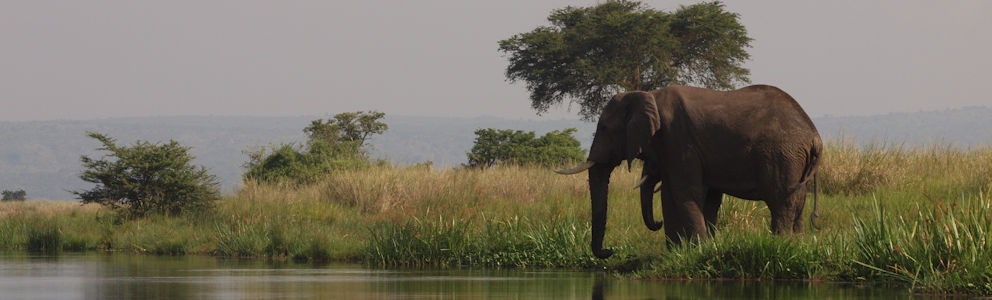
 A large African elephant walks away from the water
 A female Ugandan kob antelope
Travelogue Encounter with the Gorilla
Dag 2 | Uganda > Visit to the chimpanzees
Dag 3 | Uganda > On the way to Sipi Falls
Dag 4 | Uganda > Climbing along the waterfalls
Dag 5 | Uganda > 'Jambo, Jambo!'
Dag 6 | Uganda > The origin of the Nile
Dag 7 | Uganda > Rafting: 'Heavy 5' or 'Light 5'
Dag 8 | Uganda > Colossal rhinos
Dag 9 | Uganda > Lost in Murchison Falls NP
Dag 10 | Uganda > A leopard!
Dag 11 | Uganda > Digestive problems...
Dag 12 | Uganda > To Chimps Nest
Dag 13 | Uganda > Visiting the chimpanzees
Dag 14 | Uganda > Queen Elizabeth National Park
Dag 15 | Uganda > Boating on the Kazinga Channel
Dag 16 | Uganda > Tree-climbing lions
Dag 17 | Uganda > Dusty road to Bwindi
Dag 18 | Uganda > Rest day at Lake Matanda
Dag 19 | Uganda > Eye to eye with the gorillas
Dag 20 | Uganda > Lake Bunyonyi
Dag 21 | Uganda > The Disco in Masaka
Dag 22 | Uganda > Rare Shoebill