
154 countries
(and areas)
 - Belize
- Benin
- Bhutan
- Bolivia
- Bonaire
- Bosnia and Herzegovina
- Botswana
- Brazil
- British Virgin Islands
- Brunei
- Bulgaria
- Cambodia
- Canada
- Cape Verde
- Chile
- China
- Costa Rica
- Croatia
- Cuba
- Curacao
- Cyprus
- Czech Republic
- Denmark
- Dominica
- Dominican Republic
- Egypt
- El Salvador
- England
- Estonia
- Eswatini (Swaziland)
- Ethiopia
- Fiji
- Finland
- France
- French Guiana
- Georgia
- Germany
- Gibraltar
- Greece
- Grenada
- Guadeloupe
- Guatemala
- Honduras
- Hong Kong
- Hungary
- Iceland
- India
- Indonesia
- Iran
- Ireland
- Israel
- Italy
- Jamaica
- Japan
- Jordan
- Kazakhstan
- Kenya
- Kosovo
- Kuwait
- Kyrgyzstan
- Laos
- Latvia
- Lebanon
- Lesotho
- Liechtenstein
- Lithuania
- Luxembourg
- Macau
- Madagascar
- Malawi
- Malaysia
- Maldives
- Malta
- Martinique
- Mexico
- Moldova
- Monaco
- Mongolia
- Montenegro
- Morocco
- Mozambique
- Namibia
- Nepal
- Netherlands
- New Zealand
- Nicaragua
- North Macedonia
- Northern Ireland
- Norway
- Oman
- Pakistan
- Palestine
- Peru
- Philippines
- Poland
- Portugal
- Qatar
- Republic of Korea
- Romania
- Russia
- Saint Kitts and Nevis
- Saint Lucia
- Saint Martin
- Saint Vincent and the Grenadines
- San Marino
- São Tomé and Principe
- Saudi Arabia
- Scotland
- Senegal
- Serbia
- Singapore
- Sint Maarten
- Slovakia
- Slovenia
- South Africa
- Spain
- Sri Lanka
- Suriname
- Sweden
- Switzerland
- Tajikistan
- Tanzania
- Thailand
- The Gambia
- Tibet
- Togo
- Transnistria
- Trinidad and Tobago
- Tunisia
- Turkey
- Turkmenistan
- Uganda
- United Arab Emirates
- United States
- Uruguay
- Uzbekistan
- Vatican City
- Vietnam
- Wales
- Zambia
- Zanzibar
- Belize
- Benin
- Bhutan
- Bolivia
- Bonaire
- Bosnia and Herzegovina
- Botswana
- Brazil
- British Virgin Islands
- Brunei
- Bulgaria
- Cambodia
- Canada
- Cape Verde
- Chile
- China
- Costa Rica
- Croatia
- Cuba
- Curacao
- Cyprus
- Czech Republic
- Denmark
- Dominica
- Dominican Republic
- Egypt
- El Salvador
- England
- Estonia
- Eswatini (Swaziland)
- Ethiopia
- Fiji
- Finland
- France
- French Guiana
- Georgia
- Germany
- Gibraltar
- Greece
- Grenada
- Guadeloupe
- Guatemala
- Honduras
- Hong Kong
- Hungary
- Iceland
- India
- Indonesia
- Iran
- Ireland
- Israel
- Italy
- Jamaica
- Japan
- Jordan
- Kazakhstan
- Kenya
- Kosovo
- Kuwait
- Kyrgyzstan
- Laos
- Latvia
- Lebanon
- Lesotho
- Liechtenstein
- Lithuania
- Luxembourg
- Macau
- Madagascar
- Malawi
- Malaysia
- Maldives
- Malta
- Martinique
- Mexico
- Moldova
- Monaco
- Mongolia
- Montenegro
- Morocco
- Mozambique
- Namibia
- Nepal
- Netherlands
- New Zealand
- Nicaragua
- North Macedonia
- Northern Ireland
- Norway
- Oman
- Pakistan
- Palestine
- Peru
- Philippines
- Poland
- Portugal
- Qatar
- Republic of Korea
- Romania
- Russia
- Saint Kitts and Nevis
- Saint Lucia
- Saint Martin
- Saint Vincent and the Grenadines
- San Marino
- São Tomé and Principe
- Saudi Arabia
- Scotland
- Senegal
- Serbia
- Singapore
- Sint Maarten
- Slovakia
- Slovenia
- South Africa
- Spain
- Sri Lanka
- Suriname
- Sweden
- Switzerland
- Tajikistan
- Tanzania
- Thailand
- The Gambia
- Tibet
- Togo
- Transnistria
- Trinidad and Tobago
- Tunisia
- Turkey
- Turkmenistan
- Uganda
- United Arab Emirates
- United States
- Uruguay
- Uzbekistan
- Vatican City
- Vietnam
- Wales
- Zambia
- Zanzibar


Copyright 2004 - 2026
Veeronline.nl Travel Adventures
Home > Honduras > From Costa Rica to Guatemala > Travelogue day 20
Travelogue From Costa Rica to Guatemala
October 12 November 11 2013 (31 days)
Honduras > In the footsteps of the Mayas
Dag 20 - Thursday, October 31, 2013Saul is already waiting for me outside the hotel. Immediately, he starts telling me all about Copán—about the men in the plaza and his frustration with the trash they leave behind, about the cathedral, and about the people of Copán. Saul is an enthusiastic man full of stories

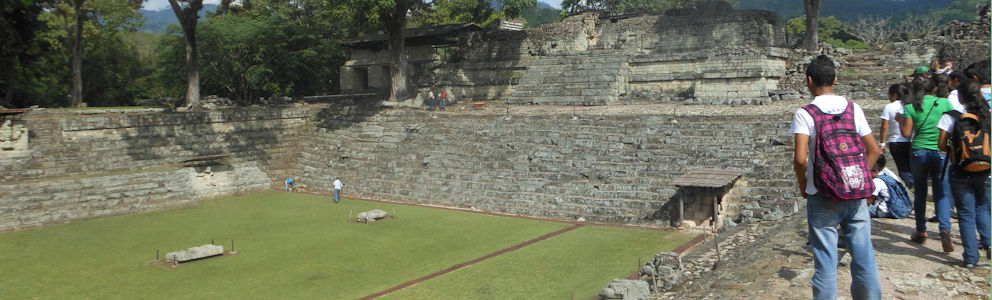
. He has been a guide for 21 years, he tells me. I follow Saul on foot to the historic site of Copán. Copán used to be the southernmost city of the Maya empire. The temples, stelae, houses, and other structures date from just before the start of the Common Era up to 700 CE. Every 52-year cycle according to the Maya calendar, new temples were built. Often the old temples were destroyed, and their remains were used to build the new temple even higher. As I approach the temples of Copán from the side, I am immediately impressed. The pyramid-shaped structures of the Maya, which I have seen so often in pictures, now stand before me among the trees. Impressive! Saul explains the original purpose of the buildings and how the area was used in the past. The center of Copán, the Acropolis, was the domain of the wealthy. The poorer population lived across the river in simple huts. At Temple 16, the underlying temple was not demolished; the new temple was built over the old one—possibly because the temple was too beautiful to destroy. Only recently was the old temple discovered beneath the newer structure.

You can visit it via a tunnel, but Saul advises against it. It is relatively expensive, and many people find it disappointing. Instead, he recommends visiting the museum, where a life-size replica of this temple is on display. At the 72-step staircase, I say goodbye to Saul. Over the past two hours, he has given me extensive information about the ruins of Copán. Now I have time to explore the remaining structures on my own. The 72-step staircase is unique because the steps contain the longest Maya text ever written in hieroglyphs. To protect the staircase, it has been temporarily covered with a cloth. This is good for preservation, of course, but it detracts from the overall view of Copán. I walk back to the exit via various temples and ancient structures. I visit the museum, particularly to see the replica of the old temple. The beautiful red building adorned with colorful decorations immediately catches my eye. After lunch back in the town of Copán, I walk back to Via Via in the afternoon.

Geert gives a tour of the town and tells stories about life in Honduras. At the market building, he talks about the low minimum wage in the country and how it can be easily circumvented: “For you, ten others.” He also explains that raising the minimum wage could lead to higher prices for products such as coffee in Europe, which would price Honduras out of the market. He talks about the low salaries of police officers and how this encourages corruption. The country’s main sources of income are remittances from family members in the U.S., followed by development aid subsidies. Tourism revenue has dropped significantly since the coup three years ago. Honduras is currently one of the poorest and least safe countries in the world. In the major cities, gangs are in control, and wealthy people are kidnapped for ransom. In Copán, it is relatively safe for tourists. The town wants to attract more visitors, especially to Copán, but faces four main problems: electricity, water, waste, and safety. Geert calculates that tourists produce much more waste than local residents. If each tourist consumes an average of six plastic bottles during their stay in Copán, that adds up to half a million bottles per year. People simply don’t know what to do with them.

In the town center, waste is still collected, but outside it is common to dispose of it out of sight. He asks visitors to be mindful of these problems and understanding if water or electricity is sometimes unavailable. Finally, he closes the walk with the topic of drugs. Honduras is a major transit point for drugs from Colombia. Drug lords earn a lot of money and have significant power in the region. Copán is an important transit point for drugs to Guatemala. Many poor people carry backpacks full of drugs through the mountains daily. Geert shows me the extreme contrasts in the town. Suddenly, I see beautiful houses standing among small huts. “This is either a donation from the U.S. or drug money,” Geert explains. Back at Via Via, I reflect on Geert’s stories over a beer. In the evening, after dinner, Geert joins me again, and the discussion continues about the future of tourism in Honduras. Eventually, the staff wants to go home, and I return to my hotel.
 Nicaragua
  Due to rainfall the stream is high and difficult to cross
 El Salvador
  The Los Tercios waterfall with basalt blocks
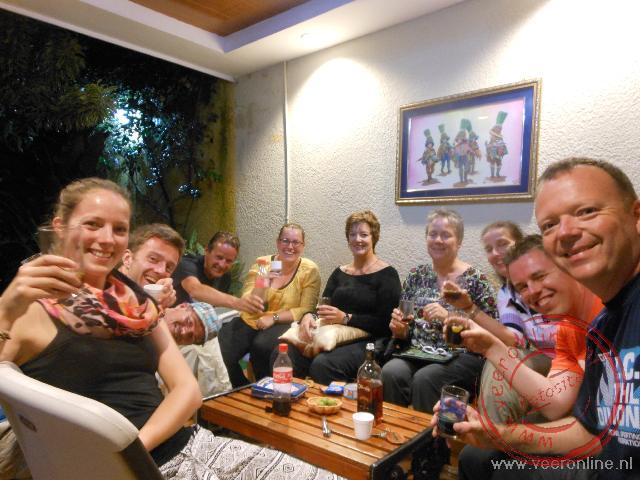 Left to right Imke Jeroen Erik Johan Marieke Maria Janke Peggy Eric and Ronald
 Guatemala
  The Castillo de San Felipe to defend against pirate attacks from the lake
Travelogue From Costa Rica to Guatemala
Dag 2 | Costa Rica > Searching for the Red Eye Frog
Dag 3 | Costa Rica > Monkeys at Caño Negro
Dag 4 | Costa Rica > From La Fortuna to Monteverde
Dag 5 | Costa Rica > A Quetzal in the treetops
Dag 6 | Costa Rica > Swinging among the treetops
Dag 7 | Costa Rica > Mud volcano of Rincón de la Vieja
Dag 8 | Nicaragua > To Isla de Ometepe
Dag 9 | Nicaragua > Climbing the Concepción volcano
Dag 10 | Nicaragua > Wandering through old Granada
Dag 11 | Nicaragua > Kayaking among the Isletas de Granada
Dag 12 | Nicaragua > The historic city of León
Dag 13 | Nicaragua > Lava on the Telica volcano
Dag 14 | Nicaragua > Sliding down the Cerro Negro volcano
Dag 15 | Nicaragua > Mountain hike through the rainforest
Dag 16 | El Salvador > Via Honduras to El Salvador
Dag 17 | El Salvador > The memory of the civil war
Dag 18 | El Salvador > Escorted to the waterfall
Dag 19 | Honduras > On the way to Copán Ruinas
Dag 20 | Honduras > In the footsteps of the Mayas
Dag 21 | Guatemala > Crossing the border to Rio Dulce
Dag 22 | Guatemala > Capsized with a jet ski
Dag 23 | Belize > The fourth hotel room is fine
Dag 24 | Belize > 'Go Slow' on Caye Caulker
Dag 25 | Belize > Swimming with a sea turtle
Dag 26 | Guatemala > Police escort to Tikal
Dag 27 | Guatemala > The Mayan city of Tikal
Dag 28 | Guatemala > Ruins in the street scene of Antigua
Dag 29 | Guatemala > Ending with the Pacaya volcano
Dag 30 | Guatemala > To the airport
Dag 31 | Guatemala > Back home