
154 countries
(and areas)
 - Belize
- Benin
- Bhutan
- Bolivia
- Bonaire
- Bosnia and Herzegovina
- Botswana
- Brazil
- British Virgin Islands
- Brunei
- Bulgaria
- Cambodia
- Canada
- Cape Verde
- Chile
- China
- Costa Rica
- Croatia
- Cuba
- Curacao
- Cyprus
- Czech Republic
- Denmark
- Dominica
- Dominican Republic
- Egypt
- El Salvador
- England
- Estonia
- Eswatini (Swaziland)
- Ethiopia
- Fiji
- Finland
- France
- French Guiana
- Georgia
- Germany
- Gibraltar
- Greece
- Grenada
- Guadeloupe
- Guatemala
- Honduras
- Hong Kong
- Hungary
- Iceland
- India
- Indonesia
- Iran
- Ireland
- Israel
- Italy
- Jamaica
- Japan
- Jordan
- Kazakhstan
- Kenya
- Kosovo
- Kuwait
- Kyrgyzstan
- Laos
- Latvia
- Lebanon
- Lesotho
- Liechtenstein
- Lithuania
- Luxembourg
- Macau
- Madagascar
- Malawi
- Malaysia
- Maldives
- Malta
- Martinique
- Mexico
- Moldova
- Monaco
- Mongolia
- Montenegro
- Morocco
- Mozambique
- Namibia
- Nepal
- Netherlands
- New Zealand
- Nicaragua
- North Macedonia
- Northern Ireland
- Norway
- Oman
- Pakistan
- Palestine
- Peru
- Philippines
- Poland
- Portugal
- Qatar
- Republic of Korea
- Romania
- Russia
- Saint Kitts and Nevis
- Saint Lucia
- Saint Martin
- Saint Vincent and the Grenadines
- San Marino
- São Tomé and Principe
- Saudi Arabia
- Scotland
- Senegal
- Serbia
- Singapore
- Sint Maarten
- Slovakia
- Slovenia
- South Africa
- Spain
- Sri Lanka
- Suriname
- Sweden
- Switzerland
- Tajikistan
- Tanzania
- Thailand
- The Gambia
- Tibet
- Togo
- Transnistria
- Trinidad and Tobago
- Tunisia
- Turkey
- Turkmenistan
- Uganda
- United Arab Emirates
- United States
- Uruguay
- Uzbekistan
- Vatican City
- Vietnam
- Wales
- Zambia
- Zanzibar
- Belize
- Benin
- Bhutan
- Bolivia
- Bonaire
- Bosnia and Herzegovina
- Botswana
- Brazil
- British Virgin Islands
- Brunei
- Bulgaria
- Cambodia
- Canada
- Cape Verde
- Chile
- China
- Costa Rica
- Croatia
- Cuba
- Curacao
- Cyprus
- Czech Republic
- Denmark
- Dominica
- Dominican Republic
- Egypt
- El Salvador
- England
- Estonia
- Eswatini (Swaziland)
- Ethiopia
- Fiji
- Finland
- France
- French Guiana
- Georgia
- Germany
- Gibraltar
- Greece
- Grenada
- Guadeloupe
- Guatemala
- Honduras
- Hong Kong
- Hungary
- Iceland
- India
- Indonesia
- Iran
- Ireland
- Israel
- Italy
- Jamaica
- Japan
- Jordan
- Kazakhstan
- Kenya
- Kosovo
- Kuwait
- Kyrgyzstan
- Laos
- Latvia
- Lebanon
- Lesotho
- Liechtenstein
- Lithuania
- Luxembourg
- Macau
- Madagascar
- Malawi
- Malaysia
- Maldives
- Malta
- Martinique
- Mexico
- Moldova
- Monaco
- Mongolia
- Montenegro
- Morocco
- Mozambique
- Namibia
- Nepal
- Netherlands
- New Zealand
- Nicaragua
- North Macedonia
- Northern Ireland
- Norway
- Oman
- Pakistan
- Palestine
- Peru
- Philippines
- Poland
- Portugal
- Qatar
- Republic of Korea
- Romania
- Russia
- Saint Kitts and Nevis
- Saint Lucia
- Saint Martin
- Saint Vincent and the Grenadines
- San Marino
- São Tomé and Principe
- Saudi Arabia
- Scotland
- Senegal
- Serbia
- Singapore
- Sint Maarten
- Slovakia
- Slovenia
- South Africa
- Spain
- Sri Lanka
- Suriname
- Sweden
- Switzerland
- Tajikistan
- Tanzania
- Thailand
- The Gambia
- Tibet
- Togo
- Transnistria
- Trinidad and Tobago
- Tunisia
- Turkey
- Turkmenistan
- Uganda
- United Arab Emirates
- United States
- Uruguay
- Uzbekistan
- Vatican City
- Vietnam
- Wales
- Zambia
- Zanzibar


Copyright 2004 - 2026
Veeronline.nl Travel Adventures

Home > India > Ladakh Little Tibet > Travelogue day 2
Travelogue Ladakh Little Tibet
July 20 August 15 2012 (27 days)
India > Salaam Baalak walk Old Delhi
Dag 2 - Saturday, July 21, 2012
In the morning, Tariq welcomes me. He takes me for a walking tour through the old Paharganj district of Delhi. Tariq is part of the Salaam Baalak organization, which supports street children. He tells me that he himself spent a year on the streets as a young boy when he was ten. He shares the hardships of growing up as a small boy in the big city of Delhi. Eventually, he was taken in by Salaam Baalak. I walk with him among the old, often dilapidated houses. Tariq earned money as a child by collecting leftover materials from the garbage. He often gambled the money away or spent it on drugs. Saving money was pointless, as it would be stolen during the night by others. He takes me to a children’s shelter, where several boys are playing games on the veranda. A little further on, I visit a small school. In a modest classroom, children are being taught. When I enter, they pause their lessons to greet me. “What's your name?” “Where do you come from?” Enthusiastically, I tell them my name and where I’m from. From the guestbook, I see that a few foreign tourists visit every day. The children clearly can’t get enough. The proceeds help sustain the organization. Before noon, I plan to take the metro to the old city. As soon as I leave the hotel, several tuk-tuks (motorized rickshaws) arrive.

They warn me about pickpockets in the metro and the long queues. To save me this hassle, they offer to drive me. I’m not impressed by the dangers, but in a tuk-tuk you see more of the city than underground. I estimate the ride will take about 45 minutes. My opening offer of 100 rupees is accepted only if I stop at a handicraft shop along the way. No way! The driver would earn a hefty commission. I take the next rickshaw. After some negotiating, I get in for 100 rupees. Just as we round the corner, the driver starts complaining that it’s a long distance. For 100 rupees, he will only go if I visit a shop. He offers me the option to get out without paying. I refuse both and gesture for him to continue to the Red Fort. He grumbles that it will cost more if I don’t stop at a shop. I feel slightly cheated, but it’s just one extra euro. Just before the Red Fort, he stops and offers to drive me around the city for the afternoon for 500 rupees. I’ve had enough and decline. I get out at the Red Fort. The fort was built in 1638 under Emperor Shah Jahan, who also built the Taj Mahal in Agra as a mausoleum for his deceased wife. The construction of the fort was intended to move the capital from Agra back to Delhi, but this never happened. Shah Jahan was soon overthrown by his son, Emperor Aurangzeb, and died in captivity in Agra a few years later. I walk under the red sandstone Lahore Gate. The gate is the center of the eighteen-meter-high wall. In 1947, the flag of independent India was first hoisted on this gate. Just behind the gate, I enter the covered bazaar. The passage is now mostly filled with tourist shops, which I pass through quickly. On the spacious inner courtyard, I hardly feel that I’m inside a fort. In the distance, I can still see the walls. I walk past the Diwan-i-Am, the hall of public audiences, where the emperor’s throne stands. Behind it are the beautifully decorated private chambers. The emperor also built a mosque within the Red Fort so he wouldn’t have to go through the old city to reach the Jama Masjid, fearing attacks on his life. I decide to follow the route out via the main gate and walk into the old city. I try to keep the many street vendors away from me. Some are very persistent. Crossing the road, I pass a maze of rickshaws, tuk-tuks, and taxis, all seeing me as their next customer. They shout and grab at me. I want to explore the neighborhood on foot.
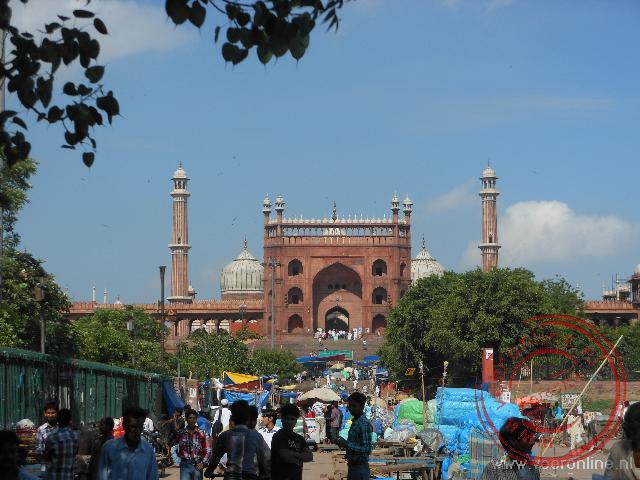
Some rickshaws follow alongside, trying to change my mind. Annoying! When I look for the entrance to the Buddhist Jain temple around the corner, a man immediately approaches as my guide. How do I get rid of him? He points out the entrance and wants to show me more of the city. I don’t want this, but he keeps walking beside me. He points to a small adjacent Sikh temple. The temple itself is closed, but through a narrow passage, I reach the back. Here, the caretaker explains the temple and advises me to return at 4 p.m. when it reopens. I give him a tip and say goodbye. Immediately, others sense an opportunity, but I keep them at bay. I turn left into the old city bazaar. I walk among the stalls, careful where I step, as the streets are littered with trash that has clearly been there a long time. Through the alleyways, I reach the Jama Masjid. Its construction began in 1650 under Shah Jahan. Like the Red Fort, it is built from red sandstone. I climb the steps and enter the central courtyard. The Jama Masjid is the largest mosque in the city. I ascend the 121 steps of the minaret. From the top, I have a panoramic view of Delhi—a fantastic sight. From the mosque, I continue wandering through Old Delhi. I quickly get lost in the narrow streets, and I’m surprised to suddenly find a metro station. I buy a ticket and join the queue. It’s crowded. I let one metro pass, but there’s room for me on the next train. Carefully, I watch my valuables. I reach the hotel safely.
 India
India  Cows in the small front garden in the district of Vashisht
 A walk along the narrow trails through the mountains
 A steep mountain trail during the trek
 The square at the mausoleum of Fatehpur Sikri Fort
Travelogue Ladakh Little Tibet
Dag 2 | India > Salaam Baalak walk Old Delhi
Dag 3 | India > A restart at Leh Airport
Dag 4 | India > Along the monasteries in the Indus valley
Dag 5 | India > Sunset at the Shanti Stupa
Dag 6 | India > Walking tour Leh
Dag 7 | India > Start Sham trekking
Dag 8 | India > Hiking over the mountain passes
Dag 9 | India > Through the mountain stream to Rizong
Dag 10 | India > From Hemis Shukpachan to Themisgang
Dag 11 | India > The monastery of Lamayuru
Dag 12 | India > Alchi, the oldest monastery of Ladakh
Dag 13 | India > Mountain biking from the Khardung La pass
Dag 14 | India > Across the Himalayan mountain passes
Dag 15 | India > From Sarchu to Keylong
Dag 16 | India > Landslides at the Rothang Pass
Dag 17 | India > Wandering through Manali
Dag 18 | India > Mountain hike to the waterfall
Dag 19 | India > On the way to Dharamsala
Dag 20 | India > Tsuglagkhang, the home of the Dalai Lama
Dag 21 | India > The Golden Sikh Temple
Dag 22 | India > Closure of the Wagah border
Dag 23 | India > By tuk-tuk through Delhi
Dag 24 | India > Cycling through Old Delhi
Dag 25 | India > Taj Mahal!!!
Dag 26 | India > The Fatehpur Sikri fort
Dag 27 | India > Good flight home