
154 countries
(and areas)
 - Belize
- Benin
- Bhutan
- Bolivia
- Bonaire
- Bosnia and Herzegovina
- Botswana
- Brazil
- British Virgin Islands
- Brunei
- Bulgaria
- Cambodia
- Canada
- Cape Verde
- Chile
- China
- Costa Rica
- Croatia
- Cuba
- Curacao
- Cyprus
- Czech Republic
- Denmark
- Dominica
- Dominican Republic
- Egypt
- El Salvador
- England
- Estonia
- Eswatini (Swaziland)
- Ethiopia
- Fiji
- Finland
- France
- French Guiana
- Georgia
- Germany
- Gibraltar
- Greece
- Grenada
- Guadeloupe
- Guatemala
- Honduras
- Hong Kong
- Hungary
- Iceland
- India
- Indonesia
- Iran
- Ireland
- Israel
- Italy
- Jamaica
- Japan
- Jordan
- Kazakhstan
- Kenya
- Kosovo
- Kuwait
- Kyrgyzstan
- Laos
- Latvia
- Lebanon
- Lesotho
- Liechtenstein
- Lithuania
- Luxembourg
- Macau
- Madagascar
- Malawi
- Malaysia
- Maldives
- Malta
- Martinique
- Mexico
- Moldova
- Monaco
- Mongolia
- Montenegro
- Morocco
- Mozambique
- Namibia
- Nepal
- Netherlands
- New Zealand
- Nicaragua
- North Macedonia
- Northern Ireland
- Norway
- Oman
- Pakistan
- Palestine
- Peru
- Philippines
- Poland
- Portugal
- Qatar
- Republic of Korea
- Romania
- Russia
- Saint Kitts and Nevis
- Saint Lucia
- Saint Martin
- Saint Vincent and the Grenadines
- San Marino
- São Tomé and Principe
- Saudi Arabia
- Scotland
- Senegal
- Serbia
- Singapore
- Sint Maarten
- Slovakia
- Slovenia
- South Africa
- Spain
- Sri Lanka
- Suriname
- Sweden
- Switzerland
- Tajikistan
- Tanzania
- Thailand
- The Gambia
- Tibet
- Togo
- Transnistria
- Trinidad and Tobago
- Tunisia
- Turkey
- Turkmenistan
- Uganda
- United Arab Emirates
- United States
- Uruguay
- Uzbekistan
- Vatican City
- Vietnam
- Wales
- Zambia
- Zanzibar
- Belize
- Benin
- Bhutan
- Bolivia
- Bonaire
- Bosnia and Herzegovina
- Botswana
- Brazil
- British Virgin Islands
- Brunei
- Bulgaria
- Cambodia
- Canada
- Cape Verde
- Chile
- China
- Costa Rica
- Croatia
- Cuba
- Curacao
- Cyprus
- Czech Republic
- Denmark
- Dominica
- Dominican Republic
- Egypt
- El Salvador
- England
- Estonia
- Eswatini (Swaziland)
- Ethiopia
- Fiji
- Finland
- France
- French Guiana
- Georgia
- Germany
- Gibraltar
- Greece
- Grenada
- Guadeloupe
- Guatemala
- Honduras
- Hong Kong
- Hungary
- Iceland
- India
- Indonesia
- Iran
- Ireland
- Israel
- Italy
- Jamaica
- Japan
- Jordan
- Kazakhstan
- Kenya
- Kosovo
- Kuwait
- Kyrgyzstan
- Laos
- Latvia
- Lebanon
- Lesotho
- Liechtenstein
- Lithuania
- Luxembourg
- Macau
- Madagascar
- Malawi
- Malaysia
- Maldives
- Malta
- Martinique
- Mexico
- Moldova
- Monaco
- Mongolia
- Montenegro
- Morocco
- Mozambique
- Namibia
- Nepal
- Netherlands
- New Zealand
- Nicaragua
- North Macedonia
- Northern Ireland
- Norway
- Oman
- Pakistan
- Palestine
- Peru
- Philippines
- Poland
- Portugal
- Qatar
- Republic of Korea
- Romania
- Russia
- Saint Kitts and Nevis
- Saint Lucia
- Saint Martin
- Saint Vincent and the Grenadines
- San Marino
- São Tomé and Principe
- Saudi Arabia
- Scotland
- Senegal
- Serbia
- Singapore
- Sint Maarten
- Slovakia
- Slovenia
- South Africa
- Spain
- Sri Lanka
- Suriname
- Sweden
- Switzerland
- Tajikistan
- Tanzania
- Thailand
- The Gambia
- Tibet
- Togo
- Transnistria
- Trinidad and Tobago
- Tunisia
- Turkey
- Turkmenistan
- Uganda
- United Arab Emirates
- United States
- Uruguay
- Uzbekistan
- Vatican City
- Vietnam
- Wales
- Zambia
- Zanzibar


Copyright 2004 - 2026
Veeronline.nl Travel Adventures

Home > Georgia > From Amsterdam to Tokyo > Travelogue day 19
Travelogue From Amsterdam to Tokyo
May 1 August 8 2016 (100 days)
Georgia > A typical Russian hotel
Dag 19 - Thursday, May 19, 2016We wake up late. We were probably in need of the sleep. It doesn’t matter much, as it’s raining outside. The view from the apartment on the eleventh floor is somewhat bleak. Sea view of the Black Sea doesn’t help much today. At our leisure, we bring the luggage downstairs. We are out of coins for the elevator. As an alternative, we fill the elevator and have someone downstairs call it. Then we press the button for the eleventh floor again to get it up. The owner and his wife of the apartment arrive as well, asking if we can take a group photo for Facebook with them. When we ask about the statue of Nino and Ali, they offer to drive ahead for us. On the coast stands the Statue of Love by the artist Tamara Kvesitadze. The sculpture of a man and woman twists and slides into each other several times a day to form a single image. There is also a Ferris wheel and the Alphabet Tower, both closed—apologizes the owner. The season only starts at the end of May. We say goodbye to them. On the central Europe Square stands the statue of the Georgian princess Medea, holding the Golden Fleece in her hand. This also symbolizes the close ties between Georgia and Europe. This is also depicted on one of the buildings, where the Georgian flag blends into the European flag. The fountain and the other stylish buildings around the square are also worth seeing. In the park along the boulevard stands the striking Technological University Tower. Halfway up the tower is a Ferris wheel with eight gondolas. The tower is still under construction, and unfortunately we cannot go inside. The beach consists of coarse pebbles and stones—not very inviting to lie on even if it were dry. The park immediately next to it, on the other hand, offers more entertainment. Several terraces, playgrounds, and wide avenues. On weekends, it’s probably very lively here.

Today, there is no one. It is still raining. By now, it’s three o’clock. We leave Batumi. We are starting to get used to the Georgian driving style. It is also clear that drivers take into account our car and foreign license plate. Outside the city, it is less hectic. Everyone is going in the same direction without intersections. Yet everyone overtakes where they technically shouldn’t. Drivers swerve slightly to the side, and everything works out. Some drivers find it necessary to overtake a car that is already overtaking. On the road, there is really never a dull moment. Cows wander freely on the roadway, and traffic navigates around them. There are also frequent large potholes in the road—either from wear or missing manhole covers. When avoiding these potholes, it is important to check if someone is overtaking at the same time. As we head further north and into the mountains, we also encounter many wet patches. The roadside ditches are almost overflowing. In some places, large puddles cover the road. Water sprays meters high as we drive through. It must have rained heavily here. When the navigation instructs us to turn left, we encounter an unpaved stretch of road ten kilometers long. Asphalt probably existed here once, but now only deep potholes remain. Carefully, we maneuver the Land Rover left and right, depending on which part of the road is best. Progress is slow. The cows on the road glance up at the yellow giant. Just past Zugdidi lies the residence of the Archbishop of Georgia. Just as I am about to take a photo, a train approaches. I am practically on the tracks. I am so startled by the train that when I step back, I almost fall down the embankment. Fortunately, I manage. How many trains pass here per day? Slightly shaken, I get back in to continue driving. By late afternoon, we arrive in Enguri, a small town near the world’s second-highest dam. This is also where our hotel is located—a typical Russian hotel, with wide, uninviting stone and concrete corridors. Nevertheless, it is a fine place to stay. When we want a beer—purchased at a small shop across from the hotel—a complete meal immediately appears on the table. The appetizer alone would have been enough, but the dishes keep coming. When a sort of cheese pizza finally comes as dessert, we don’t know where to put it. In the hotel, there is also a group of Georgian and Italian geologists. They are jointly studying the risks of a potential earthquake at the dam. They invite us for a chacha, a strong Georgian drink. Together, we toast to everything we can think of.
 Russia
  The Jewish synagogue in the Jewish Oblast Birobidzhan
 Turkey
 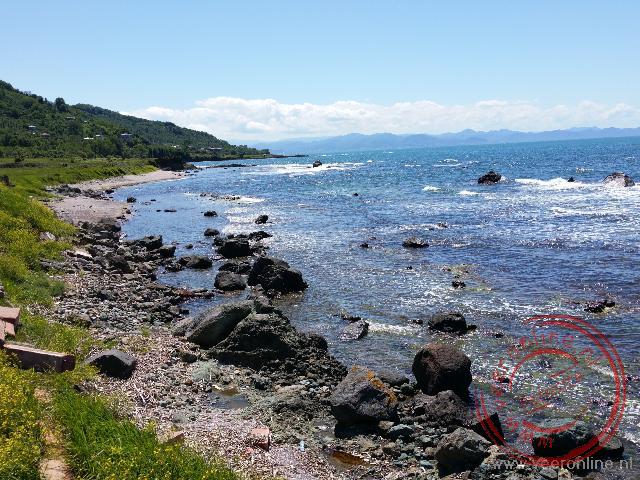 The clear waters of the Black Sea
 Georgia
  The Bridge of Peace in Tbilisi is illuminated in the colors of the Georgian flag
 Tajikistan
  A man is out of fuel We give him some from our jerrycans
Travelogue From Amsterdam to Tokyo
Dag 2 | Germany > Through Germany
Dag 3 | Austria > Ljubljana Castle
Dag 4 | Croatia > Plitvice Lakes in the rain
Dag 5 | Bosnia and Herzegovina > By the Bay of Kotor
Dag 6 | Montenegro > Across the Albanian border
Dag 7 | Albania > Driving through Tirana
Dag 8 | Albania > Ottoman houses of Berat
Dag 9 | Albania > From Gjirokaster to Metsovo
Dag 10 | Greece > The monasteries of Meteora
Dag 11 | Greece > The caves of Alistrati
Dag 12 | Greece > The Horse of Troy
Dag 13 | Turkey > The Temple of Athena
Dag 14 | Turkey > Historic Safranbolu
Dag 15 | Turkey > Football party in Amasya
Dag 16 | Turkey > Driving license returned
Dag 17 | Turkey > The D915 is 'Kapali' (closed)
Dag 18 | Turkey > To Batumi in Georgia
Dag 19 | Georgia > A typical Russian hotel
Dag 20 | Georgia > The mountain road to Ushguli
Dag 21 | Georgia > Party at the Imperial Hotel
Dag 22 | Georgia > From Kusaisi to Gori
Dag 23 | Georgia > Tsminda Sameba Church Kasbeki
Dag 24 | Georgia > The only hotel seems closed
Dag 25 | Georgia > The heating is broken
Dag 26 | Georgia > Independence Day in Tbilisi
Dag 27 | Georgia > Crossing the border to Azerbaijan
Dag 28 | Azerbaijan > Mud volcanoes of Gobustan
Dag 29 | Azerbaijan > Waiting for the boat
Dag 30 | Azerbaijan > Are we already in Turkmenistan?
Dag 31 | Azerbaijan > Stuck on the Caspian Sea
Dag 32 | Azerbaijan > Finally Turkmenistan
Dag 33 | Turkmenistan > Still going to Yangykala
Dag 34 | Turkmenistan > Swimming in an underground cave
Dag 35 | Turkmenistan > 'No Pictures, No Pictures'
Dag 36 | Turkmenistan > The border is closed
Dag 37 | Uzbekistan > Enchanting Khiva
Dag 38 | Uzbekistan > Wandering through old Khiva
Dag 39 | Uzbekistan > Through the Kyzylkum desert
Dag 40 | Uzbekistan > The Registan Square of Samarkand
Dag 41 | Uzbekistan > The palace of Timur Lenk
Dag 42 | Uzbekistan > Smuggling porn
Dag 43 | Tajikistan > The capital of Tajikistan
Dag 44 | Tajikistan > Landslides
Dag 45 | Tajikistan > The exhaust breaks off
Dag 46 | Tajikistan > Bathing in a mineral bath
Dag 47 | Tajikistan > The Wakhan Valley
Dag 48 | Tajikistan > Over the Khargush pass
Dag 49 | Tajikistan > We lost Wilco
Dag 50 | Tajikistan > Over the high Ak-Baital pass
Dag 51 | Kyrgyzstan > Recovering in Osh
Dag 52 | Kyrgyzstan > The Throne of Solomon
Dag 53 | Kyrgyzstan > Misty on the mountain top
Dag 54 | Kyrgyzstan > Overnight stay in a yurt
Dag 55 | Kyrgyzstan > Plov with salad
Dag 56 | Kyrgyzstan > Vodka by Lake Kolsai
Dag 57 | Kazakhstan > Spectacular Charyn Canyon
Dag 58 | Kazakhstan > The cathedrals of Almaty
Dag 59 | Kazakhstan > To Altyn Emel National Park
Dag 60 | Kazakhstan > The Singing Sand Dunes
Dag 61 | Kazakhstan > Looking for a Gamma store
Dag 62 | Kazakhstan > We are not allowed to pay
Dag 63 | Kazakhstan > 133 km/h on the road
Dag 64 | Kazakhstan > A beer in Semey
Dag 65 | Kazakhstan > Walking tour through Semey
Dag 66 | Kazakhstan > Welcome, welcome in Russia
Dag 67 | Russia > The battery light comes on
Dag 68 | Russia > Everyone seems drunk
Dag 69 | Russia > Desolate Kosh Agach
Dag 70 | Russia > Waiting at the border
Dag 71 | Mongolia > Beautiful valleys and lakes
Dag 72 | Mongolia > The road is being paved
Dag 73 | Mongolia > Traditional wrestling
Dag 74 | Mongolia > From Bayankhongor to Arvaikheer
Dag 75 | Mongolia > Slipping on the muddy road
Dag 76 | Mongolia > The Erdene Zuu Monastery
Dag 77 | Mongolia > Entering Ulaanbaatar
Dag 78 | Mongolia > Wandering through Ulaanbaatar
Dag 79 | Mongolia > The front suspension is broken
Dag 80 | Mongolia > The Genghis Khan equestrian statue
Dag 81 | Mongolia > Collision with an eagle
Dag 82 | Mongolia > Celebration in Choibalsan
Dag 83 | Mongolia > Refused entry at the restaurant
Dag 84 | Russia > Water on the hood
Dag 85 | Russia > The Trans-Siberian Highway
Dag 86 | Russia > Do we have a flat tire?
Dag 87 | Russia > Besieged by flies
Dag 88 | Russia > The border town Blagoveshchensk
Dag 89 | Russia > Jewish Autonomous Oblast Birobidzhan
Dag 90 | Russia > Meeting everyone again
Dag 91 | Russia > Sailing the Amur River
Dag 92 | Russia > Looking for a hotel
Dag 93 | Russia > Entering Vladivostok
Dag 94 | Russia > Farewell to the car
Dag 95 | Russia > On the way to Japan
Dag 96 | South Korea > Six hours in South Korea
Dag 97 | Japan > Paperwork, forms, and stamps
Dag 98 | Japan > The Hiroshima memorial
Dag 99 | Japan > Coolant leak
Dag 100 | Japan > TOKYO