
154 countries
(and areas)
 - Belize
- Benin
- Bhutan
- Bolivia
- Bonaire
- Bosnia and Herzegovina
- Botswana
- Brazil
- British Virgin Islands
- Brunei
- Bulgaria
- Cambodia
- Canada
- Cape Verde
- Chile
- China
- Costa Rica
- Croatia
- Cuba
- Curacao
- Cyprus
- Czech Republic
- Denmark
- Dominica
- Dominican Republic
- Egypt
- El Salvador
- England
- Estonia
- Eswatini (Swaziland)
- Ethiopia
- Fiji
- Finland
- France
- French Guiana
- Georgia
- Germany
- Gibraltar
- Greece
- Grenada
- Guadeloupe
- Guatemala
- Honduras
- Hong Kong
- Hungary
- Iceland
- India
- Indonesia
- Iran
- Ireland
- Israel
- Italy
- Jamaica
- Japan
- Jordan
- Kazakhstan
- Kenya
- Kosovo
- Kuwait
- Kyrgyzstan
- Laos
- Latvia
- Lebanon
- Lesotho
- Liechtenstein
- Lithuania
- Luxembourg
- Macau
- Madagascar
- Malawi
- Malaysia
- Maldives
- Malta
- Martinique
- Mexico
- Moldova
- Monaco
- Mongolia
- Montenegro
- Morocco
- Mozambique
- Namibia
- Nepal
- Netherlands
- New Zealand
- Nicaragua
- North Macedonia
- Northern Ireland
- Norway
- Oman
- Pakistan
- Palestine
- Peru
- Philippines
- Poland
- Portugal
- Qatar
- Republic of Korea
- Romania
- Russia
- Saint Kitts and Nevis
- Saint Lucia
- Saint Martin
- Saint Vincent and the Grenadines
- San Marino
- São Tomé and Principe
- Saudi Arabia
- Scotland
- Senegal
- Serbia
- Singapore
- Sint Maarten
- Slovakia
- Slovenia
- South Africa
- Spain
- Sri Lanka
- Suriname
- Sweden
- Switzerland
- Tajikistan
- Tanzania
- Thailand
- The Gambia
- Tibet
- Togo
- Transnistria
- Trinidad and Tobago
- Tunisia
- Turkey
- Turkmenistan
- Uganda
- United Arab Emirates
- United States
- Uruguay
- Uzbekistan
- Vatican City
- Vietnam
- Wales
- Zambia
- Zanzibar
- Belize
- Benin
- Bhutan
- Bolivia
- Bonaire
- Bosnia and Herzegovina
- Botswana
- Brazil
- British Virgin Islands
- Brunei
- Bulgaria
- Cambodia
- Canada
- Cape Verde
- Chile
- China
- Costa Rica
- Croatia
- Cuba
- Curacao
- Cyprus
- Czech Republic
- Denmark
- Dominica
- Dominican Republic
- Egypt
- El Salvador
- England
- Estonia
- Eswatini (Swaziland)
- Ethiopia
- Fiji
- Finland
- France
- French Guiana
- Georgia
- Germany
- Gibraltar
- Greece
- Grenada
- Guadeloupe
- Guatemala
- Honduras
- Hong Kong
- Hungary
- Iceland
- India
- Indonesia
- Iran
- Ireland
- Israel
- Italy
- Jamaica
- Japan
- Jordan
- Kazakhstan
- Kenya
- Kosovo
- Kuwait
- Kyrgyzstan
- Laos
- Latvia
- Lebanon
- Lesotho
- Liechtenstein
- Lithuania
- Luxembourg
- Macau
- Madagascar
- Malawi
- Malaysia
- Maldives
- Malta
- Martinique
- Mexico
- Moldova
- Monaco
- Mongolia
- Montenegro
- Morocco
- Mozambique
- Namibia
- Nepal
- Netherlands
- New Zealand
- Nicaragua
- North Macedonia
- Northern Ireland
- Norway
- Oman
- Pakistan
- Palestine
- Peru
- Philippines
- Poland
- Portugal
- Qatar
- Republic of Korea
- Romania
- Russia
- Saint Kitts and Nevis
- Saint Lucia
- Saint Martin
- Saint Vincent and the Grenadines
- San Marino
- São Tomé and Principe
- Saudi Arabia
- Scotland
- Senegal
- Serbia
- Singapore
- Sint Maarten
- Slovakia
- Slovenia
- South Africa
- Spain
- Sri Lanka
- Suriname
- Sweden
- Switzerland
- Tajikistan
- Tanzania
- Thailand
- The Gambia
- Tibet
- Togo
- Transnistria
- Trinidad and Tobago
- Tunisia
- Turkey
- Turkmenistan
- Uganda
- United Arab Emirates
- United States
- Uruguay
- Uzbekistan
- Vatican City
- Vietnam
- Wales
- Zambia
- Zanzibar


Copyright 2004 - 2026
Veeronline.nl Travel Adventures

Home > Georgia > From Amsterdam to Tokyo > Travelogue day 23
Travelogue From Amsterdam to Tokyo
May 1 August 8 2016 (100 days)
Georgia > Tsminda Sameba Church Kasbeki
Dag 23 - Monday, May 23, 2016At breakfast, a friend of the owner speaks to me. He speaks a little German. He translates our travel plans to the owner, and both are impressed. Before leaving, we first have a photo taken with the car. We leave Gori and drive via the highway to Mtskheta. Mtskheta was the capital until the 6th century. Later, King David the Builder declared Tbilisi the capital, which it still is today. We are the first to pass the Samtavro Monastery. King Merian and his wife, Queen Nana, are buried in this monastery. The church exudes a reverent atmosphere. Nuns are busy cleaning the church. It is completely silent. The church is beautifully decorated with frescoes and icons. In the center of Mtskheta stands the Svetitskhoveli Cathedral. The cathedral is enclosed by walls, which were part of the former palaces of the kings of Kartli. Later, in the 4th century, King Merian converted to Christianity here and built a cathedral. This made Georgia, after Armenia, the second country in the world to adopt Christianity as its official religion.

On the opposite side, on the hilltop, we see the Jvari Dome Church. The route there is not easy. Twice we drive in the wrong direction. Other drivers immediately gesture that we are wrong. Does this happen often with the unclear signage? From the Jvari Church, we have a beautiful view over the city of Mtskheta. In the valley below, we can see the Svetitskhoveli Cathedral. Inside the Jvari Church stands a wooden cross. This cross is said to have been placed by Saint Nino in what was then pagan Mtskheta. For this reason, it is now a pilgrimage site. From Mtskheta, we drive into the Caucasus Mountains via the Georgian Military Highway. For years, this highway was the only connection through the mountains to Russia. The road gradually ascends. We pass the Zhinvali Reservoir. By the lake stands an old, dilapidated Russian-looking monument. Its exact significance remains unclear to us. Via hairpin bends, we reach the ski village of Gudauri. Old Russian trucks crawl uphill slowly. It is a real challenge to drive fully loaded vehicles through the sharp turns. Today there is no snow on the slopes in Gudauri, only remnants from the past winter.
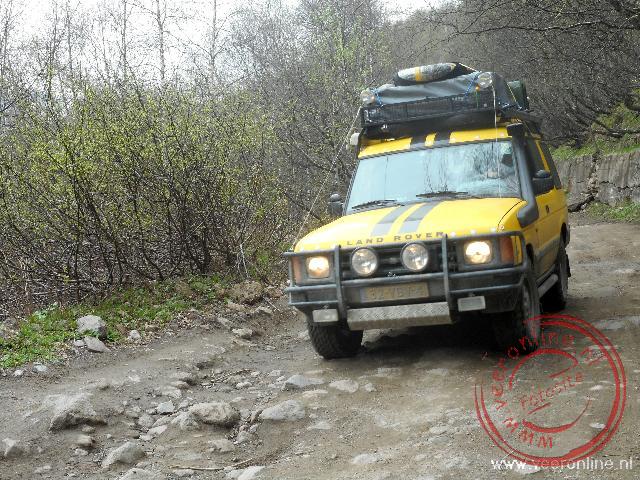
At the upper end of the village stands a striking but extremely dilapidated building. It is a kind of viewpoint. From the platform, we look deep into the valley. This is the highest point of the Jvari Pass—at 2,379 meters, the highest point of the Georgian Military Highway. Shortly after two o’clock, we approach Stepantsminda. Countless trucks are parked along the roadside for kilometers. They are waiting for the border crossing with Russia. Further along the route, there is no space to park. The police let a few trucks through at a time. We are allowed through without problems. The clouds already hang low in the mountains as we enter Stepantsminda. It will not stay dry today. We decide to skip lunch and first go to the Tsminda Sameba Church. The Tsminda Sameba Church sits over 300 meters higher on a mountain peak. The view of the church against the snow-covered peaks of Mount Kazbek is the most famous image of Georgia. As we turn onto the road, taxi drivers gesture that it is closed. Surprised, we ask how to get to the church. We are told to take a path about a hundred meters further. The path is no more than a rutted track.

Could this be the correct route? We follow the track and slowly climb. The road is poor. Carefully, we try to avoid the potholes and rocks. Minibuses carry tourists along the same route. It must be okay. Passing them sometimes is tight. In one hairpin, the road is so bad that we struggle to get through. All tires slip. We let two minibuses pass and watch how they handle the obstacles. That works. Upon reaching the top, we have a view of the Tsminda Sameba Church. Though cloudy, the view is magnificent—especially after such a harsh journey. The small church is beautifully decorated inside with frescoes. The monks are comfortably warm; the wood stove is burning. Outside, it is chilly at this altitude. What a remarkable location to build a church. The return journey is along the same route. We descend the slope carefully, taking no risks and especially not overloading Brutus. Faster-descending minibuses that travel this route daily are allowed to pass. A few kilometers past Stepantsminda, there should be a castle. But when the navigation indicates we are close, we find ourselves at the border post with Russia—the breakaway province of Chechnya, to be exact. This is not the intended destination. There is no castle here either. We turn back. In Stepantsminda, we stop at a cozy little hotel. Compared to our previous accommodations, the rooms are a bit pricey but fine. Outside, it has started to rain. Hard rain. We decide to eat at the hotel.
 Croatia
 Greece
 Japan
Japan 
 Russia
Travelogue From Amsterdam to Tokyo
Dag 2 | Germany > Through Germany
Dag 3 | Austria > Ljubljana Castle
Dag 4 | Croatia > Plitvice Lakes in the rain
Dag 5 | Bosnia and Herzegovina > By the Bay of Kotor
Dag 6 | Montenegro > Across the Albanian border
Dag 7 | Albania > Driving through Tirana
Dag 8 | Albania > Ottoman houses of Berat
Dag 9 | Albania > From Gjirokaster to Metsovo
Dag 10 | Greece > The monasteries of Meteora
Dag 11 | Greece > The caves of Alistrati
Dag 12 | Greece > The Horse of Troy
Dag 13 | Turkey > The Temple of Athena
Dag 14 | Turkey > Historic Safranbolu
Dag 15 | Turkey > Football party in Amasya
Dag 16 | Turkey > Driving license returned
Dag 17 | Turkey > The D915 is 'Kapali' (closed)
Dag 18 | Turkey > To Batumi in Georgia
Dag 19 | Georgia > A typical Russian hotel
Dag 20 | Georgia > The mountain road to Ushguli
Dag 21 | Georgia > Party at the Imperial Hotel
Dag 22 | Georgia > From Kusaisi to Gori
Dag 23 | Georgia > Tsminda Sameba Church Kasbeki
Dag 24 | Georgia > The only hotel seems closed
Dag 25 | Georgia > The heating is broken
Dag 26 | Georgia > Independence Day in Tbilisi
Dag 27 | Georgia > Crossing the border to Azerbaijan
Dag 28 | Azerbaijan > Mud volcanoes of Gobustan
Dag 29 | Azerbaijan > Waiting for the boat
Dag 30 | Azerbaijan > Are we already in Turkmenistan?
Dag 31 | Azerbaijan > Stuck on the Caspian Sea
Dag 32 | Azerbaijan > Finally Turkmenistan
Dag 33 | Turkmenistan > Still going to Yangykala
Dag 34 | Turkmenistan > Swimming in an underground cave
Dag 35 | Turkmenistan > 'No Pictures, No Pictures'
Dag 36 | Turkmenistan > The border is closed
Dag 37 | Uzbekistan > Enchanting Khiva
Dag 38 | Uzbekistan > Wandering through old Khiva
Dag 39 | Uzbekistan > Through the Kyzylkum desert
Dag 40 | Uzbekistan > The Registan Square of Samarkand
Dag 41 | Uzbekistan > The palace of Timur Lenk
Dag 42 | Uzbekistan > Smuggling porn
Dag 43 | Tajikistan > The capital of Tajikistan
Dag 44 | Tajikistan > Landslides
Dag 45 | Tajikistan > The exhaust breaks off
Dag 46 | Tajikistan > Bathing in a mineral bath
Dag 47 | Tajikistan > The Wakhan Valley
Dag 48 | Tajikistan > Over the Khargush pass
Dag 49 | Tajikistan > We lost Wilco
Dag 50 | Tajikistan > Over the high Ak-Baital pass
Dag 51 | Kyrgyzstan > Recovering in Osh
Dag 52 | Kyrgyzstan > The Throne of Solomon
Dag 53 | Kyrgyzstan > Misty on the mountain top
Dag 54 | Kyrgyzstan > Overnight stay in a yurt
Dag 55 | Kyrgyzstan > Plov with salad
Dag 56 | Kyrgyzstan > Vodka by Lake Kolsai
Dag 57 | Kazakhstan > Spectacular Charyn Canyon
Dag 58 | Kazakhstan > The cathedrals of Almaty
Dag 59 | Kazakhstan > To Altyn Emel National Park
Dag 60 | Kazakhstan > The Singing Sand Dunes
Dag 61 | Kazakhstan > Looking for a Gamma store
Dag 62 | Kazakhstan > We are not allowed to pay
Dag 63 | Kazakhstan > 133 km/h on the road
Dag 64 | Kazakhstan > A beer in Semey
Dag 65 | Kazakhstan > Walking tour through Semey
Dag 66 | Kazakhstan > Welcome, welcome in Russia
Dag 67 | Russia > The battery light comes on
Dag 68 | Russia > Everyone seems drunk
Dag 69 | Russia > Desolate Kosh Agach
Dag 70 | Russia > Waiting at the border
Dag 71 | Mongolia > Beautiful valleys and lakes
Dag 72 | Mongolia > The road is being paved
Dag 73 | Mongolia > Traditional wrestling
Dag 74 | Mongolia > From Bayankhongor to Arvaikheer
Dag 75 | Mongolia > Slipping on the muddy road
Dag 76 | Mongolia > The Erdene Zuu Monastery
Dag 77 | Mongolia > Entering Ulaanbaatar
Dag 78 | Mongolia > Wandering through Ulaanbaatar
Dag 79 | Mongolia > The front suspension is broken
Dag 80 | Mongolia > The Genghis Khan equestrian statue
Dag 81 | Mongolia > Collision with an eagle
Dag 82 | Mongolia > Celebration in Choibalsan
Dag 83 | Mongolia > Refused entry at the restaurant
Dag 84 | Russia > Water on the hood
Dag 85 | Russia > The Trans-Siberian Highway
Dag 86 | Russia > Do we have a flat tire?
Dag 87 | Russia > Besieged by flies
Dag 88 | Russia > The border town Blagoveshchensk
Dag 89 | Russia > Jewish Autonomous Oblast Birobidzhan
Dag 90 | Russia > Meeting everyone again
Dag 91 | Russia > Sailing the Amur River
Dag 92 | Russia > Looking for a hotel
Dag 93 | Russia > Entering Vladivostok
Dag 94 | Russia > Farewell to the car
Dag 95 | Russia > On the way to Japan
Dag 96 | South Korea > Six hours in South Korea
Dag 97 | Japan > Paperwork, forms, and stamps
Dag 98 | Japan > The Hiroshima memorial
Dag 99 | Japan > Coolant leak
Dag 100 | Japan > TOKYO