
154 countries
(and areas)
 - Azerbaijan
- Bahrain
- Barbados
- Belgium
- Belize
- Benin
- Bhutan
- Bolivia
- Bonaire
- Bosnia and Herzegovina
- Botswana
- Brazil
- British Virgin Islands
- Brunei
- Bulgaria
- Cambodia
- Canada
- Cape Verde
- Chile
- China
- Costa Rica
- Croatia
- Cuba
- Curacao
- Cyprus
- Czech Republic
- Denmark
- Dominica
- Dominican Republic
- Egypt
- El Salvador
- England
- Estonia
- Eswatini (Swaziland)
- Ethiopia
- Fiji
- Finland
- France
- French Guiana
- Georgia
- Germany
- Gibraltar
- Greece
- Grenada
- Guadeloupe
- Guatemala
- Honduras
- Hong Kong
- Hungary
- Iceland
- India
- Indonesia
- Iran
- Ireland
- Israel
- Italy
- Jamaica
- Japan
- Jordan
- Kazakhstan
- Kenya
- Kosovo
- Kuwait
- Kyrgyzstan
- Laos
- Latvia
- Lebanon
- Lesotho
- Liechtenstein
- Lithuania
- Luxembourg
- Macau
- Madagascar
- Malawi
- Malaysia
- Maldives
- Malta
- Martinique
- Mexico
- Moldova
- Monaco
- Mongolia
- Montenegro
- Morocco
- Mozambique
- Namibia
- Nepal
- Netherlands
- New Zealand
- Nicaragua
- North Macedonia
- Northern Ireland
- Norway
- Oman
- Pakistan
- Palestine
- Peru
- Philippines
- Poland
- Portugal
- Qatar
- Republic of Korea
- Romania
- Russia
- Saint Kitts and Nevis
- Saint Lucia
- Saint Martin
- Saint Vincent and the Grenadines
- San Marino
- São Tomé and Principe
- Saudi Arabia
- Scotland
- Senegal
- Serbia
- Singapore
- Sint Maarten
- Slovakia
- Slovenia
- South Africa
- Spain
- Sri Lanka
- Suriname
- Sweden
- Switzerland
- Tajikistan
- Tanzania
- Thailand
- The Gambia
- Tibet
- Togo
- Transnistria
- Trinidad and Tobago
- Tunisia
- Turkey
- Turkmenistan
- Uganda
- United Arab Emirates
- United States
- Uruguay
- Uzbekistan
- Vatican City
- Vietnam
- Wales
- Zambia
- Zanzibar
- Azerbaijan
- Bahrain
- Barbados
- Belgium
- Belize
- Benin
- Bhutan
- Bolivia
- Bonaire
- Bosnia and Herzegovina
- Botswana
- Brazil
- British Virgin Islands
- Brunei
- Bulgaria
- Cambodia
- Canada
- Cape Verde
- Chile
- China
- Costa Rica
- Croatia
- Cuba
- Curacao
- Cyprus
- Czech Republic
- Denmark
- Dominica
- Dominican Republic
- Egypt
- El Salvador
- England
- Estonia
- Eswatini (Swaziland)
- Ethiopia
- Fiji
- Finland
- France
- French Guiana
- Georgia
- Germany
- Gibraltar
- Greece
- Grenada
- Guadeloupe
- Guatemala
- Honduras
- Hong Kong
- Hungary
- Iceland
- India
- Indonesia
- Iran
- Ireland
- Israel
- Italy
- Jamaica
- Japan
- Jordan
- Kazakhstan
- Kenya
- Kosovo
- Kuwait
- Kyrgyzstan
- Laos
- Latvia
- Lebanon
- Lesotho
- Liechtenstein
- Lithuania
- Luxembourg
- Macau
- Madagascar
- Malawi
- Malaysia
- Maldives
- Malta
- Martinique
- Mexico
- Moldova
- Monaco
- Mongolia
- Montenegro
- Morocco
- Mozambique
- Namibia
- Nepal
- Netherlands
- New Zealand
- Nicaragua
- North Macedonia
- Northern Ireland
- Norway
- Oman
- Pakistan
- Palestine
- Peru
- Philippines
- Poland
- Portugal
- Qatar
- Republic of Korea
- Romania
- Russia
- Saint Kitts and Nevis
- Saint Lucia
- Saint Martin
- Saint Vincent and the Grenadines
- San Marino
- São Tomé and Principe
- Saudi Arabia
- Scotland
- Senegal
- Serbia
- Singapore
- Sint Maarten
- Slovakia
- Slovenia
- South Africa
- Spain
- Sri Lanka
- Suriname
- Sweden
- Switzerland
- Tajikistan
- Tanzania
- Thailand
- The Gambia
- Tibet
- Togo
- Transnistria
- Trinidad and Tobago
- Tunisia
- Turkey
- Turkmenistan
- Uganda
- United Arab Emirates
- United States
- Uruguay
- Uzbekistan
- Vatican City
- Vietnam
- Wales
- Zambia
- Zanzibar


Copyright 2004 - 2026
Veeronline.nl Travel Adventures

Home > Netherlands > Tourist in My Own Country > Travelogue day 2
Travelogue Tourist in My Own Country
July 1826 2020 (9 days)
Netherlands > The Zuiderzee Islands
Dag 2 - Sunday 19 July 2020In the restaurant, a breakfast buffet is ready. No special coronavirus guidelines apply here. Of course, the tables are placed at a safe distance, but everyone can put together their own breakfast. After breakfast, I drive to Urk. I choose to go via Emmeloord. This route is slightly longer, but otherwise, I would end up taking the same road past Schokland twice. I notice how long and straight the roads are here. For kilometres, they run arrow-straight through the polder. Approaching Urk, this changes. Urk used to be an island before the reclamation of the Noordoostpolder. I am going to take a walk here. A circular walk on Urk on a Sunday morning might not be the best combination. During the week, the people of Urk work hard in tourism and fishing. On Sundays, the predominantly religious residents observe their day of rest and go to church. Already upon entering the former island in the Zuiderzee, I notice that the streets are quiet. Only near the harbour do I see other tourists who have parked camper vans, and boat owners walking to the harbour’s toilet facilities.

It is no better than this — it just didn’t fit differently into my travel schedule. Using a walking route I found online, I head into the old part of Urk. The route runs through narrow alleyways, sometimes barely a metre wide. At times, I’m not sure if I’m looking at a public passageway or a private path. Probably because of this, I quickly lose track of the route. I change my tactic: I decide to search for the highlights on the map. This way, I pass the little Church by the Sea, the Fishermen’s Monument, and eventually arrive at the lighthouse of Urk — once an important beacon for the large fishing fleet. When I walk back along the small beach, I am surprised to find an open restaurant. I order coffee and apple pie on the terrace. After Urk, I continue my journey through the Noordoostpolder to Schokland. On the way, I pass through the village of Nagele. After the reclamation, Nagele was designed by architects who decided that all houses and buildings in the village would have flat roofs. The street plan includes a lot of greenery, especially large grass fields.

I park the car and walk around the centrally located park — a vast grassy area with the occasional tree. A piece of public art shows the height of the former IJsselmeer water level. In the middle of the park are two schools, a museum, and the church. I estimate that the houses were built in the late 1960s or early 1970s. While it’s amusing that all the houses have flat roofs, the overall look is strange. It resembles more a sheltered housing project. The lack of maintenance on many of the houses gives the village a somewhat run-down impression. I quickly head back to my car. A few kilometres further lies Schokland. This former island has become an example of how the inhabitants fought to keep their feet dry. In the museum, housed in reconstructed Schokland houses, objects from the last century are displayed. In the video presentation, they show how the island acted as a safe buffer for ships in bad weather, functioning as a breakwater. But the island also suffered from the water. Year after year, the Zuiderzee nibbled pieces off the land. They tried to hold back the water with a wooden pile revetment, but a tropical woodworm — brought in during voyages to the Indies — weakened the barrier. A stone embankment eventually provided a solution. In the mid-19th century, the Dutch government decided that the inhabitants were at too much risk on the island. They ordered an evacuation. Most residents moved, reluctantly, to Kampen and Vollenhove. The houses were demolished. Only the lighthouse keeper stayed behind. In the 1930s, the reclamation followed. I plan to take a walk along the contours of the former island. My route map isn’t very clear. At the museum reception, I get a better one. I follow the shell path southwards. Where the walking and cycling paths merge, I often have to step aside for cyclists. The route is busy with day-trippers cycling the same way. At the southern tip lie the remains of the church of Ens — formerly the Protestant church for the island’s southern inhabitants. In Emmeloord (not the present-day town), at the north side, the Catholics gathered. Here, nothing more than the foundations remain. The southern side of the island is relatively bare — fields lie between the old dikes. In the past, the island was clearly higher than the surrounding land. Due to the reclamation, the water level dropped, and the peat layer sank. The land is said to have subsided by about one and a half metres. The northern half of the island is much greener. The route leads through Stokkerbos.

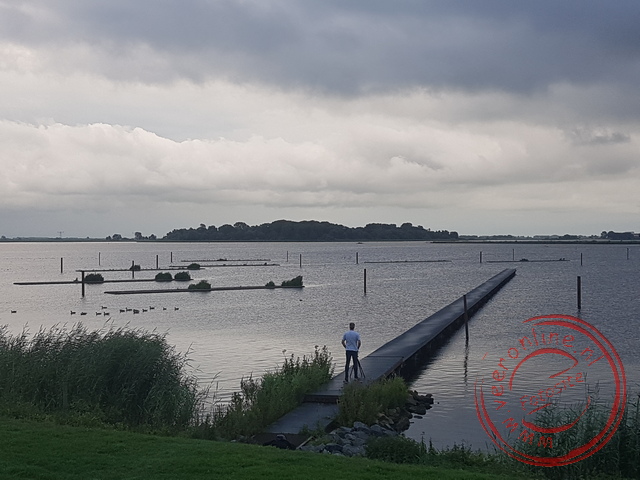
With its maze of paths, it’s tricky to find the right way. After a small detour, I arrive at the visitor centre of Flevo-landschap. I buy an ice cream. While paying, I casually mention that I find the route hard to follow, and immediately the cashier agrees — apparently, it’s a new trail, and without good map-reading skills, it’s almost impossible to follow. Waymarking still needs to be installed. Outside, I meet a retired park guide. He tells me he is 78 and has a deep connection to the park. He’s happy to be guiding again after recovering from illness a few years ago. He speaks enthusiastically about the Misthoorn, the former harbour on the north coast. “Did you know it could easily accommodate 130 ships back in the day?” he asks. He also tells me to look at the planks on the revetment as I pass. When the water was high in the past, people would walk over these wooden planks to avoid getting their feet wet. Legend has it that a stout baker’s wife once sent her children ahead because it was impossible to pass anyone on the narrow plank. Just as I’m about to leave, the man tells me he recently won a nice cash prize in the lottery — Wolter Kroes himself handed him the €10,000 cheque. I can’t help but feel glad for him. In fact, I think the lottery should make it a rule that prizes go to people who will truly appreciate them. Around four o’clock, I reach the old harbour. Wooden jetties mark where it used to be. The weather is still sunny, but a strong breeze has picked up. Hopefully, I won’t be caught in a shower — the forecast said it would stay dry until evening, and this proves correct. I walk the last stretch back to the car. I drive back to Kraggenburg. The hotel staff already recognise me and know exactly which room key I need. I have a drink on the terrace. In the evening, I drive back to Ens — Schokland and Ens are practically neighbours. At Het Wapen van Ens, I’ve reserved a table. When I walk in, I immediately spot a table with a single chair — it must be mine. “Are you Ronald?” they ask. I find it amusing they know reservations by name. The waitress says it’s good I booked, as every table is taken. Due to coronavirus, they have fewer seats. She also apologises that there’s only one chair at my table — the others are in use elsewhere. I don’t mind. Soon, I’m tucking into the house speciality: spare ribs. During my meal, a brief rain shower passes, but it doesn’t last long. After dinner, I drive back to Kraggenburg. My curiosity gets the better of me — I want to know what’s behind the signs for “Pier + Horizon.” I follow them to a car park just past the hotel. There, a sign says I still have 997 metres to walk. I glance at the clouds — will it stay dry? I take the risk. I follow the dead-straight footpath to the dike. Slowly, the dike gets closer. The pier is an artwork by Paul de Kort: a 135-metre-long steel pier stretching into the Zwarte Meer, symbolising the old breakwater that lay here before the reclamation. With the setting sun and threatening clouds, it makes for a beautiful scene. Around nine o’clock, I’m back at the hotel. I realise I’m quite tired — my step counter shows over 25,000 steps. I go to bed.
 Hotel rooms in the former lodgings
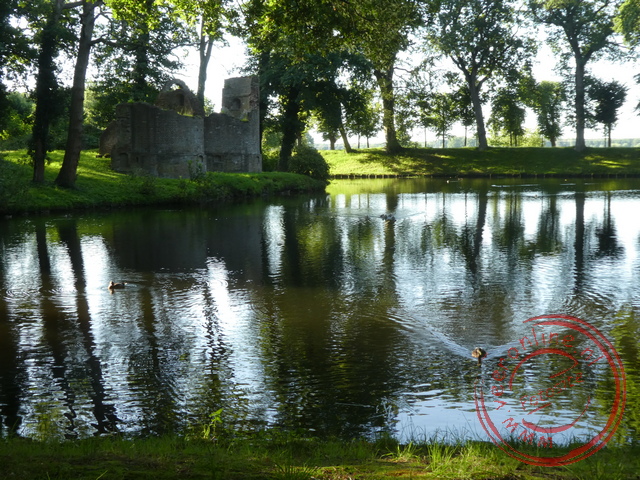 The remnants of the castle in Oldruitenborgh Park
 Impressive memorial site at the former roll call square
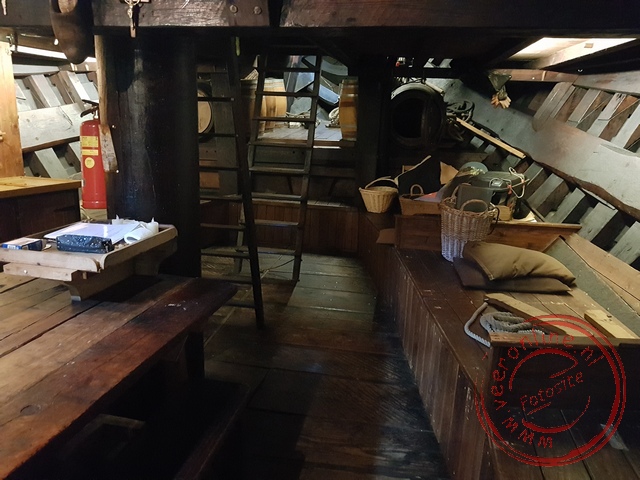 The interior of the replica cog ship
Travelogue Tourist in My Own Country
Dag 2 | Netherlands > The Zuiderzee Islands
Dag 3 | Netherlands > The Bovenkerk of Kampen
Dag 4 | Netherlands > Camp Westerbork
Dag 5 | Netherlands > The Dolmen of Borger
Dag 6 | Netherlands > Walking in Dwingelderveld
Dag 7 | Netherlands > Colonies of Benevolence
Dag 8 | Netherlands > The Fortress of Bourtange
Dag 9 | Netherlands > Via Oudeschans Back Home