
154 countries
(and areas)
 - Belize
- Benin
- Bhutan
- Bolivia
- Bonaire
- Bosnia and Herzegovina
- Botswana
- Brazil
- British Virgin Islands
- Brunei
- Bulgaria
- Cambodia
- Canada
- Cape Verde
- Chile
- China
- Costa Rica
- Croatia
- Cuba
- Curacao
- Cyprus
- Czech Republic
- Denmark
- Dominica
- Dominican Republic
- Egypt
- El Salvador
- England
- Estonia
- Eswatini (Swaziland)
- Ethiopia
- Fiji
- Finland
- France
- French Guiana
- Georgia
- Germany
- Gibraltar
- Greece
- Grenada
- Guadeloupe
- Guatemala
- Honduras
- Hong Kong
- Hungary
- Iceland
- India
- Indonesia
- Iran
- Ireland
- Israel
- Italy
- Jamaica
- Japan
- Jordan
- Kazakhstan
- Kenya
- Kosovo
- Kuwait
- Kyrgyzstan
- Laos
- Latvia
- Lebanon
- Lesotho
- Liechtenstein
- Lithuania
- Luxembourg
- Macau
- Madagascar
- Malawi
- Malaysia
- Maldives
- Malta
- Martinique
- Mexico
- Moldova
- Monaco
- Mongolia
- Montenegro
- Morocco
- Mozambique
- Namibia
- Nepal
- Netherlands
- New Zealand
- Nicaragua
- North Macedonia
- Northern Ireland
- Norway
- Oman
- Pakistan
- Palestine
- Peru
- Philippines
- Poland
- Portugal
- Qatar
- Republic of Korea
- Romania
- Russia
- Saint Kitts and Nevis
- Saint Lucia
- Saint Martin
- Saint Vincent and the Grenadines
- San Marino
- São Tomé and Principe
- Saudi Arabia
- Scotland
- Senegal
- Serbia
- Singapore
- Sint Maarten
- Slovakia
- Slovenia
- South Africa
- Spain
- Sri Lanka
- Suriname
- Sweden
- Switzerland
- Tajikistan
- Tanzania
- Thailand
- The Gambia
- Tibet
- Togo
- Transnistria
- Trinidad and Tobago
- Tunisia
- Turkey
- Turkmenistan
- Uganda
- United Arab Emirates
- United States
- Uruguay
- Uzbekistan
- Vatican City
- Vietnam
- Wales
- Zambia
- Zanzibar
- Belize
- Benin
- Bhutan
- Bolivia
- Bonaire
- Bosnia and Herzegovina
- Botswana
- Brazil
- British Virgin Islands
- Brunei
- Bulgaria
- Cambodia
- Canada
- Cape Verde
- Chile
- China
- Costa Rica
- Croatia
- Cuba
- Curacao
- Cyprus
- Czech Republic
- Denmark
- Dominica
- Dominican Republic
- Egypt
- El Salvador
- England
- Estonia
- Eswatini (Swaziland)
- Ethiopia
- Fiji
- Finland
- France
- French Guiana
- Georgia
- Germany
- Gibraltar
- Greece
- Grenada
- Guadeloupe
- Guatemala
- Honduras
- Hong Kong
- Hungary
- Iceland
- India
- Indonesia
- Iran
- Ireland
- Israel
- Italy
- Jamaica
- Japan
- Jordan
- Kazakhstan
- Kenya
- Kosovo
- Kuwait
- Kyrgyzstan
- Laos
- Latvia
- Lebanon
- Lesotho
- Liechtenstein
- Lithuania
- Luxembourg
- Macau
- Madagascar
- Malawi
- Malaysia
- Maldives
- Malta
- Martinique
- Mexico
- Moldova
- Monaco
- Mongolia
- Montenegro
- Morocco
- Mozambique
- Namibia
- Nepal
- Netherlands
- New Zealand
- Nicaragua
- North Macedonia
- Northern Ireland
- Norway
- Oman
- Pakistan
- Palestine
- Peru
- Philippines
- Poland
- Portugal
- Qatar
- Republic of Korea
- Romania
- Russia
- Saint Kitts and Nevis
- Saint Lucia
- Saint Martin
- Saint Vincent and the Grenadines
- San Marino
- São Tomé and Principe
- Saudi Arabia
- Scotland
- Senegal
- Serbia
- Singapore
- Sint Maarten
- Slovakia
- Slovenia
- South Africa
- Spain
- Sri Lanka
- Suriname
- Sweden
- Switzerland
- Tajikistan
- Tanzania
- Thailand
- The Gambia
- Tibet
- Togo
- Transnistria
- Trinidad and Tobago
- Tunisia
- Turkey
- Turkmenistan
- Uganda
- United Arab Emirates
- United States
- Uruguay
- Uzbekistan
- Vatican City
- Vietnam
- Wales
- Zambia
- Zanzibar


Copyright 2004 - 2026
Veeronline.nl Travel Adventures

Home > Netherlands > Tourist in My Own Country > Travelogue day 1
Travelogue Tourist in My Own Country
July 1826 2020 (9 days)
Netherlands > Wouda Pumping Station in Lemmer
Dag 1 - Saturday 18 July 2020Travelling to distant destinations is not an option this year due to the outbreak of the coronavirus. That’s why this time I’m travelling within the Netherlands. Even in our own country there are still so many beautiful places to discover. The advantage of the Netherlands is that it’s easy to combine with friends’ travel plans. In Dwingeloo, we’ll meet each other next week. Travelling within the Netherlands also has its downsides. In the preparation phase, you spend less time thinking about the trip, which makes packing a last-minute chore. With undoubtedly far too many things in the back of the car, I drive off on a beautiful sunny Saturday morning. The first destination of my trip is the Batavia at the Batavia Wharf in Lelystad. Right at ten o’clock I drive into the car park of the adjacent Batavia Stad shopping centre. Where could the Batavialand Museum be? I figure it’s convenient to park nearby. I ask one of the traffic attendants in which part of the car park I should park. I park the car and walk towards the water. As soon as I turn the corner, I can already see the replica of the VOC ship Batavia. The ship is larger than I expected, even though I had already seen it once before at SAIL Amsterdam. The masts, on the other hand, are lower than I had imagined. I decide to visit the wharf first. While I am still trying to start the audio tour on my phone, an enthusiastic volunteer welcomes me as the first visitor of the day. He apologises that in the first room, the audio tour still mentions a film room. He is working on a scale model of the Zeven Provinciën. This model is ten times smaller than the original. This room only had space for the model, he continues explaining. Today he is placing the highest part of the mast on the ship. A special opening has been made in the ceiling for this. When I remark that I had expected the Batavia’s masts by the quay to be taller, he tells me that they were broken off in a storm five years ago. Replacement masts are now available at the wharf, but installing them is expensive. Since the hull is also in poor condition, they are working on lifting the ship out of the water for major maintenance. More than one million euros is needed for this. He looks rather gloomy — the money isn’t available. In the sailmaker’s workshop, the Batavia’s mainsail is rolled up and hanging from the ceiling. Two staff members are making sails. These sails are for a replica of the Witte Swaen in Harlingen, one of them tells me. This ship is almost finished. All strips of the sail have been sewn together by hand. With some pride, the staff member shows me the evenness of the stitches — I could swear a machine had been involved. Outside on the wharf stands the hull of the Zeven Provinciën. The wood has suffered badly from the weather. Behind the ship lie the Batavia’s masts, waiting.

A staff member here speaks even more gloomily about the historic ship. In the past, such ships lasted a maximum of fifteen years. The Batavia has already been in the water for over twenty-five years without interruption. Lelystad municipality should dredge more often, he continues. The ship is stuck in the mud, which is bad for the wood. In fact, the ship shouldn’t be in the water at all, as this makes maintenance too expensive. A trip to Australia during the Olympic Games was actually fatal for the foundation, he goes on. There wasn’t enough money for the return voyage. His hopes are pinned on Batavia Stad’s expansion plans. The shopping centre has its eye on the wharf, and if a relocation happens, maintenance for the Batavia would also have to be negotiated. What a shame for such a fine initiative. You’d almost wish them a slice of the corona relief funding that’s been so generously distributed in recent months. On the other hand, the government can’t financially keep every initiative alive. With my newly gained knowledge, I visit the ship itself. From the outside, I can indeed see the poor condition of the hull. The colourful stern, on the other hand, is magnificent. On board, a route has been set out so you don’t have to pass other people. It isn’t very busy — a few families with children. Using the audio tour, I walk from deck to deck. On the forecastle, I walk over a kind of wooden grating. I can see the water beneath me. I wonder about the quality of this woodwork. On the lower deck, the cannons are on display. The Batavia has been reconstructed as people think it must have looked. No original blueprints were available — mainly old paintings served as the basis for this 16th-century ship. They also looked at the ship Vasa in Sweden, built in the same period. On its maiden voyage, the Vasa capsized after only 1,500 metres in Stockholm harbour. The gun ports were still open and the ship was overloaded. This ship was “recovered” in the 20th century in relatively good condition and displayed in a museum in Stockholm. I realise I visited that museum when I was in Stockholm. The lower I go inside the Batavia, the lower the living spaces become. I crouch through what must have been the sleeping quarters. I feel like I’m in the time of the Dutch East India Company, trying to imagine how hundreds of crew members could live on this ship for months on end. It would be such a pity if this replica were lost. Finally, I visit the museum. The first staff member this morning had told me I really should take a look here. The ship, the wharf, and the museum form a unity. Inside, the museum again seems divided into different sections. Looking for the highlights, I strike up a conversation with a staff member. He starts talking about the Batavia’s condition. I share my newly gained knowledge and talk along about the sister ship Vasa, the storm damage, and the much-needed restoration. It turns out I’m speaking to the director of Batavialand, who is also volunteering today. He starts a film for me about engineer Lely. The film explains the plans for reclaiming the Zuiderzee and how Lely realised them. “Winning land from the sea is easier than waging war for land,” he said, while the rest of Europe was suffering under World War I. He never saw the results himself — he died in 1929. In the decades that followed, parts of the Zuiderzee were gradually reclaimed. After the film, I leave the museum. The museum director wishes me a pleasant day. At Batavia Stad, I order a sandwich for lunch. I walk through the shops back to my car. The car park is much busier now than it was this morning. When I enter Lemmer — my next destination — into the satnav, it turns out the roads are busy too. The travel time is longer than expected. Still, I arrive at the Ir. Wouda steam pumping station in Lemmer right on time for my reserved timeslot. Along the way, many cars with caravans head north. Many of them are looking for a spot around Lemmer. The bridges open frequently for shipping, causing long traffic jams. At exactly two o’clock I reach the pumping station’s ticket office. During corona, everything must be booked in advance. Here too there are enthusiastic volunteers. On a large model of Friesland, one of them shows how the various pumping stations keep the province dry. Normally, the Wouda pumping station doesn’t need to operate.

It’s only used during extreme weather, he explains. This year marks its 100th anniversary. Unfortunately, it can’t be celebrated extensively, he adds. In the film room, we see what happens when the water level rises. With great pride, the men bring the steam pumping station into operation. Seventy cubic metres of water per second are pumped from the polder into the IJsselmeer. With this capacity, a swimming pool would be emptied in less than half a minute. After the film, Frans, another volunteer, takes a group of fifteen people on a guided tour of the pumping station. He talks enthusiastically about the sixty-metre-high tower next to the station, the four steam boilers, and the eight pumps. His explanations are lively and it’s clear he doesn’t just reel off the same story every day — every question sparks new anecdotes. I find his explanation fascinating, but the young children in the group lose interest sooner. After almost an hour and a half, we are practically overtaken by the next group. Still feeling like he’s forgotten something, Frans wraps up the tour. I thank him kindly. I drive into the Noordoostpolder and turn towards the small village of Kraggenburg, where my hotel for the next two nights is located. “You must be Ronald,” I hear as I walk to the reception — they probably don’t get many solo bookings here. On the terrace, I order a beer. The temperature has risen to over 25 degrees in the course of the afternoon. Sitting in the shade, I think back on an enjoyable day. For dinner, I’ve decided not to eat at the hotel. Although that might have been the easiest option, I drive to Marknesse, a village six kilometres away. On the terrace along the main street, I order Mexican nachos, tortillas, and beer — a tasty choice.
 The cannons are positioned to defend the Batavia
 The harbor of the former island of Urk
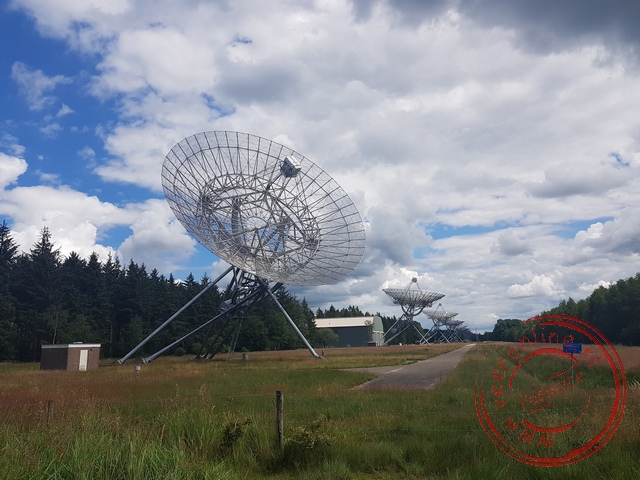 Huge telescopes on the site of the former Westerbork camp
 The church square in Vollenhove
Travelogue Tourist in My Own Country
Dag 2 | Netherlands > The Zuiderzee Islands
Dag 3 | Netherlands > The Bovenkerk of Kampen
Dag 4 | Netherlands > Camp Westerbork
Dag 5 | Netherlands > The Dolmen of Borger
Dag 6 | Netherlands > Walking in Dwingelderveld
Dag 7 | Netherlands > Colonies of Benevolence
Dag 8 | Netherlands > The Fortress of Bourtange
Dag 9 | Netherlands > Via Oudeschans Back Home