
154 countries
(and areas)
 - Belize
- Benin
- Bhutan
- Bolivia
- Bonaire
- Bosnia and Herzegovina
- Botswana
- Brazil
- British Virgin Islands
- Brunei
- Bulgaria
- Cambodia
- Canada
- Cape Verde
- Chile
- China
- Costa Rica
- Croatia
- Cuba
- Curacao
- Cyprus
- Czech Republic
- Denmark
- Dominica
- Dominican Republic
- Egypt
- El Salvador
- England
- Estonia
- Eswatini (Swaziland)
- Ethiopia
- Fiji
- Finland
- France
- French Guiana
- Georgia
- Germany
- Gibraltar
- Greece
- Grenada
- Guadeloupe
- Guatemala
- Honduras
- Hong Kong
- Hungary
- Iceland
- India
- Indonesia
- Iran
- Ireland
- Israel
- Italy
- Jamaica
- Japan
- Jordan
- Kazakhstan
- Kenya
- Kosovo
- Kuwait
- Kyrgyzstan
- Laos
- Latvia
- Lebanon
- Lesotho
- Liechtenstein
- Lithuania
- Luxembourg
- Macau
- Madagascar
- Malawi
- Malaysia
- Maldives
- Malta
- Martinique
- Mexico
- Moldova
- Monaco
- Mongolia
- Montenegro
- Morocco
- Mozambique
- Namibia
- Nepal
- Netherlands
- New Zealand
- Nicaragua
- North Macedonia
- Northern Ireland
- Norway
- Oman
- Pakistan
- Palestine
- Peru
- Philippines
- Poland
- Portugal
- Qatar
- Republic of Korea
- Romania
- Russia
- Saint Kitts and Nevis
- Saint Lucia
- Saint Martin
- Saint Vincent and the Grenadines
- San Marino
- São Tomé and Principe
- Saudi Arabia
- Scotland
- Senegal
- Serbia
- Singapore
- Sint Maarten
- Slovakia
- Slovenia
- South Africa
- Spain
- Sri Lanka
- Suriname
- Sweden
- Switzerland
- Tajikistan
- Tanzania
- Thailand
- The Gambia
- Tibet
- Togo
- Transnistria
- Trinidad and Tobago
- Tunisia
- Turkey
- Turkmenistan
- Uganda
- United Arab Emirates
- United States
- Uruguay
- Uzbekistan
- Vatican City
- Vietnam
- Wales
- Zambia
- Zanzibar
- Belize
- Benin
- Bhutan
- Bolivia
- Bonaire
- Bosnia and Herzegovina
- Botswana
- Brazil
- British Virgin Islands
- Brunei
- Bulgaria
- Cambodia
- Canada
- Cape Verde
- Chile
- China
- Costa Rica
- Croatia
- Cuba
- Curacao
- Cyprus
- Czech Republic
- Denmark
- Dominica
- Dominican Republic
- Egypt
- El Salvador
- England
- Estonia
- Eswatini (Swaziland)
- Ethiopia
- Fiji
- Finland
- France
- French Guiana
- Georgia
- Germany
- Gibraltar
- Greece
- Grenada
- Guadeloupe
- Guatemala
- Honduras
- Hong Kong
- Hungary
- Iceland
- India
- Indonesia
- Iran
- Ireland
- Israel
- Italy
- Jamaica
- Japan
- Jordan
- Kazakhstan
- Kenya
- Kosovo
- Kuwait
- Kyrgyzstan
- Laos
- Latvia
- Lebanon
- Lesotho
- Liechtenstein
- Lithuania
- Luxembourg
- Macau
- Madagascar
- Malawi
- Malaysia
- Maldives
- Malta
- Martinique
- Mexico
- Moldova
- Monaco
- Mongolia
- Montenegro
- Morocco
- Mozambique
- Namibia
- Nepal
- Netherlands
- New Zealand
- Nicaragua
- North Macedonia
- Northern Ireland
- Norway
- Oman
- Pakistan
- Palestine
- Peru
- Philippines
- Poland
- Portugal
- Qatar
- Republic of Korea
- Romania
- Russia
- Saint Kitts and Nevis
- Saint Lucia
- Saint Martin
- Saint Vincent and the Grenadines
- San Marino
- São Tomé and Principe
- Saudi Arabia
- Scotland
- Senegal
- Serbia
- Singapore
- Sint Maarten
- Slovakia
- Slovenia
- South Africa
- Spain
- Sri Lanka
- Suriname
- Sweden
- Switzerland
- Tajikistan
- Tanzania
- Thailand
- The Gambia
- Tibet
- Togo
- Transnistria
- Trinidad and Tobago
- Tunisia
- Turkey
- Turkmenistan
- Uganda
- United Arab Emirates
- United States
- Uruguay
- Uzbekistan
- Vatican City
- Vietnam
- Wales
- Zambia
- Zanzibar


Copyright 2004 - 2026
Veeronline.nl Travel Adventures

Home > Georgia > Caucasus Tour > Travelogue day 7
Travelogue Caucasus Tour
September 13th - October 3th 2025 (21 days)
Georgia > The Church of Kazbegi
Dag 7 - Friday, September 19, 2025It rained heavily through the night. Water drums on the metal roof next to our room. In Georgia, they don’t pay much attention to gutters or downspouts; the water just runs off the roof. It’s still drizzling a little as we walk to the bus. We leave Tbilisi. The morning traffic is busy, but it’s never truly stuck. Nino explains that Georgians are late starters; they prefer to begin work around ten o’clock. This is partly because they are used to eating late in the evening. We drive to the old capital, Mtskheta. Before visiting the cathedral in town, we first drive to the small church on the hill opposite Mtskheta. This church is on the other bank of the river. Inside the Jvari Church stands a large wooden cross. This cross symbolizes the wooden cross made of twigs that Saint Nino placed in Mtskheta in 337 to convert the inhabitants. The church is crowded with tourists, as most tours likely start here. Nino struggles to explain anything about the frescoes and historical icons. From the hilltop, I have a clear view of the old capital, Mtskheta. The Svetitskhoveli Cathedral dominates the center. The church was built on the site where Nino placed her cross—a true pilgrimage site. Later, defensive walls were constructed around the cathedral to protect the sanctuary from attackers. From the parking lot, I have to squeeze through a street filled with souvenir shops and food stalls, stretching hundreds of meters. A clever tactic, as all tourists must pass through here. Once we enter the walled complex, Nino points out a spot where we can photograph both the cathedral and the hilltop church together. Then I follow her inside. Within lies the tomb of Sidonia, who is said to have been buried in the Holy Tunic of Jesus. For this reason, Nino had a church built here in the fourth century. The current Georgian Orthodox cathedral dates from the 11th century. After the visit, we have a bit of time to wander along the stalls and streets of Mtskheta. We are also advised to take something for lunch later today. We follow signs to the riverside café for coffee, but unfortunately, the restaurant is closed.

We settle for the terrace of the Old Traverne in the tourist area. The owner gestures for us to come inside, as it’s too chilly on the terrace—she is right. The price for coffee is reasonable for this location. We also notice sandwiches on the menu. We order two and ask for them to be packed to go. On the way to the bus, we buy two flavors of churchkhela, a local delicacy of walnuts dipped in thickened grape juice, strung together with a thread. It tastes surprisingly good; I expected it to be much sweeter. From Mtskheta, we head toward the Georgian Military Highway, currently the only open road through the mountains connecting to Russia. There is a lot of truck traffic on this route. It is probably a way to circumvent the international blockade of Russia due to the war in Ukraine via Turkey and Georgia. As we wind up into the mountains, Nino shares her personal story and perspective on the Russian neighbor. She was born in Abkhazia, a breakaway province that separated from Georgia with Russian support. Her family had to leave Abkhazia in haste. Later, in 2008, she lived near Kutaisi, when the Russian army bombed the airport and occupied South Ossetia. During last year’s elections, a pro-Russian leader was elected, a result widely questioned. Since the new leader suspended cooperation with Europe for the next four years, protests have taken place daily in Tbilisi in front of the parliament building, mostly by young people. Nino knows people who have been arrested and sentenced to prison. This compelling story almost makes you forget the surroundings. We pass the Zhinvali Reservoir, which provides a significant portion of Georgia’s electricity. We pause along the lake, but the parking area is fully taken up by market stalls. It doesn’t feel right to eat my own sandwich on the chairs, so we sit on some rocks across the road and eat.
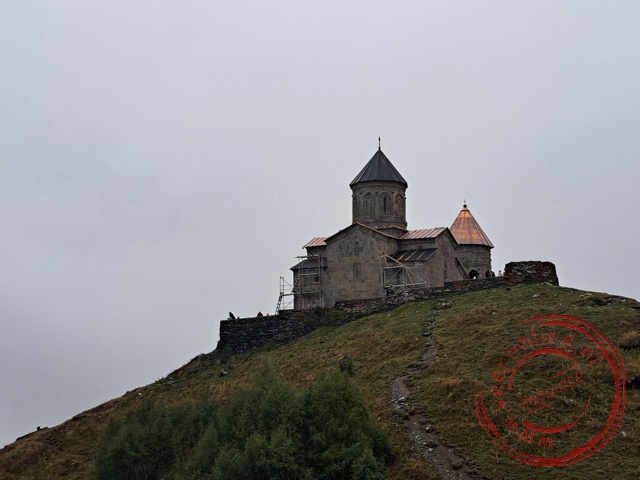
As we climb higher, it becomes increasingly cloudy, and it doesn’t take long before it starts raining. We decide to skip the Friendship Monument for now and visit it on the way back. We continue to Stepantsminda in the Kazbegi region, just a few kilometers from the Russian border. When we arrive, it is cloudy but practically dry. On a mountaintop stands the Gergeti Trinity Church, uniquely situated against the snow-capped peaks of the Kazbek Mountains. The bus cannot navigate the narrow, hairpin-filled road, so we transfer to 4x4 minibuses, each carrying six people. I remember this journey from nine years ago, when it was extremely difficult to drive up the sandy and rocky path. Now there is an asphalt road. At high RPMs, the driver quickly takes us up. Soon, I see the Gergeti Trinity Church. The mountains behind it are hidden by clouds. To my surprise, we drive past the famous photo spot and go directly to the church. This spot is where the most iconic photo of Georgia is usually taken. The journey to this church is not just about the building itself, but its unique location. Maybe we’ll stop on the way back. At the church’s parking lot, many minibuses are parked. A large group walks along a rough path to the church. Inside, women must wear a skirt in addition to covering their heads, though enforcement is not strict. I strike up a conversation with a local guide on the hill opposite the church. He tells me that the church’s tourist popularity has exploded in recent years, and sometimes the crowds are overwhelming. Back down, we drive a short distance to Gudauri, a ski resort. The Friendship Monument is completely shrouded in clouds, so we decide to skip it. This means we arrive a little earlier at the guesthouse in Gudauri, which I don’t mind. When I was here nine years ago, I found the monument hideous. In the guesthouse bar, I order a beer. Dinner tonight is included, with a good buffet prepared.
 Georgia
  The former parliament building in Tbilisi
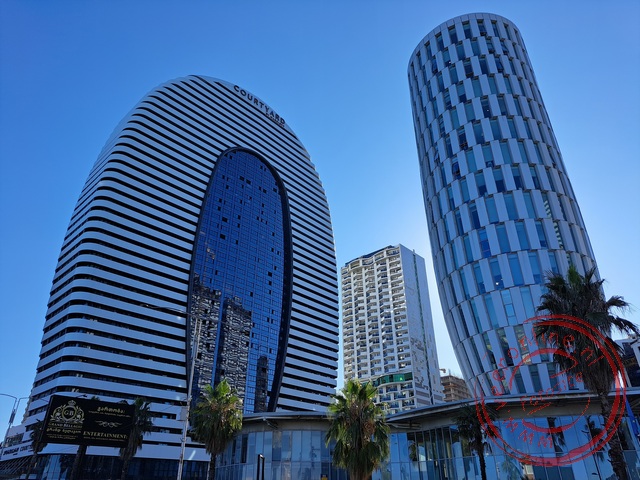 Some of the modern buildings in the resort town of Batumi
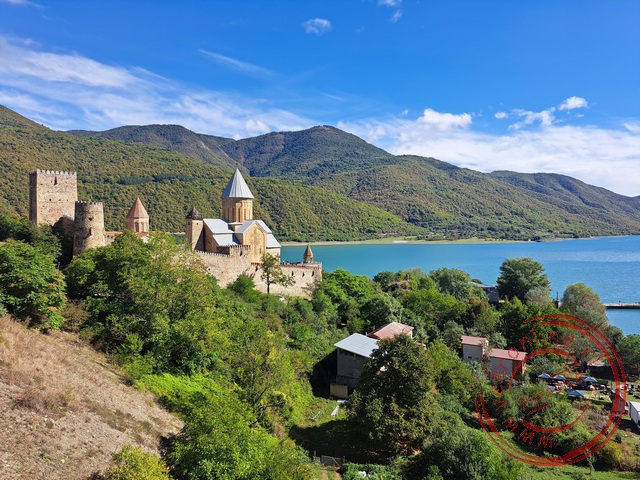 The walled Ananuri Church
 The Tsminda Sameba Cathedral was built in 1989
Travelogue Caucasus Tour
Dag 2 | Azerbaijan > The Burning Mountains of Baku
Dag 3 | Azerbaijan > The Rock Engravings of Gobustan
Dag 4 | Azerbaijan > Crossing the Border into Georgia
Dag 5 | Georgia > Saint Nino in Bodbe
Dag 6 | Georgia > A Walking Tour of Tbilisi
Dag 7 | Georgia > The Church of Kazbegi
Dag 8 | Georgia > The Stalin Museum in Gori
Dag 9 | Georgia > The Modern Seaside Resort Batumi
Dag 10 | Georgia > From Batumi to Akhaltsikhe
Dag 11 | Georgia > The Cave City of Vardzia
Dag 12 | Georgia > Via Gyumri to Yerevan
Dag 13 | Armenia > The Cathedral of Etchmiadzin
Dag 14 | Armenia > The Spear of the Geghard Monastery
Dag 15 | Armenia > In Gregory's Cellar
Dag 16 | Armenia > By Cable Car to Tatev
Dag 17 | Armenia > To Lake Sevan
Dag 18 | Armenia > Three Monasteries in One Day
Dag 19 | Armenia > Back to Tbilisi
Dag 20 | Georgia > The Davit Gareja Monastery
Dag 21 | Georgia > Flight to the Netherlands