
154 countries
(and areas)
 - Belize
- Benin
- Bhutan
- Bolivia
- Bonaire
- Bosnia and Herzegovina
- Botswana
- Brazil
- British Virgin Islands
- Brunei
- Bulgaria
- Cambodia
- Canada
- Cape Verde
- Chile
- China
- Costa Rica
- Croatia
- Cuba
- Curacao
- Cyprus
- Czech Republic
- Denmark
- Dominica
- Dominican Republic
- Egypt
- El Salvador
- England
- Estonia
- Eswatini (Swaziland)
- Ethiopia
- Fiji
- Finland
- France
- French Guiana
- Georgia
- Germany
- Gibraltar
- Greece
- Grenada
- Guadeloupe
- Guatemala
- Honduras
- Hong Kong
- Hungary
- Iceland
- India
- Indonesia
- Iran
- Ireland
- Israel
- Italy
- Jamaica
- Japan
- Jordan
- Kazakhstan
- Kenya
- Kosovo
- Kuwait
- Kyrgyzstan
- Laos
- Latvia
- Lebanon
- Lesotho
- Liechtenstein
- Lithuania
- Luxembourg
- Macau
- Madagascar
- Malawi
- Malaysia
- Maldives
- Malta
- Martinique
- Mexico
- Moldova
- Monaco
- Mongolia
- Montenegro
- Morocco
- Mozambique
- Namibia
- Nepal
- Netherlands
- New Zealand
- Nicaragua
- North Macedonia
- Northern Ireland
- Norway
- Oman
- Pakistan
- Palestine
- Peru
- Philippines
- Poland
- Portugal
- Qatar
- Republic of Korea
- Romania
- Russia
- Saint Kitts and Nevis
- Saint Lucia
- Saint Martin
- Saint Vincent and the Grenadines
- San Marino
- São Tomé and Principe
- Saudi Arabia
- Scotland
- Senegal
- Serbia
- Singapore
- Sint Maarten
- Slovakia
- Slovenia
- South Africa
- Spain
- Sri Lanka
- Suriname
- Sweden
- Switzerland
- Tajikistan
- Tanzania
- Thailand
- The Gambia
- Tibet
- Togo
- Transnistria
- Trinidad and Tobago
- Tunisia
- Turkey
- Turkmenistan
- Uganda
- United Arab Emirates
- United States
- Uruguay
- Uzbekistan
- Vatican City
- Vietnam
- Wales
- Zambia
- Zanzibar
- Belize
- Benin
- Bhutan
- Bolivia
- Bonaire
- Bosnia and Herzegovina
- Botswana
- Brazil
- British Virgin Islands
- Brunei
- Bulgaria
- Cambodia
- Canada
- Cape Verde
- Chile
- China
- Costa Rica
- Croatia
- Cuba
- Curacao
- Cyprus
- Czech Republic
- Denmark
- Dominica
- Dominican Republic
- Egypt
- El Salvador
- England
- Estonia
- Eswatini (Swaziland)
- Ethiopia
- Fiji
- Finland
- France
- French Guiana
- Georgia
- Germany
- Gibraltar
- Greece
- Grenada
- Guadeloupe
- Guatemala
- Honduras
- Hong Kong
- Hungary
- Iceland
- India
- Indonesia
- Iran
- Ireland
- Israel
- Italy
- Jamaica
- Japan
- Jordan
- Kazakhstan
- Kenya
- Kosovo
- Kuwait
- Kyrgyzstan
- Laos
- Latvia
- Lebanon
- Lesotho
- Liechtenstein
- Lithuania
- Luxembourg
- Macau
- Madagascar
- Malawi
- Malaysia
- Maldives
- Malta
- Martinique
- Mexico
- Moldova
- Monaco
- Mongolia
- Montenegro
- Morocco
- Mozambique
- Namibia
- Nepal
- Netherlands
- New Zealand
- Nicaragua
- North Macedonia
- Northern Ireland
- Norway
- Oman
- Pakistan
- Palestine
- Peru
- Philippines
- Poland
- Portugal
- Qatar
- Republic of Korea
- Romania
- Russia
- Saint Kitts and Nevis
- Saint Lucia
- Saint Martin
- Saint Vincent and the Grenadines
- San Marino
- São Tomé and Principe
- Saudi Arabia
- Scotland
- Senegal
- Serbia
- Singapore
- Sint Maarten
- Slovakia
- Slovenia
- South Africa
- Spain
- Sri Lanka
- Suriname
- Sweden
- Switzerland
- Tajikistan
- Tanzania
- Thailand
- The Gambia
- Tibet
- Togo
- Transnistria
- Trinidad and Tobago
- Tunisia
- Turkey
- Turkmenistan
- Uganda
- United Arab Emirates
- United States
- Uruguay
- Uzbekistan
- Vatican City
- Vietnam
- Wales
- Zambia
- Zanzibar


Copyright 2004 - 2026
Veeronline.nl Travel Adventures

Home > Georgia > Caucasus Tour > Travelogue day 6
Travelogue Caucasus Tour
September 13th - October 3th 2025 (21 days)
Georgia > A Walking Tour of Tbilisi
Dag 6 - Thursday, September 18, 2025The breakfast buffet is set up in the hotel’s basement. Everything is available. I choose some bread, cheese, and egg—a good start to the day. Today is a free day to explore the city of Tbilisi. Some fellow travelers use this day for an optional excursion to the archaeological site of Dmanisi. We have chosen a walking route through the city. A little after nine, we leave the hotel and walk toward the Aviabari metro station. We can take the main road or wander through the narrow streets. We think the latter will be more interesting, though it means the route immediately goes steeply uphill. We walk around the State Palace of Ceremonies, an important government building, and then descend on the other side. It’s noticeable that many buildings here are dilapidated. Balconies hang crookedly, many windows are broken, and sometimes trees grow through the roof. Renovating this district will be quite a task. When we reach the metro station, we see a large, modern metro stop. On the square in front of the station is the meeting point. At a quarter to ten, someone appears with the agreed-upon orange flag. We follow her to a small office, from where multiple tours depart. At ten o’clock, we follow Elene for the city tour. The group consists of twelve participants from India, Israel, Slovenia, Iran, the Netherlands, and the United States. The first stop is the Metekhi Church. The Metekhi Church of the Nativity of the Mother of God, as it is fully named, was built in the 13th century on a cliff above the Mtkvari River.

The church has served as a royal residence, a mosque, and a prison. Today, the Orthodox Church has restored it to its original function. When we enter, Orthodox chants can be heard—there is a service in progress, led by a priest. From behind the church, I watch the service and admire the beautiful frescoes on the walls and ceiling. Outside, the statue of King Vakhtang Gorgasali on horseback stands. In the fifth century, he had his palace and a church built at this location. The origin of the Metekhi Church predates the Mongol destructions. After visiting the church, we walk through a small park to the entrance of the cable car that leads to the Narikala Fort, which once defended the city. Unfortunately, the fort is currently under restoration and not accessible. However, the view over the city from the fort is beautiful. A little further stands the twenty-meter-high aluminum statue of the Mother of Georgia, symbolizing the country. In one hand she holds a bowl of wine for hospitality, in the other a sword to ward off enemies. The sun breaks through and shines on the statue. We return via the cable car and cross the Mtkvari River on the modern Bridge of Peace. We immediately enter the old town, which, like last night, is full of tourists.

At the clock tower, Elene explains that a puppet show is displayed in the tower at special times, and that the smallest clock in the city is at the base of the tower. We visit the adjacent Anchiskhati Basilica. This 6th-century church is the oldest Georgian church, built by King Dachi of Iberia, who also declared Tbilisi his capital. We continue wandering through the narrow streets of the old town, arriving at the Sioni Cathedral. This medieval cathedral houses the wooden cross of Saint Nino, made of twigs bound together with her hair. During the Russian occupation, the frescoes were overpainted with Russian versions, giving the church a different impression. Fortunately, the church is now in use again as a Georgian sanctuary. Meanwhile, Elene has bought a traditional treat for us. We can choose between khachapuri (cheese bread) or a bean bread. I opt for the bean version. Together with Tarkhun, a bright green soft drink, I eat this under the trees in a small park. After the break, we continue through the old town. We pass the Maiden Market, an underground passage beneath an intersection, walking between souvenir stalls. On the banks of the Mtkvari River, we enter a small wine shop for a simple tasting. Elene explains how the wine is produced in clay pots. We taste a white and a red variety. Georgia prides itself on adding nothing to the wine—not even sugar or water.

Elene says there are penalties for anyone who does. She adds that wine has been produced here for about 7,000 years. Armenia also claims this, she continues: they had the first wine cellars, we had the wine itself, she says proudly. The tour ends at the sulfur baths. These hammams, dating from the 5th century, emphasize the blending of East and West in Tbilisi, where different cultures come together. The baths are heated by volcanic activity in the ground. We thank Elene and say goodbye. We follow the small stream behind the sulfur baths to the Leghvtakhevi Waterfall—a remarkable sight in the middle of the city. We look for a terrace to sit. In the afternoon, we walk to the Tsminda Sameba Cathedral. From the Aviabari metro station, where we began the walk, it’s a short uphill walk. The Tsminda Sameba Cathedral, built in 1989 on a high part of the city, is the largest Georgian Orthodox church in the country. We’ve seen enough for today and walk back to the hotel. In the evening, we cross the river again for a cozy restaurant. In the old town, restaurants are located side by side. Although it feels touristy, the food tastes excellent. Just as we finish eating, it starts to drizzle. Until now, the weather had been fine all day. In the light rain, we walk back to the hotel.
 Georgia
  The former parliament building in Tbilisi
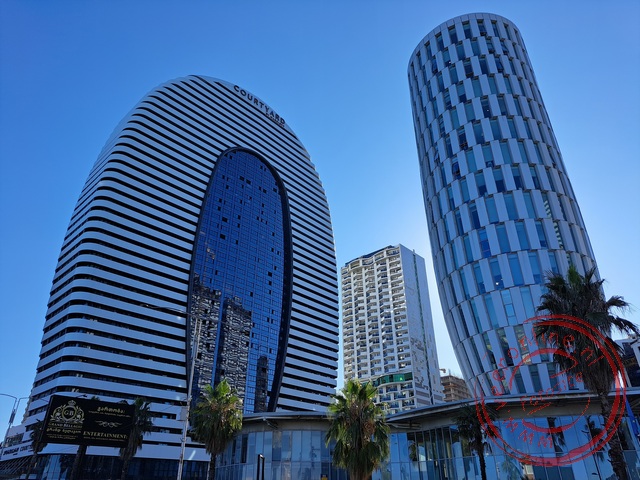 Some of the modern buildings in the resort town of Batumi
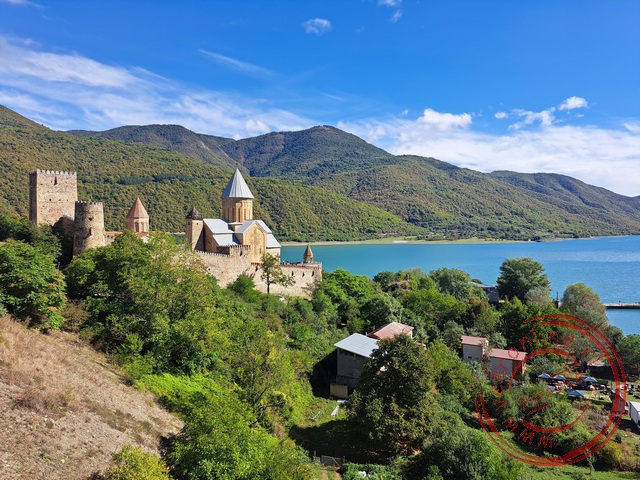 The walled Ananuri Church
 The Tsminda Sameba Cathedral was built in 1989
Travelogue Caucasus Tour
Dag 2 | Azerbaijan > The Burning Mountains of Baku
Dag 3 | Azerbaijan > The Rock Engravings of Gobustan
Dag 4 | Azerbaijan > Crossing the Border into Georgia
Dag 5 | Georgia > Saint Nino in Bodbe
Dag 6 | Georgia > A Walking Tour of Tbilisi
Dag 7 | Georgia > The Church of Kazbegi
Dag 8 | Georgia > The Stalin Museum in Gori
Dag 9 | Georgia > The Modern Seaside Resort Batumi
Dag 10 | Georgia > From Batumi to Akhaltsikhe
Dag 11 | Georgia > The Cave City of Vardzia
Dag 12 | Georgia > Via Gyumri to Yerevan
Dag 13 | Armenia > The Cathedral of Etchmiadzin
Dag 14 | Armenia > The Spear of the Geghard Monastery
Dag 15 | Armenia > In Gregory's Cellar
Dag 16 | Armenia > By Cable Car to Tatev
Dag 17 | Armenia > To Lake Sevan
Dag 18 | Armenia > Three Monasteries in One Day
Dag 19 | Armenia > Back to Tbilisi
Dag 20 | Georgia > The Davit Gareja Monastery
Dag 21 | Georgia > Flight to the Netherlands