
154 countries
(and areas)
 - Belize
- Benin
- Bhutan
- Bolivia
- Bonaire
- Bosnia and Herzegovina
- Botswana
- Brazil
- British Virgin Islands
- Brunei
- Bulgaria
- Cambodia
- Canada
- Cape Verde
- Chile
- China
- Costa Rica
- Croatia
- Cuba
- Curacao
- Cyprus
- Czech Republic
- Denmark
- Dominica
- Dominican Republic
- Egypt
- El Salvador
- England
- Estonia
- Eswatini (Swaziland)
- Ethiopia
- Fiji
- Finland
- France
- French Guiana
- Georgia
- Germany
- Gibraltar
- Greece
- Grenada
- Guadeloupe
- Guatemala
- Honduras
- Hong Kong
- Hungary
- Iceland
- India
- Indonesia
- Iran
- Ireland
- Israel
- Italy
- Jamaica
- Japan
- Jordan
- Kazakhstan
- Kenya
- Kosovo
- Kuwait
- Kyrgyzstan
- Laos
- Latvia
- Lebanon
- Lesotho
- Liechtenstein
- Lithuania
- Luxembourg
- Macau
- Madagascar
- Malawi
- Malaysia
- Maldives
- Malta
- Martinique
- Mexico
- Moldova
- Monaco
- Mongolia
- Montenegro
- Morocco
- Mozambique
- Namibia
- Nepal
- Netherlands
- New Zealand
- Nicaragua
- North Macedonia
- Northern Ireland
- Norway
- Oman
- Pakistan
- Palestine
- Peru
- Philippines
- Poland
- Portugal
- Qatar
- Republic of Korea
- Romania
- Russia
- Saint Kitts and Nevis
- Saint Lucia
- Saint Martin
- Saint Vincent and the Grenadines
- San Marino
- São Tomé and Principe
- Saudi Arabia
- Scotland
- Senegal
- Serbia
- Singapore
- Sint Maarten
- Slovakia
- Slovenia
- South Africa
- Spain
- Sri Lanka
- Suriname
- Sweden
- Switzerland
- Tajikistan
- Tanzania
- Thailand
- The Gambia
- Tibet
- Togo
- Transnistria
- Trinidad and Tobago
- Tunisia
- Turkey
- Turkmenistan
- Uganda
- United Arab Emirates
- United States
- Uruguay
- Uzbekistan
- Vatican City
- Vietnam
- Wales
- Zambia
- Zanzibar
- Belize
- Benin
- Bhutan
- Bolivia
- Bonaire
- Bosnia and Herzegovina
- Botswana
- Brazil
- British Virgin Islands
- Brunei
- Bulgaria
- Cambodia
- Canada
- Cape Verde
- Chile
- China
- Costa Rica
- Croatia
- Cuba
- Curacao
- Cyprus
- Czech Republic
- Denmark
- Dominica
- Dominican Republic
- Egypt
- El Salvador
- England
- Estonia
- Eswatini (Swaziland)
- Ethiopia
- Fiji
- Finland
- France
- French Guiana
- Georgia
- Germany
- Gibraltar
- Greece
- Grenada
- Guadeloupe
- Guatemala
- Honduras
- Hong Kong
- Hungary
- Iceland
- India
- Indonesia
- Iran
- Ireland
- Israel
- Italy
- Jamaica
- Japan
- Jordan
- Kazakhstan
- Kenya
- Kosovo
- Kuwait
- Kyrgyzstan
- Laos
- Latvia
- Lebanon
- Lesotho
- Liechtenstein
- Lithuania
- Luxembourg
- Macau
- Madagascar
- Malawi
- Malaysia
- Maldives
- Malta
- Martinique
- Mexico
- Moldova
- Monaco
- Mongolia
- Montenegro
- Morocco
- Mozambique
- Namibia
- Nepal
- Netherlands
- New Zealand
- Nicaragua
- North Macedonia
- Northern Ireland
- Norway
- Oman
- Pakistan
- Palestine
- Peru
- Philippines
- Poland
- Portugal
- Qatar
- Republic of Korea
- Romania
- Russia
- Saint Kitts and Nevis
- Saint Lucia
- Saint Martin
- Saint Vincent and the Grenadines
- San Marino
- São Tomé and Principe
- Saudi Arabia
- Scotland
- Senegal
- Serbia
- Singapore
- Sint Maarten
- Slovakia
- Slovenia
- South Africa
- Spain
- Sri Lanka
- Suriname
- Sweden
- Switzerland
- Tajikistan
- Tanzania
- Thailand
- The Gambia
- Tibet
- Togo
- Transnistria
- Trinidad and Tobago
- Tunisia
- Turkey
- Turkmenistan
- Uganda
- United Arab Emirates
- United States
- Uruguay
- Uzbekistan
- Vatican City
- Vietnam
- Wales
- Zambia
- Zanzibar


Copyright 2004 - 2026
Veeronline.nl Travel Adventures

Home > Georgia > Caucasus Tour > Travelogue day 11
Travelogue Caucasus Tour
September 13th - October 3th 2025 (21 days)
Georgia > The Cave City of Vardzia
Dag 11 - Tuesday, September 23, 2025The old train station building consists of two sections. Our rooms are in the left part of the building, while the breakfast buffet is in the other section. I pass the reception in the large hall and take the stairs to the third floor in the other section for breakfast. A simple breakfast is ready. At nine o’clock, we leave the hotel and walk to Akhaltsikhe Fortress. A few fellow travelers are not feeling well and decide not to join this morning. We walk about ten minutes uphill to the entrance of the fortress. Akhaltsikhe Fortress, also known as Rabati Castle, originally dates back to the 9th century but has been heavily renovated recently. Large parts of the fortress have been rebuilt using modern construction materials. Because of the mix of architectural styles, it sometimes seems a bit disjointed. Nevertheless, the different sections are interesting and enjoyable to visit. Nino guides us through the complex. Under the large dome of the mosque, she explains that the space was alternately used as an Orthodox church and a mosque, depending on who controlled the fortress. Behind the mosque stands the castle tower. I am surprised by a balcony in the tower, which seems like a weak point in case of an attack. At the end of the tour, I climb to the top of the tower. Through the battlements, I can see the fortress, the path we walked, and the hotel in the distance. On the way back, I buy some food at the small supermarket across from the hotel.

When I cross the street, two fellow travelers are just receiving an official warning for not using the crosswalk. I do the same, but there’s no police nearby. At noon, we leave Akhaltsikhe and drive further along the Turkish border, where the cave city of Vardzia is located. The cave city of Vardzia is a rock monastery built into the side of the Erusjeli cliffs. It was founded by Queen Tamar in 1185 as protection against the Mongols and originally contained more than six thousand apartments across thirteen levels. The only access to the complex was through a few well-hidden entrances. An earthquake in 1283 destroyed about two-thirds of the city, making the caves visible from the outside. A few monks still reside in the rock dwellings. We take a minibus up to the site. Using steps carved into the rock, we reach the former residences. In some areas, metal stairs have been added to improve accessibility. We follow the path through various caves. The views of the surrounding landscape are stunning. Halfway through the complex, we arrive at the Orthodox church. The church is adorned with remarkable frescoes. A stern-looking monk manages the church and the small shop with candles. Behind the church, a passage carved into the rock leads to the water reservoir, where mountain water flows in. The monks use a pump to collect drinking water. On a yellowed, barely legible note, visitors are asked not to throw coins into the water, as it is drinking water for the clergy. From the church, Nino takes part of the group through the “tunnel,” a passage with carved steps. In some places, the ceiling is only 1.20 meters high.

I carefully climb up and down the often worn steps. Nino constantly reminds us to place both feet on a step before moving to the next. Some steps are narrow and high, some uneven. Everyone safely returns to the church, from where we can descend to the parking area. The route passes over stone steps, through tunnels, and by the wine cellars. By quarter past three, I am back at the parking lot. I order a drink and watch how others complete their descent. For some, it was a challenging journey. The hotel is a few minutes’ drive from Vardzia—a guesthouse nestled among the vineyards by a small river. The room is small, but with the table folded out, I can open my travel bags without stepping over them to get into bed. By the creek is a small bar, where I order a drink. It’s a bit tricky to get wine by the glass, but fortunately, other travelers share some of their wine. When it gets cooler, I head to my room. For this reason, dinner is not served at the bar; it would be too chilly in the evening. Earlier groups in the season did eat there. In the main building, tables are set and various dishes are served on platters for each table of four. Each person also has a baked trout. The wine on the table is included and meant for sharing. I assume they made the wine themselves. The red wine tastes excellent.
 Armenia
  A cave dwelling carved from the rock in Khndzoresk
 Azerbaijan
  The BibiHeybat Mosque is an important pilgrimage site and houses the tomb of Ukeyma Khanum
 Georgia
 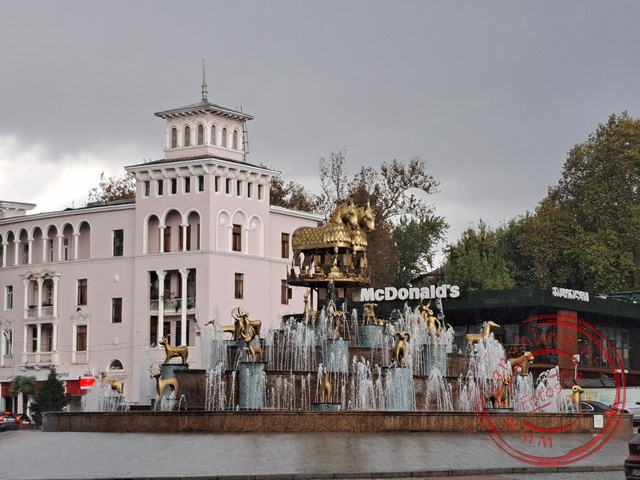 The David Agmashenebeli Square with the Colchis Fountain
 The boulevard along the Caspian Sea
Travelogue Caucasus Tour
Dag 2 | Azerbaijan > The Burning Mountains of Baku
Dag 3 | Azerbaijan > The Rock Engravings of Gobustan
Dag 4 | Azerbaijan > Crossing the Border into Georgia
Dag 5 | Georgia > Saint Nino in Bodbe
Dag 6 | Georgia > A Walking Tour of Tbilisi
Dag 7 | Georgia > The Church of Kazbegi
Dag 8 | Georgia > The Stalin Museum in Gori
Dag 9 | Georgia > The Modern Seaside Resort Batumi
Dag 10 | Georgia > From Batumi to Akhaltsikhe
Dag 11 | Georgia > The Cave City of Vardzia
Dag 12 | Georgia > Via Gyumri to Yerevan
Dag 13 | Armenia > The Cathedral of Etchmiadzin
Dag 14 | Armenia > The Spear of the Geghard Monastery
Dag 15 | Armenia > In Gregory's Cellar
Dag 16 | Armenia > By Cable Car to Tatev
Dag 17 | Armenia > To Lake Sevan
Dag 18 | Armenia > Three Monasteries in One Day
Dag 19 | Armenia > Back to Tbilisi
Dag 20 | Georgia > The Davit Gareja Monastery
Dag 21 | Georgia > Flight to the Netherlands