
154 countries
(and areas)
 - Azerbaijan
- Bahrain
- Barbados
- Belgium
- Belize
- Benin
- Bhutan
- Bolivia
- Bonaire
- Bosnia and Herzegovina
- Botswana
- Brazil
- British Virgin Islands
- Brunei
- Bulgaria
- Cambodia
- Canada
- Cape Verde
- Chile
- China
- Costa Rica
- Croatia
- Cuba
- Curacao
- Cyprus
- Czech Republic
- Denmark
- Dominica
- Dominican Republic
- Egypt
- El Salvador
- England
- Estonia
- Eswatini (Swaziland)
- Ethiopia
- Fiji
- Finland
- France
- French Guiana
- Georgia
- Germany
- Gibraltar
- Greece
- Grenada
- Guadeloupe
- Guatemala
- Honduras
- Hong Kong
- Hungary
- Iceland
- India
- Indonesia
- Iran
- Ireland
- Israel
- Italy
- Jamaica
- Japan
- Jordan
- Kazakhstan
- Kenya
- Kosovo
- Kuwait
- Kyrgyzstan
- Laos
- Latvia
- Lebanon
- Lesotho
- Liechtenstein
- Lithuania
- Luxembourg
- Macau
- Madagascar
- Malawi
- Malaysia
- Maldives
- Malta
- Martinique
- Mexico
- Moldova
- Monaco
- Mongolia
- Montenegro
- Morocco
- Mozambique
- Namibia
- Nepal
- Netherlands
- New Zealand
- Nicaragua
- North Macedonia
- Northern Ireland
- Norway
- Oman
- Pakistan
- Palestine
- Peru
- Philippines
- Poland
- Portugal
- Qatar
- Republic of Korea
- Romania
- Russia
- Saint Kitts and Nevis
- Saint Lucia
- Saint Martin
- Saint Vincent and the Grenadines
- San Marino
- São Tomé and Principe
- Saudi Arabia
- Scotland
- Senegal
- Serbia
- Singapore
- Sint Maarten
- Slovakia
- Slovenia
- South Africa
- Spain
- Sri Lanka
- Suriname
- Sweden
- Switzerland
- Tajikistan
- Tanzania
- Thailand
- The Gambia
- Tibet
- Togo
- Transnistria
- Trinidad and Tobago
- Tunisia
- Turkey
- Turkmenistan
- Uganda
- United Arab Emirates
- United States
- Uruguay
- Uzbekistan
- Vatican City
- Vietnam
- Wales
- Zambia
- Zanzibar
- Azerbaijan
- Bahrain
- Barbados
- Belgium
- Belize
- Benin
- Bhutan
- Bolivia
- Bonaire
- Bosnia and Herzegovina
- Botswana
- Brazil
- British Virgin Islands
- Brunei
- Bulgaria
- Cambodia
- Canada
- Cape Verde
- Chile
- China
- Costa Rica
- Croatia
- Cuba
- Curacao
- Cyprus
- Czech Republic
- Denmark
- Dominica
- Dominican Republic
- Egypt
- El Salvador
- England
- Estonia
- Eswatini (Swaziland)
- Ethiopia
- Fiji
- Finland
- France
- French Guiana
- Georgia
- Germany
- Gibraltar
- Greece
- Grenada
- Guadeloupe
- Guatemala
- Honduras
- Hong Kong
- Hungary
- Iceland
- India
- Indonesia
- Iran
- Ireland
- Israel
- Italy
- Jamaica
- Japan
- Jordan
- Kazakhstan
- Kenya
- Kosovo
- Kuwait
- Kyrgyzstan
- Laos
- Latvia
- Lebanon
- Lesotho
- Liechtenstein
- Lithuania
- Luxembourg
- Macau
- Madagascar
- Malawi
- Malaysia
- Maldives
- Malta
- Martinique
- Mexico
- Moldova
- Monaco
- Mongolia
- Montenegro
- Morocco
- Mozambique
- Namibia
- Nepal
- Netherlands
- New Zealand
- Nicaragua
- North Macedonia
- Northern Ireland
- Norway
- Oman
- Pakistan
- Palestine
- Peru
- Philippines
- Poland
- Portugal
- Qatar
- Republic of Korea
- Romania
- Russia
- Saint Kitts and Nevis
- Saint Lucia
- Saint Martin
- Saint Vincent and the Grenadines
- San Marino
- São Tomé and Principe
- Saudi Arabia
- Scotland
- Senegal
- Serbia
- Singapore
- Sint Maarten
- Slovakia
- Slovenia
- South Africa
- Spain
- Sri Lanka
- Suriname
- Sweden
- Switzerland
- Tajikistan
- Tanzania
- Thailand
- The Gambia
- Tibet
- Togo
- Transnistria
- Trinidad and Tobago
- Tunisia
- Turkey
- Turkmenistan
- Uganda
- United Arab Emirates
- United States
- Uruguay
- Uzbekistan
- Vatican City
- Vietnam
- Wales
- Zambia
- Zanzibar


Copyright 2004 - 2026
Veeronline.nl Travel Adventures

Home > Egypt > Travel around Egypt > Travelogue day 10
Travelogue Travel around Egypt
November 2004 (15 days)
Egypt > The temples of Karnak and Luxor
Dag 10 - Tuesday, November 23, 2004When I wake up, we are already drifting on the Nile. The crew got up at three in the morning and has let both boats float downstream with the current. Around half past five, they take down the side sails, as the feluccas catch too much crosswind. The cold breeze over the Nile instantly makes us wide awake. I pull my sleeping bag tighter around me while enjoying the beautiful sunrise. For the final stretch, the sail is raised around six o’clock. Tacking back and forth, we sail towards the Temple of Kom Ombo. In front of the temple, numerous cruise ships are already moored in thick rows.

Their passengers have already gone ahead to visit the temple. It’s not even half past seven yet. We first have breakfast on board before saying goodbye to the crew. We walk to the temple, where Mohammed gives an explanation outside. The temple is a dilapidated yet impressive Greco-Roman structure. It is built completely symmetrically — the left part is dedicated to the falcon god Haroeris (Horus) and the right part to the local crocodile god Sobek. Mohammed explains the scenes depicted on the walls. Many columns are decorated with the lotus flower of Upper Egypt and the papyrus of Lower Egypt (the Delta). After his explanation, we are given time to explore the temple on our own. It is precisely at this temple that my camera breaks down. The lens gets stuck halfway between open and closed. By removing the batteries and replacing the disk, the device comes back to life, allowing me to quickly take a few photos. After the visit, we meet Camel again, who has driven the bus from Aswan to Kom Ombo. We continue in convoy toward Edfu. There, we visit the Temple of Edfu — also known as the Temple of the Falcon God Horus. This temple lay buried under the sand for almost 2,000 years, which preserved it remarkably well. The pylon (the entrance gate) in particular shows clearly how temples were constructed in ancient times. The offering hall at the back of the temple is also still in its original state.
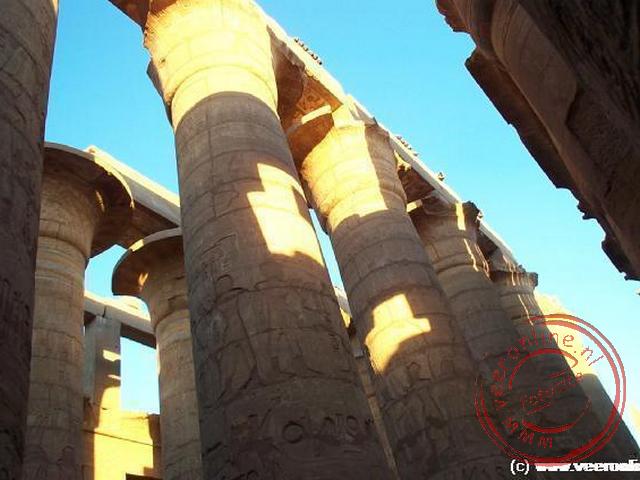
In very few temples has the roof survived intact. After the visit, we drive for about an hour toward Luxor, arriving at our hotel around half past one. Fortunately, our rooms are ready right away. We order lunch and take a shower while we wait. By the time we’re done, lunch is served — a perfect arrangement. We enjoy the meal thoroughly. At the end of the afternoon, we visit the temples of Karnak, about three kilometers from Luxor. In a procession of seven horse-drawn carriages, we ride to Karnak. In front of the temple, Mohammed gives an extensive explanation. Karnak is an immense complex of temples. At its heart stands the Temple of Amun. The courtyards, the colonnades, the colossal statues — Karnak is overwhelming. No expense or effort was spared; some 80,000 workers were employed in building it. The complex was buried under the sand for a thousand years and excavated in the mid-19th century. Inside, Mohammed explains in detail the colossi of Ramses II, the drawings and hieroglyphs on the walls, and their meanings. He also describes how the temple was constructed. He continues until it becomes clear that the temple is closing earlier than usual today (at five o’clock instead of six).

In the remaining ten minutes, Mohammed quickly shows us the rest of Karnak — the obelisk and the sacred lake. We are almost literally swept out of the temple. Outside, it has already grown dark. We take the horse-drawn carriages back to Luxor and get out at the Luxor Temple. Here too, Mohammed gives an extensive explanation of the beautifully illuminated temple. With its colonnades, the Luxor Temple is one of the most impressive monuments of ancient Egypt. The complex lies directly on the Nile River. The temple was built by Pharaoh Amenhotep III and later expanded by Ramses II. Even Alexander the Great contributed to it. Over time, parts of the temple were absorbed into the growing city, and houses were built within it. Today, only the Abu al-Haggag Mosque still stands within the temple complex. A 25-meter-high obelisk flanks the entrance. Originally, there was another obelisk, but it was gifted to France at the beginning of the 19th century — it now stands on the Place de la Concorde in Paris. After visiting the temple, it’s time for dinner. With most of the group, we go to a restaurant recommended by Mohammed, where we enjoy a nice meal on the open terrace. Finally, we end the day with a good beer back at the hotel.
 Egypt
Egypt  The quartz glistens like crystal
 The death mask of Tutankhamun in the Egyptian Museum photo Rene and Jacqueline
 View over the desert
 Erwin and Ale race upwards
Travelogue Travel around Egypt
Dag 2 | Egypt > The Sugar Feast in Cairo
Dag 3 | Egypt > Walk through Cairo
Dag 4 | Egypt > Sleeping on the desert sand
Dag 5 | Egypt > The medieval town of El-Qasr
Dag 6 | Egypt > On a camel to the Oasis
Dag 7 | Egypt > Eating with the Nubians in Aswan
Dag 8 | Egypt > High Tea at Hotel Old Cataract
Dag 9 | Egypt > Sailing on the Nile
Dag 10 | Egypt > The temples of Karnak and Luxor
Dag 11 | Egypt > Guest at an Egyptian wedding
Dag 12 | Egypt > On the way to Sharm El-Naga
Dag 13 | Egypt > A day at the beach
Dag 14 | Egypt > The Egyptian Museum
Dag 15 | Egypt > Schiphol