
160 countries
(and areas)
 - Costa Rica
- Croatia
- Cuba
- Curacao
- Cyprus
- Czech Republic
- Denmark
- Dominica
- Dominican Republic
- Egypt
- El Salvador
- England
- Estonia
- Eswatini (Swaziland)
- Ethiopia
- Fiji
- Finland
- France
- French Guiana
- Georgia
- Germany
- Ghana
- Gibraltar
- Greece
- Grenada
- Guadeloupe
- Guatemala
- Guinee
- Guinee-Bissau
- Honduras
- Hong Kong
- Hungary
- Iceland
- India
- Indonesia
- Iran
- Ireland
- Israel
- Italy
- Jamaica
- Japan
- Jordan
- Kazakhstan
- Kenya
- Kosovo
- Kuwait
- Kyrgyzstan
- Laos
- Latvia
- Lebanon
- Lesotho
- Liberia
- Liechtenstein
- Lithuania
- Luxembourg
- Macau
- Madagascar
- Malawi
- Malaysia
- Maldives
- Malta
- Martinique
- Mexico
- Moldova
- Monaco
- Mongolia
- Montenegro
- Morocco
- Mozambique
- Namibia
- Nepal
- Netherlands
- New Zealand
- Nicaragua
- North Macedonia
- Northern Ireland
- Norway
- Oman
- Pakistan
- Palestine
- Peru
- Philippines
- Poland
- Portugal
- Qatar
- Republic of Korea
- Romania
- Russia
- Saint Kitts and Nevis
- Saint Lucia
- Saint Martin
- Saint Vincent and the Grenadines
- San Marino
- São Tomé and Principe
- Saudi Arabia
- Scotland
- Senegal
- Serbia
- Sierra Leone
- Singapore
- Sint Maarten
- Slovakia
- Slovenia
- South Africa
- Spain
- Sri Lanka
- Suriname
- Sweden
- Switzerland
- Tajikistan
- Tanzania
- Thailand
- The Gambia
- Tibet
- Togo
- Transnistria
- Trinidad and Tobago
- Tunisia
- Turkey
- Turkmenistan
- Uganda
- United Arab Emirates
- United States
- Uruguay
- Uzbekistan
- Vatican City
- Vietnam
- Wales
- Zambia
- Zanzibar


Copyright 2004 - 2026
Veeronline.nl Travel Adventures
Home > Ghana > Roundtrip West Africa > Travelogue day 21
Travelogue Roundtrip West Africa
Oct 15 - Nov 9th, 2026 (26 days)
Ghana > The Kakum Canopy Walkways
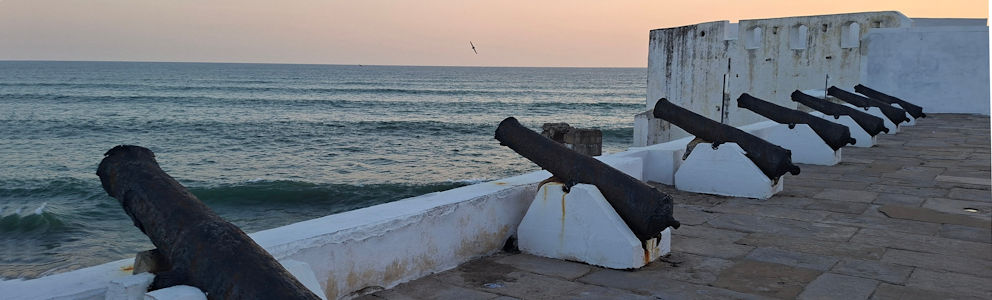
Dag 21 - Wednesday 4 November 2026Kakum National Park is on today's itinerary. Yesterday, George, our guide, told us it was a four-hour drive. I assumed he meant two hours there and two hours back. That turned out not to be the case. Because of the considerable distance, we leave the hotel as early as seven o'clock. A few travellers have decided to skip this excursion. Some have already visited the park on a previous trip, while others are not feeling particularly well.The long journey is not just due to the distance, though. The main reasons are the poor road conditions and the heavy traffic along the way. There are plans to develop a continuous road connection from Nigeria, through Benin, Togo and Ghana, all the way to Côte d'Ivoire. A good road connection would make it easier and faster to transport goods between these countries. However, this is a project that will take many years to complete. In the meantime, there is a lot of road construction going on just outside Accra. At a petrol station, I buy a couple of bottles of Coke and a Snickers bar for the journey.During the drive, George tells us about some of the customs and traditions in Ghana. There is quite a bit of laughter when he explains that most Ghanaians are Christians, but that married men sometimes keep a side chick. The reverse, however, is not acceptable: women are not allowed to have a toyboy. The term *side chick* is particularly memorable.Traffic is heavy, and in several villages it comes to a standstill around the local markets. As a result, our estimated arrival time keeps getting pushed back. It is not until around noon that we finally reach Kakum National Park.The park is located in the heart of Ghana's tropical rainforest. I follow our local guide into the park. He emphasises that we should walk slowly and stay together as a group. However, once we start climbing the stairs, the group soon begins to spread out. It is not so much our own group that struggles to keep up, but rather the Ghanaian women who are having difficulty maintaining the pace.After about twenty minutes of climbing, we reach the famous canopy walkways: a series of suspension bridges high up among the treetops. The bridges were built in the 1980s. There are two options: the longer route, crossing seven suspension bridges, or the shorter one, involving just two bridges.When I step onto the first bridge, it sways quite considerably. I actually enjoy that and try to make it to the other side without using my hands. I don't quite manage that everywhere. Some of my fellow travellers find the swaying considerably less enjoyable. I wait at the bridges until they have all made it safely across.The bridges consist of two steel cables, with a walkway made of ropes suspended between them. Beneath the walkway is a kind of ladder construction. Safety nets have been installed on both sides to prevent anyone from falling. The views across the rainforest canopy are beautiful.Along the way, I strike up conversations with a couple of Brits, a German girl and two Portuguese ladies. I complete the entire route, crossing all seven bridges, without any problems.On the walk back to the car park, I can feel mosquitoes around my legs. I have used insect repellent, but apparently not enough. I also feel some bites around my ankles. It turns out that I have picked up a few ants, which can give quite a nasty bite. At the end of the trail, I take off my shoes to remove the half-crushed ants from my socks.A few children from a Ghanaian school group who have also completed the walk want to know where I come from and what my name is. They also ask if they can take a photo with me. Before long, I am surrounded by dozens of children.Today's schedule is not going entirely according to plan. It is almost three o'clock by the time we set off for the lunch restaurant in Cape Coast. Since we are expected to return late, it was decided earlier to have a substantial lunch instead of going out for dinner in the evening. Shortly after half past three, we arrive at the restaurant. I have ordered beef stroganoff with French fries. That should keep me going for the rest of the evening.Cape Coast is also home to the castle of the same name, Cape Coast Castle, which was built by the Swedes in 1653. Enslaved people were imprisoned here before being transported across the ocean to America. The castle subsequently fell into the hands of the Danes, the Dutch and eventually the British.Nanako, our guide at the castle, leads us into the courtyard. He emphasises that the purpose here is to tell the story of history. Not to blame people living today for what happened in the past, but to make sure that something like this never happens again.Nanako takes us down into the dungeons beneath the castle, where hundreds of people were held in appalling conditions, with hardly any daylight and very little space. He explains that it was mainly the British who greatly expanded the slave trade on a large scale.The Europeans were not always directly involved in the inland regions, searching for people to enslave. Quite often, local rulers and traders captured people and then sold them to European merchants. Nanako mentions the Ashanti Kingdom as an example. I had seen something similar earlier in the Kingdom of Dahomey, with Abomey as its capital, in what is now Benin.Nanako ends the tour at the Door of No Return. The captured people were taken through a tunnel to this door, which opened onto the beach. When I walk through the doorway and step outside, I see the colourful fishing boats on the beach at Cape Coast. It is a striking contrast to the tragic history that unfolded here.It is almost six o'clock when we are back at the bus. The sun is already sinking towards the horizon. We begin the return journey to Accra in the dark. The drive is expected to take around four hours, depending on traffic.Bright, our driver, certainly puts his foot down. Nevertheless, he gives the impression of being a safe driver and seems to anticipate the movements of other traffic quite well. I am just not sure whether the other road users are equally good at anticipating his movements. To be on the safe side, I fasten my seat belt. That way, if anything does happen, at least I won't be bouncing around the bus.Around the roadworks, the chaos seems even worse than it was this morning. Vehicles are using both the diversion and the sections of road that are still under construction. In the dark, it is also difficult to see where the road continues. I am amazed that everything seems to work out all right every time. So far, I haven't seen a single accident along the way.At the police checkpoints, Bright briefly switches on the lights inside the bus. This allows the officers to see that he is carrying tourists, after which they let us continue. Since the lights keep coming on at regular intervals, it also becomes quite obvious just how many police checkpoints there are along the route.A little after half past nine, we arrive safely back at the hotel in Accra. I am pretty exhausted after such a long day, so I quickly head off to bed.
 Senegal
 Coast Ivory
Travelogue Roundtrip West Africa
Dag 2 | Senegal > Wandering Around Dakar
Dag 3 | Senegal > The Slave Island of Gorée
Dag 4 | Senegal > The Mosque of Touba
Dag 5 | The Gambia > The Stone Circles of Sine Ngayene
Dag 6 | The Gambia > Exploring Banjul
Dag 7 | Senegal > Boat Tour in Ziguinchor
Dag 8 | Guinea-Bissau > The Capital City of Bissau
Dag 9 | Guinea-Bissau > Orango National Park
Dag 10 | Guinea-Bissau > In Search of Saltwater Hippos
Dag 11 | Guinea-Bissau > Meeting the Bijagó People
Dag 12 | Guinea-Bissau > The Mausoleum of Amílcar Cabral
Dag 13 | Senegal > The Shell Island of Fadiouth
Dag 14 | Guinea > Safari Before Departing for Guinea
Dag 15 | Guinea > Exploring Conakry
Dag 16 | Sierra Leone > Crossing the Border into Sierra Leone
Dag 17 | Sierra Leone > Chimpanzees and an Introduction to Freetown
Dag 18 | Liberia > To Bunce Island
Dag 19 | Liberia > The Capital City of Monrovia
Dag 20 | Ghana > City Tour of Accra
Dag 21 | Ghana > The Kakum Canopy Walkways
Dag 22 | Ghana > Wandering Around Accra
Dag 23 | Ivory Coast > Flight to Abidjan
Dag 24 | Ivory Coast > The Old Town of Grand-Bassam
Dag 25 | Ivory Coast > The Last Day in Abidjan