
160 countries
(and areas)
 - Costa Rica
- Croatia
- Cuba
- Curacao
- Cyprus
- Czech Republic
- Denmark
- Dominica
- Dominican Republic
- Egypt
- El Salvador
- England
- Estonia
- Eswatini (Swaziland)
- Ethiopia
- Fiji
- Finland
- France
- French Guiana
- Georgia
- Germany
- Ghana
- Gibraltar
- Greece
- Grenada
- Guadeloupe
- Guatemala
- Guinee
- Guinee-Bissau
- Honduras
- Hong Kong
- Hungary
- Iceland
- India
- Indonesia
- Iran
- Ireland
- Israel
- Italy
- Jamaica
- Japan
- Jordan
- Kazakhstan
- Kenya
- Kosovo
- Kuwait
- Kyrgyzstan
- Laos
- Latvia
- Lebanon
- Lesotho
- Liberia
- Liechtenstein
- Lithuania
- Luxembourg
- Macau
- Madagascar
- Malawi
- Malaysia
- Maldives
- Malta
- Martinique
- Mexico
- Moldova
- Monaco
- Mongolia
- Montenegro
- Morocco
- Mozambique
- Namibia
- Nepal
- Netherlands
- New Zealand
- Nicaragua
- North Macedonia
- Northern Ireland
- Norway
- Oman
- Pakistan
- Palestine
- Peru
- Philippines
- Poland
- Portugal
- Qatar
- Republic of Korea
- Romania
- Russia
- Saint Kitts and Nevis
- Saint Lucia
- Saint Martin
- Saint Vincent and the Grenadines
- San Marino
- São Tomé and Principe
- Saudi Arabia
- Scotland
- Senegal
- Serbia
- Sierra Leone
- Singapore
- Sint Maarten
- Slovakia
- Slovenia
- South Africa
- Spain
- Sri Lanka
- Suriname
- Sweden
- Switzerland
- Tajikistan
- Tanzania
- Thailand
- The Gambia
- Tibet
- Togo
- Transnistria
- Trinidad and Tobago
- Tunisia
- Turkey
- Turkmenistan
- Uganda
- United Arab Emirates
- United States
- Uruguay
- Uzbekistan
- Vatican City
- Vietnam
- Wales
- Zambia
- Zanzibar


Copyright 2004 - 2026
Veeronline.nl Travel Adventures
Home > Guinea-Bissau > Roundtrip West Africa > Travelogue day 11
Travelogue Roundtrip West Africa
Oct 15 - Nov 9th, 2026 (26 days)
Guinea-Bissau > Meeting the Bijagó People
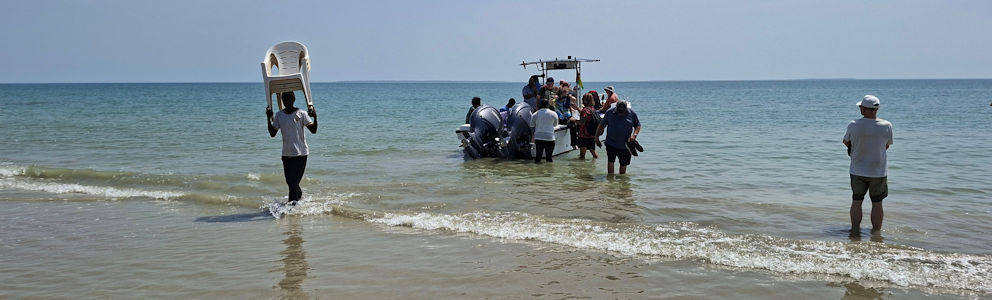
Dag 11 - Sunday 25 October 2026As I walk along the beach to the restaurant for breakfast, I notice from the sand that it has been raining. A little later, fellow travellers tell me that there was quite a thunderstorm during the night. They are surprised that I didn't hear anything. I can take things easy this morning. It is eight o'clock, and we are not leaving by boat until ten. That means I have time for another cup of coffee.At ten o'clock, we set sail for Bubaque, the town I also visited two days ago. The harbour is much quieter now. We transfer to motorised taxis with cargo beds at the back. It turns out that one of the taxis has no benches, so another one is called. Six of my fellow travellers and I set off in the first taxi. I have to hold on tight as we bump along the uneven road. There is very little tarmac left here: there are more potholes than paved sections. As a result, our motorcycle taxi driver mostly rides alongside the road rather than on it. Once we are outside the village, the road improves.We drive to Enen, a Bijagó village. The Bijagó people live on the islands of the Bijagós Archipelago. According to the explanation we are given, during the period of slavery, people moved further inland to escape the slave traders. The traditional religion of the Bijagó is animistic. They believe that nature, animals and ancestors are inhabited by spirits. These traditions create a strong connection with nature and play an important role in everyday life.In this village, the women are in charge. Not only is the village chief an elderly woman, but women are also said to play an important role in choosing partners and deciding on marriage and possible divorce.When we arrive, it is mainly the boys who interrupt their football game to welcome us. Chairs are brought out for us. A little later, a dance performance by the younger girls begins. Accompanied by the sound of drums, they sacrifice a chick. Its head is cut off. While the little animal is still struggling, the children clap enthusiastically. What I find particularly bizarre is that this ritual is performed by girls who are barely five years old. After this ceremony, the slightly older girls and women take over with a dance of their own. The drum sets the rhythm, but the beads around their legs also create rhythmic sounds. Their positions in the line are determined by their height, from tallest to shortest. It is quite something to witness a dance performed exclusively by the female inhabitants of the village, although it perhaps goes on a little longer than necessary.After the performance, we walk through the village with our guide. Here we also meet the female village chief, who is regarded as the queen of the village. Although she is clearly getting on in years, she does not want to reveal her exact age. Perhaps she doesn't know it herself. After all, record-keeping was not exactly meticulous in the old days. We are also allowed to have a look inside her house. It consists of one large room where everything takes place: cooking, relaxing and sleeping. In one corner, a hen is wandering around with her chicks. The guide explains that deceased family members are buried inside the house. This explains the names marked out with small stones in the sandy floor. We thank her for her hospitality.We return to the harbour in Bubaque by motorcycle taxi, where we board our boat again. We sail to the island of Roxa, one of the islands in the archipelago. An extensive lunch buffet has been prepared for us at a resort. I help myself to a little bit of everything and order a beer to go with it. After lunch, there is still time for a swim. I head into the warm seawater. The water here is much cleaner than it was yesterday near our lodge.At around three o'clock, we sail back to Lodge Ponta Anchaca. In the evening, dinner is once again rather chaotic. The options for the three-course dinner are written on a large board each day. The menu is in French, and the handwriting makes it difficult to translate. Lee has shared an English version, but it does not match the French text. It turns out that things are rather flexible: dishes from both the English and French versions can be ordered. More dishes are even added to the board. After some effort, I manage to make a choice. I have fish tartare as a starter and a fish skewer as my main course.Back in my room, I start getting my travel bag ready. Tomorrow we will be returning to Bissau.
 Senegal
 Coast Ivory
Travelogue Roundtrip West Africa
Dag 2 | Senegal > Wandering Around Dakar
Dag 3 | Senegal > The Slave Island of Gorée
Dag 4 | Senegal > The Mosque of Touba
Dag 5 | The Gambia > The Stone Circles of Sine Ngayene
Dag 6 | The Gambia > Exploring Banjul
Dag 7 | Senegal > Boat Tour in Ziguinchor
Dag 8 | Guinea-Bissau > The Capital City of Bissau
Dag 9 | Guinea-Bissau > Orango National Park
Dag 10 | Guinea-Bissau > In Search of Saltwater Hippos
Dag 11 | Guinea-Bissau > Meeting the Bijagó People
Dag 12 | Guinea-Bissau > The Mausoleum of Amílcar Cabral
Dag 13 | Senegal > The Shell Island of Fadiouth
Dag 14 | Guinea > Safari Before Departing for Guinea
Dag 15 | Guinea > Exploring Conakry
Dag 16 | Sierra Leone > Crossing the Border into Sierra Leone
Dag 17 | Sierra Leone > Chimpanzees and an Introduction to Freetown
Dag 18 | Liberia > To Bunce Island
Dag 19 | Liberia > The Capital City of Monrovia
Dag 20 | Ghana > City Tour of Accra
Dag 21 | Ghana > The Kakum Canopy Walkways
Dag 22 | Ghana > Wandering Around Accra
Dag 23 | Ivory Coast > Flight to Abidjan
Dag 24 | Ivory Coast > The Old Town of Grand-Bassam
Dag 25 | Ivory Coast > The Last Day in Abidjan