
160 countries
(and areas)
 - Costa Rica
- Croatia
- Cuba
- Curacao
- Cyprus
- Czech Republic
- Denmark
- Dominica
- Dominican Republic
- Egypt
- El Salvador
- England
- Estonia
- Eswatini (Swaziland)
- Ethiopia
- Fiji
- Finland
- France
- French Guiana
- Georgia
- Germany
- Ghana
- Gibraltar
- Greece
- Grenada
- Guadeloupe
- Guatemala
- Guinee
- Guinee-Bissau
- Honduras
- Hong Kong
- Hungary
- Iceland
- India
- Indonesia
- Iran
- Ireland
- Israel
- Italy
- Jamaica
- Japan
- Jordan
- Kazakhstan
- Kenya
- Kosovo
- Kuwait
- Kyrgyzstan
- Laos
- Latvia
- Lebanon
- Lesotho
- Liberia
- Liechtenstein
- Lithuania
- Luxembourg
- Macau
- Madagascar
- Malawi
- Malaysia
- Maldives
- Malta
- Martinique
- Mexico
- Moldova
- Monaco
- Mongolia
- Montenegro
- Morocco
- Mozambique
- Namibia
- Nepal
- Netherlands
- New Zealand
- Nicaragua
- North Macedonia
- Northern Ireland
- Norway
- Oman
- Pakistan
- Palestine
- Peru
- Philippines
- Poland
- Portugal
- Qatar
- Republic of Korea
- Romania
- Russia
- Saint Kitts and Nevis
- Saint Lucia
- Saint Martin
- Saint Vincent and the Grenadines
- San Marino
- São Tomé and Principe
- Saudi Arabia
- Scotland
- Senegal
- Serbia
- Sierra Leone
- Singapore
- Sint Maarten
- Slovakia
- Slovenia
- South Africa
- Spain
- Sri Lanka
- Suriname
- Sweden
- Switzerland
- Tajikistan
- Tanzania
- Thailand
- The Gambia
- Tibet
- Togo
- Transnistria
- Trinidad and Tobago
- Tunisia
- Turkey
- Turkmenistan
- Uganda
- United Arab Emirates
- United States
- Uruguay
- Uzbekistan
- Vatican City
- Vietnam
- Wales
- Zambia
- Zanzibar


Copyright 2004 - 2026
Veeronline.nl Travel Adventures
Home > Guinea > Roundtrip West Africa > Travelogue day 15
Travelogue Roundtrip West Africa
Oct 15 - Nov 9th, 2026 (26 days)
Guinea > Exploring Conakry
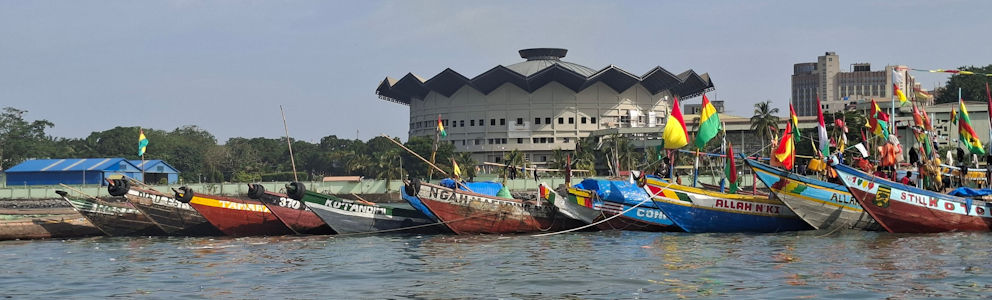
Dag 15 - Thursday 29 October 2026An extensive and excellent breakfast buffet is waiting for us. They even have salmon! What a difference from yesterday. At nine o’clock, we set off towards the harbour. The plan is to transfer to a boat there that will take us to the Îles de Los. However, it is extremely busy and the bus cannot get any closer, so we get out and walk the rest of the way.Konate, our guide in Guinea, warns us to be careful when taking photographs. People working at the fish market are not particularly happy about being photographed. He also stresses that it is absolutely forbidden to take pictures of important government buildings, police officers or military personnel. As the presidential palace is right next to the harbour, he advises us to take any photographs from the boat.The fish caught today is being brought ashore. I see men carrying baskets full of large fish, some of them more than a metre long. Further along, the fish are being cleaned and sold. The whole scene looks rather messy and chaotic. The fish are laid out on plastic sheets on the ground, and it all feels a little unhygienic.Our boat is moored among the fishing boats. With some difficulty, we manage to climb aboard over the bow. To do so, I have to walk across fishing nets that have been laid out to dry. As I take my seat and put on my life jacket, I try to take in everything happening around me. I see colourful wooden fishing boats, lavishly decorated with Guinean flags. Almost everyone working here seems to be a man.The skipper steers the boat out of the harbour. From the water, I have a good view of the presidential palace. We are heading for the Îles de Los, also known in Dutch as the Los Islands. Halfway there, the engine suddenly stops. We drift along with the current for a while. In the distance, I can see larger fishing vessels.“Those are the Chinese,” Konate sighs. They are taking over large-scale fishing in these waters. Fortunately, the skipper manages to get the engine running again and we can continue our journey.The Îles de Los played an important role in the slave trade. Ships could also be repaired there. The archipelago consists of several islands: two larger, banana-shaped islands with a round one in between. There are also a few smaller, uninhabited islands nearby. We dock at Kassa, one of the larger islands.The local economy is mainly based on fishing. Large warehouses are being built on the edge of the village, also by the Chinese, Konate explains. The village roads are little more than sandy tracks, deeply eroded by rainwater. People greet us from their homes, but also make it clear that they do not want to be photographed. Unlike in the other villages we have visited, there are no children running towards us here. According to Konate, they are at school.During his explanations, Konate repeatedly emphasises that Guinea is a wealthy country by regional standards, thanks to its natural resources and bauxite mines. However, when I look around, I find it difficult to see any evidence of that. The money stays in the hands of a small group of people and barely reaches the wider population, Konate explains, confirming my impression.Beyond the football pitch, we reach Red Beach. The sand has a reddish colour because of the presence of bauxite. There are beautiful rock formations all around. Unfortunately, there is also a great deal of rubbish on the beach and among the rocks, which considerably detracts from the beauty of the surroundings.We take the boat back to Conakry. The harbour is a little quieter now, but when we try to dock, it seems as though everyone is shouting at everyone else. In general, I have noticed that people in Guinea seem to get offended very easily and are not particularly willing to accommodate one another. I have already witnessed several heated verbal confrontations. Sometimes they start because people bump into each other while carrying heavy loads, but traffic disputes also regularly get out of hand when someone fails to give way. Fortunately, everyone makes it safely ashore.We then take the bus to the National Museum. This modest museum explains that Guinea consists of four regions, each with its own characteristics in terms of traditional thatched huts, musical instruments and crops. Outside the museum stands a statue of Ahmed Sékou Touré, the first president of independent Guinea, which gained independence in 1958.After the museum, we drive to the cathedral. Conakry’s Cathédrale Sainte-Marie was built during the French colonial period. Construction began in 1928. Inside, the church looks rather simple. The cathedral is close to Place des Martyrs de la Guinée. I am not allowed to walk over there to take a photograph, as the square is next to the presidential palace.We then drive to the Monument du 22 Novembre. This memorial column commemorates the repelling of the Portuguese attack on Guinea in 1970. Portugal wanted, among other things, to put an end to Guinea’s support for the independence fighters in neighbouring Guinea-Bissau.At around half past one, we arrive at the restaurant where we are going to have lunch. It is busy inside this upmarket establishment. I suspect that most of the customers are expats. In any case, it is certainly not the cheapest restaurant in town. I had already let them know yesterday that I wanted to order French onion soup. Even so, it takes a long time for the food to arrive. Amusingly, the travel companions who order something on the spot are served first. Their choices, incidentally, are mainly desserts.The long wait is not really a problem, as the acrobatics show by local youngsters is not scheduled to start until four o’clock. We even have time to pop back to the hotel. I am quite pleased about that, because in this heat I would love to change my shirt.At the hotel, we discover that one of the lifts is out of service for maintenance. The other one is extremely slow. The receptionist points out the emergency staircase to us. Unfortunately, the door on the second floor can only be opened from the inside. So the lift is our only option for getting upstairs. When I finally reach my room, I discover that my key does not work. Sigh! At least this time I can take the stairs back down to reception. Because of all these delays, I only just make it back in time for our departure to the acrobatics show.Acrobatics are a lively part of street culture in Conakry. For street children, the sport can offer a possible way out of poverty. When we arrive at the hall where the youngsters are performing, everyone seems to be milling around. Chairs are quickly set up for us and the show begins.Energetic drum rhythms accompany the boys and girls as they take turns dancing and doing forward rolls. Then come the somersaults, a fire-breather and a balancing act. The show is professionally organised, with synchronised dancing. At the end, the youngsters build a human tower three people high. The top acrobat balances on his head at the very top of the tower.For the final act, we are invited to join in the dancing. Fortunately, they adapt the dance so that we do not have to take part in any acrobatics ourselves. I am pleasantly surprised by the performance!Afterwards, we stop at a market selling handicrafts and souvenirs. I order a Coke and sit down on a low wall. Before long, a woman approaches me asking for money. When one of my fellow travellers walks past, she follows him to the bus. There, she continues to pester him for money in a rather unpleasant way. When the driver tries to push her away, a scuffle breaks out. The driver starts hitting her quite hard in an attempt to make her let go of his clothes. The woman then continues walking hysterically around the bus. Bystanders try in vain to calm her down. We quickly leave. The woman still manages to bang hard on the bus windows several times as we pull away.Our final stop of the day is the Grand Mosque of Conakry. The mosque was built in the 1980s with assistance from Saudi Arabia. The complex can accommodate around 25,000 worshippers, both inside and outside. In front of the mosque is the mausoleum of Ahmed Sékou Touré, the first president of independent Guinea. We had already seen his statue outside the museum earlier in the day.The mosque is impressively spacious inside, with hundreds of pillars. After this visit, we return to the hotel.We are having dinner there tonight. I choose sauce gombo, a traditional and popular Guinean dish. It is a thick, somewhat slimy stew made with okra, palm oil and meat. Although it does not look particularly appetising at first glance, it tastes delicious and savoury, especially when eaten with rice. The only problem is that the portion is far too large.I also spotted crème brûlée on the menu, so I finish my meal with that. When it comes to paying for my local beer, my credit card refuses to cooperate. Perhaps it is because it is a Mastercard, or perhaps it has something to do with the earlier problems I had with my PIN. Lee comes to my rescue and pays the 50,000 Guinean francs for me — about €5.50. So I manage to end the day on a positive note after all, with no outstanding bills!
 Senegal
 Coast Ivory
Travelogue Roundtrip West Africa
Dag 2 | Senegal > Wandering Around Dakar
Dag 3 | Senegal > The Slave Island of Gorée
Dag 4 | Senegal > The Mosque of Touba
Dag 5 | The Gambia > The Stone Circles of Sine Ngayene
Dag 6 | The Gambia > Exploring Banjul
Dag 7 | Senegal > Boat Tour in Ziguinchor
Dag 8 | Guinea-Bissau > The Capital City of Bissau
Dag 9 | Guinea-Bissau > Orango National Park
Dag 10 | Guinea-Bissau > In Search of Saltwater Hippos
Dag 11 | Guinea-Bissau > Meeting the Bijagó People
Dag 12 | Guinea-Bissau > The Mausoleum of Amílcar Cabral
Dag 13 | Senegal > The Shell Island of Fadiouth
Dag 14 | Guinea > Safari Before Departing for Guinea
Dag 15 | Guinea > Exploring Conakry
Dag 16 | Sierra Leone > Crossing the Border into Sierra Leone
Dag 17 | Sierra Leone > Chimpanzees and an Introduction to Freetown
Dag 18 | Liberia > To Bunce Island
Dag 19 | Liberia > The Capital City of Monrovia
Dag 20 | Ghana > City Tour of Accra
Dag 21 | Ghana > The Kakum Canopy Walkways
Dag 22 | Ghana > Wandering Around Accra
Dag 23 | Ivory Coast > Flight to Abidjan
Dag 24 | Ivory Coast > The Old Town of Grand-Bassam
Dag 25 | Ivory Coast > The Last Day in Abidjan