
154 countries
(and areas)
 - Belize
- Benin
- Bhutan
- Bolivia
- Bonaire
- Bosnia and Herzegovina
- Botswana
- Brazil
- British Virgin Islands
- Brunei
- Bulgaria
- Cambodia
- Canada
- Cape Verde
- Chile
- China
- Costa Rica
- Croatia
- Cuba
- Curacao
- Cyprus
- Czech Republic
- Denmark
- Dominica
- Dominican Republic
- Egypt
- El Salvador
- England
- Estonia
- Eswatini (Swaziland)
- Ethiopia
- Fiji
- Finland
- France
- French Guiana
- Georgia
- Germany
- Gibraltar
- Greece
- Grenada
- Guadeloupe
- Guatemala
- Honduras
- Hong Kong
- Hungary
- Iceland
- India
- Indonesia
- Iran
- Ireland
- Israel
- Italy
- Jamaica
- Japan
- Jordan
- Kazakhstan
- Kenya
- Kosovo
- Kuwait
- Kyrgyzstan
- Laos
- Latvia
- Lebanon
- Lesotho
- Liechtenstein
- Lithuania
- Luxembourg
- Macau
- Madagascar
- Malawi
- Malaysia
- Maldives
- Malta
- Martinique
- Mexico
- Moldova
- Monaco
- Mongolia
- Montenegro
- Morocco
- Mozambique
- Namibia
- Nepal
- Netherlands
- New Zealand
- Nicaragua
- North Macedonia
- Northern Ireland
- Norway
- Oman
- Pakistan
- Palestine
- Peru
- Philippines
- Poland
- Portugal
- Qatar
- Republic of Korea
- Romania
- Russia
- Saint Kitts and Nevis
- Saint Lucia
- Saint Martin
- Saint Vincent and the Grenadines
- San Marino
- São Tomé and Principe
- Saudi Arabia
- Scotland
- Senegal
- Serbia
- Singapore
- Sint Maarten
- Slovakia
- Slovenia
- South Africa
- Spain
- Sri Lanka
- Suriname
- Sweden
- Switzerland
- Tajikistan
- Tanzania
- Thailand
- The Gambia
- Tibet
- Togo
- Transnistria
- Trinidad and Tobago
- Tunisia
- Turkey
- Turkmenistan
- Uganda
- United Arab Emirates
- United States
- Uruguay
- Uzbekistan
- Vatican City
- Vietnam
- Wales
- Zambia
- Zanzibar
- Belize
- Benin
- Bhutan
- Bolivia
- Bonaire
- Bosnia and Herzegovina
- Botswana
- Brazil
- British Virgin Islands
- Brunei
- Bulgaria
- Cambodia
- Canada
- Cape Verde
- Chile
- China
- Costa Rica
- Croatia
- Cuba
- Curacao
- Cyprus
- Czech Republic
- Denmark
- Dominica
- Dominican Republic
- Egypt
- El Salvador
- England
- Estonia
- Eswatini (Swaziland)
- Ethiopia
- Fiji
- Finland
- France
- French Guiana
- Georgia
- Germany
- Gibraltar
- Greece
- Grenada
- Guadeloupe
- Guatemala
- Honduras
- Hong Kong
- Hungary
- Iceland
- India
- Indonesia
- Iran
- Ireland
- Israel
- Italy
- Jamaica
- Japan
- Jordan
- Kazakhstan
- Kenya
- Kosovo
- Kuwait
- Kyrgyzstan
- Laos
- Latvia
- Lebanon
- Lesotho
- Liechtenstein
- Lithuania
- Luxembourg
- Macau
- Madagascar
- Malawi
- Malaysia
- Maldives
- Malta
- Martinique
- Mexico
- Moldova
- Monaco
- Mongolia
- Montenegro
- Morocco
- Mozambique
- Namibia
- Nepal
- Netherlands
- New Zealand
- Nicaragua
- North Macedonia
- Northern Ireland
- Norway
- Oman
- Pakistan
- Palestine
- Peru
- Philippines
- Poland
- Portugal
- Qatar
- Republic of Korea
- Romania
- Russia
- Saint Kitts and Nevis
- Saint Lucia
- Saint Martin
- Saint Vincent and the Grenadines
- San Marino
- São Tomé and Principe
- Saudi Arabia
- Scotland
- Senegal
- Serbia
- Singapore
- Sint Maarten
- Slovakia
- Slovenia
- South Africa
- Spain
- Sri Lanka
- Suriname
- Sweden
- Switzerland
- Tajikistan
- Tanzania
- Thailand
- The Gambia
- Tibet
- Togo
- Transnistria
- Trinidad and Tobago
- Tunisia
- Turkey
- Turkmenistan
- Uganda
- United Arab Emirates
- United States
- Uruguay
- Uzbekistan
- Vatican City
- Vietnam
- Wales
- Zambia
- Zanzibar


Copyright 2004 - 2026
Veeronline.nl Travel Adventures

Home > India > Diwali in India > Travelogue day 5
Travelogue Diwali in India
November 614 2023 (9 days)
India > Jodhpur Mehrangarh Fort
Dag 5 - Friday, 10 November 2023Besides the fireworks, I think I also heard thunder last night. It even seemed to rain briefly. A rain shower helps against the smog in Indian cities. Even Dutch media reported about the dangerously high smog levels in the capital Delhi. The highest risk code was issued there. Around five o’clock, I go downstairs with my luggage. The night watchman wakes up startled. It is the same young man who manages the reception during the day, and he is sleeping in the same clothes. When the car arrives, he helps me load the luggage into the car. Ten minutes later, I am already at the station. My train to Jodhpur departs from track three. When I walk onto the platform, the train is already pulling in. I have a ticket for class 3A. This means three beds stacked instead of two. Also, there are no curtains here. Everyone does get sheets, a pillow, and a pillowcase. I share the compartment with an Indian family with two children. No one speaks English. I lie down and try to sleep a bit. Halfway through, the family leaves the train. I am alone now with six places. A boy who has a seat further down moves. When the train stops, he is gone too, but his belongings remain.

He went to buy something to eat during the two-minute stop. He offers me some as well. Just after eleven, the train pulls into Jodhpur station. I look on the busy platform to see if anyone is there to pick me up. I see no one. All travelers must go up a two-meter-wide staircase. Just like on the street, everyone tries to get to the top first. I quickly let go of my guilt when my bag bumps several times into the legs of people pushing their way up. Halfway up, someone struggles to lift her suitcase. She lifts it step by step, holding up the crowd. I help her and carry her suitcase up. Strange that no one else does this. Everyone seems so focused on themselves without doing anything for others. Whether in traffic, pushing to buy a ticket, or here on the stairs. Outside the station is my driver. He apologizes with "no English." I can’t even manage to ask his name. But he hands me a phone. It is the guide. Abishek suggests going into town at half past twelve. Then I have some time to freshen up. That sounds easier said than done. The hotel is located within the walls of the old city. Incoming and outgoing traffic must pass through the narrow city gate. Also, the alleys behind have barely any space for all the traffic. The driver drives somewhat uncertainly. He doesn’t know where the hotel is. I show him on my phone that he drove a bit too far. He ignores me and opens his window to ask someone. The young man tells him the same thing. The Hermitage Kacherman Haveli hotel is located on an unpaved road. Inside, the hotel is beautifully decorated in old Eastern style. I have a spacious room right next to the reception. I quickly take a shower. There is even warm water coming from the tap. At half past twelve, I don’t see a guide. The receptionist says my driver is waiting outside and will take me to the guide. A little later, I sit in the car, and the driver is searching. Funny to see a less confident driver in Indian traffic. Here you don’t get right of way, you have to take it. Shortly after, Abishek gets into the car. He says we will first go to the Mehrangarh Fort and then to the Jaswant Thada tombs. I indicate that I would like to have lunch first. This turns out to be reasonably easy to fit in. Abishek helps me choose from the menu. He also eats with me. During lunch, we talk about Jodhpur and my trip. The Mehrangarh Fort is situated on a rocky hill high above the walled old city. Once Marwar was the most important city, but this location between the hills became increasingly difficult to defend. Therefore, in 1459, Rao Jodha, the ruler of Marwar, ordered a new fort to be built.

Various kings later expanded the fort. The fort is built from red sandstone. It has imposing walls and towers and is extended with several palaces and courtyards. I enter through the Jai Pol, the gate built in 1808. Maharaja Man Singh had this gate built after the victory over the Maharaja of Jaipur. When I enter the first courtyard, I am impressed by the richly decorated buildings. Abishek shows me some rooms with collections of palanquins, clothing, and royal cradles. The showpiece of the fort are the stacked Sheesha Mahal, Phool Mahal, and Moti Mahal. The Sheesha Mahal, or Mirror Palace, is decorated with small pieces of mirror. The Phool Mahal was used for entertainment, where dancing and music took place. Finally, the Moti Mahal, the Pearl Palace, was the king’s private chamber. When I look out the window over the city of Jodhpur, I immediately understand why the city is called the ‘Blue City.’ The facades of many houses are painted blue. This used to indicate nobility, but blue also reflects the sun and keeps the house cooler. In the distance, I also see the Umaid Bhavan Palace. I will visit this palace tomorrow. On the other hill, I see the Jaswant Thada, a huge marble cenotaph built in 1899 in memory of Maharaja Jaswant Singh II. By car, we drive there afterward. Abishek explains this was the cremation site of the rulers of Marwar. Monuments were built on the cremation sites in their memory. The ashes themselves were scattered in the Ganges in Varanasi. Inside, the Jaswant Thada is relatively sparsely furnished. Images of the 34 kings hang on the wall. In the center of Jodhpur, I say goodbye to the guide. He says I can manage myself tomorrow. I believe no guide was included in my itinerary for tomorrow either. The driver drops me off at the hotel. Abishek mentioned that there is a Diwali ceremony at the well tonight. He showed the location on the map. Before I go to that ceremony, I walk through the old center of Jodhpur.

The streets are lit in all kinds of colors for Diwali. The streets are busy. Everyone is doing last-minute shopping. The market is centered around the old clock tower from 1912. I cut through to the place Abishek indicated: a large water basin in the middle of the city. I see no activities here. A family is just releasing a wish lantern. The fire heats the air so the paper lantern rises. I wonder where this burning thing will come down. I cross the basin via the stone footbridge. There is nothing on the other side either. Children who see me looking around greet me cheerfully and ask where I am from. In Varanasi and Jaipur, I experienced this much less. I try the second water basin in the center. It is even more deserted here. People look surprised to see a tourist here. I decide to walk one more round and then give up. On the north side of the first lake, I hear music. Here, about one hundred meters from the basin, is the deep Toorji’s Step Well, where people used to fetch water. Burning candles are placed on every step. Together with the music, it is a beautiful sight. A cord is stretched. It is unclear to me who may or may not cross the cord. It seems like a close-knit group. I would probably be allowed if the guide recognized me, but I don’t think I will enjoy this for very long. I decide to go back to my hotel. On the way, I buy some drinks and a snack for the room.
 India
India 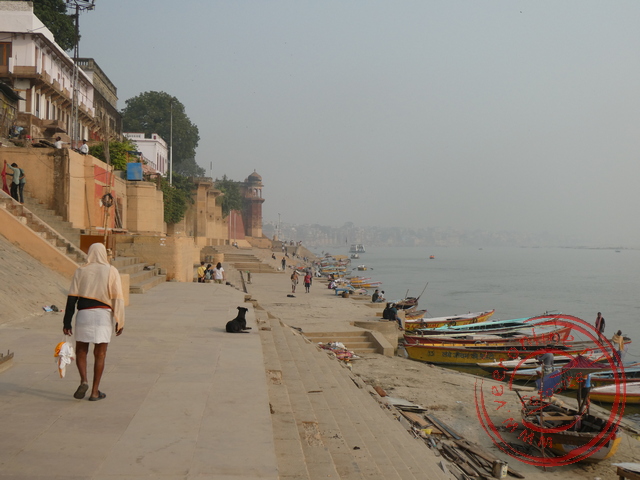 Along the banks of the Ganges are steps to reach the water
 Dozens of oil lamps burn for Diwali
 The colorfully lit station of Delhi
 Many balconies are decorated with blinking lights for Diwali
Travelogue Diwali in India
Dag 2 | India > Cremations on the Ganges
Dag 3 | India > The Sarnath Buddhist Temple
Dag 4 | India > The Amber Fort in Jaipur
Dag 5 | India > Jodhpur Mehrangarh Fort
Dag 6 | India > The Umaid Bhavan Palace
Dag 7 | India > 'Happy Diwali”
Dag 8 | India > Farewell to Delhi
Dag 9 | India > Delayed in Frankfurt