
154 countries
(and areas)
 - Azerbaijan
- Bahrain
- Barbados
- Belgium
- Belize
- Benin
- Bhutan
- Bolivia
- Bonaire
- Bosnia and Herzegovina
- Botswana
- Brazil
- British Virgin Islands
- Brunei
- Bulgaria
- Cambodia
- Canada
- Cape Verde
- Chile
- China
- Costa Rica
- Croatia
- Cuba
- Curacao
- Cyprus
- Czech Republic
- Denmark
- Dominica
- Dominican Republic
- Egypt
- El Salvador
- England
- Estonia
- Eswatini (Swaziland)
- Ethiopia
- Fiji
- Finland
- France
- French Guiana
- Georgia
- Germany
- Gibraltar
- Greece
- Grenada
- Guadeloupe
- Guatemala
- Honduras
- Hong Kong
- Hungary
- Iceland
- India
- Indonesia
- Iran
- Ireland
- Israel
- Italy
- Jamaica
- Japan
- Jordan
- Kazakhstan
- Kenya
- Kosovo
- Kuwait
- Kyrgyzstan
- Laos
- Latvia
- Lebanon
- Lesotho
- Liechtenstein
- Lithuania
- Luxembourg
- Macau
- Madagascar
- Malawi
- Malaysia
- Maldives
- Malta
- Martinique
- Mexico
- Moldova
- Monaco
- Mongolia
- Montenegro
- Morocco
- Mozambique
- Namibia
- Nepal
- Netherlands
- New Zealand
- Nicaragua
- North Macedonia
- Northern Ireland
- Norway
- Oman
- Pakistan
- Palestine
- Peru
- Philippines
- Poland
- Portugal
- Qatar
- Republic of Korea
- Romania
- Russia
- Saint Kitts and Nevis
- Saint Lucia
- Saint Martin
- Saint Vincent and the Grenadines
- San Marino
- São Tomé and Principe
- Saudi Arabia
- Scotland
- Senegal
- Serbia
- Singapore
- Sint Maarten
- Slovakia
- Slovenia
- South Africa
- Spain
- Sri Lanka
- Suriname
- Sweden
- Switzerland
- Tajikistan
- Tanzania
- Thailand
- The Gambia
- Tibet
- Togo
- Transnistria
- Trinidad and Tobago
- Tunisia
- Turkey
- Turkmenistan
- Uganda
- United Arab Emirates
- United States
- Uruguay
- Uzbekistan
- Vatican City
- Vietnam
- Wales
- Zambia
- Zanzibar
- Azerbaijan
- Bahrain
- Barbados
- Belgium
- Belize
- Benin
- Bhutan
- Bolivia
- Bonaire
- Bosnia and Herzegovina
- Botswana
- Brazil
- British Virgin Islands
- Brunei
- Bulgaria
- Cambodia
- Canada
- Cape Verde
- Chile
- China
- Costa Rica
- Croatia
- Cuba
- Curacao
- Cyprus
- Czech Republic
- Denmark
- Dominica
- Dominican Republic
- Egypt
- El Salvador
- England
- Estonia
- Eswatini (Swaziland)
- Ethiopia
- Fiji
- Finland
- France
- French Guiana
- Georgia
- Germany
- Gibraltar
- Greece
- Grenada
- Guadeloupe
- Guatemala
- Honduras
- Hong Kong
- Hungary
- Iceland
- India
- Indonesia
- Iran
- Ireland
- Israel
- Italy
- Jamaica
- Japan
- Jordan
- Kazakhstan
- Kenya
- Kosovo
- Kuwait
- Kyrgyzstan
- Laos
- Latvia
- Lebanon
- Lesotho
- Liechtenstein
- Lithuania
- Luxembourg
- Macau
- Madagascar
- Malawi
- Malaysia
- Maldives
- Malta
- Martinique
- Mexico
- Moldova
- Monaco
- Mongolia
- Montenegro
- Morocco
- Mozambique
- Namibia
- Nepal
- Netherlands
- New Zealand
- Nicaragua
- North Macedonia
- Northern Ireland
- Norway
- Oman
- Pakistan
- Palestine
- Peru
- Philippines
- Poland
- Portugal
- Qatar
- Republic of Korea
- Romania
- Russia
- Saint Kitts and Nevis
- Saint Lucia
- Saint Martin
- Saint Vincent and the Grenadines
- San Marino
- São Tomé and Principe
- Saudi Arabia
- Scotland
- Senegal
- Serbia
- Singapore
- Sint Maarten
- Slovakia
- Slovenia
- South Africa
- Spain
- Sri Lanka
- Suriname
- Sweden
- Switzerland
- Tajikistan
- Tanzania
- Thailand
- The Gambia
- Tibet
- Togo
- Transnistria
- Trinidad and Tobago
- Tunisia
- Turkey
- Turkmenistan
- Uganda
- United Arab Emirates
- United States
- Uruguay
- Uzbekistan
- Vatican City
- Vietnam
- Wales
- Zambia
- Zanzibar


Copyright 2004 - 2026
Veeronline.nl Travel Adventures

Home > India > Diwali in India > Travelogue day 4
Travelogue Diwali in India
November 614 2023 (9 days)
India > The Amber Fort in Jaipur
Dag 4 - Thursday, 9 November 2023Last night, the driver asked what time I wanted to leave—8:30 or 9 o’clock? Given how late it was yesterday, I chose the latter. When I arrive in the breakfast room at half past eight, I’m the only one there. The young man taking my breakfast order speaks hardly any English. An omelette with cheese and tomato, two toasts, and a cup of tea is quickly explained. When I look uncomfortably at the plain water, it’s replaced with a bottled water. I get the impression that I was the only guest last night. At nine o’clock, the driver arrives at the hotel. He drives me to the old city. There I meet Durga, who introduces himself as today’s guide. First, he shows me the “Palace of the Winds.” The Hawa Mahal was built in 1799 by order of Maharaja Sawai Pratap Singh. It has a pink sandstone façade shaped like a stretched-out wall with small windows and niches. Behind the more than nine hundred little windows, his harem ladies could see what was happening on the street. Clever use of wind was also made to cool the building, hence the name. Durga suggests possibly visiting the City Palace first. I sense some program adjustments ahead and show him my itinerary. Based on this, we first go to the Amber Fort. The Amber Fort is located a few kilometers outside Jaipur.

It was originally built in the 16th century by Raja Man Singh I, a ruler of the Kachwaha dynasty. Amber was originally the capital of the Kachwaha tribe before the capital moved to Jaipur in 1722. Amber became too small for the growing population. Jaipur now has over three and a half million people. At the fort, we stop briefly to take a photo of the enormous fort. I decline the option to go up on an elephant. Instead, we drive up by car. The route passes through narrow cobbled streets. We drive in a line of cars between houses. At the top, it is busy with tourists. I buy an entrance ticket and follow Durga through the gate. I arrive at a huge courtyard. Tourists arrive from the other side on elephant backs. This courtyard was mainly used for military purposes, Durga explains. The complex has four zones in total, and this is the first. Through an impressively decorated gate, I enter the second zone—a courtyard with canopies in a mix of Persian and Hindi styles. The third zone was only for the royal family. To the left lies the Sheesh Mahal (the Mirror Palace), famous for decorative pieces of mirrors and stained glass.

To the right of the garden is the summer residence. Finally, I come to the living quarters of the king’s twelve wives. Each wife had her own apartment. On the way back, we stop at the Jal Mahal, the Water Palace. The Jal Mahal was originally built in the 18th century in the middle of the Man Sagar Lake as a hunting lodge. Currently, the palace is not in use. They are considering turning it into a hotel, says Durga. He wants to show me traditional block-printing, unique to this region, he adds. We stop at a small factory. I get an explanation of how the fabric is printed in layers with different wooden blocks. Before the tour reaches the shop, I cut it short. I ask Durga if we can leave. There are nicer things to see in Jaipur. Back in the car, I ask if we are now going to the Royal Gaitor Tombs? He asks if I want to see the Maharajas’ tombs? I don’t really know what it is exactly, but if it’s in the program, it must be worth it. Gaitore is a complex of cenotaphs—memorial monuments—built in honor of deceased Maharajas. The monuments stand on the places where the cremations took place. Each Maharaja has his own monument. Although formal power was handed over in 1947 when India unified, the current Maharajas are still cremated here. The last Maharaja Sawai Bhawani Singh was cremated here in 2011. The relatively new-looking tomb has been taken over by a large group of pigeons. It is just after noon. Durga says there are better restaurants in this neighborhood for lunch. An early lunch sounds fine to me. When I enter the restaurant, I am the first guest. A lunch buffet is ready. While I eat, I count at least twelve staff members. Luckily for them, several groups of tourists arrive soon after.

In the old city lies the City Palace, the former residence of the Maharajas. Nowadays, the palace is a museum, and the current Maharaja still uses a small part of it. In the large reception hall hang portraits of the Maharajas. As I walk past the paintings, I realize I just saw their graves. Durga also shows me the portrait of Maharaja Sawai Jai Singh II, who in 1722 decided to leave Amber and found Jaipur. Later, in the 19th century, the city got the nickname “Pink City.” The palace, the Hawa Mahal, and the city gates have a pink color. The pink color is said to represent hospitality. Several cities in the region are recognizable by one color. For example, Jodhpur is the Blue City. Lastly in Jaipur, I visit the Jantar Mantar, the historic observatory. In the courtyard stand various astronomical instruments, built by order of Maharaja Sawai Jai Singh II, the founder of Jaipur. The most striking instrument is the Samrat Yantra, a gigantic sundial that can measure time accurately to the second. It is one of the largest sundials in the world. After this tour, I say goodbye to Durga. I stroll through the shops in the old city on my own. They practically all sell the same things: fabrics and clothing. You can have tailor-made clothing made here. It can even be delivered to the hotel tonight. Many shops are also decorated extra for the upcoming Diwali. Several shops have completely focused on selling fireworks. The city is already covered in smog. I fear what this will mean after Diwali. The driver takes me back to the hotel. I notice I’m tired from all the impressions and the short night.

I lie down for a bit. Late in the afternoon, I walk to the famous Raj Mandir cinema. The historic cinema is known for showing popular Bollywood films. The movie “Jawan” is playing. I read the story beforehand because the film is in Hindi. At the entrance, I’m directed to a small booth for a ticket. “Do you want a ticket for 170, 300, or 400 Rupees?” I have no idea. When the cashier sees my hesitation, he says 170 are good seats. I have a seat in the last row, right by the aisle. No one is sitting in front of me. The film is about an action hero who wants to correct the wrongs in society. It’s good that I read the story beforehand; otherwise, I wouldn’t have been able to follow it. The film lasts three hours. During the intermission, I decide to leave. I exit the cinema. I take a tuk-tuk back. The asked 200 Rupees end up being 80 when I suggest going to another tuk-tuk. A friend of the driver also rides along. He wants to know what I think of his city. Meanwhile, I have to give the driver directions to get to my hotel. He has no idea. Outside the hotel, the two young men ask if they may take a photo? We take a photo together. At the reception, I arrange to check out at five o’clock tomorrow morning. They tell me I’ll probably have to wake the night porter for that. I order a beer in my room and go to sleep early. Outside, fireworks sound all night as Diwali approaches.
 India
India 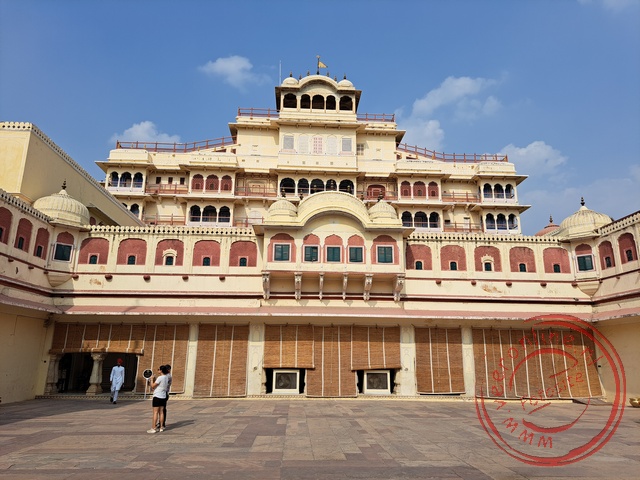 The current Maharaja still resides in this part of the City Palace
 Selling fruit on the street in Jodhpur
 Priests perform the ritual Aarti ceremony
 The holiday is over
Travelogue Diwali in India
Dag 2 | India > Cremations on the Ganges
Dag 3 | India > The Sarnath Buddhist Temple
Dag 4 | India > The Amber Fort in Jaipur
Dag 5 | India > Jodhpur Mehrangarh Fort
Dag 6 | India > The Umaid Bhavan Palace
Dag 7 | India > 'Happy Diwali”
Dag 8 | India > Farewell to Delhi
Dag 9 | India > Delayed in Frankfurt