
154 countries
(and areas)
 - Belize
- Benin
- Bhutan
- Bolivia
- Bonaire
- Bosnia and Herzegovina
- Botswana
- Brazil
- British Virgin Islands
- Brunei
- Bulgaria
- Cambodia
- Canada
- Cape Verde
- Chile
- China
- Costa Rica
- Croatia
- Cuba
- Curacao
- Cyprus
- Czech Republic
- Denmark
- Dominica
- Dominican Republic
- Egypt
- El Salvador
- England
- Estonia
- Eswatini (Swaziland)
- Ethiopia
- Fiji
- Finland
- France
- French Guiana
- Georgia
- Germany
- Gibraltar
- Greece
- Grenada
- Guadeloupe
- Guatemala
- Honduras
- Hong Kong
- Hungary
- Iceland
- India
- Indonesia
- Iran
- Ireland
- Israel
- Italy
- Jamaica
- Japan
- Jordan
- Kazakhstan
- Kenya
- Kosovo
- Kuwait
- Kyrgyzstan
- Laos
- Latvia
- Lebanon
- Lesotho
- Liechtenstein
- Lithuania
- Luxembourg
- Macau
- Madagascar
- Malawi
- Malaysia
- Maldives
- Malta
- Martinique
- Mexico
- Moldova
- Monaco
- Mongolia
- Montenegro
- Morocco
- Mozambique
- Namibia
- Nepal
- Netherlands
- New Zealand
- Nicaragua
- North Macedonia
- Northern Ireland
- Norway
- Oman
- Pakistan
- Palestine
- Peru
- Philippines
- Poland
- Portugal
- Qatar
- Republic of Korea
- Romania
- Russia
- Saint Kitts and Nevis
- Saint Lucia
- Saint Martin
- Saint Vincent and the Grenadines
- San Marino
- São Tomé and Principe
- Saudi Arabia
- Scotland
- Senegal
- Serbia
- Singapore
- Sint Maarten
- Slovakia
- Slovenia
- South Africa
- Spain
- Sri Lanka
- Suriname
- Sweden
- Switzerland
- Tajikistan
- Tanzania
- Thailand
- The Gambia
- Tibet
- Togo
- Transnistria
- Trinidad and Tobago
- Tunisia
- Turkey
- Turkmenistan
- Uganda
- United Arab Emirates
- United States
- Uruguay
- Uzbekistan
- Vatican City
- Vietnam
- Wales
- Zambia
- Zanzibar
- Belize
- Benin
- Bhutan
- Bolivia
- Bonaire
- Bosnia and Herzegovina
- Botswana
- Brazil
- British Virgin Islands
- Brunei
- Bulgaria
- Cambodia
- Canada
- Cape Verde
- Chile
- China
- Costa Rica
- Croatia
- Cuba
- Curacao
- Cyprus
- Czech Republic
- Denmark
- Dominica
- Dominican Republic
- Egypt
- El Salvador
- England
- Estonia
- Eswatini (Swaziland)
- Ethiopia
- Fiji
- Finland
- France
- French Guiana
- Georgia
- Germany
- Gibraltar
- Greece
- Grenada
- Guadeloupe
- Guatemala
- Honduras
- Hong Kong
- Hungary
- Iceland
- India
- Indonesia
- Iran
- Ireland
- Israel
- Italy
- Jamaica
- Japan
- Jordan
- Kazakhstan
- Kenya
- Kosovo
- Kuwait
- Kyrgyzstan
- Laos
- Latvia
- Lebanon
- Lesotho
- Liechtenstein
- Lithuania
- Luxembourg
- Macau
- Madagascar
- Malawi
- Malaysia
- Maldives
- Malta
- Martinique
- Mexico
- Moldova
- Monaco
- Mongolia
- Montenegro
- Morocco
- Mozambique
- Namibia
- Nepal
- Netherlands
- New Zealand
- Nicaragua
- North Macedonia
- Northern Ireland
- Norway
- Oman
- Pakistan
- Palestine
- Peru
- Philippines
- Poland
- Portugal
- Qatar
- Republic of Korea
- Romania
- Russia
- Saint Kitts and Nevis
- Saint Lucia
- Saint Martin
- Saint Vincent and the Grenadines
- San Marino
- São Tomé and Principe
- Saudi Arabia
- Scotland
- Senegal
- Serbia
- Singapore
- Sint Maarten
- Slovakia
- Slovenia
- South Africa
- Spain
- Sri Lanka
- Suriname
- Sweden
- Switzerland
- Tajikistan
- Tanzania
- Thailand
- The Gambia
- Tibet
- Togo
- Transnistria
- Trinidad and Tobago
- Tunisia
- Turkey
- Turkmenistan
- Uganda
- United Arab Emirates
- United States
- Uruguay
- Uzbekistan
- Vatican City
- Vietnam
- Wales
- Zambia
- Zanzibar


Copyright 2004 - 2026
Veeronline.nl Travel Adventures

Home > India > Diwali in India > Travelogue day 2
Travelogue Diwali in India
November 614 2023 (9 days)
India > Cremations on the Ganges
Dag 2 - Tuesday, 7 November 2023I slept well on the train last night. I wake up around seven to a tea vendor. It’s already light outside. I stay in bed a little longer. When the train stops about an hour later at Gyanpur Road, I pack away my sleeping bag and open the curtains. Outside, I see the Indian landscape passing by. The hazy smog layer stands out. When the train crosses a bridge over the river, the opposite shore quickly disappears from sight. Trash lies everywhere among the tracks. While a bulldozer collects the rubbish at a small dump, boys are searching for something valuable. The difference between rich and poor is striking. The cows don’t seem to mind much; they walk everywhere. One cow grazes between the rails. Let’s hope no train is coming. The view of cities in the Netherlands from the tracks isn’t ideal either, but in India it seems even worse. Many of the buildings probably looked good once, but since then there’s been little maintenance. Paint is peeling and concrete is damaged. I start talking to the girl who slept above me last night. She’s returning to Varanasi to celebrate Diwali with her family. I tell her about my travel plans. She thinks I’m spending far too little time in Varanasi. At the station, it’s a bit unclear where I’m being picked up — on the platform or in front of the station? And what exactly is the front? The girl from the train offers to take me to the meeting point. That turns out not to be necessary. At the top of the stairs at the platform, someone is holding a sign with my name. It’s Pramood, my driver. On the way to the hotel, Shiwan calls and introduces himself as my guide. He’ll pick me up at the hotel at half past two. It’s almost eleven now. Later, Nabul calls. He introduces himself as the manager for Varanasi. I can always call him, and he promises to send me his details. He wonders why I would stay at the hotel until half past two? “You’re only in Varanasi for one day.” He offers to have the driver pick me up earlier. I say that after a shower I want to go to the Blue Lassi shop in downtown Varanasi. There’s some back and forth by phone.

The Lassi shop is on a narrow street, inaccessible to cars. I get dropped off somewhere nearby. To avoid having to go back and forth to the hotel, I understand that the guide will come to the Lassi shop at half past two. Just to be sure, I also send him a text. The traffic heading into town is busy. Pramood knows the size of his car well and forces his way forward. Following the route on his phone doesn’t go as well. Soon we get stuck in narrow streets full of honking tuk-tuks and scooters. What chaos. It’s better to get out here and continue on foot. The old city is a maze of narrow little streets. Scooters roar through the alleys. On the wider streets, so many scooters are parked that only a narrow path remains. Cows also roam here, sniffing through the trash. One cow sticks its head into a shop. Using navigation on my phone, I check which alleys I need and how to get to the Blue Lassi. I have to check several times. When I stand in front of Blue Lassi, I hesitate if I’m in the right place. A blue-painted room with hundreds of passport photos of previous customers on the walls. “Come in,” gestures the employee. I choose a strawberry Lassi from the long list of options. Meanwhile, more tourists enter the small shop. It makes sense the taxi couldn’t come here—the alley is less than a meter and a half wide. While I drink my Lassi, a funeral passes by. Four men carry a bamboo stretcher with the deceased on it. The body is covered with colorful cloths and flowers. Later, when I walk down the same alley in the same direction, I realize I am approaching the cremation site. A boy in a blue shirt approaches me. “You’d better go right here,” he says. “There’s a better view for tourists there.” I expect to come here later with the guide and say I’m not interested. Still, he has piqued my curiosity. When I walk into the alley, he follows me. He stresses that he is not a guide but manages a small shop. I’m cautious. He leads me to the cremation site.

For the first time, I see the Ganges River. On the shore, I see burning piles of wood where people are cremated. I am asked not to take pictures here. My companion introduces me to a volunteer at the cremation site. He invites me onto a higher platform. Here, the cremations of the wealthy take place. The lower castes are cremated below, he says. Behind me, the body that just came through the streets is now on the pyre. I realize I am standing barely five meters away. I don’t want to witness the actual burning. I say I want to leave. The volunteer takes me to the eternal fire. This fire lights all the cremations. Meanwhile, he explains that special wood is used that costs up to 1,800 Rupees per kilo (about 20 euros). A minimum of ten kilos is needed for a cremation. He asks if I want to donate ten kilos for the orphanage. I don’t feel like that at all. I donate 500 Rupees (about 6 euros) and ignore the remark that it is very little. When they protest some more, I ask for my money back. Suddenly my gift is accepted. The boy who brought me asks if I want to see his shop. It turns out to be a place selling silk scarves. Before he has unpacked the whole collection, I thank him, give a small tip, and walk away. Despite all the attempts to extort money, I have experienced a remarkable scene. This image I will not forget soon. I return to Blue Lassi. I don’t see the guide. When I call him, he says he’s at the hotel. Sigh. The message from Nadal and my text didn’t get through. He suggests meeting at five at Assi Ghat. It’s a pity that part of the program is cancelled due to misunderstanding. Assi Ghat is a few kilometers south. Since I have plenty of time, I decide to walk. I wander through the narrow streets. With all the scooters that barely pass each other, progress is slow. I go to the main road. To my surprise, the traffic—including scooters and pedestrians—is completely stuck here too. I try to move forward through the traffic. Maybe it would be a good idea to make this area car- and scooter-free? When I get near the Sri Nichibag Hanuman Temple, I realize I’m walking the wrong way. The distance to Assi Ghat only increases. I have to go back through the busy traffic the other way. A tuk-tuk is no use. Walking seems fastest. Still, everyone tries to get me into a tuk-tuk. Not once, twice, but eighty to a hundred times. Even after I have said no ten times in a row, the eleventh driver asks if I need transport. I pass the Kashi Vishwanath Temple. I don’t expect to visit this temple today with my guide. I don’t even know if tourists are allowed in this important Hindu temple in Varanasi. I ask an officer at the gate. He looks a bit uncomfortable and gestures that he doesn’t speak English. He points to his colleagues. I can visit the temple but need a ticket. I can get a ticket a hundred meters to the right. With this clue, I search. After asking twice more, I find the ticket office. They ask for my passport and visa. Those are still in my hotel room. I can’t enter the temple. The street noises, the constant honking, and people selling everything start to annoy me. I dive back into the narrow streets. It’s quieter here. Judging by the clothing, I am now walking in the Muslim quarter.

I think of what Ramesh said to me two days ago. Because of the recent Hamas attack in Israel, many bookings were cancelled. I had, wrongly, not realized that many Muslims live in India. As I approach Assi Ghat, I decide to take a break in a café. I don’t know how the program will go. I order something to drink and eat. The Palak Paneer with rice tastes good—a kind of spinach with cheese. Around five, I arrive at Assi Ghat. It’s busy. While I’m taking photos, someone approaches me. “Are you Ronald?” It’s Shiwan. He immediately starts explaining the religious bathing places. He suggests taking a boat trip this afternoon instead of tomorrow morning. I leave it to his advice. From the water, I see the successive bathing places, the Ghats. These steps stretch about seven kilometers, Shiwan says. The boat also passes the cremation sites. Shiwan arranged for me to sit on the front deck with a good view. With some hesitation, I tell him I visited the cremation site. The answer that I was extorted for money was expected. Still, I wouldn’t have missed it. As dusk falls, preparations are made for the Aarti. An Aarti is a Hindu ritual ceremony in which light is offered to a deity. During the Aarti ceremony, a priest swings a candelabrum with candles in circular movements. I expected to watch the Aarti from the water, but Shiwan explains we are too early. He assures me that from the shore, the view is better. We will watch the Aarti at Assi Ghat and not at the famous Dashashwamedh Ghat. “It’s just as beautiful here,” Shiwan emphasizes. Meanwhile, he opens small bags of a kind of snack crumbs. “Do you want some?” He hasn’t eaten yet himself. I see priests preparing for the Aarti. Shiwan takes me to the riverside.

“Here you have a better view.” He waves away my argument about the backlight from the lamps. “He knows where you can take the best photos,” he says. This also somewhat characterizes him. He seems a bit stubborn and doesn’t really listen when I say something. He probably means it as a joke but even says I’m lucky he had time to guide me. Despite some odd traits, he has the ambition to show me the best spots in Varanasi. We leave the Aarti to visit a few more temples. The car is about a half-hour walk away, Shiwan says. “Stay here, we’ll pick you up soon.” I don’t really understand. Does he want to drive through the narrow streets by car? “Wouldn’t it be better to go to the car together?” I ask hesitantly. “Do you dare to ride on the back?” he asks, pointing at a scooter. I hadn’t realized he wanted to take the scooter, but why not. A little later we drive through the streets. “Trust me,” Shiwan says several times. That has to be so when he later pushes the scooter straight through traffic onto the main road. Here too, the right of the boldest applies. When we stop at the car, I begin to understand the plan. The driver has been waiting here the whole time. We continue by taxi to the university complex. Although it’s dark, the traffic is still heavy. Banaras Hindu University was founded in 1916 to better educate Indians. The complex is huge. We stop at the Vishwanath Temple. The Vishwanath Temple, also known as the Golden Temple, is one of the holiest places for Hindus and is located within the university campus. This temple is dedicated to Lord Shiva, one of the main deities in Hinduism. If you want to go inside, you have to take off your shoes. I am used to that by now. I follow Shiwan into the temple. A priest blesses worshippers with a sweep across their foreheads. Taking pictures is not customary, but Shiwan wants to ask for an exception. I don’t want that. I’m not that special. I can also take a photo from outside. Heading back towards the center, we also visit the Tulsi Manas Mandir and the Durga Temple. The Durga Temple is especially beautiful. Photos are not allowed here. I even have to put my camera and phone in a locker. Suddenly, Shiwan asks if I want a beer. “Yes, why not.” “Maybe that can be combined with a toilet stop?” I ask.

The toilet is at the temple. However, I’m wearing socks. “Take the slippers here.” When I want to put them on, the soles are soaking wet. So I go in with socks. Shiwan has meanwhile arranged a beer for me. I get a cold can of Kingfisher beer in the back of the taxi. I didn’t expect this when he asked if I wanted a beer, but it tastes good. Finally, Shiwan wants to take me to the Muslim quarter. This turns out to be a different part of town than where I was earlier. I enter a silk weaving workshop. I get the feeling I’m about to end up in a shop. It’s funny to see that the patterns are fed in by punch cards. A little further on, a boy makes these punch cards by hand. It’s labor-intensive work. All around the alley, mechanical looms sound. My fear comes true when I am led into a small shop. The door closes behind me. Immediately, rugs are laid out. At the second rug, I thank them for the tour and step back outside. I didn’t need this addition to the program. I return to the hotel. When I’m back in my room, I try to process all today’s impressions. It was so much. Maybe it’s best to just go to sleep. I spend some time trying to find all the light switches in my hotel room. Eventually, the room is dark.
 India
India 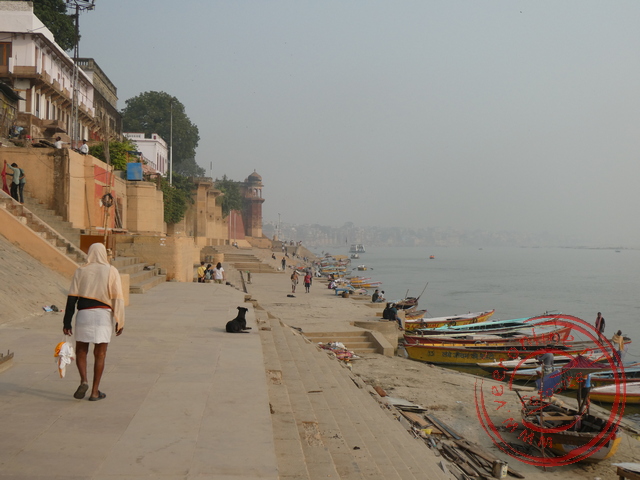 Along the banks of the Ganges are steps to reach the water
 Dozens of oil lamps burn for Diwali
 The colorfully lit station of Delhi
 Many balconies are decorated with blinking lights for Diwali
Travelogue Diwali in India
Dag 2 | India > Cremations on the Ganges
Dag 3 | India > The Sarnath Buddhist Temple
Dag 4 | India > The Amber Fort in Jaipur
Dag 5 | India > Jodhpur Mehrangarh Fort
Dag 6 | India > The Umaid Bhavan Palace
Dag 7 | India > 'Happy Diwali”
Dag 8 | India > Farewell to Delhi
Dag 9 | India > Delayed in Frankfurt