
154 countries
(and areas)
 - Belize
- Benin
- Bhutan
- Bolivia
- Bonaire
- Bosnia and Herzegovina
- Botswana
- Brazil
- British Virgin Islands
- Brunei
- Bulgaria
- Cambodia
- Canada
- Cape Verde
- Chile
- China
- Costa Rica
- Croatia
- Cuba
- Curacao
- Cyprus
- Czech Republic
- Denmark
- Dominica
- Dominican Republic
- Egypt
- El Salvador
- England
- Estonia
- Eswatini (Swaziland)
- Ethiopia
- Fiji
- Finland
- France
- French Guiana
- Georgia
- Germany
- Gibraltar
- Greece
- Grenada
- Guadeloupe
- Guatemala
- Honduras
- Hong Kong
- Hungary
- Iceland
- India
- Indonesia
- Iran
- Ireland
- Israel
- Italy
- Jamaica
- Japan
- Jordan
- Kazakhstan
- Kenya
- Kosovo
- Kuwait
- Kyrgyzstan
- Laos
- Latvia
- Lebanon
- Lesotho
- Liechtenstein
- Lithuania
- Luxembourg
- Macau
- Madagascar
- Malawi
- Malaysia
- Maldives
- Malta
- Martinique
- Mexico
- Moldova
- Monaco
- Mongolia
- Montenegro
- Morocco
- Mozambique
- Namibia
- Nepal
- Netherlands
- New Zealand
- Nicaragua
- North Macedonia
- Northern Ireland
- Norway
- Oman
- Pakistan
- Palestine
- Peru
- Philippines
- Poland
- Portugal
- Qatar
- Republic of Korea
- Romania
- Russia
- Saint Kitts and Nevis
- Saint Lucia
- Saint Martin
- Saint Vincent and the Grenadines
- San Marino
- São Tomé and Principe
- Saudi Arabia
- Scotland
- Senegal
- Serbia
- Singapore
- Sint Maarten
- Slovakia
- Slovenia
- South Africa
- Spain
- Sri Lanka
- Suriname
- Sweden
- Switzerland
- Tajikistan
- Tanzania
- Thailand
- The Gambia
- Tibet
- Togo
- Transnistria
- Trinidad and Tobago
- Tunisia
- Turkey
- Turkmenistan
- Uganda
- United Arab Emirates
- United States
- Uruguay
- Uzbekistan
- Vatican City
- Vietnam
- Wales
- Zambia
- Zanzibar
- Belize
- Benin
- Bhutan
- Bolivia
- Bonaire
- Bosnia and Herzegovina
- Botswana
- Brazil
- British Virgin Islands
- Brunei
- Bulgaria
- Cambodia
- Canada
- Cape Verde
- Chile
- China
- Costa Rica
- Croatia
- Cuba
- Curacao
- Cyprus
- Czech Republic
- Denmark
- Dominica
- Dominican Republic
- Egypt
- El Salvador
- England
- Estonia
- Eswatini (Swaziland)
- Ethiopia
- Fiji
- Finland
- France
- French Guiana
- Georgia
- Germany
- Gibraltar
- Greece
- Grenada
- Guadeloupe
- Guatemala
- Honduras
- Hong Kong
- Hungary
- Iceland
- India
- Indonesia
- Iran
- Ireland
- Israel
- Italy
- Jamaica
- Japan
- Jordan
- Kazakhstan
- Kenya
- Kosovo
- Kuwait
- Kyrgyzstan
- Laos
- Latvia
- Lebanon
- Lesotho
- Liechtenstein
- Lithuania
- Luxembourg
- Macau
- Madagascar
- Malawi
- Malaysia
- Maldives
- Malta
- Martinique
- Mexico
- Moldova
- Monaco
- Mongolia
- Montenegro
- Morocco
- Mozambique
- Namibia
- Nepal
- Netherlands
- New Zealand
- Nicaragua
- North Macedonia
- Northern Ireland
- Norway
- Oman
- Pakistan
- Palestine
- Peru
- Philippines
- Poland
- Portugal
- Qatar
- Republic of Korea
- Romania
- Russia
- Saint Kitts and Nevis
- Saint Lucia
- Saint Martin
- Saint Vincent and the Grenadines
- San Marino
- São Tomé and Principe
- Saudi Arabia
- Scotland
- Senegal
- Serbia
- Singapore
- Sint Maarten
- Slovakia
- Slovenia
- South Africa
- Spain
- Sri Lanka
- Suriname
- Sweden
- Switzerland
- Tajikistan
- Tanzania
- Thailand
- The Gambia
- Tibet
- Togo
- Transnistria
- Trinidad and Tobago
- Tunisia
- Turkey
- Turkmenistan
- Uganda
- United Arab Emirates
- United States
- Uruguay
- Uzbekistan
- Vatican City
- Vietnam
- Wales
- Zambia
- Zanzibar


Copyright 2004 - 2026
Veeronline.nl Travel Adventures

Home > India > Diwali in India > Travelogue day 3
Travelogue Diwali in India
November 614 2023 (9 days)
India > The Sarnath Buddhist Temple
Dag 3 - Wednesday, 8 November 2023When I wake up at quarter past six to the alarm, I am still full of impressions from yesterday. I also notice that my eyes sting from the heavy smog in the city. This can’t be healthy. At quarter to seven, I am picked up at the hotel. When I step outside, I don’t see the driver. I wait ten minutes and call Shiwan. The driver is a bit late, he apologizes. He’ll be there in ten minutes. By now I’m getting used to that flexible “ten minutes” and wait in the lobby. A little after seven, Promood, the driver, arrives. The streets are quiet on the way to Assi Ghat, the place where I also met the guide yesterday. Upon arrival, it turns out he has stepped away for a moment. “Go ahead and take pictures, I’ll be there in ten minutes,” he relays through the driver. It’s a bit strange that he’s always busy with other things. Yesterday, he also left a few times to make calls. The spot where there was a dance performance yesterday, near the ceremony location, is cordoned off. There are film shoots. The security guard gestures that I can quickly cross. His colleagues on the other side ask not to linger and to keep walking—probably to avoid tourists appearing on camera. Boats depart for trips on the Ganges. Many boatmen eagerly want me aboard. The ceremony site is deserted. Women clean the candle holders from last night’s ceremony under a tree. Shiwan comes walking over. He easily spots me.

Together, we walk along the Ghats, the famous steps where Hindus bathe in the Ganges. I see several people washing in the holy river. “Don’t take pictures of bathing women,” Shiwan requests. They can get angry about that. Just behind the riverbank, Shiwan takes me to a special bathing place. A deep staircase leads down to a bath connected to the river. Here, unmarried women are allowed to bathe. Nearby is the former house of Rani Lakshmibai, the queen of Jhansi. She led a rebellion in 1857 against the British rulers during the First War of Independence. She is regarded as a national heroine in India. Eventually, we arrive at the small cremation site. I visited the larger cremation site yesterday. Men are cleaning up the ashes from the cremations and push the remains into the river. Through narrow streets, we return to the taxi. I say goodbye to Shiwan. I give him a tip for his guiding, but he seems unsatisfied. “Don’t you have a little more?” he asks. I don’t respond to this. I am on time at the hotel for breakfast. The employee who told me yesterday there were more Dutch guests at the hotel comes over enthusiastically. “The Dutch are sitting at that table,” he points out. I greet them. They are of Hindustani descent and are visiting important pilgrimage sites in India. “Would you like to sit with us?” While eating my omelette, we talk about India, Nepal, Suriname, and Amsterdam. After breakfast, Pramood drives me to the last location in Varanasi. Just outside the city lies the temple of Sarnath. I take my luggage with me already. From the temple, I go directly to the airport. The temple of Sarnath is located where Buddha attained enlightenment. Here he gave his first sermon. Sarnath is one of the four important pilgrimage sites for Buddhists.

I am dropped off near the temple. I mainly see stalls and many vendors trying to sell me something. Where exactly do I need to go? First, I visit the large Buddha statue in the park. Then I cross the street. I don’t have to search; I follow the other tourists. I pass the museum and first go to the archaeological ruins of Sarnath. At the entrance, I am stopped. “Ticket?” On the wall hang QR codes to order a ticket online. This dates back to the contactless period during corona. Not very convenient for tourists without Wi-Fi. A boy points to a vendor who can order my ticket online for 300 Rupees instead of the original 250. I have little choice. The boy accompanies me to the entrance to have the ticket scanned on his phone. I’m allowed in. The Dhamekh Stupa has withstood the test of time fairly well. The second temple, the Dharmarajika Stupa, was dismantled in the 18th century by order of the then king to reuse building materials. Underneath the temple, remains of temples and monasteries from the 3rd century were discovered. Nearby lies another temple. I thought this was the Sarnath temple already, but it’s not. A man watches my shoes and awkwardly places them in a rack with a stick. Inside, the caretaker apologizes that he only has descriptions in English, German, and Spanish. The handwritten explanations look amusing. I thank him. The next temple is the Sarnath Buddhist Temple. At this place, Buddha gave his first sermon after attaining enlightenment in Bodhgaya. Next to the temple stands the sacred Bodhi tree, and nearby lies the deer park where Buddha spoke to his disciples. I decide to order a drink at a terrace and skip the museum. I have seen enough of Sarnath. Around half past twelve, I am back at the car. Pramood drives me to the airport. At the entrance of the airport building, two men approach me saying I must first check in at their kiosk. Why? They show me their badges proving they belong to the airport. I am photographed and given a note with a scan code.

With this code, I can enter the building. I can walk straight to the baggage drop-off. My luggage weighs 12.7 kg, less than the allowed maximum of 15 kilos. In the restaurant, I order coffee and something to eat. I am well on time. Patiently, I wait. I start talking with two Indians. They are brothers, and one of them lives in the United States. He is back for Diwali. During boarding, my row is among the first group to board. When food is handed out, I get a sandwich, a cookie, and something to drink. Not everyone gets this. Since my name was called, this was probably an extra booking. I don’t complain. The older gentleman next to me is also traveling to Jaipur but transfers to a plane. He is very enthusiastic about Jaipur and casually mentions he is 85 years old. When disembarking, I thank him for the information. In the arrivals hall, the baggage comes fairly quickly. Not many passengers travel with checked luggage. At the exit, I see some people holding name signs, but my name is not among them. I look further to see if there is another spot where people can be met. I come upon the taxi drivers. One of them points me back to the earlier spot. There stands Giresh now, holding a note with my name. Together we walk to the car. Giresh is a young man of about twenty-five. He loads my luggage and we set off. Although it’s only seven kilometers to the train station, Google says it will take half an hour. Right after leaving the airport, traffic stalls. The usual pushing and shoving begins. Compared to previous drivers, Giresh drives calmly. This means he’s not always first. In terms of time, it doesn’t matter. I expect to be dropped off at the station. However, Giresh walks with me. To get to the platform, he must buy a ticket. Judging by the coin, it costs five or ten cents. We sit on a bench and wait for the train. Since we are early, several other trains must pass first. About ten minutes before departure, the platform allocation appears. I stand by sign A3. When the train arrives, the allocation is wrong. My compartment is two carriages further. I quickly walk over, say goodbye to Giresh, and board the train. I take bed 25. I start a conversation with an English traveler. She has lived in India for four years. We talk about travel and her profession: writing. An Indian man on the other bed joins the conversation. This way, the journey passes quickly. Around midnight, the train approaches Jaipur. I walk with my luggage to the intermediate platform. The boy in front has already opened the door while the train is still at full speed. Just after midnight, I get off at Jaipur Railway Station. As I squeeze my luggage through the narrow doorway, I already see someone holding a handwritten note. My name is indeed on it. The driver welcomes me to Jaipur. He has a strange English accent, and I have to make an effort to understand him well. Normally, every driver snatches my bag from my hands, but he’s fine with me carrying it upstairs myself. That’s no problem either. In the dark, we drive to the hotel. Where the navigation indicates the hotel, there is no Hotel Maru Casa. We drive a few rounds around a large intersection. Asking around doesn’t help either. Suddenly, the driver sees a sign for a bar with the same name. The hotel is located on this street. The door is closed. The driver knocks, and someone comes over. I quickly check in and go to my room. It was a long day, and I go to sleep quickly.
 India
India  Chet Singhs Palace on the banks of the Ganges
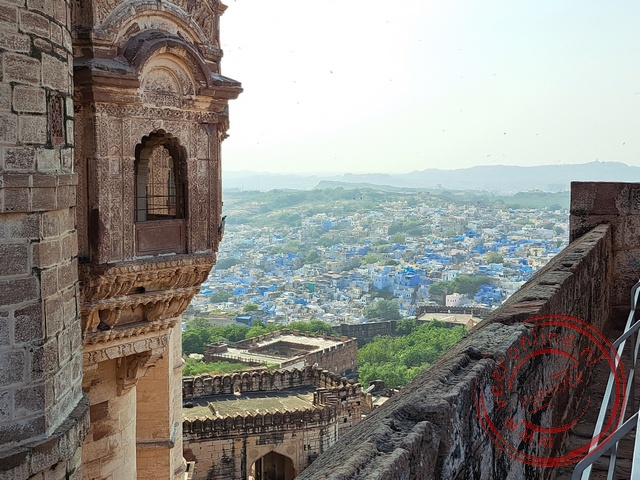 View of the blue city Jodhpur from the fort
 The ghat of the Kashi Vishwanath Temple
 The Hawa Mahal was built in 1799 by Maharaja Sawai Pratap Singh
Travelogue Diwali in India
Dag 2 | India > Cremations on the Ganges
Dag 3 | India > The Sarnath Buddhist Temple
Dag 4 | India > The Amber Fort in Jaipur
Dag 5 | India > Jodhpur Mehrangarh Fort
Dag 6 | India > The Umaid Bhavan Palace
Dag 7 | India > 'Happy Diwali”
Dag 8 | India > Farewell to Delhi
Dag 9 | India > Delayed in Frankfurt