
154 countries
(and areas)
 - Belize
- Benin
- Bhutan
- Bolivia
- Bonaire
- Bosnia and Herzegovina
- Botswana
- Brazil
- British Virgin Islands
- Brunei
- Bulgaria
- Cambodia
- Canada
- Cape Verde
- Chile
- China
- Costa Rica
- Croatia
- Cuba
- Curacao
- Cyprus
- Czech Republic
- Denmark
- Dominica
- Dominican Republic
- Egypt
- El Salvador
- England
- Estonia
- Eswatini (Swaziland)
- Ethiopia
- Fiji
- Finland
- France
- French Guiana
- Georgia
- Germany
- Gibraltar
- Greece
- Grenada
- Guadeloupe
- Guatemala
- Honduras
- Hong Kong
- Hungary
- Iceland
- India
- Indonesia
- Iran
- Ireland
- Israel
- Italy
- Jamaica
- Japan
- Jordan
- Kazakhstan
- Kenya
- Kosovo
- Kuwait
- Kyrgyzstan
- Laos
- Latvia
- Lebanon
- Lesotho
- Liechtenstein
- Lithuania
- Luxembourg
- Macau
- Madagascar
- Malawi
- Malaysia
- Maldives
- Malta
- Martinique
- Mexico
- Moldova
- Monaco
- Mongolia
- Montenegro
- Morocco
- Mozambique
- Namibia
- Nepal
- Netherlands
- New Zealand
- Nicaragua
- North Macedonia
- Northern Ireland
- Norway
- Oman
- Pakistan
- Palestine
- Peru
- Philippines
- Poland
- Portugal
- Qatar
- Republic of Korea
- Romania
- Russia
- Saint Kitts and Nevis
- Saint Lucia
- Saint Martin
- Saint Vincent and the Grenadines
- San Marino
- São Tomé and Principe
- Saudi Arabia
- Scotland
- Senegal
- Serbia
- Singapore
- Sint Maarten
- Slovakia
- Slovenia
- South Africa
- Spain
- Sri Lanka
- Suriname
- Sweden
- Switzerland
- Tajikistan
- Tanzania
- Thailand
- The Gambia
- Tibet
- Togo
- Transnistria
- Trinidad and Tobago
- Tunisia
- Turkey
- Turkmenistan
- Uganda
- United Arab Emirates
- United States
- Uruguay
- Uzbekistan
- Vatican City
- Vietnam
- Wales
- Zambia
- Zanzibar
- Belize
- Benin
- Bhutan
- Bolivia
- Bonaire
- Bosnia and Herzegovina
- Botswana
- Brazil
- British Virgin Islands
- Brunei
- Bulgaria
- Cambodia
- Canada
- Cape Verde
- Chile
- China
- Costa Rica
- Croatia
- Cuba
- Curacao
- Cyprus
- Czech Republic
- Denmark
- Dominica
- Dominican Republic
- Egypt
- El Salvador
- England
- Estonia
- Eswatini (Swaziland)
- Ethiopia
- Fiji
- Finland
- France
- French Guiana
- Georgia
- Germany
- Gibraltar
- Greece
- Grenada
- Guadeloupe
- Guatemala
- Honduras
- Hong Kong
- Hungary
- Iceland
- India
- Indonesia
- Iran
- Ireland
- Israel
- Italy
- Jamaica
- Japan
- Jordan
- Kazakhstan
- Kenya
- Kosovo
- Kuwait
- Kyrgyzstan
- Laos
- Latvia
- Lebanon
- Lesotho
- Liechtenstein
- Lithuania
- Luxembourg
- Macau
- Madagascar
- Malawi
- Malaysia
- Maldives
- Malta
- Martinique
- Mexico
- Moldova
- Monaco
- Mongolia
- Montenegro
- Morocco
- Mozambique
- Namibia
- Nepal
- Netherlands
- New Zealand
- Nicaragua
- North Macedonia
- Northern Ireland
- Norway
- Oman
- Pakistan
- Palestine
- Peru
- Philippines
- Poland
- Portugal
- Qatar
- Republic of Korea
- Romania
- Russia
- Saint Kitts and Nevis
- Saint Lucia
- Saint Martin
- Saint Vincent and the Grenadines
- San Marino
- São Tomé and Principe
- Saudi Arabia
- Scotland
- Senegal
- Serbia
- Singapore
- Sint Maarten
- Slovakia
- Slovenia
- South Africa
- Spain
- Sri Lanka
- Suriname
- Sweden
- Switzerland
- Tajikistan
- Tanzania
- Thailand
- The Gambia
- Tibet
- Togo
- Transnistria
- Trinidad and Tobago
- Tunisia
- Turkey
- Turkmenistan
- Uganda
- United Arab Emirates
- United States
- Uruguay
- Uzbekistan
- Vatican City
- Vietnam
- Wales
- Zambia
- Zanzibar


Copyright 2004 - 2026
Veeronline.nl Travel Adventures
Home > Gambia > Exploring Gambia and Senegal > Travelogue day 7
Travelogue Exploring Gambia and Senegal
August 25 September 1 2022 (8 days)
Gambia > The Stone Circles of Wassu
Dag 7 - Wednesday 31 August 2022
When I wake up during the night, it is quiet. Quiet in nature outside, but I also no longer hear any toilet sounds. This probably means the water supply has been cut off again. I turn over for a bit and decide to see about it in the morning. A little after seven, someone calls “Kebba” in the room next to me. I wake up as well. To my surprise, I hear the toilet running again. This probably means I have water again. I turn on the shower. A small trickle comes out of the showerhead. Just when I think I’ll have to wash with this today, suddenly a good cold stream comes down. I quickly step under the shower. At breakfast, Henk doesn’t feel well. He has pain near his bladder. Everything hurts. We need to see a doctor. Near the resort there is a military post. There is also a first aid station there. However, the bus cannot reach the resort. The road is too muddy. ‘Uncle’ took the ferry across the Gambia River this morning and is waiting for us where the ferry arrives. A small boat has been arranged for us. The luggage was already ferried over during breakfast. After breakfast, we get into the small boat. It barely fits the entire group. A few hundred meters further, we get back on solid ground. ‘Uncle’ has already loaded the luggage onto the bus and waves to us from the roof. The camp owner is also present. He rides his motorcycle ahead of us to the military post. Kebba and Henk get off at the first aid station. Unfortunately, bad news. The military post can’t help Henk. He has to go to a doctor in a bigger town. Kebba says he will go with Henk to the doctor. ‘Uncle’ takes the rest of the group to the Wassu stone circles. It is not better. Shortly after, Henk and Kebba get off at the ferry to cross the Gambia River to the other side. There they take a taxi. We continue via the north bank. The Wassu stone circles are probably ancient burial monuments. About two thousand years ago, the circles were erected. The pillars were dug out of the nearby rocks. Using wooden beams, the pillars were rolled to the site of the circles. At least, that’s what people think happened. There is no certainty about this, explains Jesus, our local guide. He goes on to say that in Gambia and Senegal, several sites with stone circles have been found.

In total, 93 circles have been discovered in this region. In Wassu there are 10 circles. There used to be eleven, Jesus explains, but all the pillars of one circle have been broken off. Erosion is a danger for this UNESCO World Heritage site. Covering the site would negatively affect its appearance. In the small museum, it is shown how the stones were probably transported. It’s remarkable that around the turn of the century this could already be created. Back at the bus, ‘Uncle’ has good news. Henk has seen the doctor and is on the mend. We say goodbye to the stone circles and to the large group of singing children at the entrance. We drive along the north bank to the Trans-Gambia Bridge over the Gambia River. On the other side of the river, we will meet Henk and Kebba again. Yesterday we collected some money to buy food for a family. ‘Uncle’ bought the groceries yesterday. We stop by the roadside near a cluster of houses. ‘Uncle’ goes to ask if we are welcome to visit the family. All the children in the village are already by the bus. They definitely say yes. One of the family members is studying in Banjul and is currently visiting her family. She speaks English and explains that several families live here. Each family has its own walled compound. Almost a thousand people live in the village. She also translates to the villagers that we come from the Netherlands and that we brought food. She promises to distribute the food among the families. When we ask if there are any requests from the village, two older women say they need help with the broken water pump and support for solar energy. That might be asking too much for now, but maybe future groups can help.

During the tour of the camp, the children walk along holding hands. Others happily sing along. It’s special to see how people live in the countryside. When we continue, we get enthusiastic waves goodbye. The weather can change quickly at this time of year. While we stood in the sun visiting the family, a heavy downpour broke out as we passed Farafenni. Everyone on the street quickly looked for shelter from the sudden storm. In Farafenni, we turn toward the Trans-Gambia Bridge. This toll bridge is the only fixed crossing over the Gambia River. Because of the river’s width, this is not easy to accomplish. When we drive over the bridge, rain is pouring down heavily. Because of the amount of water, we can hardly see the river. This is not good weather for our boat trip through Kiang West National Park later today. When we arrive at the gas station in Soma, the worst of the rain has passed. This was also our first stop on day one. Kebba and Henk come here as well, but they still need three quarters of an hour. In a restaurant, we order something to drink. Well, order—actually we take the drinks ourselves from the fridge. Everyone is fine with this. When Henk arrives, we quickly continue. It feels good to travel on together. Because of the delay, we arrive a bit late for lunch at Kiang West National Park. We quickly take our seats at the table. The food is a disappointment. The meat is tough, the fish is full of bones, and the fries are soggy. Maybe the food was waiting for us too. Two not-so-large boats are moored at the wooden pier.

We spread ourselves over the boats. When we cross the Gambia River to the mangrove forests on the other side, it turns out the boats are not entirely watertight. Water is bailed out along the way. The river here is several hundred meters wide. On the other side, we sail into the mangrove forests. What a beautiful environment. Some birds sit among the branches. The skipper sails too fast to take a photo here. We pass too quickly. On a tree trunk lies a monitor lizard. The animal is one meter long. When we get too close, it dives underwater. Large amounts of water plants float on the water in the wetlands. An ideal place for birds. In the distance, I see a pelican take flight. Some ibises also keep an eye on the boats. From here, we sail back to the pier. It is already five o’clock when we start the last leg for today. We drive to Sindola Safari Lodge in Kanilai. Kanilai is the birthplace of former dictator Yahya Jammeh. The Sindola resort has a swimming pool. However, the pool is only open until seven o’clock. We check in quickly. I decide not to swim. I prefer the shower. Unfortunately, only a very small trickle of water comes out of the tap. I did not expect this at this resort. I freshen up a bit at the washbasin. Because we had no electricity in the camp yesterday, I now have to charge my phone. The outlets are British. A few days ago, I forgot to bring my charger and British adapter. This means I cannot charge. Fellow travelers lend me an adapter. This gives me more confidence that my phone has enough power to serve as an alarm clock tomorrow morning.
 Senegal
  Cola is sold in a small shop
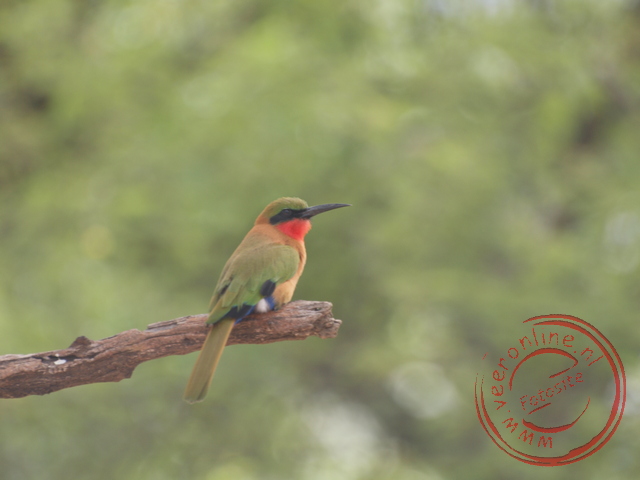 A bee eater on a branch
 Children eager to be photographed
 A boat trip on the Gambia river
Travelogue Exploring Gambia and Senegal
Dag 2 | Gambia > The Capital Banjul
Dag 3 | Senegal > The Masked Kankurang
Dag 4 | Senegal > Boat Trip on the Gambia River
Dag 5 | Senegal > Safari in Niokolo-Koba N.P.
Dag 6 | Gambia > The Jang Jang Burreh Camp
Dag 7 | Gambia > The Stone Circles of Wassu
Dag 8 | Gambia > The Brikama Craft Market