
153 countries
(and areas)
 - Azerbaijan
- Bahrain
- Barbados
- Belgium
- Belize
- Benin
- Bhutan
- Bolivia
- Bonaire
- Bosnia and Herzegovina
- Botswana
- Brazil
- British Virgin Islands
- Brunei
- Bulgaria
- Cambodia
- Canada
- Cape Verde
- Chile
- China
- Costa Rica
- Croatia
- Cuba
- Curacao
- Cyprus
- Czech Republic
- Denmark
- Dominica
- Dominican Republic
- Egypt
- El Salvador
- England
- Estonia
- Eswatini (Swaziland)
- Ethiopia
- Fiji
- Finland
- France
- French Guiana
- Georgia
- Germany
- Gibraltar
- Greece
- Grenada
- Guadeloupe
- Guatemala
- Honduras
- Hong Kong
- Hungary
- Iceland
- India
- Indonesia
- Iran
- Ireland
- Israel
- Italy
- Jamaica
- Japan
- Jordan
- Kazakhstan
- Kenya
- Kosovo
- Kuwait
- Kyrgyzstan
- Laos
- Latvia
- Lebanon
- Lesotho
- Liechtenstein
- Lithuania
- Luxembourg
- Macau
- Madagascar
- Malawi
- Malaysia
- Maldives
- Malta
- Martinique
- Mexico
- Moldova
- Monaco
- Mongolia
- Montenegro
- Morocco
- Mozambique
- Namibia
- Nepal
- Netherlands
- New Zealand
- Nicaragua
- North Macedonia
- Northern Ireland
- Norway
- Oman
- Pakistan
- Palestine
- Peru
- Philippines
- Poland
- Portugal
- Qatar
- Republic of Korea
- Romania
- Russia
- Saint Kitts and Nevis
- Saint Lucia
- Saint Martin
- Saint Vincent and the Grenadines
- San Marino
- Saudi Arabia
- Scotland
- Senegal
- Serbia
- Singapore
- Sint Maarten
- Slovakia
- Slovenia
- South Africa
- Spain
- Sri Lanka
- Suriname
- Sweden
- Switzerland
- Tajikistan
- Tanzania
- Thailand
- The Gambia
- Tibet
- Togo
- Transnistria
- Trinidad and Tobago
- Tunisia
- Turkey
- Turkmenistan
- Uganda
- United Arab Emirates
- United States
- Uruguay
- Uzbekistan
- Vatican City
- Vietnam
- Wales
- Zambia
- Zanzibar
- Azerbaijan
- Bahrain
- Barbados
- Belgium
- Belize
- Benin
- Bhutan
- Bolivia
- Bonaire
- Bosnia and Herzegovina
- Botswana
- Brazil
- British Virgin Islands
- Brunei
- Bulgaria
- Cambodia
- Canada
- Cape Verde
- Chile
- China
- Costa Rica
- Croatia
- Cuba
- Curacao
- Cyprus
- Czech Republic
- Denmark
- Dominica
- Dominican Republic
- Egypt
- El Salvador
- England
- Estonia
- Eswatini (Swaziland)
- Ethiopia
- Fiji
- Finland
- France
- French Guiana
- Georgia
- Germany
- Gibraltar
- Greece
- Grenada
- Guadeloupe
- Guatemala
- Honduras
- Hong Kong
- Hungary
- Iceland
- India
- Indonesia
- Iran
- Ireland
- Israel
- Italy
- Jamaica
- Japan
- Jordan
- Kazakhstan
- Kenya
- Kosovo
- Kuwait
- Kyrgyzstan
- Laos
- Latvia
- Lebanon
- Lesotho
- Liechtenstein
- Lithuania
- Luxembourg
- Macau
- Madagascar
- Malawi
- Malaysia
- Maldives
- Malta
- Martinique
- Mexico
- Moldova
- Monaco
- Mongolia
- Montenegro
- Morocco
- Mozambique
- Namibia
- Nepal
- Netherlands
- New Zealand
- Nicaragua
- North Macedonia
- Northern Ireland
- Norway
- Oman
- Pakistan
- Palestine
- Peru
- Philippines
- Poland
- Portugal
- Qatar
- Republic of Korea
- Romania
- Russia
- Saint Kitts and Nevis
- Saint Lucia
- Saint Martin
- Saint Vincent and the Grenadines
- San Marino
- Saudi Arabia
- Scotland
- Senegal
- Serbia
- Singapore
- Sint Maarten
- Slovakia
- Slovenia
- South Africa
- Spain
- Sri Lanka
- Suriname
- Sweden
- Switzerland
- Tajikistan
- Tanzania
- Thailand
- The Gambia
- Tibet
- Togo
- Transnistria
- Trinidad and Tobago
- Tunisia
- Turkey
- Turkmenistan
- Uganda
- United Arab Emirates
- United States
- Uruguay
- Uzbekistan
- Vatican City
- Vietnam
- Wales
- Zambia
- Zanzibar


Copyright 2004 - 2026
Veeronline.nl Travel Adventures
Home > Senegal > Exploring Gambia and Senegal > Travelogue day 3
Travelogue Exploring Gambia and Senegal
August 25 September 1 2022 (8 days)
Senegal > The Masked Kankurang
Dag 3 - Saturday 27 August 2022When I wake up, I hear noises from outside. Travel companions can no longer open their door. The lock is jammed. Staff quickly come running to help. I walk to the small bathroom. There is no electricity. In the dark room without a window, I turn on the tap. I wash myself a little under the cold stream. The camp is close to the Gambia River. I walk to the shore. Two boys reassure me that there are no crocodiles here. It’s too noisy, they explain. The hippos don’t show themselves during the day either. In the dark, they sometimes come ashore to graze. After breakfast, we drive by bus to Janjanbureh, formerly called Georgetown. This place on the island in the Gambia River played an important role in the slave trade. Slaves were collected from the hinterlands in Janjanbureh. From here, the slaves were transported to Banjul for further transport. Unfortunately, the tour through the village is only by bus. From the bus, Kebba points out the remnants of buildings where slaves were held by the English. Slavery was only abolished in 1823. Some of the freed slaves stayed on the island of Janjanbureh. We stop at the freedom tree. A slave who managed to touch the tree regained his freedom. With English soldiers present, this was practically impossible. Kebba explains that the current tree is no longer the original one from the 19th century. The tree now symbolizes the freedom of the people. Today we continue eastwards to the border with Senegal. Kebba’s idea is to cross the border before lunch. We quickly set off. Via the bridge, we leave the island in the river and continue along the main west-east road. After an hour and a half, we enter the town of Basse. Basse is the last major town before the border. In the center, lively trade is taking place.

People try to sell their goods everywhere. We walk among the market stalls. Compared to the market in Banjul, the market looks messy and chaotic. On the other hand, it is much more colorful. Especially the women wear beautiful colorful robes. Most don’t want to be photographed. They watch the cameras carefully. Trading also takes place outside the market in the shops. A cart with donkeys transports goods away. Curious children come from side streets to wave goodbye to us. I enter a small shop. The vendor sits behind the counter, shielded by chicken wire. What could he be afraid of? I pay for a pack of cookies and a can of soda. The change I get back is still barely held together. Especially the lower denominations are often dirty and worn. The money here literally smells. In Gambia, it seems that only banknotes are used in transactions. Even for the smallest amounts, there is a note available. A 5 dalasi note is worth less than 18 cents. Kebba takes his wallet and shows some coins. He laughs that these coins hardly have any value. The largest note is worth 200 dalasi, which is less than four euros. Larger amounts are paid by means of a bundle of 100 banknotes wrapped with a rubber band. Just outside Basse lies the border. First the formalities on the Gambian side. A few hundred meters further on, we reach the Senegalese customs. With two new stamps in my passport, I drive into Senegal. From the border, it is about 100 kilometers to Tambacounda, the largest city in eastern Senegal. Along the way, the streetscape looks different compared to Gambia.

We drive on a nice wide asphalt road, which even has space for cyclists and pedestrians at the edges. The houses, however, look simpler and more primitive. Here there are mud huts with thatched roofs, alternated with neatly finished concrete houses. The difference between rich and poor is clearly visible here. When entering Tamba, as the locals call Tambacounda, the hustle and bustle on the street also increases. Shops, street vendors, and traffic all mix together. Tonight we stay in a four-star hotel on the outskirts of the city. At two o’clock, we drive through the gate. Lunch is already ready for us. The hotel rooms are beautifully situated around the pool. It’s wonderful to use it right away. While we are in the water with most of the travel group, dark clouds gather above us. We haven’t had any rain today. It doesn’t last long. Thick drops fall into the pool water. At the end of the afternoon, a travel companion and I take a walk through the outskirts of Tambacounda. The hotel is on a busy main road. Heavy trucks roar by. Next to the road lies the old railway line to Mali. We cross the tracks and walk past the mosque. Puddles lie on the sandy streets. A group of children play soccer, while others amuse themselves with an old tire. With a piece of plastic, they push the tire forward without it tipping over. They stop briefly to say hello. In Senegal, they do this in French. Soon after follows the request for money or a gift. We don’t do this. In Gambia, children begged much less. We look for somewhere to have a drink. Among the simple houses, this is not an easy task. In a small shop of barely four by four meters, they sell chilled soft drinks.

With a can of cola in hand, we continue our way. When we want to turn right to walk back to our hotel, we hear drum sounds from the other side. A large group of children runs through the streets. We follow them. Suddenly, they turn around and run past us. We witness the ‘Kankurang masquerade,’ a ritual of the Mandinka tribe, in which the Kankurang is dressed in leaves, bark, and tree fibers. The Kankurang performs a threatening dance. During this ritual, boys are made men. I see a Kankurang dressed in red and one in brown tree fibers. The children run away when the masked man steps toward them. Someone explicitly asks us not to take video or photos. We respect this. The procession arrives at a house. This ceremony is probably in honor of a circumcision, but it is not entirely clear to us. We walk back to the hotel. For the evening, a meal is served in the restaurant. An omelet as a starter. For dinner, green beans, fries, and fish with a curry sauce. Together with a local Gazelle beer, the meal tastes great. When I want to put my phone on the charger, I notice I don’t have the charger with me. The charger is still plugged into the socket in the previous accommodation. Sigh. Fortunately, I have an extra cable with me.
 The Gambia
  The transfer place from bus to boat looks a bit messy
 We drink a beer in a local restaurant
 Senegal
  Cooling off in the pool in Tambacounda
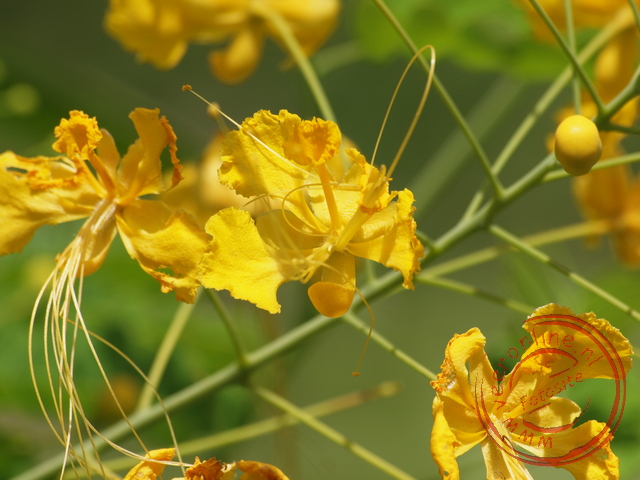 The Peacock flower in NiokoloKoba NP
Travelogue Exploring Gambia and Senegal
Dag 2 | Gambia > The Capital Banjul
Dag 3 | Senegal > The Masked Kankurang
Dag 4 | Senegal > Boat Trip on the Gambia River
Dag 5 | Senegal > Safari in Niokolo-Koba N.P.
Dag 6 | Gambia > The Jang Jang Burreh Camp
Dag 7 | Gambia > The Stone Circles of Wassu
Dag 8 | Gambia > The Brikama Craft Market