
154 countries
(and areas)
 - Belize
- Benin
- Bhutan
- Bolivia
- Bonaire
- Bosnia and Herzegovina
- Botswana
- Brazil
- British Virgin Islands
- Brunei
- Bulgaria
- Cambodia
- Canada
- Cape Verde
- Chile
- China
- Costa Rica
- Croatia
- Cuba
- Curacao
- Cyprus
- Czech Republic
- Denmark
- Dominica
- Dominican Republic
- Egypt
- El Salvador
- England
- Estonia
- Eswatini (Swaziland)
- Ethiopia
- Fiji
- Finland
- France
- French Guiana
- Georgia
- Germany
- Gibraltar
- Greece
- Grenada
- Guadeloupe
- Guatemala
- Honduras
- Hong Kong
- Hungary
- Iceland
- India
- Indonesia
- Iran
- Ireland
- Israel
- Italy
- Jamaica
- Japan
- Jordan
- Kazakhstan
- Kenya
- Kosovo
- Kuwait
- Kyrgyzstan
- Laos
- Latvia
- Lebanon
- Lesotho
- Liechtenstein
- Lithuania
- Luxembourg
- Macau
- Madagascar
- Malawi
- Malaysia
- Maldives
- Malta
- Martinique
- Mexico
- Moldova
- Monaco
- Mongolia
- Montenegro
- Morocco
- Mozambique
- Namibia
- Nepal
- Netherlands
- New Zealand
- Nicaragua
- North Macedonia
- Northern Ireland
- Norway
- Oman
- Pakistan
- Palestine
- Peru
- Philippines
- Poland
- Portugal
- Qatar
- Republic of Korea
- Romania
- Russia
- Saint Kitts and Nevis
- Saint Lucia
- Saint Martin
- Saint Vincent and the Grenadines
- San Marino
- São Tomé and Principe
- Saudi Arabia
- Scotland
- Senegal
- Serbia
- Singapore
- Sint Maarten
- Slovakia
- Slovenia
- South Africa
- Spain
- Sri Lanka
- Suriname
- Sweden
- Switzerland
- Tajikistan
- Tanzania
- Thailand
- The Gambia
- Tibet
- Togo
- Transnistria
- Trinidad and Tobago
- Tunisia
- Turkey
- Turkmenistan
- Uganda
- United Arab Emirates
- United States
- Uruguay
- Uzbekistan
- Vatican City
- Vietnam
- Wales
- Zambia
- Zanzibar
- Belize
- Benin
- Bhutan
- Bolivia
- Bonaire
- Bosnia and Herzegovina
- Botswana
- Brazil
- British Virgin Islands
- Brunei
- Bulgaria
- Cambodia
- Canada
- Cape Verde
- Chile
- China
- Costa Rica
- Croatia
- Cuba
- Curacao
- Cyprus
- Czech Republic
- Denmark
- Dominica
- Dominican Republic
- Egypt
- El Salvador
- England
- Estonia
- Eswatini (Swaziland)
- Ethiopia
- Fiji
- Finland
- France
- French Guiana
- Georgia
- Germany
- Gibraltar
- Greece
- Grenada
- Guadeloupe
- Guatemala
- Honduras
- Hong Kong
- Hungary
- Iceland
- India
- Indonesia
- Iran
- Ireland
- Israel
- Italy
- Jamaica
- Japan
- Jordan
- Kazakhstan
- Kenya
- Kosovo
- Kuwait
- Kyrgyzstan
- Laos
- Latvia
- Lebanon
- Lesotho
- Liechtenstein
- Lithuania
- Luxembourg
- Macau
- Madagascar
- Malawi
- Malaysia
- Maldives
- Malta
- Martinique
- Mexico
- Moldova
- Monaco
- Mongolia
- Montenegro
- Morocco
- Mozambique
- Namibia
- Nepal
- Netherlands
- New Zealand
- Nicaragua
- North Macedonia
- Northern Ireland
- Norway
- Oman
- Pakistan
- Palestine
- Peru
- Philippines
- Poland
- Portugal
- Qatar
- Republic of Korea
- Romania
- Russia
- Saint Kitts and Nevis
- Saint Lucia
- Saint Martin
- Saint Vincent and the Grenadines
- San Marino
- São Tomé and Principe
- Saudi Arabia
- Scotland
- Senegal
- Serbia
- Singapore
- Sint Maarten
- Slovakia
- Slovenia
- South Africa
- Spain
- Sri Lanka
- Suriname
- Sweden
- Switzerland
- Tajikistan
- Tanzania
- Thailand
- The Gambia
- Tibet
- Togo
- Transnistria
- Trinidad and Tobago
- Tunisia
- Turkey
- Turkmenistan
- Uganda
- United Arab Emirates
- United States
- Uruguay
- Uzbekistan
- Vatican City
- Vietnam
- Wales
- Zambia
- Zanzibar


Copyright 2004 - 2026
Veeronline.nl Travel Adventures
Home > Gambia > Exploring Gambia and Senegal > Travelogue day 6
Travelogue Exploring Gambia and Senegal
August 25 September 1 2022 (8 days)
Gambia > The Jang Jang Burreh Camp
Dag 6 - Tuesday 30 August 2022I wake up again to the sounds of nature. After breakfast, the luggage is loaded back onto the roof of the bus. The plastic is carefully stretched over the suitcases. ‘Uncle’ ties everything tightly with a rope. We leave the Wassadou Camp via the bumpy access road. Today we return to Gambia. For this, we must drive back the same way we came. In just over two hours, we drive via Tambacounda to the border with Gambia. Along the way, children continuously wave at us—from their bicycles or from simple wooden huts. Life along the route appears poorer in Senegal than in Gambia. Many people sit or lie in front of their huts. At the border, the customs ritual follows. Kebba collects all passports and takes them to the Senegalese customs. They stamp the passports. We don’t even have to get off the bus. Also, there is no check whether everyone handed in their passport. They probably trust Kebba. At the Gambia customs, we do have to get off the bus. The customs officer takes the pile of passports and calls out our names one by one. After a few passports, the officer seems satisfied. It remains quiet for a moment, then he comes out with all the stamped passports. We no longer have to visit him separately. We continue our route in Gambia. So far, the sky has looked threatening with clouds, but apart from a few small drops, it has stayed dry. In Gambia, we see dark clouds hanging in a half-circle in front of us. We are driving straight toward them. At Bansang, on the Gambia River, ‘Uncle’ stops at a landing pier. It looks chaotic. People are busy everywhere. Trucks are being unloaded and loaded. The concrete pier itself is broken. Probably a vehicle that was too heavy once drove onto the pier. Just before the pier, the luggage is unloaded and transferred to a waiting boat. The luggage is placed on the foredeck. The plastic is carefully stretched over the luggage. Meanwhile, I take a seat on the lower deck. With the boat, we sail to our camp for tonight, the Jang Jang Burreh Camp near Janjanbureh. The camp lies on the north bank of the Gambia River, directly opposite our camp from three days ago. There is no electricity at the camp. How primitive will it be? On board, lunch is served: chicken, rice, pasta, and sauce. Drinks are kept cold in a cooler. Along the shore, little birds seek shelter as the boat passes. The river water appears very high. Nowhere are sandbanks where crocodiles or hippos can rest. I don’t expect to spot them anymore during this trip. We do see some birds of prey in the treetops. Behind the white birds, the sky quickly darkens. It doesn’t take long before it starts raining.

The wind blows the drops through the open boat. For the first time during this holiday, I put on my raincoat. The camp comes into view. The skipper docks the boat at the somewhat rickety pier. It seems as if a boat once hit it too hard. Along the shore lies a half-sunken and decayed boat—probably the predecessor of our boat. Just as we go ashore, the rain really lets loose and a strong wind rises. We take shelter under the camp’s awning. Meanwhile, the luggage is unloaded. The carriers are soaked through. We are offered coffee and tea while the rain pounds on the roof. The monkeys watch curiously from the trees. One of them rummages through the boat looking for food. With a bag of sugar, one climbs back into the trees. The Jang Jang Burreh Camp consists of round huts. The path to it is slippery and slick. I almost slip several times but luckily keep my balance. The huts are assigned in order. I am last and unlucky. The newer huts are full. I get an older hut. The door hangs crooked. Maybe I don’t have a nice round hut, but it’s a good place to sleep. The water doesn’t work. The owner fiddles with the pipe outside the hut and the water flows again. I patch the holes in the mosquito net with tape. The net has seen better days—I count more than ten holes. The bed is a concrete basin in a half-round shape.

The mattress was later made to fit the bed’s shape. By lying across the oval bed, I can sleep well tonight. When I return to the river, it is dry. I order a beer. As it slowly gets dark, I play a card game with fellow travelers. We play until the cards are no longer readable in the twilight. Candles appear on the table. Empty cups are placed around the candles to prevent them from blowing out. Some ladies from the village perform a traditional dance. At the last song, we are all invited to join in dancing. When I go back to my hut at night, the water is again unavailable. The owner comes to fix it. This helps, but also causes new problems. The toilet in my hut keeps running. I hesitate under my mosquito net whether I want to get out of bed to fix it. Unfortunately, the valve at the toilet is stuck. The leaking water runs under the toilet to the shower drain. What a mess. I crawl back into bed. With the sounds from outside and the toilet, I fall asleep.
 Senegal
 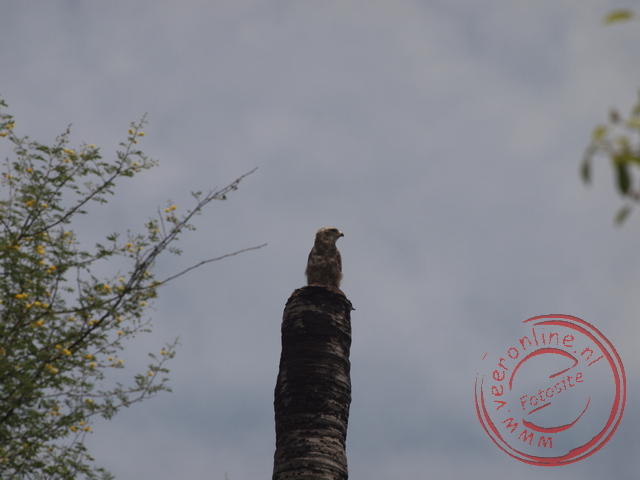 A bird keeps watch from a tree trunk
 Crocodiles are not visible due to the high river water
 A boat trip on the Gambia river
 Various birds sit among the trees
Travelogue Exploring Gambia and Senegal
Dag 2 | Gambia > The Capital Banjul
Dag 3 | Senegal > The Masked Kankurang
Dag 4 | Senegal > Boat Trip on the Gambia River
Dag 5 | Senegal > Safari in Niokolo-Koba N.P.
Dag 6 | Gambia > The Jang Jang Burreh Camp
Dag 7 | Gambia > The Stone Circles of Wassu
Dag 8 | Gambia > The Brikama Craft Market