
154 countries
(and areas)
 - Belize
- Benin
- Bhutan
- Bolivia
- Bonaire
- Bosnia and Herzegovina
- Botswana
- Brazil
- British Virgin Islands
- Brunei
- Bulgaria
- Cambodia
- Canada
- Cape Verde
- Chile
- China
- Costa Rica
- Croatia
- Cuba
- Curacao
- Cyprus
- Czech Republic
- Denmark
- Dominica
- Dominican Republic
- Egypt
- El Salvador
- England
- Estonia
- Eswatini (Swaziland)
- Ethiopia
- Fiji
- Finland
- France
- French Guiana
- Georgia
- Germany
- Gibraltar
- Greece
- Grenada
- Guadeloupe
- Guatemala
- Honduras
- Hong Kong
- Hungary
- Iceland
- India
- Indonesia
- Iran
- Ireland
- Israel
- Italy
- Jamaica
- Japan
- Jordan
- Kazakhstan
- Kenya
- Kosovo
- Kuwait
- Kyrgyzstan
- Laos
- Latvia
- Lebanon
- Lesotho
- Liechtenstein
- Lithuania
- Luxembourg
- Macau
- Madagascar
- Malawi
- Malaysia
- Maldives
- Malta
- Martinique
- Mexico
- Moldova
- Monaco
- Mongolia
- Montenegro
- Morocco
- Mozambique
- Namibia
- Nepal
- Netherlands
- New Zealand
- Nicaragua
- North Macedonia
- Northern Ireland
- Norway
- Oman
- Pakistan
- Palestine
- Peru
- Philippines
- Poland
- Portugal
- Qatar
- Republic of Korea
- Romania
- Russia
- Saint Kitts and Nevis
- Saint Lucia
- Saint Martin
- Saint Vincent and the Grenadines
- San Marino
- São Tomé and Principe
- Saudi Arabia
- Scotland
- Senegal
- Serbia
- Singapore
- Sint Maarten
- Slovakia
- Slovenia
- South Africa
- Spain
- Sri Lanka
- Suriname
- Sweden
- Switzerland
- Tajikistan
- Tanzania
- Thailand
- The Gambia
- Tibet
- Togo
- Transnistria
- Trinidad and Tobago
- Tunisia
- Turkey
- Turkmenistan
- Uganda
- United Arab Emirates
- United States
- Uruguay
- Uzbekistan
- Vatican City
- Vietnam
- Wales
- Zambia
- Zanzibar
- Belize
- Benin
- Bhutan
- Bolivia
- Bonaire
- Bosnia and Herzegovina
- Botswana
- Brazil
- British Virgin Islands
- Brunei
- Bulgaria
- Cambodia
- Canada
- Cape Verde
- Chile
- China
- Costa Rica
- Croatia
- Cuba
- Curacao
- Cyprus
- Czech Republic
- Denmark
- Dominica
- Dominican Republic
- Egypt
- El Salvador
- England
- Estonia
- Eswatini (Swaziland)
- Ethiopia
- Fiji
- Finland
- France
- French Guiana
- Georgia
- Germany
- Gibraltar
- Greece
- Grenada
- Guadeloupe
- Guatemala
- Honduras
- Hong Kong
- Hungary
- Iceland
- India
- Indonesia
- Iran
- Ireland
- Israel
- Italy
- Jamaica
- Japan
- Jordan
- Kazakhstan
- Kenya
- Kosovo
- Kuwait
- Kyrgyzstan
- Laos
- Latvia
- Lebanon
- Lesotho
- Liechtenstein
- Lithuania
- Luxembourg
- Macau
- Madagascar
- Malawi
- Malaysia
- Maldives
- Malta
- Martinique
- Mexico
- Moldova
- Monaco
- Mongolia
- Montenegro
- Morocco
- Mozambique
- Namibia
- Nepal
- Netherlands
- New Zealand
- Nicaragua
- North Macedonia
- Northern Ireland
- Norway
- Oman
- Pakistan
- Palestine
- Peru
- Philippines
- Poland
- Portugal
- Qatar
- Republic of Korea
- Romania
- Russia
- Saint Kitts and Nevis
- Saint Lucia
- Saint Martin
- Saint Vincent and the Grenadines
- San Marino
- São Tomé and Principe
- Saudi Arabia
- Scotland
- Senegal
- Serbia
- Singapore
- Sint Maarten
- Slovakia
- Slovenia
- South Africa
- Spain
- Sri Lanka
- Suriname
- Sweden
- Switzerland
- Tajikistan
- Tanzania
- Thailand
- The Gambia
- Tibet
- Togo
- Transnistria
- Trinidad and Tobago
- Tunisia
- Turkey
- Turkmenistan
- Uganda
- United Arab Emirates
- United States
- Uruguay
- Uzbekistan
- Vatican City
- Vietnam
- Wales
- Zambia
- Zanzibar


Copyright 2004 - 2026
Veeronline.nl Travel Adventures
Home > Gambia > Exploring Gambia and Senegal > Travelogue day 2
Travelogue Exploring Gambia and Senegal
August 25 September 1 2022 (8 days)
Gambia > The Capital Banjul
Dag 2 - Friday 26 August 2022When I wake up, I hear the rain pounding on the roof. It’s a heavy shower. At this time of year, such showers occur regularly — short and intense. When I booked, I hadn’t paid attention to the rainy season in Gambia. When I walk to breakfast, the weather is dry again. I carefully avoid the puddles. The breakfast buffet is ready in the restaurant. I order an omelet with cheese. The boy behind the buffet enthusiastically gets to work. Before we leave, I want to take a photo of the pool and the garden, but I notice there is no memory card in my camera. Forgotten in the hectic preparation. So far, I have only taken photos with my phone. What now? I didn’t bring any spare cards either, which I normally do. I take the card from my GoPro. From the Senegambia Beach Hotel, we first drive to Banjul. Banjul is the capital of Gambia and is located on a peninsula on the south bank of the Gambia River. Together with the largest city, Serekunda, it forms the main economic area of Gambia. Trade happens everywhere along the roadside—in stalls, shops, or sometimes just on a mat on the ground. Traffic moves along in a long line. We enter Banjul via Arch 22. This commemorative arch was built in 1996 on the orders of dictator Yahya Jammeh. He came to power in a coup in 1994. I climb the 160 steps of Arch 22. From the top floor, I have a nice view over the city and the harbor. I also see dark clouds hanging over the center. It doesn’t take long before a new shower breaks loose. On the top floor of the Arch, there is a small exhibition about dictator Yahya Jammeh and victims of his regime. The good and bad aspects of his 22-year rule are presented. Behind Arch 22 is a large covered grandstand where parades are held.

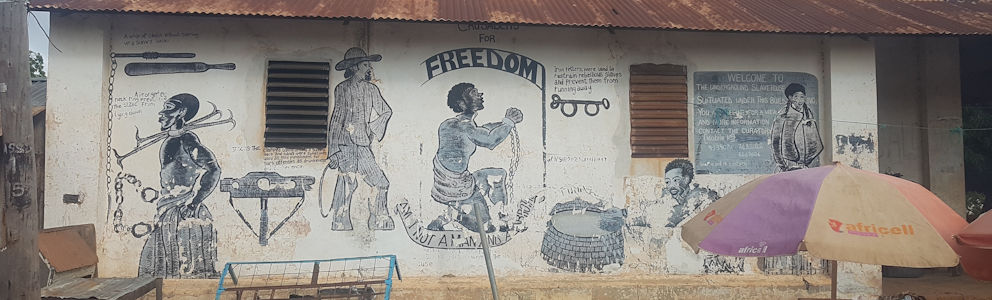
A little further along Independence Drive lies the historic museum of Gambia. Three rooms show various collections—from slavery to African musical instruments. Nice to take a look at. Albert Market is where locals buy their food. Small streets with stalls form a maze. Many vendors want to know where I’m from or if I want to buy something—from slippers, fruit to fish. The fish here was probably caught this morning. Tucked away among the market stalls is the Banjul Craft Market. Wood carvings and other souvenirs. There’s hardly a chance to browse. The vendors come straight over and show their products. The streetscape of Banjul is best described as “cozy chaotic.” Cars, carts, and pedestrians all mingle. Due to recent rain, large puddles lie on mostly unpaved roads. Just outside Banjul, we stop at an oyster stall. Oysters grow in the mangrove wetlands and can be gathered at low tide. At the stall, large amounts of shells lie drying along the roadside. Our last stop in this area is a batik workshop. On a courtyard, cloths are made in various natural colors. By applying wax, parts of the cloth are protected from dye. After several layers with different colors, a cloth is finished. Some hang on the clothesline to dry. It seems a labor-intensive process to make one cloth. Normally, we would drive to Janjanbureh via the north side of the Gambia River, but because the ferry at Banjul is under maintenance, this is currently not possible. We have to detour via the south side. This route takes about one and a half hours longer. Also, we cannot visit the Wassu stone circles now; we will visit them later in the week. For lunch, we stop at a beach restaurant in Serekunda. On the menu is Domoda, a traditional dish with rice, chicken, and peanut sauce. Very tasty. During lunch, we look out over the beach and sea. What starts as nice and sunny weather suddenly turns into a heavy rain shower. We are already getting used to the short, heavy showers. From Banjul to the island of Janjanbureh over the south bank is a three-hundred-kilometer drive. The driver is Kebba’s uncle. “Uncle” has been driving for thirty years, Kebba proudly says. Today it’s more than five hours driving for Uncle. Along the way, we pass lively villages. Children wave enthusiastically to the bus. Most houses are made of concrete with corrugated iron roofs. I hardly see any wooden huts with thatched roofs like those I know from other African countries. Cows and goats roam the streets. There are strikingly many police and military checkpoints along the way. It seems every village has its own checkpoint. At every post, gates block the road. “Uncle” weaves his way through them. Almost everywhere we can drive through immediately. We make a short stop at a gas station, which also has a toilet. At the end of the afternoon, we arrive at Baobolong Camp in Janjanbureh. It was a long bus trip. On the original route, lunch and the visit to the stone circles would have split the trip.

Today, the luggage lay on the roof of the bus. A large plastic tarp is supposed to protect the luggage from the rain. My bag feels a little wet on the outside. Hopefully, the clothes are dry. The room at Baobolong Camp is simple. On either side of the door is a concrete box with a mattress on top as a bed. Above the beds hangs a mosquito net. In the small bathroom, the showerhead hangs right above the toilet. Funny. The door is warped from the moisture. When I walk to the restaurant in the evening, little frogs jump away everywhere. I walk carefully so as not to step on any critters.
 Senegal
  A boat trip on the Gambia river
 Various birds sit among the trees
 A colorful kingfisher among the branches
 An iguana sunning itself on a tree trunk
Travelogue Exploring Gambia and Senegal
Dag 2 | Gambia > The Capital Banjul
Dag 3 | Senegal > The Masked Kankurang
Dag 4 | Senegal > Boat Trip on the Gambia River
Dag 5 | Senegal > Safari in Niokolo-Koba N.P.
Dag 6 | Gambia > The Jang Jang Burreh Camp
Dag 7 | Gambia > The Stone Circles of Wassu
Dag 8 | Gambia > The Brikama Craft Market