
154 countries
(and areas)
 - Belize
- Benin
- Bhutan
- Bolivia
- Bonaire
- Bosnia and Herzegovina
- Botswana
- Brazil
- British Virgin Islands
- Brunei
- Bulgaria
- Cambodia
- Canada
- Cape Verde
- Chile
- China
- Costa Rica
- Croatia
- Cuba
- Curacao
- Cyprus
- Czech Republic
- Denmark
- Dominica
- Dominican Republic
- Egypt
- El Salvador
- England
- Estonia
- Eswatini (Swaziland)
- Ethiopia
- Fiji
- Finland
- France
- French Guiana
- Georgia
- Germany
- Gibraltar
- Greece
- Grenada
- Guadeloupe
- Guatemala
- Honduras
- Hong Kong
- Hungary
- Iceland
- India
- Indonesia
- Iran
- Ireland
- Israel
- Italy
- Jamaica
- Japan
- Jordan
- Kazakhstan
- Kenya
- Kosovo
- Kuwait
- Kyrgyzstan
- Laos
- Latvia
- Lebanon
- Lesotho
- Liechtenstein
- Lithuania
- Luxembourg
- Macau
- Madagascar
- Malawi
- Malaysia
- Maldives
- Malta
- Martinique
- Mexico
- Moldova
- Monaco
- Mongolia
- Montenegro
- Morocco
- Mozambique
- Namibia
- Nepal
- Netherlands
- New Zealand
- Nicaragua
- North Macedonia
- Northern Ireland
- Norway
- Oman
- Pakistan
- Palestine
- Peru
- Philippines
- Poland
- Portugal
- Qatar
- Republic of Korea
- Romania
- Russia
- Saint Kitts and Nevis
- Saint Lucia
- Saint Martin
- Saint Vincent and the Grenadines
- San Marino
- São Tomé and Principe
- Saudi Arabia
- Scotland
- Senegal
- Serbia
- Singapore
- Sint Maarten
- Slovakia
- Slovenia
- South Africa
- Spain
- Sri Lanka
- Suriname
- Sweden
- Switzerland
- Tajikistan
- Tanzania
- Thailand
- The Gambia
- Tibet
- Togo
- Transnistria
- Trinidad and Tobago
- Tunisia
- Turkey
- Turkmenistan
- Uganda
- United Arab Emirates
- United States
- Uruguay
- Uzbekistan
- Vatican City
- Vietnam
- Wales
- Zambia
- Zanzibar
- Belize
- Benin
- Bhutan
- Bolivia
- Bonaire
- Bosnia and Herzegovina
- Botswana
- Brazil
- British Virgin Islands
- Brunei
- Bulgaria
- Cambodia
- Canada
- Cape Verde
- Chile
- China
- Costa Rica
- Croatia
- Cuba
- Curacao
- Cyprus
- Czech Republic
- Denmark
- Dominica
- Dominican Republic
- Egypt
- El Salvador
- England
- Estonia
- Eswatini (Swaziland)
- Ethiopia
- Fiji
- Finland
- France
- French Guiana
- Georgia
- Germany
- Gibraltar
- Greece
- Grenada
- Guadeloupe
- Guatemala
- Honduras
- Hong Kong
- Hungary
- Iceland
- India
- Indonesia
- Iran
- Ireland
- Israel
- Italy
- Jamaica
- Japan
- Jordan
- Kazakhstan
- Kenya
- Kosovo
- Kuwait
- Kyrgyzstan
- Laos
- Latvia
- Lebanon
- Lesotho
- Liechtenstein
- Lithuania
- Luxembourg
- Macau
- Madagascar
- Malawi
- Malaysia
- Maldives
- Malta
- Martinique
- Mexico
- Moldova
- Monaco
- Mongolia
- Montenegro
- Morocco
- Mozambique
- Namibia
- Nepal
- Netherlands
- New Zealand
- Nicaragua
- North Macedonia
- Northern Ireland
- Norway
- Oman
- Pakistan
- Palestine
- Peru
- Philippines
- Poland
- Portugal
- Qatar
- Republic of Korea
- Romania
- Russia
- Saint Kitts and Nevis
- Saint Lucia
- Saint Martin
- Saint Vincent and the Grenadines
- San Marino
- São Tomé and Principe
- Saudi Arabia
- Scotland
- Senegal
- Serbia
- Singapore
- Sint Maarten
- Slovakia
- Slovenia
- South Africa
- Spain
- Sri Lanka
- Suriname
- Sweden
- Switzerland
- Tajikistan
- Tanzania
- Thailand
- The Gambia
- Tibet
- Togo
- Transnistria
- Trinidad and Tobago
- Tunisia
- Turkey
- Turkmenistan
- Uganda
- United Arab Emirates
- United States
- Uruguay
- Uzbekistan
- Vatican City
- Vietnam
- Wales
- Zambia
- Zanzibar


Copyright 2004 - 2026
Veeronline.nl Travel Adventures
Home > Israel > Israel the Holy Land > Travelogue day 7
Travelogue Israel the Holy Land
April 310 2014 (8 days)
Israel > Annunciation Church of Nazareth
Dag 7 - Wednesday, April 9, 2014I begin the day in Nazareth. Jesus spent his youth in Nazareth. I get off at the Basilica of the Annunciation. Here, the angel Gabriel told Mary that she would bear a son. The fairly modern church has two levels. The lower church is dedicated to the grotto where Mary lived. The remains of the grotto form a central point in the church. I enter and am struck by the tranquility radiating from the building. I descend a small staircase and walk past Mary’s grotto. When I take the broad spiral staircase up to the upper church, I am even more impressed. I enter a tall, spaciously designed church. Sunlight shines through the beautiful stained-glass windows. In the middle, directly above the grotto, is an octagonal opening to the lower church. On the walls hang artworks donated by different countries. The Netherlands donated the side doors. Outside, I take some time for myself. I wander upward through the souq. I pass many small stalls offering all sorts of goods. Vendors try to sell me everything. On the other side of the market, I arrive at St. Joseph’s Church. This is the place where Joseph’s carpentry workshop once stood. A broad wall separates the street from the church grounds. It is not immediately clear how I can get in. A man stepping out of a small door notices me hesitating. When I gesture that I want to visit the church, he opens the door and lets me in. Inside the courtyard, I see that the actual entrance lies all the way down at the Annunciation Church I had visited earlier. I thank the man and continue to St. Joseph’s Church. In the crypt, the remains of the past are still visible. I see several old rooms and a deep well. Compared to the previous church, this one has a rather simple interior. I round off my walk through Bethlehem with a stroll past the shops on the street.

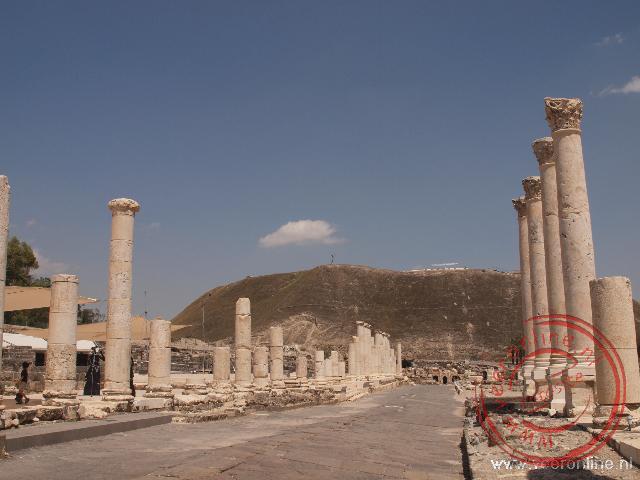
Afterward, I continue by bus toward the Dead Sea. It becomes clear that I am descending again to 400 meters below sea level. Just before reaching the Dead Sea, I arrive at Beit She’an. Beit She’an is an ancient city dating back to the Early Bronze Age. As I approach, I see a large site of excavations at the foot of a tel (hill). This must once have been an important city. I walk past the bathhouses. As in Masada, I see the construction of the underfloor heating system. By letting warm air circulate beneath the floors, they were heated. Along Beit She’an’s broad main streets stand rows of columns. These are the cardo streets, designed in Roman style. The city was heavily damaged by a powerful earthquake in 749 AD. Fortunately, parts have been restored authentically. I finish my tour of Beit She’an with the Roman theater. In the past, the theater seated 7,000 spectators. Today, only the first tier has been restored. From there, I truly realize how impressive it must once have been. A performance here must have been an unforgettable experience. At a small restaurant outside the site, I order a falafel sandwich for lunch. Being 400 meters below sea level, I also notice how hot it is. Luckily, a warm breeze brings some relief. In the afternoon, I follow the Jordan River southwards. The landscape is barren and dry. The green glow of vegetation soon disappears as well. The dry season has begun, and no rain will fall until October. Meanwhile, the sun grows only more intense. The terrain proves ideal for palm plantations. For kilometers along the road, date palms stretch out. These provide the date harvest. Here they also attempt to grow bananas.
To protect the plants from pests and the harsh sun, the trees are covered with cloths, creating long tent-like structures lining the route. As we approach Jericho, Viraz takes a turn into the city’s northern district. From a viewpoint, I see the Monastery of the Temptation built into the mountainside. A cable car has been installed specifically for this monastery. I do not go up, but continue instead to Kibbutz Almog, just past Jericho. The entrance gate is heavily guarded. Around it stands a double row of fences reinforced with barbed wire. This kibbutz is an Israeli enclave in Palestinian territory, which gives it a rather strange atmosphere. In the late afternoon, I take a walk around the kibbutz. About 200 people live here in bungalow-like homes. As I stroll across the grounds, it reminds me somewhat of a village of container houses. The original idea of a kibbutz—running the community collectively—has faded. Now everyone has their own house and garden. Few keep their gardens tidy; belongings are scattered everywhere, creating a somewhat messy impression. I had imagined a kibbutz quite differently. In the evening, I dine in the communal hall. In the past, all residents would eat here together, but nowadays they eat in their own homes. This allows the hall to be used for guests. The tour leader still worries about her tip. As we approached Almog, she reminded us again on the bus. The local agent suggested three euros per person per day. When added up, this comes to an extra tip of a thousand euros for a single week. That seems highly excessive. During dinner, several travel companions are asked to hand over their tips. The voluntary aspect feels somewhat undermined this way. I retreat with a few fellow travelers to the balcony of my cottage. Together we share a glass of wine and look back on a beautiful journey.
 Israel


 Palestine
Travelogue Israel the Holy Land
Dag 2 | Israel > View over Jerusalem
Dag 3 | Israel > The lowest point on earth
Dag 4 | Israel > The Church of the Nativity in Bethlehem
Dag 5 | Israel > The Roman city of Caesarea
Dag 6 | Israel > Holy places at Lake Galilee
Dag 7 | Israel > Annunciation Church of Nazareth
Dag 8 | Israel > Farewell to Israel