
154 countries
(and areas)
 - Belize
- Benin
- Bhutan
- Bolivia
- Bonaire
- Bosnia and Herzegovina
- Botswana
- Brazil
- British Virgin Islands
- Brunei
- Bulgaria
- Cambodia
- Canada
- Cape Verde
- Chile
- China
- Costa Rica
- Croatia
- Cuba
- Curacao
- Cyprus
- Czech Republic
- Denmark
- Dominica
- Dominican Republic
- Egypt
- El Salvador
- England
- Estonia
- Eswatini (Swaziland)
- Ethiopia
- Fiji
- Finland
- France
- French Guiana
- Georgia
- Germany
- Gibraltar
- Greece
- Grenada
- Guadeloupe
- Guatemala
- Honduras
- Hong Kong
- Hungary
- Iceland
- India
- Indonesia
- Iran
- Ireland
- Israel
- Italy
- Jamaica
- Japan
- Jordan
- Kazakhstan
- Kenya
- Kosovo
- Kuwait
- Kyrgyzstan
- Laos
- Latvia
- Lebanon
- Lesotho
- Liechtenstein
- Lithuania
- Luxembourg
- Macau
- Madagascar
- Malawi
- Malaysia
- Maldives
- Malta
- Martinique
- Mexico
- Moldova
- Monaco
- Mongolia
- Montenegro
- Morocco
- Mozambique
- Namibia
- Nepal
- Netherlands
- New Zealand
- Nicaragua
- North Macedonia
- Northern Ireland
- Norway
- Oman
- Pakistan
- Palestine
- Peru
- Philippines
- Poland
- Portugal
- Qatar
- Republic of Korea
- Romania
- Russia
- Saint Kitts and Nevis
- Saint Lucia
- Saint Martin
- Saint Vincent and the Grenadines
- San Marino
- São Tomé and Principe
- Saudi Arabia
- Scotland
- Senegal
- Serbia
- Singapore
- Sint Maarten
- Slovakia
- Slovenia
- South Africa
- Spain
- Sri Lanka
- Suriname
- Sweden
- Switzerland
- Tajikistan
- Tanzania
- Thailand
- The Gambia
- Tibet
- Togo
- Transnistria
- Trinidad and Tobago
- Tunisia
- Turkey
- Turkmenistan
- Uganda
- United Arab Emirates
- United States
- Uruguay
- Uzbekistan
- Vatican City
- Vietnam
- Wales
- Zambia
- Zanzibar
- Belize
- Benin
- Bhutan
- Bolivia
- Bonaire
- Bosnia and Herzegovina
- Botswana
- Brazil
- British Virgin Islands
- Brunei
- Bulgaria
- Cambodia
- Canada
- Cape Verde
- Chile
- China
- Costa Rica
- Croatia
- Cuba
- Curacao
- Cyprus
- Czech Republic
- Denmark
- Dominica
- Dominican Republic
- Egypt
- El Salvador
- England
- Estonia
- Eswatini (Swaziland)
- Ethiopia
- Fiji
- Finland
- France
- French Guiana
- Georgia
- Germany
- Gibraltar
- Greece
- Grenada
- Guadeloupe
- Guatemala
- Honduras
- Hong Kong
- Hungary
- Iceland
- India
- Indonesia
- Iran
- Ireland
- Israel
- Italy
- Jamaica
- Japan
- Jordan
- Kazakhstan
- Kenya
- Kosovo
- Kuwait
- Kyrgyzstan
- Laos
- Latvia
- Lebanon
- Lesotho
- Liechtenstein
- Lithuania
- Luxembourg
- Macau
- Madagascar
- Malawi
- Malaysia
- Maldives
- Malta
- Martinique
- Mexico
- Moldova
- Monaco
- Mongolia
- Montenegro
- Morocco
- Mozambique
- Namibia
- Nepal
- Netherlands
- New Zealand
- Nicaragua
- North Macedonia
- Northern Ireland
- Norway
- Oman
- Pakistan
- Palestine
- Peru
- Philippines
- Poland
- Portugal
- Qatar
- Republic of Korea
- Romania
- Russia
- Saint Kitts and Nevis
- Saint Lucia
- Saint Martin
- Saint Vincent and the Grenadines
- San Marino
- São Tomé and Principe
- Saudi Arabia
- Scotland
- Senegal
- Serbia
- Singapore
- Sint Maarten
- Slovakia
- Slovenia
- South Africa
- Spain
- Sri Lanka
- Suriname
- Sweden
- Switzerland
- Tajikistan
- Tanzania
- Thailand
- The Gambia
- Tibet
- Togo
- Transnistria
- Trinidad and Tobago
- Tunisia
- Turkey
- Turkmenistan
- Uganda
- United Arab Emirates
- United States
- Uruguay
- Uzbekistan
- Vatican City
- Vietnam
- Wales
- Zambia
- Zanzibar


Copyright 2004 - 2026
Veeronline.nl Travel Adventures
Home > Israel > Israel the Holy Land > Travelogue day 2
Travelogue Israel the Holy Land
April 310 2014 (8 days)
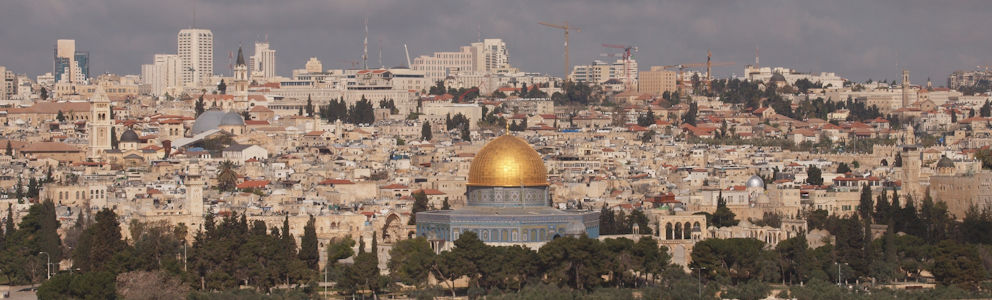
Israel > View over Jerusalem
Dag 2 - Friday, April 4, 2014Viraz is already waiting with the bus in front of the hotel. He drives me back to Jerusalem. Along the way, we pick up Dafne, who had to rush because of the morning traffic. Out of breath, she begins her story about the city. The first stop is the Mount of Olives. From here, I have a stunning view over Jerusalem on the other side of the Kidron Valley. I see the characteristic golden dome of the Dome of the Rock, an Islamic shrine. From the viewpoint, Dafne points out the Temple Mount, the Church of the Holy Sepulchre, and Mount Zion, where Jesus held the Last Supper. I walk down through the olive trees. On the slope lies an extensive Jewish cemetery. According to the Bible, God will resurrect the dead from the Mount of Olives at the end of time, so many Israelis have chosen to be buried on this slope. It is estimated that 150,000 graves are here. Nowadays, only prominent Jews can be buried here. As I pass by, a funeral of Orthodox Jews is taking place. In their distinctive black garments, they carry a loved one to the final resting place. On the slope, I visit the Dominus Flevit Church and the Russian Orthodox Church of Mary Magdalene with its golden domes. The charm is somewhat diminished by the huge number of tour groups all following the same route. Sometimes it is a struggle to catch a glimpse of the view.

It is, after all, high season. In a procession of tourists, I arrive at the Garden of Gethsemane, a garden with olive trees adjacent to the Church of All Nations. This church stands on the site where Jesus was arrested after being betrayed by Judas. The mosaic façade is particularly impressive. By bus, I drive around the city to Mount Zion. I visit the Abbey of the Dormition. This modern-looking church was built in 1910 by German Benedictines. According to tradition, Mary ended her earthly life at this location. The crypt beneath the church is dedicated to her and adorned with numerous beautiful mosaics. Next to the church is the site of the Last Supper. A church now stands on this spot, filled with tourists. Various guides compete to out-explain one another, which is a shame at such a remarkable location. I step outside and enter the old city of Jerusalem through the Eastern Gate. I walk through the narrow streets of the Jewish Quarter. An ancient mosaic depicts what the city must have looked like in the past. During Roman times, the city had two main roads. Trade was conducted along the pillars of these covered Cardo streets. Today, restored sections of the Cardo mainly house tourist shops. I wander through the old narrow streets and see a few Orthodox Jews walking unflinchingly through the streets.

What must they think of all the tourists? They seem immune to it. In a hurried pace, they pass by without looking up. At a currency exchange, I swap euros for shekels, as I had run out of local money. Dafne finds it difficult to keep track of the group in the narrow streets. Time and again, she counts the group to make sure everyone is present. For safety, she gave everyone a card with her phone number, advising: “Just go into a shop and ask them to call me if you lose the group.” With the whole group together, I arrive at a lunch restaurant. On the rooftop terrace, I order a shawarma sandwich. After lunch, I continue through Jerusalem to the Church of the Holy Sepulchre. The impressive church stands on the site where Jesus was crucified at Golgotha. The nearby tomb, where Jesus was buried and rose after three days, is now part of the church. At the cross, you can touch the stone where it stood. I have to bend down to crawl through a small opening and reach through a round hole to touch the stone. The stone where Jesus was embalmed is also a true pilgrimage site, and I see several pilgrims kissing it. A long line of visitors waits to enter the tomb where Jesus was buried. Entry is slow, and it takes too much time to stand in line, so I leave the church. From the Church of the Holy Sepulchre, I follow the Via Dolorosa—the path of Jesus carrying the cross—in the opposite direction.

Walking through the narrow streets, I encounter a procession of people preceded by clergy, broadcasting prayers through a sound system. At the end of the Via Dolorosa, I reach the Western Wall, located on the west side of the Temple Mount. Here, Jews lament the destruction of their temple. Orthodox Jews still consider this the holiest site. Upon entering, I am given a kippah, as men are required to cover their heads. Approaching the wall, I see Orthodox Jews praying devoutly. I walk into Wilson’s Arch, an old covered space on the north side of the wall, where people are also praying.

It is a special experience and a memorable conclusion to my visit to Jerusalem. By late afternoon, Viraz drives me back to my hotel in Bethlehem. After dinner, a surprise awaits: at ten o’clock in the evening, the hotel manager comes to my room, asking if I want to change rooms tomorrow. It turns out I am currently staying in a section of a different hotel. I am absolutely not pleased but seem to have little choice. It is inconvenient that the tour guide is still in Jerusalem. There is nothing to do but pack my suitcase again in the morning.
 Palestine
  Sunlight streaming into the Church of the Nativity in Bethlehem
 Israel
  Two young pelicans being fed with their mothers blood in the Upper Room
 The Via Dolorosa is the route Jesus walked carrying his cross to the hill of Golgotha
 The ruins of Capernaum where Jesus lived on the Sea of Galilee
Travelogue Israel the Holy Land
Dag 2 | Israel > View over Jerusalem
Dag 3 | Israel > The lowest point on earth
Dag 4 | Israel > The Church of the Nativity in Bethlehem
Dag 5 | Israel > The Roman city of Caesarea
Dag 6 | Israel > Holy places at Lake Galilee
Dag 7 | Israel > Annunciation Church of Nazareth
Dag 8 | Israel > Farewell to Israel