
154 countries
(and areas)
 - Belize
- Benin
- Bhutan
- Bolivia
- Bonaire
- Bosnia and Herzegovina
- Botswana
- Brazil
- British Virgin Islands
- Brunei
- Bulgaria
- Cambodia
- Canada
- Cape Verde
- Chile
- China
- Costa Rica
- Croatia
- Cuba
- Curacao
- Cyprus
- Czech Republic
- Denmark
- Dominica
- Dominican Republic
- Egypt
- El Salvador
- England
- Estonia
- Eswatini (Swaziland)
- Ethiopia
- Fiji
- Finland
- France
- French Guiana
- Georgia
- Germany
- Gibraltar
- Greece
- Grenada
- Guadeloupe
- Guatemala
- Honduras
- Hong Kong
- Hungary
- Iceland
- India
- Indonesia
- Iran
- Ireland
- Israel
- Italy
- Jamaica
- Japan
- Jordan
- Kazakhstan
- Kenya
- Kosovo
- Kuwait
- Kyrgyzstan
- Laos
- Latvia
- Lebanon
- Lesotho
- Liechtenstein
- Lithuania
- Luxembourg
- Macau
- Madagascar
- Malawi
- Malaysia
- Maldives
- Malta
- Martinique
- Mexico
- Moldova
- Monaco
- Mongolia
- Montenegro
- Morocco
- Mozambique
- Namibia
- Nepal
- Netherlands
- New Zealand
- Nicaragua
- North Macedonia
- Northern Ireland
- Norway
- Oman
- Pakistan
- Palestine
- Peru
- Philippines
- Poland
- Portugal
- Qatar
- Republic of Korea
- Romania
- Russia
- Saint Kitts and Nevis
- Saint Lucia
- Saint Martin
- Saint Vincent and the Grenadines
- San Marino
- São Tomé and Principe
- Saudi Arabia
- Scotland
- Senegal
- Serbia
- Singapore
- Sint Maarten
- Slovakia
- Slovenia
- South Africa
- Spain
- Sri Lanka
- Suriname
- Sweden
- Switzerland
- Tajikistan
- Tanzania
- Thailand
- The Gambia
- Tibet
- Togo
- Transnistria
- Trinidad and Tobago
- Tunisia
- Turkey
- Turkmenistan
- Uganda
- United Arab Emirates
- United States
- Uruguay
- Uzbekistan
- Vatican City
- Vietnam
- Wales
- Zambia
- Zanzibar
- Belize
- Benin
- Bhutan
- Bolivia
- Bonaire
- Bosnia and Herzegovina
- Botswana
- Brazil
- British Virgin Islands
- Brunei
- Bulgaria
- Cambodia
- Canada
- Cape Verde
- Chile
- China
- Costa Rica
- Croatia
- Cuba
- Curacao
- Cyprus
- Czech Republic
- Denmark
- Dominica
- Dominican Republic
- Egypt
- El Salvador
- England
- Estonia
- Eswatini (Swaziland)
- Ethiopia
- Fiji
- Finland
- France
- French Guiana
- Georgia
- Germany
- Gibraltar
- Greece
- Grenada
- Guadeloupe
- Guatemala
- Honduras
- Hong Kong
- Hungary
- Iceland
- India
- Indonesia
- Iran
- Ireland
- Israel
- Italy
- Jamaica
- Japan
- Jordan
- Kazakhstan
- Kenya
- Kosovo
- Kuwait
- Kyrgyzstan
- Laos
- Latvia
- Lebanon
- Lesotho
- Liechtenstein
- Lithuania
- Luxembourg
- Macau
- Madagascar
- Malawi
- Malaysia
- Maldives
- Malta
- Martinique
- Mexico
- Moldova
- Monaco
- Mongolia
- Montenegro
- Morocco
- Mozambique
- Namibia
- Nepal
- Netherlands
- New Zealand
- Nicaragua
- North Macedonia
- Northern Ireland
- Norway
- Oman
- Pakistan
- Palestine
- Peru
- Philippines
- Poland
- Portugal
- Qatar
- Republic of Korea
- Romania
- Russia
- Saint Kitts and Nevis
- Saint Lucia
- Saint Martin
- Saint Vincent and the Grenadines
- San Marino
- São Tomé and Principe
- Saudi Arabia
- Scotland
- Senegal
- Serbia
- Singapore
- Sint Maarten
- Slovakia
- Slovenia
- South Africa
- Spain
- Sri Lanka
- Suriname
- Sweden
- Switzerland
- Tajikistan
- Tanzania
- Thailand
- The Gambia
- Tibet
- Togo
- Transnistria
- Trinidad and Tobago
- Tunisia
- Turkey
- Turkmenistan
- Uganda
- United Arab Emirates
- United States
- Uruguay
- Uzbekistan
- Vatican City
- Vietnam
- Wales
- Zambia
- Zanzibar


Copyright 2004 - 2026
Veeronline.nl Travel Adventures

Home > Spain > Roundtrip Andalusia > Travelogue day 6
Travelogue Roundtrip Andalusia
March 14 - 25, 2026 (12 days)
Spain > The Cathedral of Seville
Dag 6 - Thursday, March 19, 2026It takes a long time for the elevator to arrive on the seventh floor. Many guests are probably heading down to breakfast. Some fellow travellers decide to take the stairs to the breakfast buffet on the second floor. Just as I consider doing the same, the lift finally arrives. The breakfast room is busy, with several tour groups gathered there. In the bustle of people, I manage to put together my breakfast. It takes some getting used to after the excellent breakfasts of the past few days. Even after breakfast, the wait for the lift is again an issue. There are so many people that not everyone fits in one ride, so I decide to take the stairs up instead. At nine o’clock, we travel by bus to the centre of Seville and get off at Plaza de Armas. From there, we walk into María Luisa Park. The park was originally part of the San Telmo Palace but was later donated to the city of Seville. In the park, there are several pavilions from the 1929 Ibero-American Exposition. On the other side of the park, we arrive at Plaza de España, the impressive pavilion built for the 1929 Seville Expo. I walk under the arcades and view the square from the first-floor balcony. In the Murillo Gardens, we meet Chiel, a Dutchman who lives in Seville. He will guide us through the Santa Cruz district and the cathedral. First, he tells us about the statue of Columbus in the Murillo Gardens. According to Chiel, DNA evidence suggests that Columbus is buried in the Cathedral of Seville.

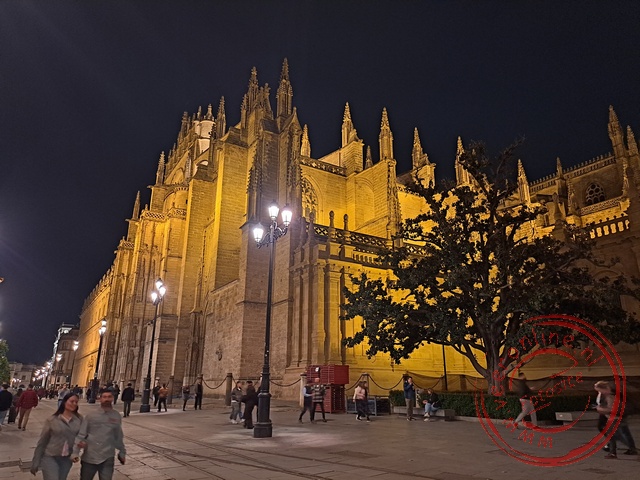
The Dominican Republic claims the same, and there are also stories that only his knee and a few bones are buried in Spain, while the rest of his remains are in Santo Domingo. As Chiel speaks, we follow him through the winding streets of the Santa Cruz district, which was once the Jewish quarter. During the Inquisition in 1492, Jews were forced to convert, leave, or were killed. At that time, around 5,000 Jews lived in this area; today there are fewer than 150. Before visiting the cathedral, we have time for coffee. The waiter is very busy, and we just manage to order, drink, and pay within half an hour. The Cathedral of Seville is the largest Gothic cathedral in the world. Construction began in the 15th century on the site of a former mosque, parts of which remain, including the iconic bell tower, the Giralda.

This tower originally served as a minaret and now offers a beautiful view over the city. Inside, I am struck by the sheer size and height of the building. The enormous main altar is richly decorated in gold and tells biblical stories in detailed reliefs. In the cathedral, we also see the tomb of explorer Columbus. Around one o’clock, we say goodbye to Chiel. With a few fellow travellers, I climb the Giralda tower. The ramp spirals gently upward instead of stairs, as it was once designed so that a caretaker could ride up on a donkey to ring the bells. The tower is crowded, with a constant flow of visitors going up and down, but at the top there is plenty of space to enjoy the magnificent view. Unfortunately, we were unable to get tickets for the Royal Alcázar, so instead we visit Casa de Pilatos. This palace is considered the finest 16th-century palace in the city after the Alcázar. On the way, we pass a small restaurant with a table outside and decide to stop for lunch first. I order Tuna Tataki without really knowing what to expect.
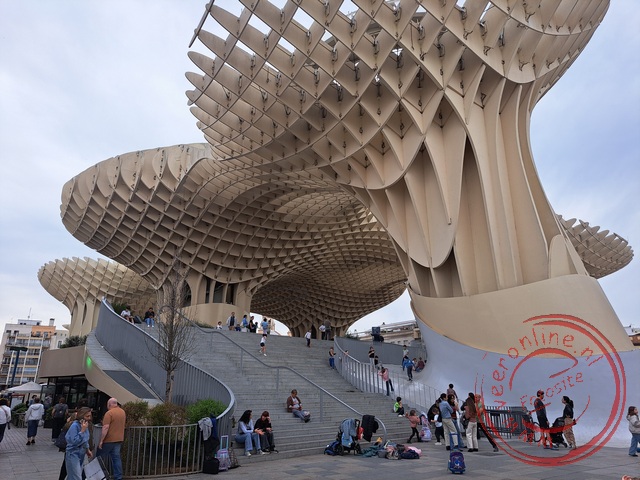
The marinated tuna tastes good, but the portion is small, so I also order a chicken and apple salad. Casa de Pilatos was built in the 16th century by the noble Enríquez de Ribera family and served as a residence for the Spanish aristocracy. Inside, the central patio immediately stands out, surrounded by elegant arches, marble columns, and colourful azulejo tiles. A short walk away is the Iglesia del Salvador. The cathedral ticket also grants entry to this church. Inside, it is richly decorated in Baroque style with abundant gold—overwhelming in its richness. In the crypt below, you can see that the church was built over the remains of a mosque. By five o’clock, we leave the church and walk to Plaza de la Encarnación, where the Setas de Sevilla—huge wooden mushroom-like structures—stand. We sit on a terrace for a drink while watching children play around the structures. At the beginning of the evening, we walk back towards the cathedral. In a side street, we find a pleasant restaurant with outdoor seating. I order the Plato del Día: cheese croquettes as a starter, tuna steak as a main course, and cake for dessert. Around nine o’clock, we take the metro back to the hotel.
 Spain
Spain 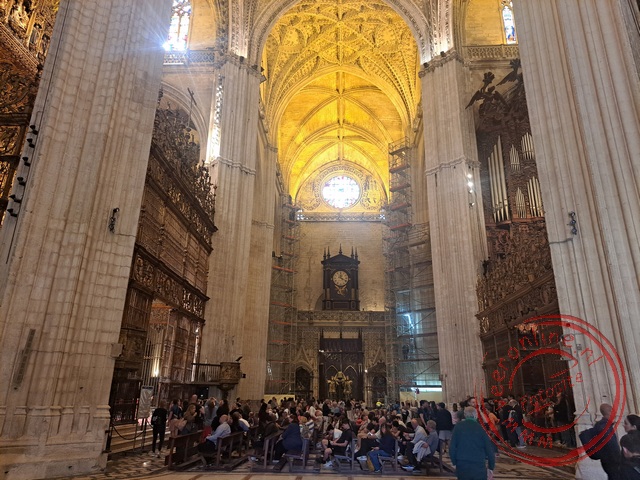 Inside the cathedral of Seville
 The IglesiaConvento San Gregorio on Plaza San Gregorio
 The beautiful reflections in the Moorish Alhambra palace
 The cathedral of beda is unfortunately closed
Travelogue Roundtrip Andalusia
Dag 2 | Spain > Historic bridge of Ronda
Dag 3 | Spain > The old city of Cádiz
Dag 4 | Gibraltar > The microstate of Gibraltar
Dag 5 | Spain > Arcos de la Frontera
Dag 6 | Spain > The Cathedral of Seville
Dag 7 | Spain > Cycling tour through Seville
Dag 8 | Spain > The Mezquita of Córdoba
Dag 9 | Spain > Baeza and Úbeda
Dag 10 | Spain > The Alhambra of Granada
Dag 11 | Spain > Cave dwellings of Granada
Dag 12 | Spain > A day in Málaga