
154 countries
(and areas)
 - Belize
- Benin
- Bhutan
- Bolivia
- Bonaire
- Bosnia and Herzegovina
- Botswana
- Brazil
- British Virgin Islands
- Brunei
- Bulgaria
- Cambodia
- Canada
- Cape Verde
- Chile
- China
- Costa Rica
- Croatia
- Cuba
- Curacao
- Cyprus
- Czech Republic
- Denmark
- Dominica
- Dominican Republic
- Egypt
- El Salvador
- England
- Estonia
- Eswatini (Swaziland)
- Ethiopia
- Fiji
- Finland
- France
- French Guiana
- Georgia
- Germany
- Gibraltar
- Greece
- Grenada
- Guadeloupe
- Guatemala
- Honduras
- Hong Kong
- Hungary
- Iceland
- India
- Indonesia
- Iran
- Ireland
- Israel
- Italy
- Jamaica
- Japan
- Jordan
- Kazakhstan
- Kenya
- Kosovo
- Kuwait
- Kyrgyzstan
- Laos
- Latvia
- Lebanon
- Lesotho
- Liechtenstein
- Lithuania
- Luxembourg
- Macau
- Madagascar
- Malawi
- Malaysia
- Maldives
- Malta
- Martinique
- Mexico
- Moldova
- Monaco
- Mongolia
- Montenegro
- Morocco
- Mozambique
- Namibia
- Nepal
- Netherlands
- New Zealand
- Nicaragua
- North Macedonia
- Northern Ireland
- Norway
- Oman
- Pakistan
- Palestine
- Peru
- Philippines
- Poland
- Portugal
- Qatar
- Republic of Korea
- Romania
- Russia
- Saint Kitts and Nevis
- Saint Lucia
- Saint Martin
- Saint Vincent and the Grenadines
- San Marino
- São Tomé and Principe
- Saudi Arabia
- Scotland
- Senegal
- Serbia
- Singapore
- Sint Maarten
- Slovakia
- Slovenia
- South Africa
- Spain
- Sri Lanka
- Suriname
- Sweden
- Switzerland
- Tajikistan
- Tanzania
- Thailand
- The Gambia
- Tibet
- Togo
- Transnistria
- Trinidad and Tobago
- Tunisia
- Turkey
- Turkmenistan
- Uganda
- United Arab Emirates
- United States
- Uruguay
- Uzbekistan
- Vatican City
- Vietnam
- Wales
- Zambia
- Zanzibar
- Belize
- Benin
- Bhutan
- Bolivia
- Bonaire
- Bosnia and Herzegovina
- Botswana
- Brazil
- British Virgin Islands
- Brunei
- Bulgaria
- Cambodia
- Canada
- Cape Verde
- Chile
- China
- Costa Rica
- Croatia
- Cuba
- Curacao
- Cyprus
- Czech Republic
- Denmark
- Dominica
- Dominican Republic
- Egypt
- El Salvador
- England
- Estonia
- Eswatini (Swaziland)
- Ethiopia
- Fiji
- Finland
- France
- French Guiana
- Georgia
- Germany
- Gibraltar
- Greece
- Grenada
- Guadeloupe
- Guatemala
- Honduras
- Hong Kong
- Hungary
- Iceland
- India
- Indonesia
- Iran
- Ireland
- Israel
- Italy
- Jamaica
- Japan
- Jordan
- Kazakhstan
- Kenya
- Kosovo
- Kuwait
- Kyrgyzstan
- Laos
- Latvia
- Lebanon
- Lesotho
- Liechtenstein
- Lithuania
- Luxembourg
- Macau
- Madagascar
- Malawi
- Malaysia
- Maldives
- Malta
- Martinique
- Mexico
- Moldova
- Monaco
- Mongolia
- Montenegro
- Morocco
- Mozambique
- Namibia
- Nepal
- Netherlands
- New Zealand
- Nicaragua
- North Macedonia
- Northern Ireland
- Norway
- Oman
- Pakistan
- Palestine
- Peru
- Philippines
- Poland
- Portugal
- Qatar
- Republic of Korea
- Romania
- Russia
- Saint Kitts and Nevis
- Saint Lucia
- Saint Martin
- Saint Vincent and the Grenadines
- San Marino
- São Tomé and Principe
- Saudi Arabia
- Scotland
- Senegal
- Serbia
- Singapore
- Sint Maarten
- Slovakia
- Slovenia
- South Africa
- Spain
- Sri Lanka
- Suriname
- Sweden
- Switzerland
- Tajikistan
- Tanzania
- Thailand
- The Gambia
- Tibet
- Togo
- Transnistria
- Trinidad and Tobago
- Tunisia
- Turkey
- Turkmenistan
- Uganda
- United Arab Emirates
- United States
- Uruguay
- Uzbekistan
- Vatican City
- Vietnam
- Wales
- Zambia
- Zanzibar


Copyright 2004 - 2026
Veeronline.nl Travel Adventures

Home > Saudi Arabia > Fascinating Saudi Arabia > Travelogue day 12
Travelogue Fascinating Saudi Arabia
October 823 2022 (16 days)
Saudi Arabia > The Rijal Almaa Open-Air Museum
Dag 12 - Wednesday 19 October 2022It is clearly noticeable that Abha is situated at an altitude of 2,200 meters. At night, it is cooler than other locations in Saudi Arabia. For the first time during the trip, the duvet comes in handy. The shower is a bit alarming. Right next to the shower is an electrical outlet. Carefully, I turn off the stream of water near the outlet. Who would come up with something like that? We have breakfast in the apartment. This is not so easy. In the kitchen there is only one small pan, barely large enough for two eggs. The electric cooker has two burners, but one is always on. When we finish, we just unplug it. The kettle, which worked yesterday, no longer functions. Still, we manage to prepare a simple breakfast. We start the day at the market. When we arrive, there are hardly any people, and the stalls are closed. The market turns out to be held on Tuesdays. We are a day too late. The Muftaha village is an artists’ village that should be near the market. The houses are built in the traditional style of the Asir mountains. We cannot find it. We ask around, but no luck. At the regional museum, which is still under construction, we ask again.
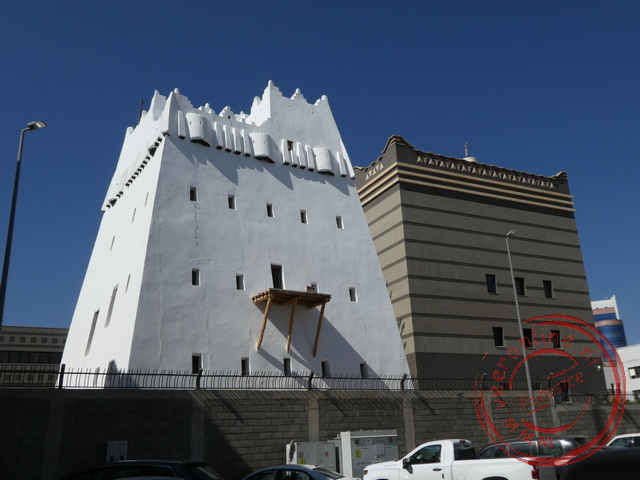
It is behind the market but under renovation. The nearby historic Shada Palace is also being renovated, says the man helping us. The Saudi government is doing everything to attract more tourists in the future, and large-scale maintenance is part of that. The origin of the former royal palace dates back to 1820. From the outside, we see the white palace made of mud. It is a fine example of traditional South Arabian architecture. The palace has remarkably few and small windows, which supposedly protects privacy. The palace was used, among others, by King Abdul Aziz, the founder of Saudi Arabia. Just outside Abha’s center lies the Al Nasb district. Here are still a few houses built according to the traditional method using mud and stone. Most historic houses are empty, causing them to quickly deteriorate. We also visit the Abu Bakr Mosque in this district. On the outskirts of the city lies the Dabab Walkway. From the boulevard, we have a view of the deep valley. Behind it, we see the peaks of the Asir mountains. When we stop at a viewpoint along the road a bit further on, monkeys immediately approach our car.

A large group of baboons lives here on the rocks. A male baboon is already sitting on our hood, looking around expectantly for something edible. Signs clearly request not to feed the animals. The group of monkeys moves across the parking lot. At every car, they try again. At a pickup truck, the baboons already examine the cargo bed before the vehicle even stops. We continue driving. At Alogl, we take the exit toward Rijal Almaa. Large signs warn of sharp bends and prohibit trucks. This is for good reason. Over sixteen kilometers, the road descends steeply. Sharp hairpin bends cling to the mountainside. At the bottom of the mountain in the valley, we arrive in Rijal Almaa. This village, originating in the eighth century, lies against a mountainside. It served as a resting place for travelers from Yemen heading to Mecca and Medina. Today, about sixty traditional houses form an open-air museum. Via steps, we walk between the brown mud houses. The old building style in the valley differs greatly from traditional construction methods in Abha. Some houses are open for viewing. Inside, the houses are colorfully decorated. Artifacts from the past are also exhibited. Daylight comes in through the small white windows. Around the museum’s main entrance, all houses are restored. Further back, we encounter dilapidated houses. Sometimes only the walls remain standing. Doors hang crooked in the frames.

These houses will likely be renovated soon. At the intersection a bit back, there is a small eatery. The Indian owner opens the pans to show us the food. We choose two dishes and some bread. From Rijal Almaa, we drive back up the mountain pass. Monkeys seem to be everywhere now. There are hundreds. When we stop briefly, the group immediately runs toward the car. We stay inside just to be safe. Back at the top, we choose not the route to Abha but the other direction. Here lie some villages with traditional houses. In Al Sharma, we walk among mostly abandoned historic homes. In Al Aft, the neighboring village, we visit two houses. In Al Tabab lies the Historical Center. The museum is fenced off. We can’t imagine many tourists come here. We walk around the building to take a photo from the other side. When we climb up again through an open gate, we find ourselves in the museum’s courtyard. This is surely not allowed. We pass the closed gate and return to the car. At the end of the afternoon, we return to Abha. We drive past the market once more. A few stalls are open, but it is not busy. Next to the market is a small terrace. We order tea. A woman is baking bread in the oven. We follow the example of local visitors and order bread with a kind of vegetable sauce. The fresh bread just out of the oven tastes delicious. On the way back to the hotel, we buy some food for breakfast the next morning. In the evening, we eat at a Yemeni restaurant mentioned in the Lonely Planet. The Yemeni cuisine is more varied than the Saudi. Saudi cuisine mainly consists of rice with chicken. This time, we choose three dishes just by looking at the pictures. There is no English. This results in a surprising but tasty combination. Unlike yesterday, we now sit on a mat without partitions and right by the window in the brightly lit restaurant.
 Saudi Arabia
  A keffiyeh the distinctive redchecked Arab headscarf
 Beach purchases can be made from the car
 The beach south of Jeddah
 Together in a photo with the hospitable Saudis
Travelogue Fascinating Saudi Arabia
Dag 2 | Saudi Arabia > The Skybridge in Riyadh
Dag 3 | Saudi Arabia > Offroad to 'the Edge'
Dag 4 | Saudi Arabia > The Mud City of Ushaiger
Dag 5 | Saudi Arabia > The Forts of Ha'il
Dag 6 | Saudi Arabia > The Stonehenge of Saudi Arabia
Dag 7 | Saudi Arabia > The Castle of Tabuk
Dag 8 | Saudi Arabia > Overnight in Wadi Al Disah
Dag 9 | Saudi Arabia > The Historic Old Town of Al'Ula
Dag 10 | Saudi Arabia > The Tombs of Madain Saleh
Dag 11 | Saudi Arabia > The Flight to Abha
Dag 12 | Saudi Arabia > The Rijal Almaa Open-Air Museum
Dag 13 | Saudi Arabia > We Got Hit ...
Dag 14 | Saudi Arabia > The Flight to Jeddah
Dag 15 | Saudi Arabia > The Old Centre of Jeddah
Dag 16 | Saudi Arabia > Back to the Netherlands