
154 countries
(and areas)
 - Belize
- Benin
- Bhutan
- Bolivia
- Bonaire
- Bosnia and Herzegovina
- Botswana
- Brazil
- British Virgin Islands
- Brunei
- Bulgaria
- Cambodia
- Canada
- Cape Verde
- Chile
- China
- Costa Rica
- Croatia
- Cuba
- Curacao
- Cyprus
- Czech Republic
- Denmark
- Dominica
- Dominican Republic
- Egypt
- El Salvador
- England
- Estonia
- Eswatini (Swaziland)
- Ethiopia
- Fiji
- Finland
- France
- French Guiana
- Georgia
- Germany
- Gibraltar
- Greece
- Grenada
- Guadeloupe
- Guatemala
- Honduras
- Hong Kong
- Hungary
- Iceland
- India
- Indonesia
- Iran
- Ireland
- Israel
- Italy
- Jamaica
- Japan
- Jordan
- Kazakhstan
- Kenya
- Kosovo
- Kuwait
- Kyrgyzstan
- Laos
- Latvia
- Lebanon
- Lesotho
- Liechtenstein
- Lithuania
- Luxembourg
- Macau
- Madagascar
- Malawi
- Malaysia
- Maldives
- Malta
- Martinique
- Mexico
- Moldova
- Monaco
- Mongolia
- Montenegro
- Morocco
- Mozambique
- Namibia
- Nepal
- Netherlands
- New Zealand
- Nicaragua
- North Macedonia
- Northern Ireland
- Norway
- Oman
- Pakistan
- Palestine
- Peru
- Philippines
- Poland
- Portugal
- Qatar
- Republic of Korea
- Romania
- Russia
- Saint Kitts and Nevis
- Saint Lucia
- Saint Martin
- Saint Vincent and the Grenadines
- San Marino
- São Tomé and Principe
- Saudi Arabia
- Scotland
- Senegal
- Serbia
- Singapore
- Sint Maarten
- Slovakia
- Slovenia
- South Africa
- Spain
- Sri Lanka
- Suriname
- Sweden
- Switzerland
- Tajikistan
- Tanzania
- Thailand
- The Gambia
- Tibet
- Togo
- Transnistria
- Trinidad and Tobago
- Tunisia
- Turkey
- Turkmenistan
- Uganda
- United Arab Emirates
- United States
- Uruguay
- Uzbekistan
- Vatican City
- Vietnam
- Wales
- Zambia
- Zanzibar
- Belize
- Benin
- Bhutan
- Bolivia
- Bonaire
- Bosnia and Herzegovina
- Botswana
- Brazil
- British Virgin Islands
- Brunei
- Bulgaria
- Cambodia
- Canada
- Cape Verde
- Chile
- China
- Costa Rica
- Croatia
- Cuba
- Curacao
- Cyprus
- Czech Republic
- Denmark
- Dominica
- Dominican Republic
- Egypt
- El Salvador
- England
- Estonia
- Eswatini (Swaziland)
- Ethiopia
- Fiji
- Finland
- France
- French Guiana
- Georgia
- Germany
- Gibraltar
- Greece
- Grenada
- Guadeloupe
- Guatemala
- Honduras
- Hong Kong
- Hungary
- Iceland
- India
- Indonesia
- Iran
- Ireland
- Israel
- Italy
- Jamaica
- Japan
- Jordan
- Kazakhstan
- Kenya
- Kosovo
- Kuwait
- Kyrgyzstan
- Laos
- Latvia
- Lebanon
- Lesotho
- Liechtenstein
- Lithuania
- Luxembourg
- Macau
- Madagascar
- Malawi
- Malaysia
- Maldives
- Malta
- Martinique
- Mexico
- Moldova
- Monaco
- Mongolia
- Montenegro
- Morocco
- Mozambique
- Namibia
- Nepal
- Netherlands
- New Zealand
- Nicaragua
- North Macedonia
- Northern Ireland
- Norway
- Oman
- Pakistan
- Palestine
- Peru
- Philippines
- Poland
- Portugal
- Qatar
- Republic of Korea
- Romania
- Russia
- Saint Kitts and Nevis
- Saint Lucia
- Saint Martin
- Saint Vincent and the Grenadines
- San Marino
- São Tomé and Principe
- Saudi Arabia
- Scotland
- Senegal
- Serbia
- Singapore
- Sint Maarten
- Slovakia
- Slovenia
- South Africa
- Spain
- Sri Lanka
- Suriname
- Sweden
- Switzerland
- Tajikistan
- Tanzania
- Thailand
- The Gambia
- Tibet
- Togo
- Transnistria
- Trinidad and Tobago
- Tunisia
- Turkey
- Turkmenistan
- Uganda
- United Arab Emirates
- United States
- Uruguay
- Uzbekistan
- Vatican City
- Vietnam
- Wales
- Zambia
- Zanzibar


Copyright 2004 - 2026
Veeronline.nl Travel Adventures

Home > Saudi Arabia > Fascinating Saudi Arabia > Travelogue day 10
Travelogue Fascinating Saudi Arabia
October 823 2022 (16 days)
Saudi Arabia > The Tombs of Madain Saleh
Dag 10 - Monday 17 October 2022Today we have the whole day to explore the surroundings of Al‘Ula. We need to be there early for the first excursion. At half past seven, we leave the apartment complex. The road is quiet. It’s surprising that at half past ten in the evening the road is much busier than during the morning rush hour. Around eight o’clock, we park the car at the visitor center. We park next to Bas and Bert. We had already advised them earlier to book the excursion to Madain Saleh in advance. Full is full, after all. The three American ladies also get out of a taxi. They have different tickets that cannot be scanned. They are referred to the Visitors Center. It turns out they have tickets for the Dadan excursion. We will do that excursion this afternoon. This morning we visit the magnificent tombs of the Nabataeans in Madain Saleh. Just before the start of the Common Era, the Nabataeans expanded the trade routes from Petra, in Jordan. In Hegra, another name for Madain Saleh, they also made tombs with beautiful façades. From the visitor center, we take a bus to the UNESCO World Heritage site. The site can only be visited with pre-booked tickets. There is no ticket sale at the tombs themselves. The bus drives through the south gate onto the grounds. This is a temporary entrance gate. At the northern gate, the former train station is being converted into a visitor center. The bus stops at a parking lot where we get something to drink. Asad welcomes everyone in fluent English. He explains that during the tour we will visit four places. To the first and most impressive tomb, the Qasr Al-Farid, we can walk. The morning sun shines exactly from behind the rock from which the 21-meter-high façade was carved.
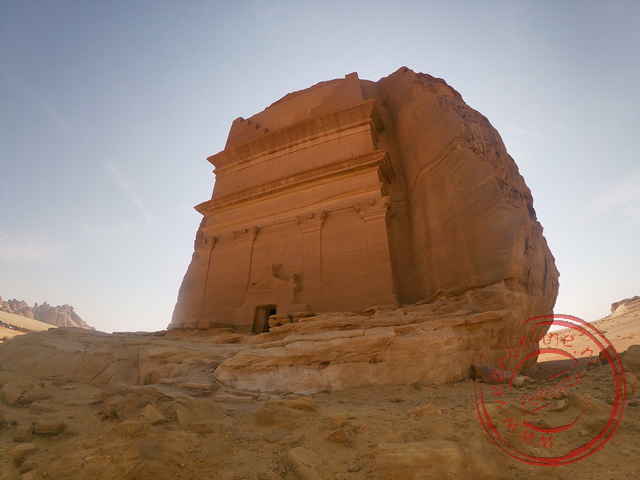
This tomb is one of the most famous graves of Madain Saleh because it lies completely isolated from the other graves. The height of the monument was meant as an indication of wealth and social status. By bus, we then drive to the tombs of Qasr Al-Bint. Around 35 graves have been found in one mountain. Some tombs are beautifully and colossally carved, others are simpler. In total, more than one hundred graves have been uncovered in Madain Saleh. It is wonderful to see how precisely the façades of the tombs have been created. A little further lies Al-Siq. A naturally narrow gorge once offered access to the city. We are lucky. The sun shines exactly through the rock crevice. This happens only two hours a day. In the gorge, small altars have been carved in honor of the Nabataean gods. There is also a carved space with stone benches, a kind of meeting place. The excursion to Madain Saleh ends at the ‘Palace rock,’ a series of tombs side by side in one rock block.

It is beautiful to see these tombs next to each other. By bus, we return to the visitor center in Al‘Ula. The second excursion, the tour to the tombs of Dadan, starts at two o’clock. We have more than two hours for a drive to the Harrat Viewpoint above the city. There is also a restaurant to have lunch. Behind the visitor center, we drive into the mountains. The road winds upward. The gradient is sometimes steep. Especially on the sharp hairpin bends, we gain height quickly. On the plateau, a flat road leads to the viewpoint. Just before the viewpoint is a gate and security. We are not allowed further. The restaurant and viewpoint open only at five o’clock. We are allowed to enjoy the view to the left and right from this point. “Would you like some coffee?” asks the guard. He rushes to his car and returns with Arabic coffee. While we sip the coffee, his colleague honks. He has cookies for us. The view on both sides is beautiful. We see the new city of Al‘Ula and in the distance Madain Saleh on the other side. Only the old city we visited yesterday cannot be seen from here. We thank the guards for the coffee and drive down the mountain again. We stop in Al‘Ula to get something to eat. We park the car in the shade behind another car. When we get out, it turns out the car in front of us is waiting for the drive-thru of a restaurant. Ha ha, mistake. We quickly park on the other side. We end up at a burger restaurant. Although not traditional, it is a change from a rolled flatbread with cheese. At two o’clock, we report back at the visitor center. This time for the excursion to the tombs of Dadan, and in particular the ‘Tomb of the Lion.’ We don’t see Bas and Bert anymore, who also took part in the excursion this morning. They are on their way by car to Medina. After that, they drive through Jeddah to Abha. However, the French couple who also participated this morning arrive again.

By bus, we drive to the entrance of the Dadan excavations. Alam, our guide, tells us that the archaeological site of Dadan is older than Madain Saleh. She also says that new discoveries are still being made in archaeological research. Then we go to the tomb itself. This is a disappointment. It is nothing more than a viewpoint. The Tomb of the Lion lies in the mountains before us. Unfortunately, we cannot get closer than two hundred meters. In the square tombs in the rock wall, influential people of the Dadanite kingdom were buried in the fifth century BC. A little further on, excavations are still underway. We watch the work from a distance. We see the remains of a temple and a water well. A statue over two meters high of a Lihyanite king is on loan at the Louvre in Paris. The plan is for the statue to be exhibited later in Saudi Arabia. “The tour here is over,” says Alam. The tour ended earlier than I thought. The bus drives back. At least that’s what I thought. The bus passes the visitor center and stops at Jabal Ikmah. This gorge between the mountains is like an ancient library, Alam explains. Even before the Common Era, sacred texts were written on the rocks. The texts vary in time, making the valley a valuable collection for archaeologists. Texts and rock drawings are everywhere on the rock walls. Besides the sights, it is also nice to have contact with the other travelers. The small group is truly international. England, Wales, France, Egypt, the Philippines, and of course Saudi Arabia and the Netherlands. At the end of the afternoon, we return to the visitor center of Al‘Ula. Before sunset, we drive to Elephant Rock. We are already getting the hang of the traffic junction. We now know exactly where to turn around and which exits to take. It all doesn’t seem very logical. The exit to Elephant Rock is not logical either. The road is still closed. We drive over the dirt road beside the road. Ahead of us, a van is stuck in the loose sand. Road workers try to pull the small truck free. This does not really succeed. They signal that we can pass. Hopefully, we don’t get stuck in the sand.

Without problems, we drive past. When we park, a guard tells us we are not allowed to park here. The parking lot is further on. We hadn’t seen that. In the large parking lot, maybe ten cars are parked. Elephant Rock is a twenty-meter-high rock with a passage through it. This gives the rock the shape of a huge elephant. The last sun rays shine exactly under the trunk. On the other side of the rock is a lounge bar. Loud music sounds between the rocks. In the sand, seating pits with round benches have been dug out. With a drink in hand, we sit in one of the pits. We see the sun rays on the rock slowly fading. Meanwhile, around us the lights come on, torches are lit, and the rock is illuminated. We drop the original plan to eat here. The food seems more like a collection of snacks. In the dark, we leave the site. We drive to the center. We buy some bread for tomorrow morning and fill the rental car with fuel for the last time. In the same street where we ate yesterday is the Heritage Garden restaurant, recommended by Lonely Planet. This is definitely not fast food. No one speaks English or wants to make the effort. The menu has an English translation. We select three dishes and something to drink. Back at the apartment, we empty all compartments and drawers of the car. Tomorrow we have to return the rental car. We are flying to Abha.
 Saudi Arabia
  In the museum we are offered coffee and dates
 Sixty old houses form an openair museum in Rijal Almaa
 One of the rooms in the Abdul Raouf Khalil Museum
 A huge aquarium in the arrivals hall of Jeddah Airport
Travelogue Fascinating Saudi Arabia
Dag 2 | Saudi Arabia > The Skybridge in Riyadh
Dag 3 | Saudi Arabia > Offroad to 'the Edge'
Dag 4 | Saudi Arabia > The Mud City of Ushaiger
Dag 5 | Saudi Arabia > The Forts of Ha'il
Dag 6 | Saudi Arabia > The Stonehenge of Saudi Arabia
Dag 7 | Saudi Arabia > The Castle of Tabuk
Dag 8 | Saudi Arabia > Overnight in Wadi Al Disah
Dag 9 | Saudi Arabia > The Historic Old Town of Al'Ula
Dag 10 | Saudi Arabia > The Tombs of Madain Saleh
Dag 11 | Saudi Arabia > The Flight to Abha
Dag 12 | Saudi Arabia > The Rijal Almaa Open-Air Museum
Dag 13 | Saudi Arabia > We Got Hit ...
Dag 14 | Saudi Arabia > The Flight to Jeddah
Dag 15 | Saudi Arabia > The Old Centre of Jeddah
Dag 16 | Saudi Arabia > Back to the Netherlands