
154 countries
(and areas)
 - Belize
- Benin
- Bhutan
- Bolivia
- Bonaire
- Bosnia and Herzegovina
- Botswana
- Brazil
- British Virgin Islands
- Brunei
- Bulgaria
- Cambodia
- Canada
- Cape Verde
- Chile
- China
- Costa Rica
- Croatia
- Cuba
- Curacao
- Cyprus
- Czech Republic
- Denmark
- Dominica
- Dominican Republic
- Egypt
- El Salvador
- England
- Estonia
- Eswatini (Swaziland)
- Ethiopia
- Fiji
- Finland
- France
- French Guiana
- Georgia
- Germany
- Gibraltar
- Greece
- Grenada
- Guadeloupe
- Guatemala
- Honduras
- Hong Kong
- Hungary
- Iceland
- India
- Indonesia
- Iran
- Ireland
- Israel
- Italy
- Jamaica
- Japan
- Jordan
- Kazakhstan
- Kenya
- Kosovo
- Kuwait
- Kyrgyzstan
- Laos
- Latvia
- Lebanon
- Lesotho
- Liechtenstein
- Lithuania
- Luxembourg
- Macau
- Madagascar
- Malawi
- Malaysia
- Maldives
- Malta
- Martinique
- Mexico
- Moldova
- Monaco
- Mongolia
- Montenegro
- Morocco
- Mozambique
- Namibia
- Nepal
- Netherlands
- New Zealand
- Nicaragua
- North Macedonia
- Northern Ireland
- Norway
- Oman
- Pakistan
- Palestine
- Peru
- Philippines
- Poland
- Portugal
- Qatar
- Republic of Korea
- Romania
- Russia
- Saint Kitts and Nevis
- Saint Lucia
- Saint Martin
- Saint Vincent and the Grenadines
- San Marino
- São Tomé and Principe
- Saudi Arabia
- Scotland
- Senegal
- Serbia
- Singapore
- Sint Maarten
- Slovakia
- Slovenia
- South Africa
- Spain
- Sri Lanka
- Suriname
- Sweden
- Switzerland
- Tajikistan
- Tanzania
- Thailand
- The Gambia
- Tibet
- Togo
- Transnistria
- Trinidad and Tobago
- Tunisia
- Turkey
- Turkmenistan
- Uganda
- United Arab Emirates
- United States
- Uruguay
- Uzbekistan
- Vatican City
- Vietnam
- Wales
- Zambia
- Zanzibar
- Belize
- Benin
- Bhutan
- Bolivia
- Bonaire
- Bosnia and Herzegovina
- Botswana
- Brazil
- British Virgin Islands
- Brunei
- Bulgaria
- Cambodia
- Canada
- Cape Verde
- Chile
- China
- Costa Rica
- Croatia
- Cuba
- Curacao
- Cyprus
- Czech Republic
- Denmark
- Dominica
- Dominican Republic
- Egypt
- El Salvador
- England
- Estonia
- Eswatini (Swaziland)
- Ethiopia
- Fiji
- Finland
- France
- French Guiana
- Georgia
- Germany
- Gibraltar
- Greece
- Grenada
- Guadeloupe
- Guatemala
- Honduras
- Hong Kong
- Hungary
- Iceland
- India
- Indonesia
- Iran
- Ireland
- Israel
- Italy
- Jamaica
- Japan
- Jordan
- Kazakhstan
- Kenya
- Kosovo
- Kuwait
- Kyrgyzstan
- Laos
- Latvia
- Lebanon
- Lesotho
- Liechtenstein
- Lithuania
- Luxembourg
- Macau
- Madagascar
- Malawi
- Malaysia
- Maldives
- Malta
- Martinique
- Mexico
- Moldova
- Monaco
- Mongolia
- Montenegro
- Morocco
- Mozambique
- Namibia
- Nepal
- Netherlands
- New Zealand
- Nicaragua
- North Macedonia
- Northern Ireland
- Norway
- Oman
- Pakistan
- Palestine
- Peru
- Philippines
- Poland
- Portugal
- Qatar
- Republic of Korea
- Romania
- Russia
- Saint Kitts and Nevis
- Saint Lucia
- Saint Martin
- Saint Vincent and the Grenadines
- San Marino
- São Tomé and Principe
- Saudi Arabia
- Scotland
- Senegal
- Serbia
- Singapore
- Sint Maarten
- Slovakia
- Slovenia
- South Africa
- Spain
- Sri Lanka
- Suriname
- Sweden
- Switzerland
- Tajikistan
- Tanzania
- Thailand
- The Gambia
- Tibet
- Togo
- Transnistria
- Trinidad and Tobago
- Tunisia
- Turkey
- Turkmenistan
- Uganda
- United Arab Emirates
- United States
- Uruguay
- Uzbekistan
- Vatican City
- Vietnam
- Wales
- Zambia
- Zanzibar


Copyright 2004 - 2026
Veeronline.nl Travel Adventures

Home > Saudi Arabia > Fascinating Saudi Arabia > Travelogue day 6
Travelogue Fascinating Saudi Arabia
October 823 2022 (16 days)
Saudi Arabia > The Stonehenge of Saudi Arabia
Dag 6 - Thursday 13 October 2022Using the groceries we bought yesterday at the supermarket, we prepare a nice breakfast. We leave some boxes of chocolates in the hotel room for the staff. They would melt in the car with us. We drive out of the city of Ha’il toward the highway. It still amazes us that the maximum speed on the wide boulevards through the city is 100 km/h. We get back on the highway heading to Al Jouf. We drove here yesterday as well. At the gas station, we fill up the tank and buy food at the supermarket. This worked well yesterday. We still have two boxes of dates with us. We give one box to the gas station attendants. They immediately start handing out dates to their colleagues. We set the navigation to Al Jouf. More than three hundred kilometers straight ahead through the Nafud desert. The only entertainment is trying not to hit the cat's eyes between the lanes when changing lanes. Very occasionally, we succeed. You have to do something. As we move further north, the sand dunes increase. The dark asphalt of the highway contrasts beautifully with the red sand dunes. Occasionally, there is a camel standing by the road. Just before noon, we arrive in Sakakah, the capital of the Al Jouf region. Using the trunk as a table, we prepare a simple lunch: bread with banana and a kind of honey. After lunch, we walk to Za’abel castle. The castle is located on top of a rocky point. We reach the entrance via a staircase. No tickets are asked for anywhere. Many tourist attractions in Saudi Arabia are free to visit. There is not even supervision here. The castle has five towers made of mud. The walls around the castle have small stepped battlements, characteristic of this region. Unfortunately, LED light strips have been installed over these battlements.

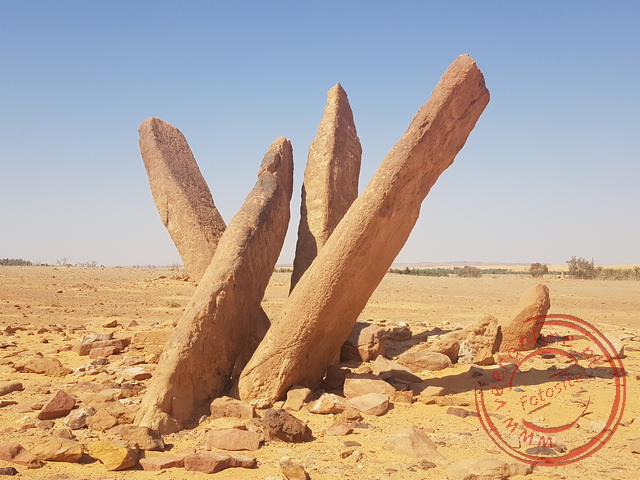
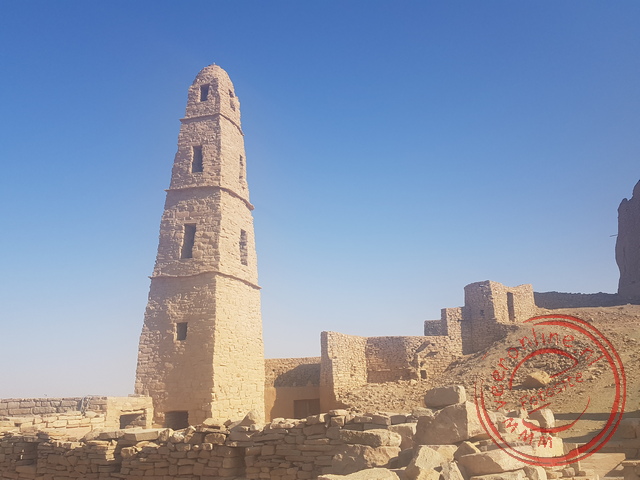
In the inner courtyard, there is a larger round tower. The room inside the tower is empty. The castle has little more than the courtyard. We continue to the Rajajil Columns, the Standing Stones of Saudi Arabia. About 6,000 years ago, these standing stones were erected: groups of rock pillars. Some pillars stand upright, others lean diagonally out of the ground. The exact origin is unknown, but scientists think the pillars were part of a temple in the fourth millennium BC. At the exit, we take a bowl with spicy meatballs we received yesterday at the chocolate shop. We make a round visiting the Nepalese staff. What we don’t finish, we leave with them. With some hesitation, they gladly accept it. For the last stage, we drive to Dumah Al Jandal. Here lies Marid Castle, a historic military fortress built on a strategic rock. We park the car in front of the regional museum. When we walk onto the grounds, a guard approaches. “The museum is closed,” he says. He points out how to get to the castle and the mosque. At the castle entrance, it turns out we can only view the castle from the outside. The guard warns there is a danger of collapse inside. The castle’s origin dates back to the first or second century AD. It served a military function. We can, however, visit the 1,300-year-old Omar ibn al-Khattab Mosque. This mosque is one of the oldest in the Middle East. Via a staircase, we reach the roof of the mosque. We look out over the ruins of the mud houses next to the mosque.
Archaeologists are conducting research. I climb the stairs to the old minaret. In the small space, it is clearly visible how the minaret becomes narrower as it rises. I climb a small stone staircase to the first platform. Just to be safe, I stand at the edge. I don’t trust the stones forming the platform. Via some stepping stones in the wall, you can also reach the second platform. I do not dare to go that far. At the foot of the minaret is the mosque’s entrance. The mosque is still in use. Prayer rugs are ready. When we walk back, two Arab men approach us. Where are you coming from today? Did you visit the mosque and the castle? When we say the castle is closed, one of the men is instructed to show us the castle. Somewhat awkwardly, he accompanies us. In the castle, he shows the courtyard and the water well. He emphasizes again that the castle itself is not safe. We take his word for it. He doesn’t seem too eager. We continue to the hotel. For the first time, we have two separate hotel rooms. So far, we have had some kind of apartment every time. For dinner, we have two options. Restaurants, aside from fast food and snack bars, are scarce. One restaurant is a fifteen-minute walk away. For the other, we need the car. We choose the first option. No one in Saudi Arabia walks. People use their cars for everything. It is therefore not surprising that cars are parked so much on the sidewalks that we have to walk on the street to pass. The curbs are also surprisingly high. A curb of twenty centimeters is normal, but we encounter higher ones as well.
When we arrive at the restaurant, it is dark. Closed? We see the door open. We go inside. The power appears to be out. In the kitchen, everyone is searching with phone lights. “Five minutes,” the receptionist says enthusiastically. We sit on the veranda. The five minutes turn into ten. Nothing happens. We decide to wait until half past seven. Next to the restaurant is a kind of shawarma place. If we find nothing here, we can eat there. We walk around the block. We pass a wedding party. Only Arab men in white djellabas and red checkered keffiyeh headscarves are present. They will certainly not ask us in. Around the corner, there is also a restaurant. Although the place is brightly and not atmospherically lit, we decide to eat here. The menu is only in Arabic. A man offers to help. In good English, he explains the menu. He turns out to be the owner. All dishes contain chicken. The question is only whether we want roasted, steamed, or grilled chicken. We choose three small dishes. When our food is served, the small portions still turn out to be too much. After the meal, the owner offers us crème brûlée. A kind gesture. We get into conversation with him about Saudi clothing. He explains that there are no rules about who may or may not wear a djellaba. The keffiyeh, the headscarf, is also optional. He personally finds it not always practical and warm. Especially older men wear the headscarf as a status symbol. The so-called agal keeps the headscarf in place. The weight takes care of this without causing uncomfortable pressure, we are told.
 Saudi Arabia
  We are on our way back home again
 The Wadi Al Disah oasis is beautiful to drive through
 The castle on a rocky spur in Hail
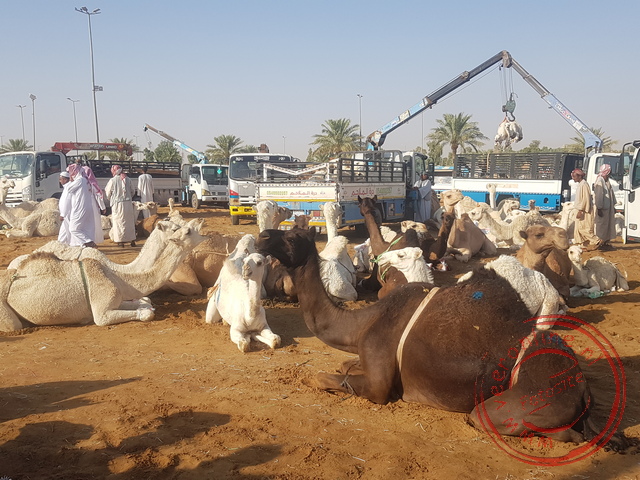 The Buraydah camel market is the largest in the Middle East
Travelogue Fascinating Saudi Arabia
Dag 2 | Saudi Arabia > The Skybridge in Riyadh
Dag 3 | Saudi Arabia > Offroad to 'the Edge'
Dag 4 | Saudi Arabia > The Mud City of Ushaiger
Dag 5 | Saudi Arabia > The Forts of Ha'il
Dag 6 | Saudi Arabia > The Stonehenge of Saudi Arabia
Dag 7 | Saudi Arabia > The Castle of Tabuk
Dag 8 | Saudi Arabia > Overnight in Wadi Al Disah
Dag 9 | Saudi Arabia > The Historic Old Town of Al'Ula
Dag 10 | Saudi Arabia > The Tombs of Madain Saleh
Dag 11 | Saudi Arabia > The Flight to Abha
Dag 12 | Saudi Arabia > The Rijal Almaa Open-Air Museum
Dag 13 | Saudi Arabia > We Got Hit ...
Dag 14 | Saudi Arabia > The Flight to Jeddah
Dag 15 | Saudi Arabia > The Old Centre of Jeddah
Dag 16 | Saudi Arabia > Back to the Netherlands